
Marian devotion
Birhen sa Simala / Our Lady of Simala
Marian devotion of Sibonga (Cebu) (Bisayas)
La advocación de Birhen sa Simala / Our Lady of Simala, also called popularly Mama Mary sa Simala o Mama Mary of SimalaIt's on. Monasterio del Santísimo Sacramento (Monastery of the Holy Eucharist) in Barangay Simala, municipality of Sibonga, island of Cebu, Philippines. The religious community was founded in the 1990s by the Mariano Monks of the Eucharist (Marian Monks of the Eucharistic Adoration), within the diocese of Cebu. Since the end of that decade the place began to attract crowds for the growing fame of graces received and curations attributed to the intercession of the Virgin Mary.
Main data
Origin and history
La advocación de Birhen sa Simala / Our Lady of Simala, also called popularly Mama Mary sa Simala o Mama Mary of SimalaIt's on. Monasterio del Santísimo Sacramento (Monastery of the Holy Eucharist) in Barangay Simala, municipality of Sibonga, island of Cebu, Philippines. The religious community was founded in the 1990s by the Mariano Monks of the Eucharist (Marian Monks of the Eucharistic Adoration), within the diocese of Cebu. Since the end of that decade the place began to attract crowds for the growing fame of graces received and curations attributed to the intercession of the Virgin Mary.
According to the local tradition, the Marian image venerated in Simala would have cried real tears on various occasions, especially in 1998, which was interpreted by many faithful as a sign of call to conversion and spiritual change. There have been numerous testimonies of so-called miracles, cures and favors, gathered in letters of thanks in the sanctuary. However, no official declaration of the Church approving apparitions, tears or other extraordinary phenomena linked to this image; the place works canonically as sanctuary of popular piety, and devotion focuses on the intercession of Mary and on the ordinary sacramental life.
Historically, the sanctuary has developed as an important regional and national pilgrimage centre since the beginning of the twenty-first century, with an expanding infrastructure to host the crowds of pilgrims, especially on weekends and Marian parties. The devotion is within the Latin Catholic rite, in communion with the local Church and the hierarchy of the Church in the Philippines.
The image and the sanctuary
La image of the Virgin venerated in Simala is a statue of Mary with the Child Jesus, modern style devotional Filipino, richly dressed with blankets and crowns, and presented as "Most Holy Mary in the Tears" because of the so-called episodes of tears. The size is exposed in a shrimp to which the pilgrims access in line to approach the image, present offerings and letters of request or thanks. The concrete material of the image (wood, resin or other) is not reliably recorded in the sources consulted.
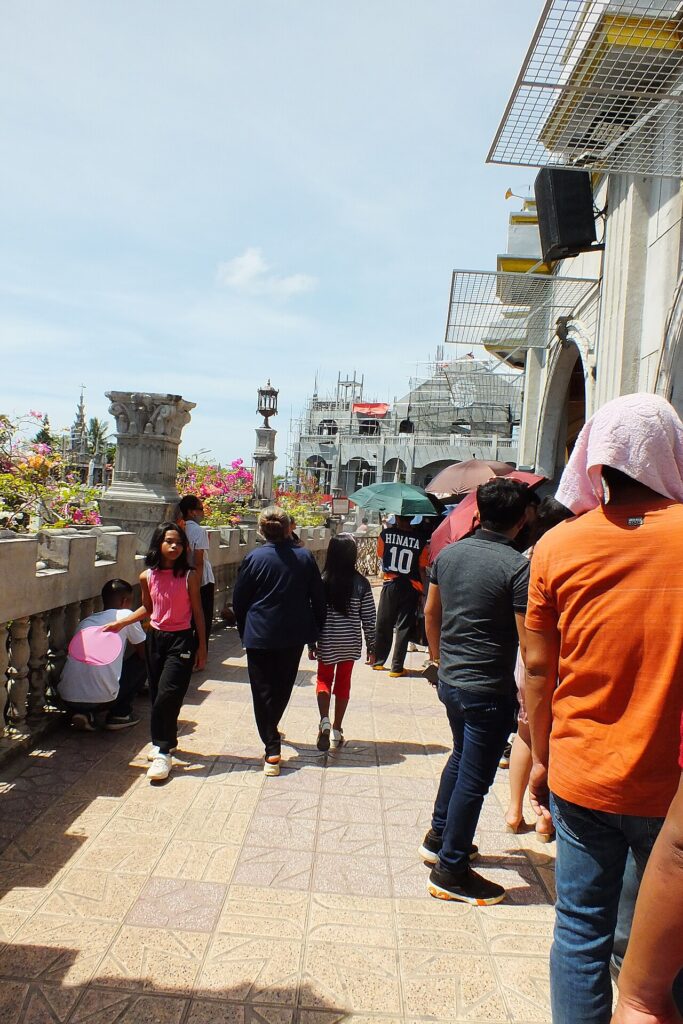
The main temple is officially known as Monastery of the Holy Eucharist (Monastery of the Most Holy Sacrament), located on the top of a hill in Barangay Simala, Sibonga, Cebu. The architectural set has a striking style, castle type or fortified complex, with monumental steps, towers, arches and large terraces, designed to host large flows of pilgrims. Inside is the church where the Eucharist is celebrated, chapels of worship, spaces of confession and rooms where exvotes, written testimonies and objects offered by the devotees are displayed.
In available sources does not know that the temple has been raised to a minor basilica, national sanctuary or diocesan sanctuary formally declared; is known and treated de facto as a great Marian pilgrimage sanctuary administered by the Marian Monks of the Eucharistic Adorationunder the authority of the corresponding diocese.
Sponsorship and coronation
The advocation of Our Lady of Simala is especially linked to municipality of Sibonga y a la island of Cebubeing a focus of Marian devotion for faithful from all over the Bisayas region and from other parts of the Philippines. It is not clear that the Episcopal Conference of the Philippines has declared it the principal patron of the nation; devotion is fundamentally regional and popular.
As for liturgical and symbolic honors, the sources reflect the strong Marian devotion, but does not contain a specific canonical patronage (by formal decree) at the diocesan or national level for this particular advocation. Nor has official documentation been found to witness a special elevation of the sanctuary beyond its function as a place of pilgrimage.
As for the coronationin the sources consulted does not contain a documented canonical coronation (i.e. carried out by a pontifical mandate or by the ecclesiastical authority competent with the requirements of the Church). In the field of popular devotion, crowns are used in the image, following the Philippine Marian tradition, but not equivalent to an officially recognized canonical coronation.
Party and devotion
The devotion to Our Lady of Simala is expressed intensively throughout the year, with special inflow of weekendsthe main Marian parties and the days of precepto. The sources point to very high peaks of assistance, with thousands of pilgrims on certain days, from Cebu and other provinces, who come in buses and private vehicles. Equivalent annual inflow figures are not officially recorded, but press reports and testimonies continuously describe "crowds" and "waves" of pilgrims.
On a fiesta principal propia of the advocation (specific liturgical day of "Our Lady of Simala"), in the sources consulted does not contain a clearly defined official date. The liturgical life of the sanctuary is mainly ordered around:
– Las grandes fiestas marianas universales (por ejemplo, Inmaculada Concepción, Natividad de María, Nuestra Señora del Rosario, Asunción). – Las solemnidades y tiempos fuertes de la Iglesia (Semana Santa, Pascua, Navidad).
A very visible feature of devotion is the letters of request and thankstogether with photographs, uniforms and personal objects that the faithful leave as exvotes for favors attributed to the intercession of the Virgin. Also very common sacramental confessionparticipation in the Eucharist and silent prayer before the Most Holy, consistent with the Eucharistic character of the monastery.
In this context, the Local Church insists on the centrality of the sacraments and of faith in Christand maintains a prudent attitude to the allegations of extraordinary phenomena, which have not been officially approved.
Link to the Rosary
The sources do not document a historical link to specific doctrinal between the advocation of Our Lady of Simala and a particular revelation or promise linked to Rosary (as in Lourdes or Fatima, for example, with explicit messages about this prayer). The devotion in Simala is part of the wide flow of Marian Filipino piety, where the prayer of the Rosary is deeply rooted in the lives of families and communities.
Although one does not collect a rite of the Rosary unique to this sanctuary, in practice the Rosary is a regular part of the pilgrimage: many faithful pray on the way to the sanctuary, in the long rows to approach the image, or in the prayer spaces of the monastery. The Rosary thus becomes a simple and continuous way of contemplating with Mary the mysteries of Christ's life, and of presenting by his intercession the pleas and thanksgiving that characterize devotion in Simala.
In the Mariological key, the advocation of Most Holy Mary in the Tears refers to the participation of the Virgin in the sufferings of Christ and the Church; the RosaryBy going through the joyful, luminous, painful and glorious mysteries, it offers a privileged framework for uniting the very tears and hopes of the faithful to the mysteries of redemption, entrusted to Mary's spiritual motherhood.
—
General information about the Monastery of the Holy Aucharist and devotion to Simala, collected in reports and descriptions of the sanctuary. Philippine journalistic chronicles
A flower for the Virgin
Offer a simple prayer to this Marian devotion. Pray a Hail Mary for the Philippines and for world peace.
Pray Hail MaryIs the advocation of the Virgin Mary of your people missing?
Si no encuentras la advocación mariana de tu ciudad o pueblo, cuéntanosla: la investigaremos para ubicarla y darla a conocer en este mapa del amor de la Madre por el mundo.
Propose an apvocation →