Marian devotion
Our Lady of the Rocks
Marian Advocation of Perast (Kotor Bay)
Tradition / Legend
Main data
Origin and history
Tradition / Legend
According to the local tradition, the 22 July 1452 two brothers from Perast, fishermen or sailors, found on a rock in the sea a icon of the Virgin with the Child. They took him home, but the image would have disappeared and appeared again on the same rock, repeatedly, which was interpreted as a sign of the Virgin's desire to remain there. As a result of this fact, the inhabitants of Perast would have committed themselves to building a sanctuary in that place and began to arrojar piedras y hundir barcos viesas to form an islet around the rock where the image was found.
The annual rite of the fašinada (o Fasinada), where the boats surround the island and throw stones into the sea on July 22, with songs and procession, symbolically prolonging the creation of the island and maintaining its foundations.
Documented history
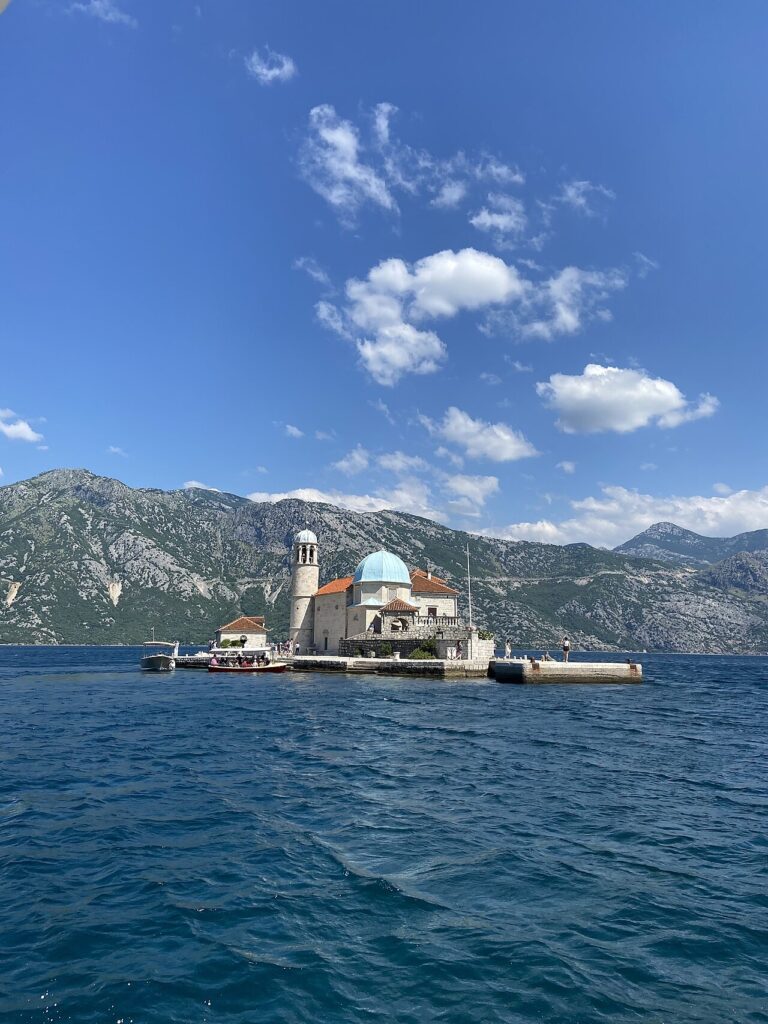
In a historically documented way, Gospa od Škrpjela is a artificial island located opposite Perast, in the Bocas / Kotor Bay, formed by the contribution of stones and remains of ships sunk by the local population. The first chapel dedicated to the Virgin was erected on the islet to 1452and was later replaced by a church built in 1632, extended and reformed 1722.
The whole of Kotor Bay, including the island and its church, was incorporated into 1979 to the list of UNESCO World Heritage Site, which confirms the historical and cultural relevance of the place. The cult is developed in the Latin catholic ritein a historical context marked by the Venetian presence and strong marine identity of Perast.
The image and the sanctuary
The image
In the sanctuary a icon of the Virgin with the Child, traditionally related to the finding of 1452. A Marian source indicates that the icon was painted in the mid-15th century by the painter Lovro Dobričević (Lovro Marinov Dobričević), artist at the Ragusina school. It is an image of a orientating type (icon), venerated as a protector of sailors and fishermen.
Other tourist descriptions also point to the presence of a figure of the Virgin in mármol de Carrara, also attributed to Lovro Marinov Dobričević in the 15th century, located on the main altar; however, there are divergences between sources on whether the main work is painted icon or marble sculpture, so it can be recognized that devotion is currently focused on the Marian whole of the altar, with strong historical roots.
The sanctuary
In the center of the islet the Church of Our Lady of the Rocks (Crkva Gospe od Škrpjela), one-ship Catholic temple. The present church is of mainly Baroque style, with elements of Byzantine tradition in interior decoration.
– La estructura básica data de 1632 and was extended in 1722. – Presenta cúpula central about 11 metres and bell añadidos en el siglo XVIII, que refuerzan el carácter barroco. – El interior está ricamente decorado con Mural paintings and canvas by Tripo Kokolja, pintor barroco originario de Perast (siglo XVII), con unas 68 obras atribuidas a él en el templo. – El altar of mármolin 1796 by the genovese sculptor Antonio KapelanoThe main Marian imagen is located.
Next to the church works a small museum with exvotes of sailors, tapestries (including a famous one embroidered with human hair) and various historical objects, which bear witness to centuries of popular piety and gratitude for favors attributed to the intercession of the Virgin.
It is not known that the church has the title of minor basilica or officially declared National sanctuary; it is mainly recognized as an iglesia- local sanctuary with strong tourist and devotional projection.
Sponsorship and coronation
Tradition presents Our Lady of the Rocks as patron of the sailors and fishermen of Perast, protector of those who sail in Kotor Bay. The island and the church are part of the historical identity of Perast, and the advocation is deeply linked to this town and to the region of the bay. There is no modern formal proclamation of diocesan or national patronage in the sources consulted.
On a canonical coronation of the icon or image of Our Lady of the Rocks, in reliable sources (Marian, tourist, encyclopedic and outreach) does not contain a documented canonical coronation (with the Pontifical Decree or the Congregation for the Divine Worship and the Discipline of the Sacraments).
Party and devotion
La main party of Our Lady of the Rocks is celebrated the 22 July, date linked to both the tradition of finding the icon and the rite of the fašinada. On that day, fishermen and inhabitants of Perast participate in a procession of boats around the island and throw stones into the sea, accompanied by songs and prayers. This ceremony, called fašinada, keeps alive the memory of the construction of the island and expresses the desire to continue "holding" the sanctuary and the protection of the Virgin over the bay.
Devotion is also expressed by:
– Pilgrimage by boat desde Perast y otras localidades de la bahía de Kotor, especialmente en verano y en torno al 22 de julio. – Numerosos exvotes de marineros y familias, colgados en la iglesia o conservados en el museo, como acción de gracias por auxilios en el mar. – La presencia constante de fieles y visitantes, ya que la isla es uno de los lugares más emblemáticos de Montenegro, combinando turismo cultural y peregrinación.
Although there are no official figures of inflow in the sources consulted, it is usually described as a very visited destination by pilgrims and tourists, accessible on short boat trips from Perast.
Link to the Rosary
The available sources on Gospa od Škrpjela focus on the icon legendthe fašinada and the history of the sanctuary, but does not contain a specific or unique relationship with the prayer of the Rosary (for example, historical rosarian copradies or parties explicitly linked to Our Lady of the Rosary).
However, as a Marian advocation in a Latin Catholic sanctuary, the Rosary is naturally inserted into the spiritual life of the place. The icon of the Virgin with the Child, a protector of sailors, invites you to contemplate, by praying the mysteries of the Rosary:
– Los joyful mysteries, donde se recuerda la Encarnación y la maternidad de María, confiando a la Virgen la vida familiar y el trabajo cotidiano de los habitantes de Perast. – Los painful mysteries, que ofrecen consuelo a quienes han sufrido pérdidas en el mar o en la historia convulsa de la región. – Los glorious and luminous mysterieswhich open to the waiting
A flower for the Virgin
It offers a simple prayer to this advocation. Pray a Hail Mary for Montenegro and for the peace of the world.
Pray Hail MaryIs the advocation of the Virgin Mary of your people missing?
Si no encuentras la advocación mariana de tu ciudad o pueblo, cuéntanosla: la investigaremos para ubicarla y darla a conocer en este mapa del amor de la Madre por el mundo.
Propose an apvocation →