
Marian devotion
Our Lady Dolorosa of Sloup
Marian Invocation of Sloup (Moravia)
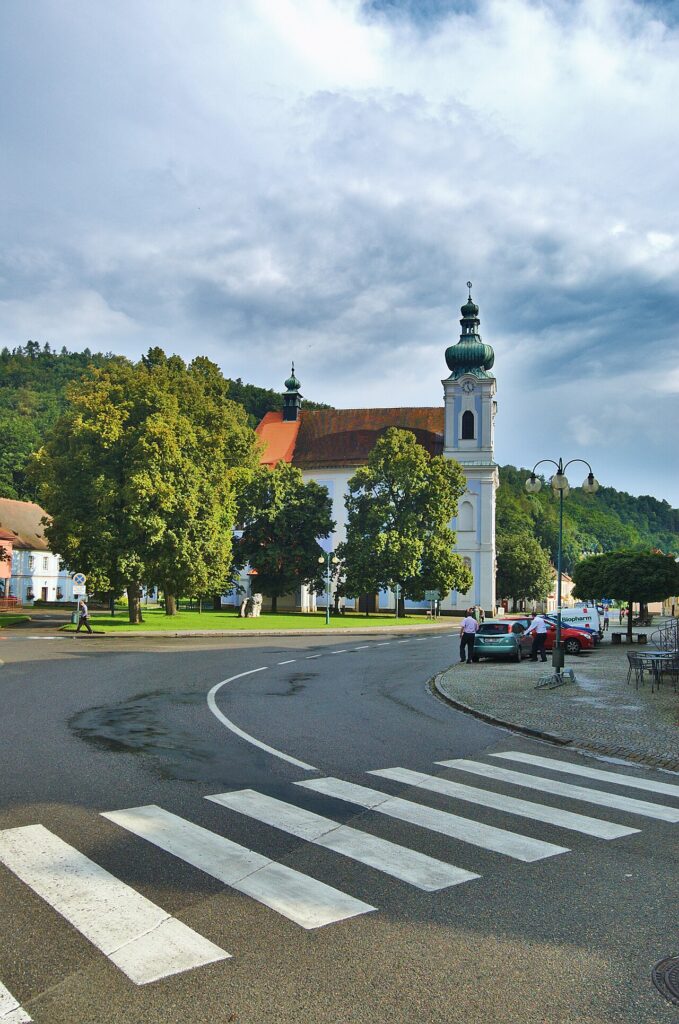
As for the documented history, la actual Church of pilgrimage of the Virgin Mary of the Dolores in Sloup (Pilgrimage Church of the Virgin Mary of Dolours, Sloup) was built in the 18th century, in Baroque style, as a temple linked to the noble family of the Roggendorf Counts (Rogendorf), which used Sloup as a summer residence. The church stood next to an old farm, today a parish house, and in it is buried the founder of the temple. Sloup is located in the so-called karst of Moravia, in the current region of Blansko, where various Marian pilgrimage places flourished in Baroque times.
Main data
Origin and history
As for the documented history, la actual Church of pilgrimage of the Virgin Mary of the Dolores in Sloup (Pilgrimage Church of the Virgin Mary of Dolours, Sloup) was built in the 18th century, in Baroque style, as a temple linked to the noble family of the Roggendorf Counts (Rogendorf), which used Sloup as a summer residence. The church stood next to an old farm, today a parish house, and in it is buried the founder of the temple. Sloup is located in the so-called karst of Moravia, in the current region of Blansko, where various Marian pilgrimage places flourished in Baroque times.
The available documentation identifies the temple as church of pilgrimage dedicated to the Virgin Mary of the Dolores, but the accessible sources do not detail an exact date of consecration or a precise account of the beginning of devotion to this image in Sloup. It is known, on the other hand, that the devotion to the Virgin of the Dolores spread forcefully in Central Europe between the 17th and 18th centuries, particularly in areas of Catholic tradition such as Moravia, marked by Marian shrines and by religious orders that promoted this spirituality.
As regards local tradition or legend, the sources consulted of historical-artistic character focus on architecture and barely collect pious accounts of concrete apparitions or miracles linked to the origin of this advocation in Sloup; therefore, beyond the general context of devotion to the Virgin Dolorosa, no consta a well-defined and documented legendary account for this particular sanctuary.
The image and the sanctuary
La Church of pilgrimage of the Virgin Mary of the Dolores in Sloup is a baroque temple located in the village of Sloup (Moravia), built as a pilgrimage church linked to the Counts of Roggendorf. It is integrated into the landscape of the moravian karst, a region known for its rock and cavern formations. The church is considered a relevant monument within the Baroque heritage of Chequia. It does not know that the temple has the title of minor basilica nor is officially recognized as a national sanctuary; its importance is mainly regional/diocesana as a place of Marian pilgrimage.
In the environment of Sloup there is also a known columnates the Marian sculpture group (Sloup se sochou Panny Marie, "column with the statue of the Virgin Mary"), work of 1718 in arenisca and protected as a cultural monument. This sculpture, although not presented explicitly in the sources as "Dolorosa," is part of the Marian devotional landscape of the place. The sources available online focus mainly on the architecture of the pilgrimage church and on the historical value of these sets, without providing a detailed and secure description of the concrete iconography of the headline image (type of Virgin Dolorosa, size, position of the sword, etc.); therefore, on these details no consta sufficiently accurate and documented information.
In line with the invocation, it can be said with certainty that it is an image of the Virgin Mary of the Dolores, that is, the Mother of God contemplated in her sufferings attached to the Passion of Christ. However, details such as the exact material of the main size (wood, stone, etc.), its author or its specific dating do not appear in the sources consulted and therefore, no constan.
Sponsorship and coronation
The specific sources on the pilgrimage church of the Virgin Mary of the Dolores in Sloup present it as a sanctuary of local / regional level, frequented by pilgrims from the area of Moravia and the corresponding diocese. No documentation has been found to explicitly declare a Our Lady Dolorosa of Sloup as an official patron of the municipality, the diocese or a wider region, so with the information available, the precise patronage no consta.
As for a canonical coronation of the image, the sources consulted (of historical-artistic and general character on important churches of Chequia) do not mention any ceremony of pontifical coronation or canonical coronation recognized by the Holy See in this sanctuaria.Unlike other claims of the Virgin of the Dolores in the world, they have received documented canonical coronations, for the advocation of Sloup does not contain a documented canonical coronation.
Party and devotion
For the general invocation of Our Lady of Sorrowsthe universal Church celebrates the memory of the Blessed Virgin 15 September, a feast established for the whole Church by Pope Pius VII in 1814. Since the church of Sloup is expressly dedicated to the Virgin Mary of the Dolores, it is reasonable to consider that this date constitutes at least one fiesta litúrgica de referencia in the sanctuary; however, the specific sources on Sloup do not detail a calendar of parties and novies, so the the specific date of the local main party is not of documented manera.
The temple is defined as church of pilgrimage, indicating a stable influx of pilgrims throughout the year, especially around the Marian festivities and the summer season. The Czech Republic retains a network of Marian shrines, including several dedicated to the Virgin Dolorosa, which are reference points for spiritual life and regional pilgrimages. Within this set, Sloup is located as an important center of devotion in the Blansko region, although the sources do not provide specific assistance figures or very detailed popular traditions (processions, specific promises, etc.), which, therefore, no constan Precisely.
Link to the Rosary
No specific references have been found to indicate a unique historical association between the advocation of Our Lady Dolorosa of Sloup and practices of the Rosary (for example, rosarian cofradies of the sanctuary, particular indulgences linked to the prayer of the Rosary there, etc.); this particular link, therefore, no consta in available sources.
However, by the very nature of the advocation -the Virgin Mary of the Dolores- there is a deep affinity with the prayer of the Rosaryespecially with painful mysterieswho contemplate the Passion of Christ in union with the sufferings of the Heart of Mary. In many shrines dedicated to the Blessed Virgin in the world, the meditation of Mary's pains is usually integrated into the Rosary (traditional or biblical), or into the prayer of the "Seven Dolores," as a way of spiritually accompanying the Mother at the foot of the cross. It is reasonable to consider that, also in Sloup, pilgrims find in the Rosary a privileged means to contemplate the Dolores of the Virgin and to unite their own sorrows to the redeeming sufferings of Christ, even though this concrete practice is not explicitly described in the sources.
A flower for the Virgin
Offer a simple prayer to this Marian devotion. Pray a Hail Mary for the Czech Republic and for world peace.
Pray Hail MaryIs the advocation of the Virgin Mary of your people missing?
Si no encuentras la advocación mariana de tu ciudad o pueblo, cuéntanosla: la investigaremos para ubicarla y darla a conocer en este mapa del amor de la Madre por el mundo.
Propose an apvocation →