
Marian devotion
Our Lady of Smolensk
Marian title of Smolensk (Russia)
According to the traditionthe icon of the Mother of God of Smolensk would be of Byzantine origin and some pious accounts link it even to the evangelist Luke, as is the case with other great Marian icons of the Christian East; however, this attribution cannot be documented historically, so it should be considered a devotional legend and not a proven data. The same tradition states that the icon would have arrived from Byzancio to the Rus de Kiev and then to Smolensk in the 11th century, where it began to be venerated as a protector of the city and the surrounding territory.
Main data
Origin and history
According to the traditionthe icon of the Mother of God of Smolensk would be of Byzantine origin and some pious accounts link it even to the evangelist Luke, as is the case with other great Marian icons of the Christian East; however, this attribution cannot be documented historically, so it should be considered a devotional legend and not a proven data. The same tradition states that the icon would have arrived from Byzancio to the Rus de Kiev and then to Smolensk in the 11th century, where it began to be venerated as a protector of the city and the surrounding territory.
En la documented history, it is attested that the Smolensk icon is one of the oldest and most venerated Marian icons in Russia, and that already in the Middle Ages many favors and miracles were attributed to it, including the protection of the city from military invasions, such as that of Khan Baty in 1239. For centuries he was guarded in the Cathedral of the Sleeping of the Mother of God (Ushemki Sobor) of Smolensk, the main temple of the local Orthodox epoch. The original icon disappeared during the German occupation in World War II (around 1943) and has since been considered lost; today, particularly honest copies are venerated in both the Smolensk Cathedral and the Novdevichy monastery of Moscow.
The image and the sanctuary
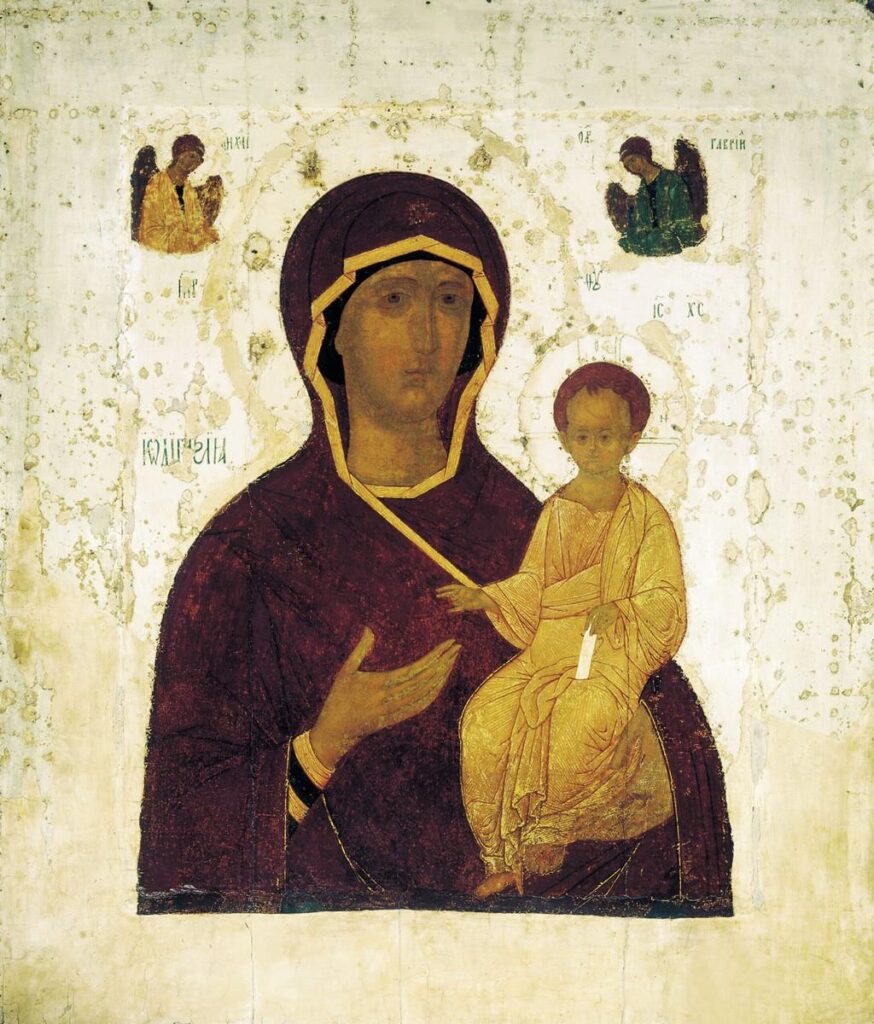
The Virgin of Smolensk is an icon of the Mother of God of type Hodigitria: Mary appears half-body, holding the Child Jesus on the left arm, while pointing out with her right hand, indicating that He is the "way" to the Father. This iconography also highlights the divine motherhood and Mary's role as a guide to Christ. As is common in Byzantine and Russian art, it is an icon painted on a wooden board, with a tempere technique and golden background, intended for liturgical and personal veneration. The stylistic features link it to the Eastern iconographic tradition, related to other famous "Hodigitria" icons.
The main sanctuary associated with this advocation is the Cathedral of the Sleep of the Mother of God in Smolensk (Зспенский собор), Orthodox cathedral and seat of the Eparchia of Smolensk and Kaliningrad of the Patriarchate of Moscow. This temple, reconstructed in late baroque style after the destruction of an earlier church, has been the main church of the eparchia for about 800 years. Until 1941 he hosted the ancient miraculous icon of Our Lady of Smolensk, missing in the war. There is also a Cathedral of Our Lady of Smolensk at the Novdeovthy monastery in Moscow (16th century), where venerated copies of the icon are also guarded.
It is not known that the Cathedral of Smolensk and the church of the Novodevichy monastery have a title of minor basilica in the Catholic sense; these are temples of the Russian Orthodox Church, with the rank of cathedral (in Smolensk) and monastic church (in Moscow).
Sponsorship and coronation
Our Lady of Smolensk is especially venerated as of the city of Smolensk and its population, with a strong character of local and regional patronage within the Russian Orthodox tradition. Several chronicles and traditions highlight their intercession to the dangers of war and the protection of the Russian army at times of special threat, although many of these stories belong to the scope of religious memory and are not always documented with historical precision.
As for its recognition in the Catholic field, it is mainly a known and respected advocation as an Orthodox icon, with particular relevance in the spiritual dialogue between East and West. There is no official patronage of the Catholic diocese under this title.
On a canonical coronation, there is no documented canonical coronation given by the pontifical authority to this advocation, to its original icon or copies, at least in the sources consulted.
Party and devotion
In Russian Orthodox liturgical tradition, Smolensk's Mother of God icon has own memory; in various Orthodox calendars it is commemorated in summer (around the end of July or the beginning of August), but the specific dates vary according to the editions and no single and documented reference has been found in the sources accessible in Spanish, so the exact date of the main feast in the rite is not fully recorded. [no precise date in the sources mentioned above]
Devotion is characterized by:
– La veneración del icono como spiritual defense of the city y protección frente a guerras e invasiones. – Peregrinaciones y oraciones de intercesión en la catedral de la Dormición de Smolensk, especialmente en torno a las fiestas marianas y las conmemoraciones locales, donde los fieles acuden a besar el icono o sus copias y a encender cirios. – Una piedad popular que subraya a María como guidance and protection, asking for their help in important decisions and in situations of danger, in the light of their title "the one that shows the way."
No reliable data have been found in Spanish on specific inflow figures or pilgrimage statistics, so there are no documented numbers.
Link to the Rosary
It does not contain a specific historical or institutional relationship between the advocation of Our Lady of Smolensk and the prayer of the Rosary as practiced in the Latin Catholic Church. It is an icon of Orthodox spirituality, where other forms of Marian prayer, such as the acatists and the repetition of hymns and pleas before icons.
However, from a Catholic perspective, the figure of Mary as Hodigitria, "the one that shows the way", se armoniza profundamente con el espíritu del Rosario. En esta oración, los misterios gozosos, luminosos, dolorosos y gloriosos contemplan la vida de Cristo “con los ojos de María”; del mismo modo, el icono de Smolensk presenta a la Madre que señala a su Hijo como única senda hacia la salvación. La devoción al Rosario puede, por tanto, acompañar la contemplación de esta imagen: – ayudando a meditar cómo María conduce siempre a Cristo, – pidiendo la intercesión de la Madre de Dios como protectora de los pueblos en conflicto y de las ciudades amenazadas, – y favoreciendo una mirada de comunión espiritual con los cristianos de Oriente que veneran a la Theotokos bajo esta antigua y venerable advocación.
A flower for the Virgin
Offer a simple prayer to this Marian devotion. Pray a Hail Mary for Russia and for world peace.
Pray Hail MaryIs the advocation of the Virgin Mary of your people missing?
Si no encuentras la advocación mariana de tu ciudad o pueblo, cuéntanosla: la investigaremos para ubicarla y darla a conocer en este mapa del amor de la Madre por el mundo.
Propose an apvocation →