
Marian devotion
Panakia Soumelá
Marian vocation of Kastania (Veria) (Macedonia)
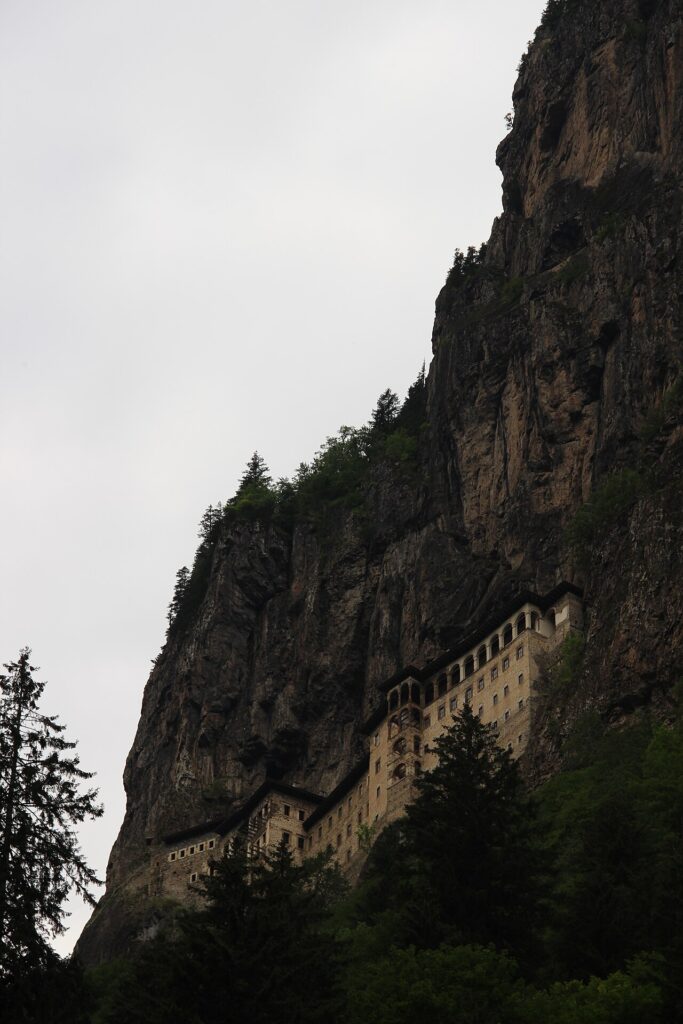
According to the tradition of the Orthodox Church, the icon of the Panakia Soumelá (Our Lady of Sumela) would have been painted by Saint Luke evangelist and later taken to the Ponto, on the coast of the Black Sea. The legend places its miraculous finding in a cave of Mount Mela, near Trebisonda, where two Athenian monks, Barnabás and Sopinio, had founded a monastery hung on the cliff to guard the icon. There is no historical documentation that confirms the lucana authorship of the icon or all the legendary details of its transfer.
Main data
Origin and history
According to the tradition of the Orthodox Church, the icon of the Panakia Soumelá (Our Lady of Sumela) would have been painted by Saint Luke evangelist and later taken to the Ponto, on the coast of the Black Sea. The legend places its miraculous finding in a cave of Mount Mela, near Trebisonda, where two Athenian monks, Barnabás and Sopinio, had founded a monastery hung on the cliff to guard the icon. There is no historical documentation that confirms the lucana authorship of the icon or all the legendary details of its transfer.
As for the documented history, the existence of the Monastery of Panagia Soumelá in the Ponto at least since the Byzantine Middle Ages, with references to its importance as Marian sanctuary and place of pilgrimage of the pontic Greek Christians in the surroundings of Trebisonda. After the fall of the Byzantine Empire and during the Ottoman period, the monastery continued to be a spiritual center of the Greek Orthodox population, with alternate periods of protection and difficulties, but maintaining the veneration of the icon.
After the exchange of populations between Greece and Turkey following the Lausanne treaty (1923), the pontic Greek community was displaced and the original monastery was abandoned. Tradition and modern sources agree that the icon was transferred - or, after a period of concealment, recovered - and taken to Greece. There it became a religious and identity symbol of the Pontic Greeks refugees, who promoted the creation of a new sanctuary for the Panagia Soumelá in Greek Macedonia.
The image and the sanctuary
La image of Panagia Soumelá es un Orthodox icon of the Virgin and the Child, of Byzantine type. It is often described as an icon Hodigitria (the Virgin who "shows the Way" pointing to Christ), although iconographic accuracy may vary according to descriptions. Its support is the characteristic of the icons: a wooden table, with a tempered and golden painting; in the modern stage it is usually partially or entirely covered with curling or metal coating for protection and ornament. The authorship of Saint Luke belongs to the Pious traditionnot to historical criticism.
After 1923, the main veneration of the icon was established in the new sanctuary of Panakia Soumelá en Kastania (or Kastania / Kastaniottissa), near Veria (Beroya), in the region of Macedonia, Greece. The sanctuary was raised in a mountainous area, symbolically evoking the location of the old Ponto monastery. It is a great monastic and pilgrimage complex of the Greek Orthodox Church, with main church, monastic dependencies and spaces for the reception of the faithful. It does not know that the temple has the title of minor basilica (figure of Latin canon law), nor that it is officially recognized as "national sanctuary" by the Catholic Church; it is an Orthodox sanctuary of strong regional and national irradiation for the pontic Greeks.
Sponsorship and coronation
The Panagia Soumelá is, in practice, Spiritual Pattern of the Pontic Greeksin both Greece and the diaspora, and a religious symbol of their historical and cultural identity. It is also an important focus of Marian devotion in the region of Macedonia griegaespecially in the surroundings of Veria and Kastania. It does not contain a decree of patronage of Catholic dioceses, since it is an advocation mainly orthodox.
With regard to a solemn coronation according to the right of the Catholic Church (canonical coronation with pontifical decree): does not contain a documented canonical coronation. In the Orthodox sphere, veneration is expressed by own rites, processions, ornaments and offerings to the icon, but not by the legal institute of Latin canonical coronation.
Party and devotion
La main party of Panagia Soumelá celebrates the August 15, coinciding with the Solemnity of the Sleep / Assumption of the Virgin Mary, a date of great Marian relevance in both the East and the West. On that day the sanctuary of Kastania- Veria becomes a center of intense pilgrimage, especially for the Pontic Greekswho come from all over Greece and even from abroad. Solemn liturgy, processions with the icon and cultural acts linked to the memory of the Ponto are performed.
The devotion to Panagia Soumelá is marked by two main features:
– Su carácter de Protective mother of refugees and displaced persons, en particular de los griegos procedentes del Ponto, que la reconocen como quien acompañó su éxodo y custodia su memoria. – Su dimensión de identity symbolwhere Marian veneration is intertwined with the preservation of the language, music, dances and pontic customs.
There are no precise official figures of influx, but the press and religious chronicles point out that the sanctuary brings together a multitude of faithful every 15 August, among the most significant Marian pilgrimages in contemporary Greece.
Link to the Rosary
No consta una specific and documented relationship between the advocation of Panagia Soumelá and the prayer of Rosary in the Latin sense (crown of meditated mysteries). The spirituality of the sanctuary is part of the tradition of the Orthodox Churchwhere the usual form of repetitive prayer is, rather, the the prayer of Jesus and the use of komboskini (knot cord), and where Marian veneration is expressed above all by hymns, akáthistos, paraklysis and liturgical parties.
However, from a Marian Catholic perspective, the Rosary can perfectly accompany devotion to Panagia Soumelá:
– El icono, que presenta a María señalando a Cristo, armoniza con la esencia del Rosario, que busca contemplar los mysteries of Christ's life with the eyes of Mary. – La memoria de los sufrimientos y desplazamientos del pueblo póntico encuentra eco en los painful mysterieswhile the hope of the heavenly homeland and the maternal protection of Mary are reflected in the glorious mysteries. – Allí donde fieles católicos veneran esta advocación —por ejemplo, en comunidades de diáspora o en contextos ecuménicos— el Rosario ofrece un modo propio de unir la plegaria mariana latina con la rica tradición iconográfica y litúrgica del Oriente cristiano, en profunda comunión de amor a la misma Madre del Señor.
A flower for the Virgin
Offer a simple prayer to this Marian devotion. Pray a Hail Mary for Greece and for world peace.
Pray Hail MaryIs the advocation of the Virgin Mary of your people missing?
Si no encuentras la advocación mariana de tu ciudad o pueblo, cuéntanosla: la investigaremos para ubicarla y darla a conocer en este mapa del amor de la Madre por el mundo.
Propose an apvocation →