
Marian devotion
Our Lady of Sumampa Consolation, patron of Santiago del Estero
Marian Advocation of Sumampa (Santiago del Estero)
La devoción a Our Lady of Sumampa Consolation was born in the context of the colonization of northern Argentina in the 17th century, in the current province of Santiago del Estero (Argentina), in a place known as Sumampa Viejo, south of the province. The image belongs to the type of the Consolation of Utrera, Marian devotion spread from Andalusia that arrived in America on commercial and missionary routes. The tradition closely links it to the development of the so-called "road route" between the Rio de la Plata and the interior, which explains its subsequent patronage of the routes and of the carriers.
Main data
Origin and history
La devoción a Our Lady of Sumampa Consolation was born in the context of the colonization of northern Argentina in the 17th century, in the current province of Santiago del Estero (Argentina), in a place known as Sumampa Viejo, south of the province. The image belongs to the type of the Consolation of Utrera, Marian devotion spread from Andalusia that arrived in America on commercial and missionary routes. The tradition closely links it to the development of the so-called "road route" between the Rio de la Plata and the interior, which explains its subsequent patronage of the routes and of the carriers.
### Tradition and legend
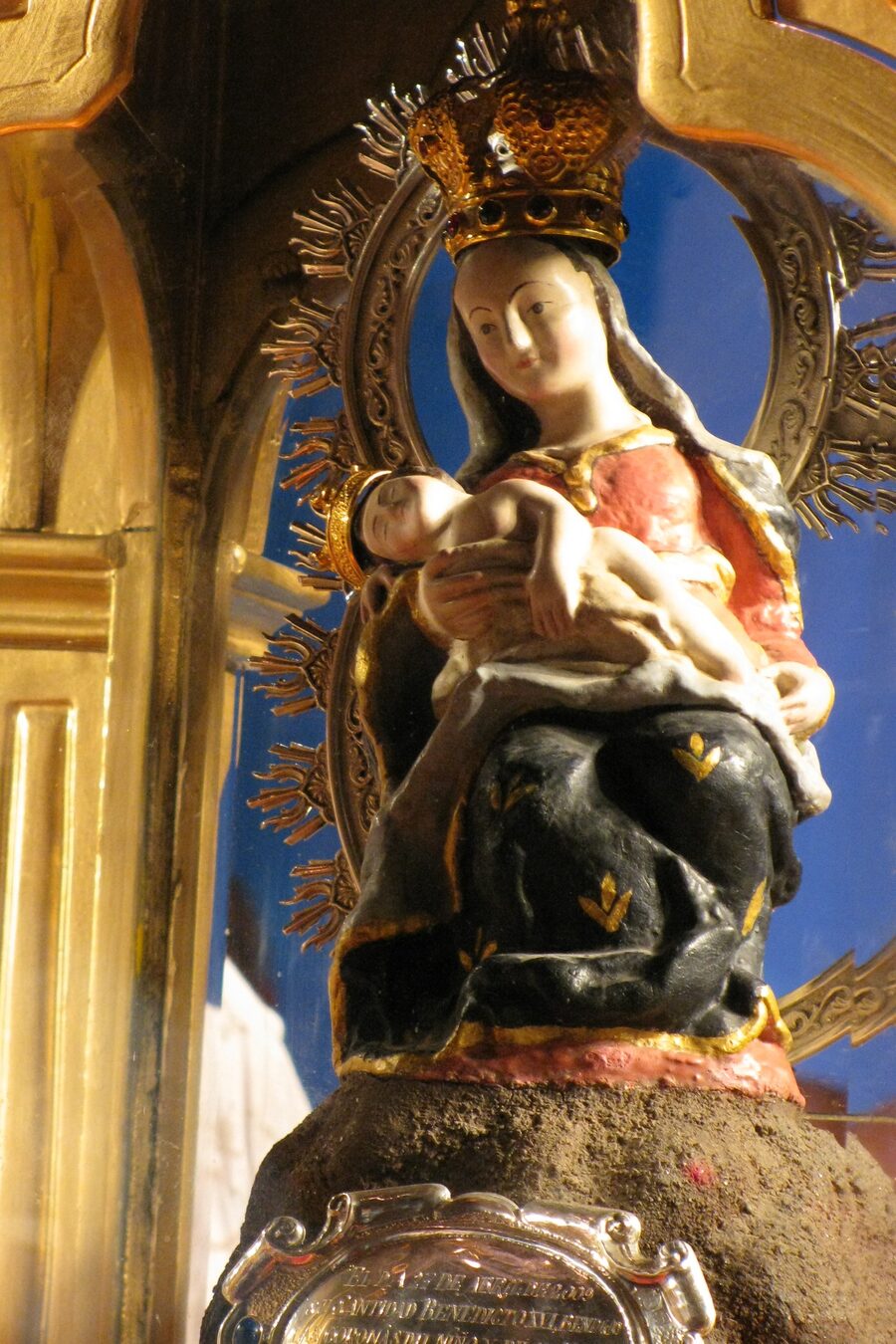
According to the Pious tradition, around 1629 the Portuguese stanciero Antonio Farías de Sá, resident of the Sumampa region, asked a friend in Brazil to send her an image of the Virgin for her future chapel. He referred two to him: one of the Immaculate Conception and one of the Virgin with the Child Jesus sleeping in the arms, both of the advocation of Consolation. During the road trip inwards, the rivals stopped in a place near the Luján River; when they tried to resume the march, the wagon carrying the images could not move until one of them was removed. That image remained in place (origin of devotion to Our Lady of Luján), while the other continued to travel to Sumampa, going around 900 km. This narrative, deeply rooted in popular piety, presents the Virgin of Sumampa as the "sister" of the Virgin of Luján.
♪ documented history ♪
Historical studies indicate that at the end of November 1630 The image was placed in the chapel built by Antonio Farias de Sá in Old Sumampa, a fact that is considered the documented beginning of devotion. The present sanctuary is recognized as the only building on foot in the province of Santiago del Estero, which indicates the continuity of the cult since the colonial era. The devotion was especially spread through the southern Santiagueño and adjacent areas of Córdoba, remaining alive for almost four centuries.
> Note: all the sources consulted place this sanctuary in Sumampa, Quebrachos department, province of Santiago del Estero, Argentina. It is not known that there is a self-named sanctuary in Sumampa, Colombia, linked to this specific advocation.
The image and the sanctuary
La image of Our Lady of Sumampa Consolation is a small size (dress image), colonial style, that represents the Virgin with the Child Jesus in arms, associated with the iconographic model of Utrera Consolation. The Virgin appears holding the Child, traditionally asleep, a sign of trust and rest in the maternal lap. Because of its antiquity and fragility, the original image is often guarded with special care, being exhibited to the faithful in great feasts and pilgrimages.
The place of veneration is the Parish and Sanctuary "Our Lady of Sumampa Consolation"located in a small valley surrounded by low serranies, about 4 km from the village of Sumampa, in the Quebrachos departmentabout 238 km from the city of Santiago del Estero. The temple is also National Sanctuary in Argentina and is an important historical-religious center; various sources point to it as the only vireinal building preserved in the province, with simple architecture of colonial lines, adobe walls and characteristics of the ancient rural oratoriums.
In documents and in ecclesial communication it is simply called "Sanctuary of Our Lady of Sumampa Consolation" o "Parish and Sanctuary". The formal title of minor basilica given by the Holy See; therefore, this rank cannot be safely affirmed.
Sponsorship and coronation
According to official agencies of the province and the ecclesial spread itself, Our Lady of the Consolation of Sumampa is:
– Patron of the people of Santiagueño (i.e. from province of Santiago del Estero). – Carrier pattern, título concedido en 1983 por su relación simbólica con el largo viaje desde Brasil hasta Sumampa en barco, carreta y mula. – Patron of the culture of Santiago del Estero desde 1995. – Pattern of the stanciers, en recuerdo del estanciero que introdujo la imagen. – Patrona de la rain, de los humble and helpless, y de las schools and the provincial policeas well as "guardana del honor y la dignidad Argentina," according to the devotional and civil declaration of the province.
No clear and verifiable data on a canonical coronation of the image (with date and pontifical authority or delegate). Accordingly:
– No documented canonical coronation.
There may be diocesan coronations or local coronation, but in the absence of precise and reliable reference, they cannot be mentioned as pontifical canonical coronation.
Party and devotion
La main party in honor of Our Lady of the Sumampa Consolation is celebrated the 23 November. The ninth patron usually begins on November 11 and ends on November 19; on the 20th, 21st and 22nd a solemn preparatory triduum is performed, culminating in the 23rd with the main mass and the procession with the sacred image. The date recalls the placement of the image in the early chapel at the end of November 1630.
The devotion brings together many pilgrims from not only Santiago del Estero, but also from neighbouring provinces such as Córdoba, and other regions of the country. Many devotees come as on foot, on horseback, on a bicycle or on vehiclesespecially carriers and road workers, who are entrusted to the protection of the Virgin. The sanctuary is presented as a "historic place that manifests the presence of Mary in the history of northern Argentina."
Between the Devotional features The following are highlighted:
– Ofrendas y exvotos en acción de gracias por favores recibidos, especialmente relacionados con viajes, salud, lluvia y trabajo rural. – Participación de escuelas, fuerzas de seguridad, instituciones culturales y gremios del transporte en las celebraciones patronales. – Procesión con la imagen por los alrededores del santuario, a veces acompañada por manifestaciones propias de la religiosidad popular regional (música, danzas, expresiones de piedad típica del noroeste argentino).
Link to the Rosary
The sources consulted on the advocation of Our Lady of Sumampa Consolation no condenser of explicit manera a own origin or trait directly linked to the prayer of Rosary (for example, apparitions with rosary in hand, historical fellowship of the specific Rosary of this sanctuary, etc.). Consequently, there is no historical - documentary link with the Rosary beyond the general practice of the Church.
However, as in every Marian sanctuary, the Rosary occupies a central place in the spirituality and pastoral of the place:
– El rezo del Rosario acompaña las Novies, tridudes and pilgrimages, ayudando a contemplar, junto a María, los misterios de Cristo. – La iconografía de la Consolación —María sosteniendo al Niño— armoniz
A flower for the Virgin
Offer a simple prayer to this Marian devotion. Pray a Hail Mary for Argentina and for all of America.
Pray Hail MaryIs the advocation of the Virgin Mary of your people missing?
Si no encuentras la advocación mariana de tu ciudad o pueblo, cuéntanosla: la investigaremos para ubicarla y darla a conocer en este mapa del amor de la Madre por el mundo.
Propose an apvocation →