Marian devotion
Our Lady of Święta Lipka
Marian title of Święta Lipka (Varmia and Masuria)
According to the tradition collected in local memory, the origin of Święta Lipka (Saint Titus o Santa Tila) se vincula a un tilo next to the road between Reszel and Kętrzyn, in which was hung a small image of the Virgin Mary carved in wood, related to the conversion of a convicted prisoner who would have sculpted the figure in prison and obtained freedom in a way considered miraculous. This image, placed on the tree, soon became miraculous, attracting faithful who came to pray and ask for favors, and eventually gave rise to a place of prayer and popular pilgrimage. These details fall within the scope of the Pious Legend and cannot be documented with historical accuracy.
Main data
Origin and history
According to the tradition collected in local memory, the origin of Święta Lipka (Saint Titus o Santa Tila) se vincula a un tilo next to the road between Reszel and Kętrzyn, in which was hung a small image of the Virgin Mary carved in wood, related to the conversion of a convicted prisoner who would have sculpted the figure in prison and obtained freedom in a way considered miraculous. This image, placed on the tree, soon became miraculous, attracting faithful who came to pray and ask for favors, and eventually gave rise to a place of prayer and popular pilgrimage. These details fall within the scope of the Pious Legend and cannot be documented with historical accuracy.
In the plan of the documented historyalready in the Middle Ages there was in the place a small chapel linked to this Marian devotion, which was destroyed during the Protestant Reformation. The reconstruction of the sanctuary is due to the jesuitaswho raised a new chapel and again promoted the pilgrimages; the chapel was consecrated in 1619 by the former bishop of Varmia, Simon Rudnicki, consolidating Święta Lipka as a pilgrimage church for Catholics from the region and other territories of the Polish-Lithuanian Commonwealth. The present Baroque basilica was built in the late 17th century and was inaugurated 1693, becoming one of the most prominent Baroque complexes in Poland.
Over time, the sanctuary has remained one of the main Marian centres in the north of the country, under the jurisdiction of the archdiocese of Warmia, and has been favored by the impulse of various congregations, keeping alive the memory of the ancient image "of the tyl" as the origin of devotion.
The image and the sanctuary
La advocación de Nuestra Señora de St. Lipka (Mother of Saint Mary) refers to the Virgin Mary venerated in the Santuario de St. Lipka, whose official title is the Basilica of the Visitation of the Blessed Virgin Mary in Święta Lipka (Basilica of the Visitation of the Blessed Virgin Mary in Holy July). Tradition speaks of a first wood figure placed on a tile, miraculous, but easily accessible sources do not describe with technical precision the current main image (exact type of sculpture or painting, material and dimensions), so no consta in documentary detail in the sources consulted.
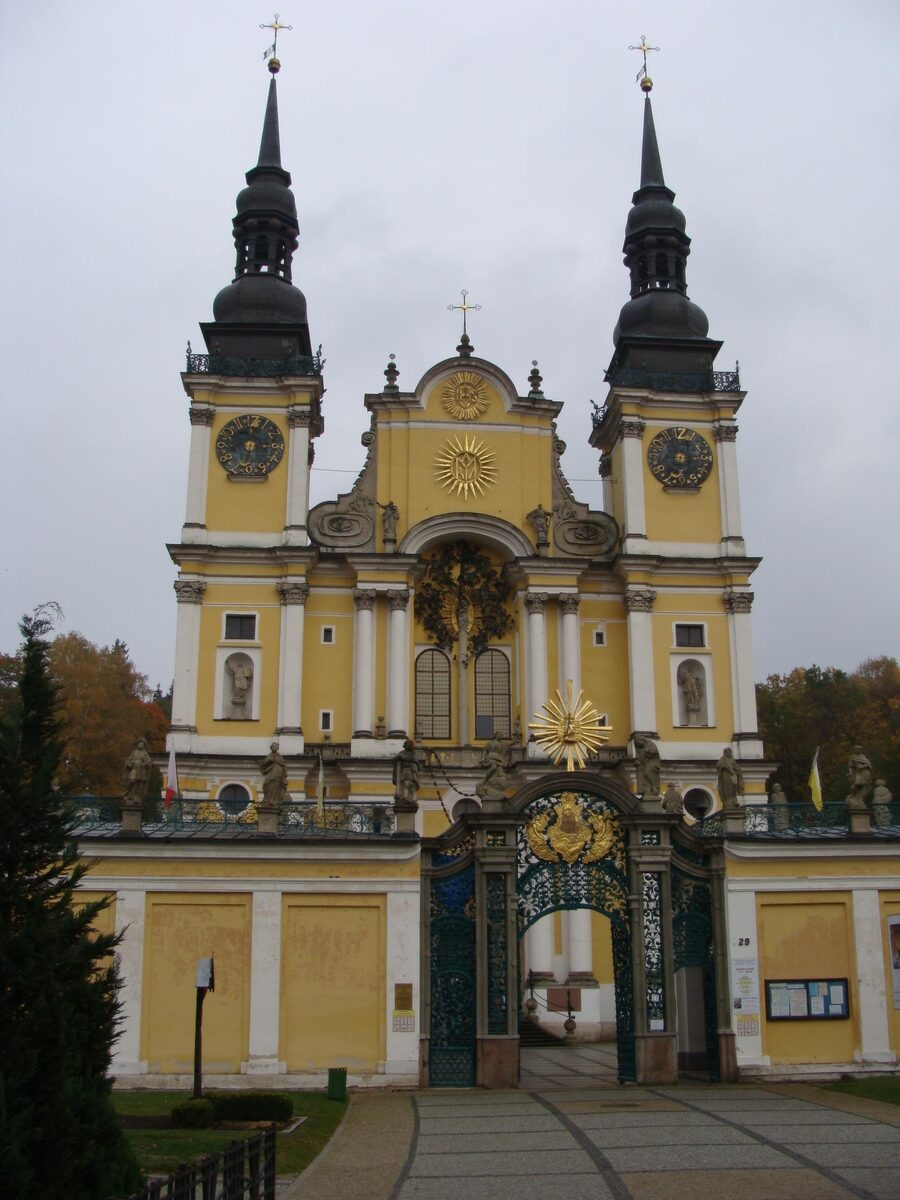
The present sanctuary is a minor basilica Catholic, style baroque, considered one of the most beautiful Baroque works in Poland. It is a three-ship church, richly decorated, with a remarkable set of sacred architecture and art that includes cloisters, annexed buildings and an 18th-century baroque door that introduces the enclosure. One of the most famous elements of the temple is its Baroque organ (dated 1721), of complex ornamentation and with mobile elements, much appreciated by both pilgrims and music lovers.
The basilica- sanctuary is located in the small town of Holy July, in the voivodship (department) of Varmia y Masuriato the north-east of Poland, and belongs ecclesiastically to the Archdiocese of Warmia. The monastic set of Jesuit origin, historically associated with the pastoral animation of the place, has made Święta Lipka one of the best known Marian shrines in this region.
Sponsorship and coronation
The sources consulted indicate that the sanctuary is dedicated to the Blessed Virgin Mary, Queen of Polandbut they do not specify a formal canonical patronage (for example, as a patron of a city or the whole nation) beyond its relevance as a Marian sanctuary of great regional importance. There is no explicit decree in the revised sources to declare it officially the principal patron of a particular diocese, so that only its condition of great place of Marian pilgrimage Northern Poland.
On the coronation, various Marian sources point out that the image of Our Lady of Święta Lipka was crowned in the 20th century, specifically in 1968; however, in the accessible online documentation of the sanctuary and in the encyclopedic entrances consulted no verifiable and direct data is found confirming the act with official mention of the Pontiff or the Pontifical Delegate. Since no explicit reference to the documented canonical coronation (with exact date, specific ecclesial authority and decree), for the purposes of rigour it can be said: does not contain a documented canonical coronation in the sources consulted.
Party and devotion
The local liturgical tradition places the main feast of Our Lady of Święta Lipka the September 8, coinciding with the Nativity of the Virgin Marybut this data is not specifically detailed in the general sources consulted; therefore, it is indicated as traditional data, linked to the Marian custom of celebrating important advocacy on that date. [no direct source]
Święta Lipka is described as one of the most famous Marian pilgrimage places in Polandthat attracts both pilgrims and tourists. In the course of the year, and especially in the summer and in the Marian holidays, groups of faithful from the region of Varmia and Masuria, from other parts of Poland and even from abroad come to visit the to pray before the image of the Virgin, participate in the Eucharist, confess and listen to concerts of the Baroque organ.
A significant devotional feature is the union between pilgrimage, sacred music and Marian prayer. The organ concerts, the Marian songs and the celebration of the liturgy make the sanctuary not only a spiritual center, but also an important cultural focus. The memory of the origins linked to the tile and the image hanging on the tree persists in popular piety, which continues to come to Our Lady of Święta Lipka to ask for protection, health and help in family and personal needs.
Link to the Rosary
The sources consulted on Święta Lipka highlight the character mariano y peregrino of the sanctuary, but do not specifically mention a tradition of its own linked to the prayer of Rosary (for example, historical rosarian copradies, processions of monumental rosaries or particular indulgences linked to the Rosary). Therefore, no consta a unique documented relationship between this advocation and the Rosary, beyond the general practice of the Marian prayer in the sanctuary.
However, in a sanctuary of these characteristics, dedicated explicitly to the Virgin and with intense life of pilgrimages, the Rosary It is one of the most widespread ways of accompanying pilgrimages, of preparing for participation in the Eucharist and of extending prayer before the image of Mary. In the light of the teaching of the Church, the Rosary helps to contemplate, together with Mary, the mysteries of Christ's lifeand in a place like Święta Lipka allows the faithful to unite the memory of the origins of the sanctuary and its graces with the meditation of the joyful, painful, glorious and luminous mysteries, thus strengthening the union with Christ through the intercession of the Mother of God.
A flower for the Virgin
Offer a simple prayer to this Marian devotion. Pray a Hail Mary for Poland and for world peace.
Pray Hail MaryDocumentary update: Święta Lipka
Święta Lipka, in Varmia and Masuria, is a Marian Catholic sanctuary historically entrusted to the Jesuits and known in Polish devotion as a great place of pilgrimage. The institutional documentation distinguishes the cult of the image and history of the sanctuary from the traditional narrative of its origin: it is said that an image or statuette was placed on a tile by a released prisoner, but there is no coetarian document here to present that extraordinary episode as a proven fact. This fact sheet therefore speaks of tradition when it relates to the pious origin and documented history when it comes to the institution, the basilica and the celebrations.
The image was crowned on August 11, 1968 with pontifical authorization. The celebration was presided over by Cardinal Stefan Wyszyński, with the liturgical participation of then Cardinal Karol Wojtyła, according to information disseminated by the Polish Episcopal Conference and the Archdiocese of Varmia. The coronated image condition attests to the public arraigo of the cult; it does not amount to an approval of each account of origin or to a supernatural pronunciation about an apparition. The elevation of the church to the lower basilica has been held since 24 February 1983.
The map uses the shrine point identified by OpenStreetMap (way 173495845). The research report provided two pairs of close coordinates; the one for the cartographic object found on that way is retained, without presenting as accurate a greater accuracy than the source allows. The local name Our Lady of Saint Mary and the title "Mother of the Unity of Christians" can help to locate devotion, but do not replace the Spanish name of the tab.
The Marian prayer of this fact sheet is understood as a request for intercession: the pilgrim addresses God and asks Mary to pray for him and lead him to Christ.
Verified sources for this extension: Polish Episcopal Conference, fiftieth anniversary of the coronation, Archdiocese of Varmia, parish and sanctuary of Święta Lipka y OpenStreetMap.
Is the advocation of the Virgin Mary of your people missing?
Si no encuentras la advocación mariana de tu ciudad o pueblo, cuéntanosla: la investigaremos para ubicarla y darla a conocer en este mapa del amor de la Madre por el mundo.
Propose an apvocation →