
Marian devotion
Our Lady of Tortosa
Marian Advocation of Tartus (Syria)
According to the tradition local Christian, the origin of the sanctuary of Our Lady of Tortosa would go back to a chapel attributed to St Peter the Apostlewhere an image of the Virgin linked to an icon of Luke would have been venerated. Some devotional authors point out this chapel as the "first church dedicated to Our Lady by St Peter," in the city of Tartus (then Tortosa for the Crusaders), although this fact belongs to the scope of the Pious tradition and has no verifiable historical documentation.
Main data
Origin and history
According to the tradition local Christian, the origin of the sanctuary of Our Lady of Tortosa would go back to a chapel attributed to St Peter the Apostlewhere an image of the Virgin linked to an icon of Luke would have been venerated. Some devotional authors point out this chapel as the "first church dedicated to Our Lady by St Peter," in the city of Tartus (then Tortosa for the Crusaders), although this fact belongs to the scope of the Pious tradition and has no verifiable historical documentation.
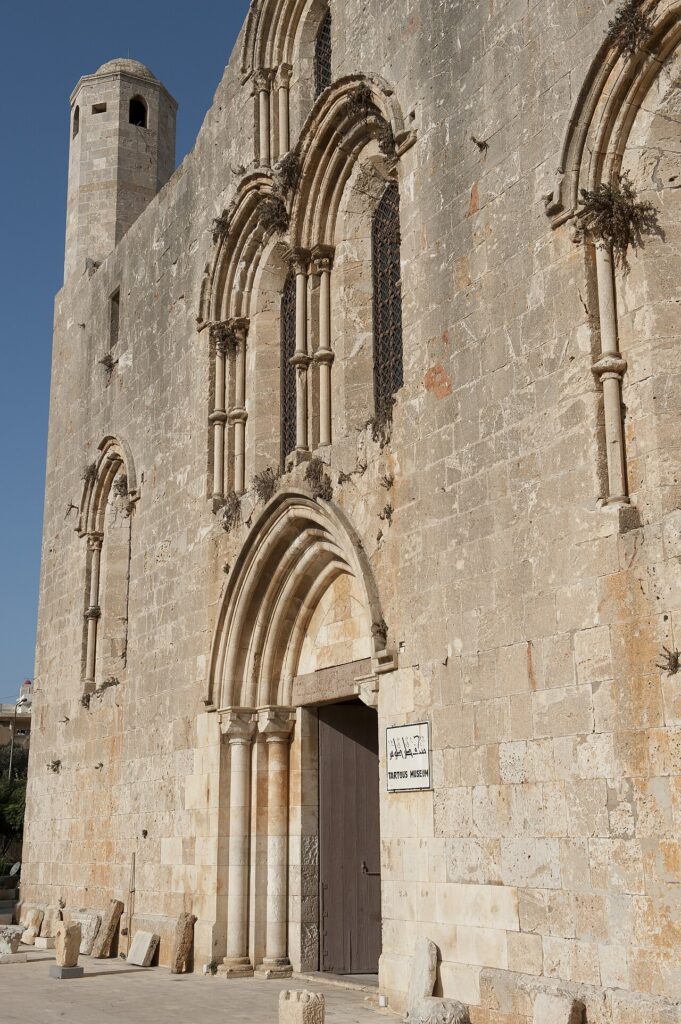
La documented history of the sanctuary begins with the time of the Crossed. The city, known by Latinos as Tortosa, became an important square on the Syrian coast, and in it was built the Cathedral of Our Lady of Tortosa, identified as a cathedral of the cross era. The construction is located in the 12th century; some news sources point around 1123 as the approximate date of the beginning or consolidation of the cross temple, although this accuracy is not unanimously documented in academic sources. After the fall of the crossed states, the building lost its function as a Latin cathedral and, over time, was reused and preserved as a historic monument in the modern city of Tartus.
The image and the sanctuary
As for the image concrete of Our Lady of Tortosa, no consta in the accessible sources a detailed, continuous and documented description (type of size or icon, material, iconographic style) that allows to identify a main image still in veneration. The references speak of a Marian veneration originating in a icon attributed to San Lucas according to tradition, but without verifiable data on its current form or conservation.
El sanctuary is the old Cathedral of Our Lady of Tortosa in Tartus, built during the cross-sectional period and considered one of the best preserved medieval buildings in Syria. It is located in the historical center of Tartus and is described as a fortified church of Latin Romano-Gothic style, which today functions mainly as museum / monument historical. It is not known that it currently has canonical status of minor basilica, ni de Nacional or diocesan sanctuary within the Catholic Church; the sources describe it as an ancient cross cathedral and heritage building, not an officially recognized Marian sanctuary.
Sponsorship and coronation
– Patronage: No official decree of the canonical patronage of Our Lady of Tortosa on the city of Tartus, its diocese or some specific ecclesiastical constituency. The advocation is historically linked to the city of Tartus / Tortosa and to the Latin-cross presence, but without current documentation of liturgical patronage recognized by the Holy See.
– Canonical coronation: About Our Lady of Tortosa does not contain a documented canonical coronation (no date, no pontiff or delegate) in the sources consulted, both historical and devotional.
Party and devotion
Some devotional sources point to the 5 February as a memory of the "dedication of Our Lady's first church by Peter in Tortosa (Tartus, Syria)," in reference to the tradition of the primitive chapel dedicated to Our Lady in this place. However, it has not been found that this date is officially included in the General Roman Calendar or in a local calendar recognized today by the Holy See; it is rather a devotional commemoration linked to the tradition of Tartus.
Today, the ancient cathedral of Our Lady of Tortosa is visited above all as historical and archaeological monumentand not as a regular Marian sanctuary for Catholic veneration. No official data on organized Catholic pilgrimages, no Marian devotional influx statistics comparable to other shrines; access is described in guides and travel portals mainly as a cultural visit to a cross building preserved in the old town of Tartus. In the recent Syrian context, the building is also inserted into an environment of religious plurality, where the figure of Mary is also respected by Christians and Muslims, as shown by the existence in Tartus of a mosque dedicated to Mary.
Link to the Rosary
Not found in available sources a specific and documented link between the advocation of Our Lady of Tortosa and particular practices linked to prayer of the Rosary (rosarian copradies, own indulgences, pilgrimages of the Rosary, etc.). It does not, therefore, contain a rosarian tradition of its own comparable to that of other historical Marian shrines.
However, as it is a ancient Marian dedication on the land of the East, linked to the memory of the Virgin in the first centuries of Christianity according to tradition, this advocation is naturally integrated into the spirituality of the Rosary. The Rosary, in contemplating the mysteries of Christ's life with Mary, allows to unite the Marian devotion of Tartus - marked by the apostolic memory and crossed - with the prayer for peace and fidelity in the Christian communities of the Middle East, as well as for dialogue and respect among peoples who venerate Mary as the Mother of the Lord.
A flower for the Virgin
It offers a simple prayer to this advocation. Pray a Hail Mary for Syria and for world peace.
Pray Hail MaryIs the advocation of the Virgin Mary of your people missing?
Si no encuentras la advocación mariana de tu ciudad o pueblo, cuéntanosla: la investigaremos para ubicarla y darla a conocer en este mapa del amor de la Madre por el mundo.
Propose an apvocation →