
Marian devotion
Our Lady of Tijvin
Marian Advocation of Tijvin (Russia)
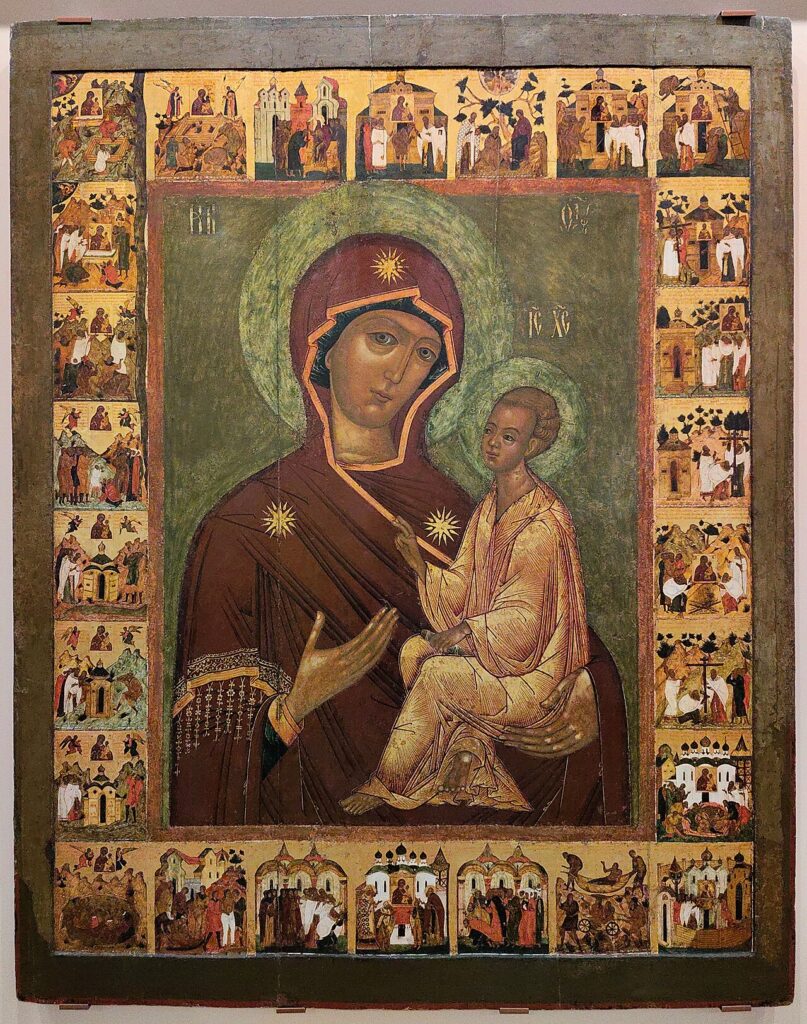
According to the tradition, el icono de Our Lady of Tijvin (in Russian Tijvinskaya Bogoroditsa), of a kind Hodigitria, miraculously appeared in the year 1383 on the waters of Lake Ladoga, in the north of European Russia, and was then moved to the place where Tijvin would be founded, becoming a protector of the north Russian. This tradition also links it, in a pious way, with Saint Luke and the ancient Constantinople, as is the case with other great Marian icons of the East, although there is no conclusive historical evidence to demonstrate these origins.
Main data
Origin and history
According to the tradition, el icono de Our Lady of Tijvin (in Russian Tijvinskaya Bogoroditsa), of a kind Hodigitria, miraculously appeared in the year 1383 on the waters of Lake Ladoga, in the north of European Russia, and was then moved to the place where Tijvin would be founded, becoming a protector of the north Russian. This tradition also links it, in a pious way, with Saint Luke and the ancient Constantinople, as is the case with other great Marian icons of the East, although there is no conclusive historical evidence to demonstrate these origins.
En la documented history, the icon is firmly associated with Monastery of the Sleeping of the Mother of God in Tijvin (Tijvin, oblast of Leningrad, Russia), a foundation that dates back to the 15th century and was consolidated as one of the great pilgrimage centers of northern Russia. For centuries he was honored as protector of the Russian northand in times of war. In Soviet times, the monastery was closed and the icon left Russia, passing through various places of the Orthodox diaspora; it was guarded for decades by the Russian Orthodox Church in exile and, already in the 20th century, ended up in an Orthodox parish in the United States.
En 2004, the icon was solemnly returned to Russia and rejoined in the monastery of Tijvin, after a solemn act presided over by the Patriarchate of Moscow, regaining its role as one of the main national icons. Since then, the restored monastery has regained its role as a pilgrimage sanctuary.
The image and the sanctuary
The image of Our Lady of Tijvin is a Orthodox icon of type Hodigitria: The Mother of God holds the Child Jesus on the left arm and with her right hand points it out, indicating that He is the way, in the Eastern iconographic tradition. It's painted on Table with icon technique (temple on wood) and follow the Byzantine canons. The original iconography is partially covered by a storage or precious metal coating in some of its historical versions, as is common in the large Russian icons, although the concrete details of the coating vary according to the restorations and times; there is no uniform and detailed technical description in the sources consulted.
The icon is venerated in the Monastery of the Sleeping of the Mother of God of Tijvinin the city of Tijvin, Russian Federation. This monastery, one of the most important in the north of the country, was strongly affected by Soviet religious persecution and later restored. It does not know that the temple has the title of minor basilica nor is it formally recognized as a national sanctuary within the Catholic Church; in Orthodox tradition it is considered a great regional and national sanctuary of devotion to the Mother of God. No official mention has been found to call it a "national sanctuary" in the Catholic canon legal sense, so this no consta.
Sponsorship and coronation
Our Lady of Tijvin is venerated as great protector of the Russian northespecially from the Tijvin region and the Ládoga Lake area. The sources mention it as one of the main protectors of Russia, along with other large icons such as Kazan or Vladimir, particularly in the north. There is no formal proclamation of diocesan or national patronage under Catholic canon law; in the Orthodox context its patronage is mainly regional y nacional by devotional practice and historical tradition.
On a canonical coronation in the Catholic sense (by pontifical mandate), does not contain a documented canonical coronation. In the Russian Orthodox tradition, there are solemnities of entronization and special honor to the icon, but no reference has been found to a pontifical coronation or an equitable act within the discipline of the Catholic Church.
Party and devotion
The main feast of the Mother of God of Tijvin on the calendar of the Russian Orthodox Church is celebrated 26 June (13 June according to the Julian calendar), commemorate the miraculous apparition or arrival of the icon. Around that date, and also in other Marian solemnities, they are organized pilgrimages to the monastery of Tijvin, with the participation of the faithful of the region and other parts of Russia. No precise statistical data on the annual influx are available, but the sources point to it as one of the great pilgrimage destinations of northern Russia.
The devotion is characterized by the Icon veneration by kissing, incensation and traditional prayers of Eastern spirituality, rather than by typically Latin practices such as structured novenas. In times of historical danger (wars, invasions, persecutions), the icon has been repeatedly invoked as spiritual shield and a reason for confidence in the protection of the Mother of God over the Russian people of the north. After his return in 2004, the pilgrimage and restoration of the monastic liturgy in the sanctuary have been revitalized.
Link to the Rosary
No consta una direct historical relationship between the advocation of Our Lady of Tijvin and the prayer of the Rosary, since it is an icon eminently orthodoxin whose spiritual environment other forms of Marian prayer, such as the Akathistos, predominate the pleas to the Mother of God and the prayer of Jesus. The devotion to the icon is mainly part of the Byzantine liturgical tradition and the veneration of sacred images through icons.
However, from a Marian Catholic perspective, the Rosary offers a privileged way of to join the mysteries of Christ with Marywhich fully harmonizes with the theology implicit in the Hodigitria iconography: the Virgin who "shows the way" always leads to the Son. For the Catholic faithful who venerate this advocation, the prayer of the Rosary can be a form of to accompany spiritually the inner pilgrimage that the icon of Tijvin suggests: to contemplate Christ with the eyes of Mary, to ask for his protection for the peoples of northern Russia and to beg for peace and unity between East and West under the intercession of the Mother of God.
A flower for the Virgin
Offer a simple prayer to this Marian devotion. Pray a Hail Mary for Russia and for world peace.
Pray Hail MaryIs the advocation of the Virgin Mary of your people missing?
Si no encuentras la advocación mariana de tu ciudad o pueblo, cuéntanosla: la investigaremos para ubicarla y darla a conocer en este mapa del amor de la Madre por el mundo.
Propose an apvocation →