
Marian devotion
Our Lady of Trakai
Marian title of Trakai (Vilna)
According to the tradition Lithuanian, the image of Our Lady of Trakai is linked to the great Duke Vitautas (Vytautas) el Grande, ruler of the Grand Duchy of Lithuania in the late 14th and early 15th century, who would have especially favoured this Marian sanctuary in the then relevant city of Trakai. The devotion presents features of continuity with the Christianization of Lithuania (14th century) and with the implantation of Marian devotion on the lands of the Grand Duchy, although the legendary details about the exact way the icon came to Trakai vary according to the chronicles and are not always consistent; therefore, many narrations about a personal gift of Vitauts or miraculous procedencies should be considered as Pious tradition and not as a proven fact.
Main data
Origin and history
According to the tradition Lithuanian, the image of Our Lady of Trakai is linked to the great Duke Vitautas (Vytautas) el Grande, ruler of the Grand Duchy of Lithuania in the late 14th and early 15th century, who would have especially favoured this Marian sanctuary in the then relevant city of Trakai. The devotion presents features of continuity with the Christianization of Lithuania (14th century) and with the implantation of Marian devotion on the lands of the Grand Duchy, although the legendary details about the exact way the icon came to Trakai vary according to the chronicles and are not always consistent; therefore, many narrations about a personal gift of Vitauts or miraculous procedencies should be considered as Pious tradition and not as a proven fact.
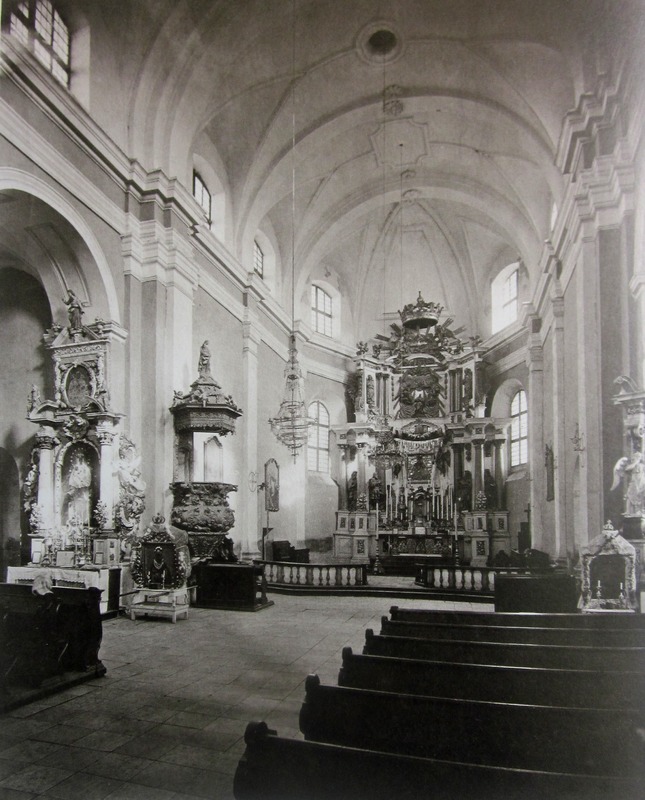
As for the documented historythe existence of a Catholic church in Trakai dedicated to the Virgin already in medieval times, in a city that was the capital of the Grand Duchy of Lithuania. The present Church of the Visitation of the Blessed Virgin Mary is a building that combines elements góticos y barrocos, located on a hill in the centre of Trakai, and is documented as a stable Marian place of worship. With the passing of the centuries, the icon of Our Lady of Trakai was acquired as a miraculous and protective image of the nation, until it was officially recognized as a Marian symbol of Lithuania.
In contemporary times, the temple has been restored and the awareness of its historical and spiritual importance within the Church in Lithuania has been consolidated. The recognition of the church as a minor basilica by the Holy See was an official confirmation of the relevance of this advocation to Lithuanian Catholic life.
The image and the sanctuary
The venerated image is a type of painting Marian icon of tradition bizantina, que representa a la Virgin with the Child Jesus. It is a table on table (icon), similar in style to other Eastern icons venerated in Lithuania and Central-Eastern Europe, in which the Mother of God appears in the attitude of presenting Christ to the faithful. Local sources present this painting as one of the oldest and most venerated Marian images of the country, although the technical details (author, exact date of execution, precise materials) are not unanimously recorded in the available sources; therefore, a complete and dated technical sheet of the icon is not with certainty. It is said in a constant way that the image is famous for being miraculous and is known as Our Lady of Trakai, Patron of Lithuania.
The sanctuary is the Basilica of the Visitation of the Blessed Virgin Mary de Trakai (Trakų Švč. Mergelės Marijos Apsilankymo bazilika), a Catholic temple located on the Trakai peninsula, surrounded by lakes and very close to the famous castle.
– Es una iglesia de origen Gothic, later transformed with elements Baroque, que destaca en el paisaje de la ciudad histórica. – Se encuentra en el centro de Trakai, en una pequeña colina, y es uno de los edificios emblemáticos de la localidad, “igualando” en importancia monumental al castillo de la isla. – La Santa Sede le ha concedido el título de minor basilicarecognition that emphasizes its value as a place of pilgrimage and Marian devotion in the country.
In addition to its parish function, the basilica acts de facto as National Marian Sanctuary due to the presence of the Lithuanian Patron icon and the influx of pilgrims.
Sponsorship and coronation
The Lithuanian sources and religious information agree that Our Lady of Trakai is venerated as Patrona de Lituania. The very title of the icon - "Our Lady of Trakai, Patron of Lithuania" - is used in ecclesial documents and public communications on the basilica. In addition to this national patronage, the Virgin of Trakai is also patron of the city and the surroundings of Trakai, who comes to it as a special protector of the place.
On the coronationthe sources available on the basilica emphasize the importance of the image and its title of Patrona, but do not offer, explicitly and verifiably, the detailed data of a canonical coronation (exact date, pontifical decree, name of the Pontiff and delegate) similar to what is clearly documented in other claims (for example, the coronation of Our Lady of Šiluva in 1786 by Pius VI).
Although local tradition maintains that Our Lady of Trakai was crowned with papal crowns in the 18th century and is presented in some contexts as one of the first Marian images crowned outside Italy, in the sources consulted it does not appear explicitly a full and direct documentary record (cited pontifical decree, precise date and name of the delegate) to allow the data to be entered in full security. Therefore, following the above criteria:
On canonical coronation: does not contain a documented canonical coronation (with date and formal act) in directly consulting sources.
Party and devotion
The easily accessible documentation does not clearly indicate a fecha de fiesta litúrgica propia of Our Lady of Trakai, different from the general Marian parties (such as the Visitation or the Nativity of the Virgin). Therefore, for a specific local liturgical holiday date of the "Patron of Lithuania":
– It does not clearly contain a date of celebration of its own and universally cited in the sources consulted.
However, the nature of place of pilgrimage of the sanctuary:
– La basílica de Trakai es uno de los principales puntos de atracción espiritual de la región de Vilna, recibiendo peregrinos que acuden a orar ante la imagen mariana. – La ciudad, rodeada de lagos y con el castillo medieval cercano, es un destino turístico muy frecuentado, lo que favorece también la difusión de la devoción a la Virgen de Trakai entre visitantes y peregrinos. – La Iglesia en Lituania ha subrayado pastoralmente la importancia de este santuario; el arzobispo de Vilna, Gintaras Grušas, ha destacado que el título de basílica concedido a la iglesia de Trakai está ligado expresamente a la veneración de Nuestra Señora de Trakai como Patrona de Lituania.
In devotional life, special emphasis is given to the intercession of Mary by the Lithuanian nation. The title is framed in the tradition of Lithuania as "Land of Mary" (Terra Mariana), an expression used by Pope Pius XI in relation to the country's deep Marian devotion. Processions, Marian celebrations and diocesan pilgrimages reinforce this role of the Virgin of Trakai as the spiritual mother of the Lithuanian people, although the exact figures of annual inflow are not detailed in the sources consulted.
Link to the Rosary
It does not contain a specific and documented relationship between the advocation of Our Lady of Trakai and a unique or unique practice of prayer of the Rosary (for example, a fellowship of the Rosary from the sanctuary or a feast of the Rosary linked to this image).
However, as in many sanctuaries Mary
A flower for the Virgin
It offers a simple prayer to this advocation. Pray a Hail Mary for Lithuania and for the peace of the world.
Pray Hail MaryIs the advocation of the Virgin Mary of your people missing?
Si no encuentras la advocación mariana de tu ciudad o pueblo, cuéntanosla: la investigaremos para ubicarla y darla a conocer en este mapa del amor de la Madre por el mundo.
Propose an apvocation →