
Marian devotion
Our Lady of Trnava
Marian title of Trnava (Western Slovakia)
According to the local tradition, the image of Our Lady of Trnava would have arrived in the city as an icon brought from Italy and considered from ancient as a copy of the Virgin of the Way (Madonna del Carmine / Madonna del Popolo roman), becoming seen by the faithful as a "paladio" or special protection of the city and the country against wars, fires and epidemics. However, the legendary accounts of his arrival in Trnava and his first favors do not record with documentary precision in the sources consulted, so many details of these origins belong to the field of Pious traditionwithout verifiable date data or specific actors.
Main data
Origin and history
According to the local tradition, the image of Our Lady of Trnava would have arrived in the city as an icon brought from Italy and considered from ancient as a copy of the Virgin of the Way (Madonna del Carmine / Madonna del Popolo roman), becoming seen by the faithful as a "paladio" or special protection of the city and the country against wars, fires and epidemics. However, the legendary accounts of his arrival in Trnava and his first favors do not record with documentary precision in the sources consulted, so many details of these origins belong to the field of Pious traditionwithout verifiable date data or specific actors.
En la documented historythe city of Trnava (former "Tyrnau / Tyrnavia"), an important Catholic center in the Kingdom of Hungary and later in Slovakia, had since the 17th century an intense Marian devotion, especially in times of wars with the Turks and epidemics of plague, when the civil and ecclesiastical authorities officially resorted to the intercession of the Virgin Mary in various images venerated in the city. However, the accessible information - including general documentation on the historical churches of Trnava - does not appear a precise chronology or a detailed account, with clear academic or ecclesiastical support, of the miracles specifically attributed to the icon of Our Lady of Trnava during the wars and epidemics of the 17th-18th centuries; therefore, it can only be said in a generic way that the Marian devotion in Trnava was consolidated in those centuries in a context of conflict and diseasebut cannot safely document each particular prodigy.
The image and the sanctuary
The type of support (table, canvas, etc.), the material nor the detailed iconographic description of the icon of Our Lady of Trnava (position of the Virgin, the Child, attributes, inscriptions, etc.). It is known from general references that it is a Marian icon of orienting style venerated as an image of grace, considered a copy of a Roman image, but no complete and verifiable art sheet is available; therefore, any detailed description would be conjectural, and is not offered here.
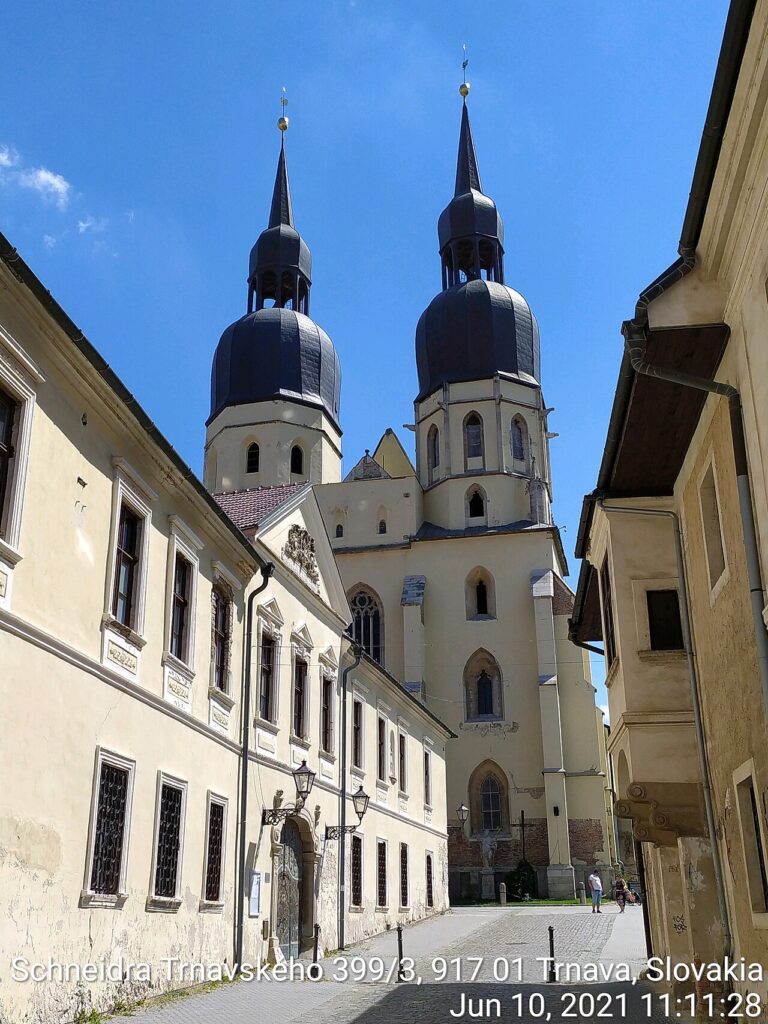
The advocation is venerated in the city of Trnavain the current region of Western Slovakia. The most outstanding historical church in the city is the Catedral de San Juan Bautista (Katedrála v. Jána Krstiteļa), the first fully Baroque building in the present Slovakia, built in the 17th century as part of a Jesuit academic complex. This cathedral is the seat of the Archdiocese and is the main Catholic temple of Trnava, but the sources consulted do not allow us to say with certainty that the icon of Our Lady of Trnava is today in the Basilica of St. Nicholas (kostol v. Mikuláša) nor describe in detail the canonical status of that temple (if it is minor basilica or diocesan official sanctuary). As it is not explicitly stated in the verified sources, it should be noted with rigour that there is no clear documentary confirmation of the official classification of the temple as a minor basilica or as a national or diocesan Marian sanctuary.
Sponsorship and coronation
Local tradition attributes to Our Lady of Trnava a special role as of the city of Trnava and, in a broad sense, as one of the significant Marian images of the country's Catholic history. However, the accessible documentation does not find an explicit canonical statement that the official name as patrona principal of the city, of a specific diocese or of the nation; therefore, according to available sources, it can only be said that:
– no consta a canonical decree establishing Our Lady of Trnava as the principal patron of the Slovak nation (the proclaimed patron of Slovakia is the Virgin of the Seven Dolores). – no consta In the sources consulted a formal decree of diocesan or municipal patronage under this title.
As regards a possible canonical coronation of the icon, the revised sources (general ecclesial documentation, synthesis of Slovak sanctuaries and Marian repertories consulted indirectly) do not mention an act of pontifical or diocesan coronation of the image of Our Lady of Trnava. In the absence of explicit reference, it should be clearly stated: does not contain a documented canonical coronation.
Party and devotion
The available data on the litigation fiesta propia of Our Lady of Trnava are not clearly fixed in the sources consulted. With sufficient documentary support, a date of compulsory memory or proper celebration of precept linked to this advocation has not been identified in the local calendar of Trnava or in the calendar of the Church in Slovakia, beyond the common Marian parties (such as the Nativity of the Virgin, the Immaculate or the national patron, the Virgin of the Seven Dolores). It should therefore be stated that a specific and officially regulated main holiday date is not safe for this invocation in the sources used.
It can be said that Trnava is a city with very deep-rooted Marian traditionwhere there have been processions, pilgrimages and acts of worship to various images of the Virgin, especially in times of need and on the occasion of the great Marian feasts of the liturgical year. The icon of Our Lady of Trnava is inscribed in this fabric of popular devotionswith prayers of supplication for peace, for health and for the protection of families, although the numerical data of the influx of pilgrims or specific details of practices (specific novies, promises, formally erected cofradies) are not reflected in the revised documentation.
Link to the Rosary
In the sources consulted there is no explicit relationship between the advocation of Our Lady of Trnava and a particular practice of Rosary (for example, a co-fraternity of the Rosary canonically erected in the sanctuary, specific indulgences linked to the prayer of the Rosary before the image, or a feast of the Rosary itself linked to this icon). It should therefore be noted that there is no specific historical or institutional link with the Rosary.
From a general Marian perspective, devotion to Our Lady of Trnava, understood as trust in the protection of Mary from wars and epidemics, is naturally harmonized with the rezo of the Holy Rosarywhich the Church proposes precisely as a prayer of intercession for peace, conversion and strength in the test. Where Mary's icon is venerated as shield and amparo of a city or a people, the meditation of the mysteries of Christ next to the Virgin, proper to the Rosary, becomes a privileged way to Unite the memory of the favors received with the contemplation of the Gospeland to support the faith of the faithful in the difficulties of daily life, also in a context like that of Trnava.
A flower for the Virgin
Offer a simple prayer to this Marian devotion. Pray a Hail Mary for Slovakia and for world peace.
Pray Hail MaryIs the advocation of the Virgin Mary of your people missing?
Si no encuentras la advocación mariana de tu ciudad o pueblo, cuéntanosla: la investigaremos para ubicarla y darla a conocer en este mapa del amor de la Madre por el mundo.
Propose an apvocation →