
Marian devotion
Our Lady of Trsat
Marian vocation of Rijeka (Litoral)
According to the traditionthe origin of Our Lady of Trsat's sanctuary is linked to the mysterious transfer of the Holy House of Nazareth from the Holy Land to the West. According to this legend, the house of the Holy Family would have remained on the hill of Trsat, over Rijeka, between 1291 y 1294before being transferred to Loreto, Italy. This miraculous stay would have turned the place into a Marian reference point for the region.
Main data
Origin and history
According to the traditionthe origin of Our Lady of Trsat's sanctuary is linked to the mysterious transfer of the Holy House of Nazareth from the Holy Land to the West. According to this legend, the house of the Holy Family would have remained on the hill of Trsat, over Rijeka, between 1291 y 1294before being transferred to Loreto, Italy. This miraculous stay would have turned the place into a Marian reference point for the region.
When the Holy House "disappeared" from Trsat to go to Loreto, tradition states that the faithful were discomforted; then, the Pope Urbano V habría enviado en 1367 un Miraculous picture of the Virgin as comfort and confirmation of the predilection of the Virgin for this place. This narrative belongs to the field of popular piety y de la legendary traditionwithout all its details being historically verified with contemporary documents.
From the perspective of the documented historythe sanctuary is a place of Marian devotion at least since the 14th century. After the spread of the fame of the "painting of the Virgin of Trsat," the place was consolidated as a pilgrimage centre for Western Croatia. In 1453the noble Martin Frankopan began the construction of a new church and a convent for the Franciscans of the Vicar of Bosniawho, since the 15th century, attend the sanctuary continuously. The current baroque configuration of the set is due to the reconstruction after the great fire of 1629. In recent times, the sanctuary was again highlighted when San Juan Pablo II peregrinó a Trsat el 8 June 2003, joining the multitude of faithful.
The image and the sanctuary
In the sanctuary a icon / picture of the Virgin known as “Virgen de Trsat” o “Gospa Trsatska”, considered miraculous by local tradition. Various devotional sources mention that this is an ancient image of the Mother of God, linked to the gesture of Urban V in 1367; however, the accessible documentation does not contain in a certain way a precise historical attribution to St Luke painter, so such attribution should be considered traditional and undocumented. The exact material (table, canvas, etc.) and a detailed description of the technique, beyond its character as an image of the Virgin with the Child venerated as miraculous, are not clearly recorded in the sources consulted.
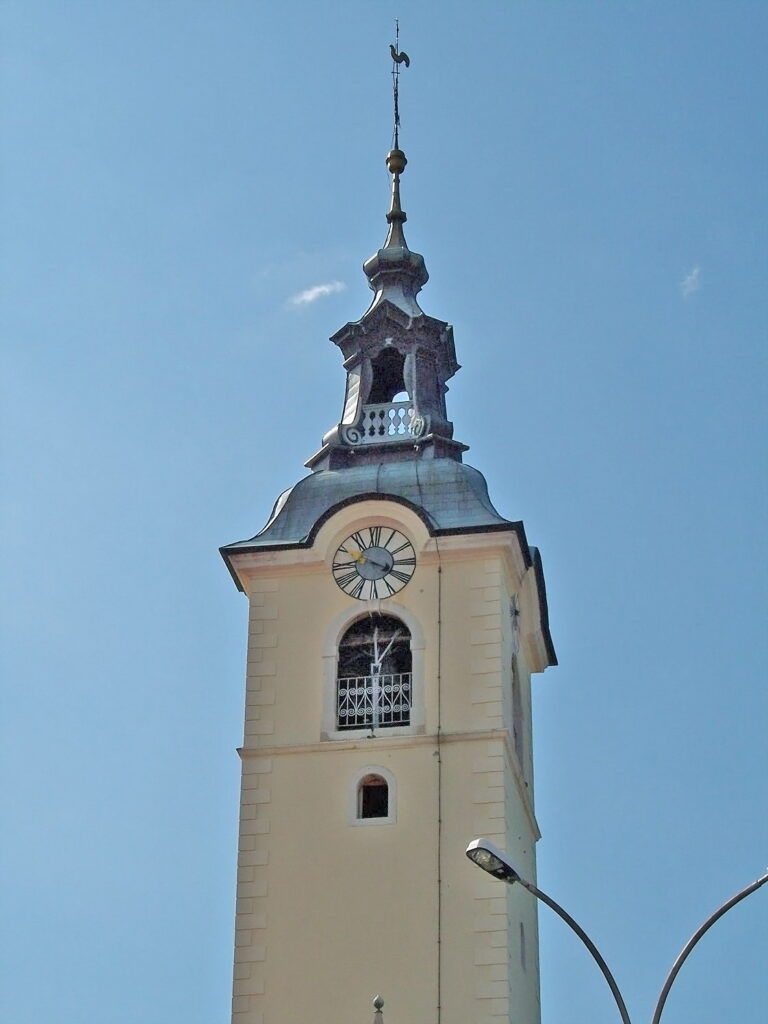
The place of worship is the Church of Our Lady of Trsat (Crkva Gospe Trsatske), un Baroque sanctuary located on the Trsat hill above the city of Rijeka in the Croatian coastal region. It is considered the oldest Marian shrine in Croatia dedicated to the Virgin, and the main pilgrimage center of Western Croatia. The church has a baroque facade and a wide interior dominated by a luxurious altar greater than 1692. The oldest parts of the main ship and the presbytery come from the time late Gothic, linked to the works started in 1453, while the current physionomy is due to the Baroque reconstruction after the fire of 1629. On the triumphal bow, a great painting of the Announcement which includes, in the same composition, the scene of the transfer of the Holy House.
The sanctuary forms a set with the Franciscan monastery of Trsatwhich is still guarded by the Order of Minor Friars. It is not clear from the sources consulted that the church has received the title of minor basilica, ni que haya was formally designated as National sanctuary; if it appears in a constant way described as pilgrimage sanctuary of regional importance and one of the oldest in Croatia.
Sponsorship and coronation
Our Lady of Trsat is recognized in tradition as an important patron of the Croatian coast. Devotional sources mention it as "Queen of the Adriatic" y patron of Croatian fishermen, reflecting the deep link between this Marian invocation and the life of coastal communities. The sanctuary is described as the main Marian pilgrimage center of the Western Croatia and spiritual reference for the city of Rijeka and its environment. In the sources consulted, there is no official decree requiring canonical patronage at the level of diocese or nation, although its role as regional patronage is well rooted in popular piety.
As for the canonical coronation of the image, in the accessible documentation (official tourist sites of Rijeka and Trsat, devotional materials and general publications) does not contain a documented canonical coronation with clear date and pontifical or delegated authority.
Party and devotion
The main feast of Our Lady of Trsat is held August 15, solemnidad de la Assumption of the Virgin Mary, known in the region as “Vela Gospa” ("Great Lady"). This day is the most important and traditional celebration of the sanctuary, which brings together a large multitude of pilgrims from the city, the coastal strip and other parts of Croatia. In addition to this great feast, the sanctuary hosts Marian celebrations throughout the year, especially in the strong times of the liturgical calendar.
Our Lady of Trsat is one of the larger pilgrimage centres in Western Croatia, receiving many Croatian and foreign pilgrims daily. Many faithful ascend to the sanctuary by the well-known step that links Rijeka with the Trsat hill (more than five hundred steps), in a penitential gesture of Marian trust. Devotion is expressed through participation in the Eucharist, prayer before the miraculous image and various processions, especially around August 15. The visit of St. John Paul II in 2003 reinforced the character of the place as a Marian sanctuary of relevance to all Croatia.
Link to the Rosary
The sources consulted do not contain a specific tradition which uniquely links this advocation to a concrete historical fact related to the Rosary (such as apparitions, particular promises or world-known co-fradies). However, as in so many Franciscan Marian shrines, the prayer of the Rosary is a regular part of the popular piety of pilgrims and Marian spirituality living in Trsat.
The contemplation of the mysteries of Christ next to Mary in the Rosary naturally fits the identity of the sanctuary: a place where tradition recalls the presence of the Holy House of Nazareth, and where the Virgin is venerated as a close Mother who accompanies the daily life of the families and the fishermen of the Adriatic. The Rosary, as a simple and deep prayer, thus becomes a way to join the faith of generations of pilgrims who have come up to the hill of Trsat to trust Our Lady with her work, suffering and hope.
A flower for the Virgin
Offer a simple prayer to this Marian devotion. Pray a Hail Mary for Croatia and for world peace.
Pray Hail MaryDocumentary update
The fact sheet of the Virtual Museum of Baroque Art documents that the Franciscan church and monastery of Our Lady of Trsat were born in the 13th century and that the sanctuary was developed around the tradition of the Holy House. The traditional account places the house in Trsat in 1291, its subsequent transfer to Recanati in 1294 and its arrival in Loreto in 1295; the source itself presents it as legend, not as a proven historical statement.
The architectural history does allow to follow several documented stages: the church promoted by the Frankopan in the 15th century, the complete renewal of the whole in Baroque style in 1641 and the artistic inventory of the 17th and 18th centuries. The heritage source identifies concrete works and authors, including the paintings of Cristoforo Tasca made between 1704 and 1714 and the great canvas of 1714 on the Annunciation and transfer of the Holy House.
Baroque decoration, Franciscan presence and spiritual relationship with Loreto explain the historical and artistic importance of the Trsat shrine. Public veneration and the preservation of this memory do not make the tradition of angelic transport a proven historical fact or an ecclesial approval of supernatural.
Source of this update: Museum With No Frontiers, Franciscan Church and Monastery of Our Lady of Trsat.
Is the advocation of the Virgin Mary of your people missing?
Si no encuentras la advocación mariana de tu ciudad o pueblo, cuéntanosla: la investigaremos para ubicarla y darla a conocer en este mapa del amor de la Madre por el mundo.
Propose an apvocation →