
Marian devotion
Our Lady of the Dolores of Turumba
Marian Advocation of Pakil (Laguna) (Luzón)
According to the tradition local, a small picture or image of the Virgin Dolorosa was found floating in Lake Bay in the 18th century, near the village of Pakil (province of Laguna, on the island of Luzon). The pious interpretation of this finding as a sign of Marian predilection would have given rise to particular devotion to Our Lady of the Dolores of Turumba and to subsequent parties called "Turumba." The traditional account highlights the prodigious character of the finding and the rapid dissemination of the cult among the inhabitants of the place.
Main data
Origin and history
According to the tradition local, a small picture or image of the Virgin Dolorosa was found floating in Lake Bay in the 18th century, near the village of Pakil (province of Laguna, on the island of Luzon). The pious interpretation of this finding as a sign of Marian predilection would have given rise to particular devotion to Our Lady of the Dolores of Turumba and to subsequent parties called "Turumba." The traditional account highlights the prodigious character of the finding and the rapid dissemination of the cult among the inhabitants of the place.
As for the documented history, the existence of the Sanctuary of Our Lady of the Dolores of Turumba as a Marian cult center in the town of Pakil, linked to the parish of San Pedro de Alcántara, within the Latin Catholic rite. The devotion is structured around an image of the Virgin of the Dolores and a cycle of celebrations after Holy Week, which have been shaped as one of the novena or series of longer Marian processions in the popular Filipino context. There are no precise and fully verifiable dates in the sources consulted on the first finding or on the initial institutionalization of the parties; beyond the general framework of the 18th century, there is no reliable detailed chronology.
The image and the sanctuary
The advocation of Our Lady of the Dolores of Turumba focuses on a Marian image of the Dolores, conservada en la Parish of San Pedro de Alcantarawhich is at the same time the Sanctuary of Our Lady of the Dolores of Turumba. The main image is described as a oil paint on canvas, representing Mary in an attitude of intense affliction, with the face contracted by pain y daggers stuck in her heartaccording to the traditional iconography of the Seven Dolores. This painting is venerated as a main relic of devotion.
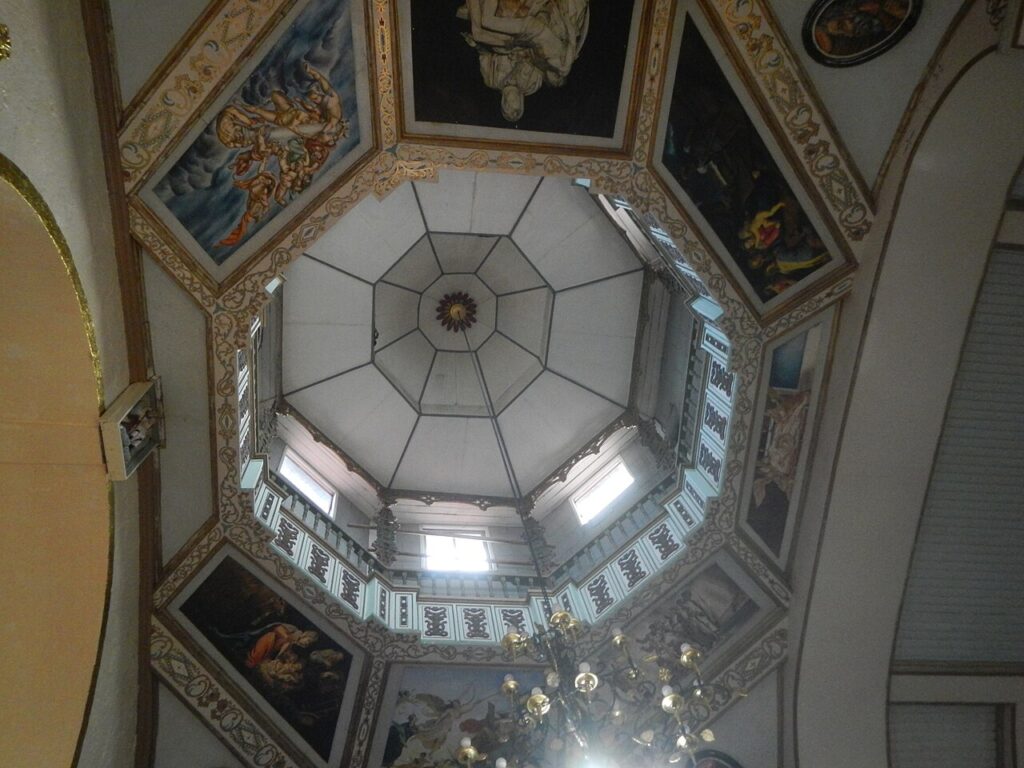
The sanctuary is identified with the Church of San Pedro de Alcantara, Catholic parish temple in Pakil, Laguna province. The image of Our Lady of the Dolores of Turumba is kept inside and a concrete statue of Our Lady of the Dolores. The sources also point to the existence of a second image of the Virgin Dolorosa, presented as replica of the image of Our Lady of the Ancient of Spain. It is not recorded in the documentation consulted that the temple has received the title of minor basilica, ni que haya was formally designated National sanctuary; its verified condition is that of parish church and diocesan local sanctuary dedicated to Our Lady of the Dolores of Turumba.
Sponsorship and coronation
Our Lady of the Dolores of Turumba is venerated as Patrona of the town of Pakil, in the province of Lagunaon the island of Luzon, Philippines. Devotion is closely associated with the religious and cultural identity of the municipality, which is recognized under its spiritual sponsorship. There are no verified references to a diocesan or national patronage; therefore, beyond the local patronage of Pakil, no consta a wider official recognition in the sources consulted.
On the canonical coronationa clear reference, with date, to a pontifical decree or a papal delegate, does not appear in the accessible documentation, which makes it possible to claim with certainty that the image has been canonically crowned according to the rules of the Holy See. Therefore, according to the information currently available, does not contain a documented canonical coronation.
Party and devotion
The devotion to Our Lady of the Dolores of Turumba is expressed in a unique way in the calls parties of the Turumbaheld in Pakil. These parties form a series of Marian celebrations after Holy Week, traditionally described as one of the world's longest nays or chains of Marian processions, structured in seven parties After Easter. Although the specific schedule of dates varies, local tradition links these celebrations to the Seven Dolores of Marydistributed on different holidays. The sources consulted do not offer a unique and precise date for an isolated "main party," as devotion is rather organized around this long cycle of parties; therefore, no consta with certain documented a single main party date.
Turumba parties include processions with the image of the Virgin, Marian songs and prayers, and intense popular participation. The tradition has given rise to pilgrimages from other locations in Laguna and from nearby regions, so that Pakil becomes, during the holidays, a point of convergence for the faithful and devotees who come to honor Our Lady of the Dolores. No official flow figures verified for these celebrations; therefore, no consta a reliable numerical data on the number of pilgrims or participants.
Link to the Rosary
In the sources directly referred to Our Lady of the Dolores of Turumba does not contain a specific and explicit linkage of this advocation with a fellowship of the Rosary, with a particular title of the Rosary or with own practices differentiated from the common prayer of this Marian prayer. So, on the historical-documentary plane, no consta a unique link with the Rosary beyond the general Marian piety.
However, in Catholic spirituality, the contemplation of the Dolores of Mary is deeply harmonized with the prayer of Rosarythat the Magisterium has defined as "compendium of the whole Gospel." The Rosary allows us to contemplate, in its painful mysteries, the Passion of Christ in which Mary participates intimately as a Dolored Mother, and helps the faithful to unite their own sufferings with those of Christ, accompanied by the Virgin. In this sense, although there is no "own" form of the Rosary of Turumba, the Rosary It is presented as a privileged way of living devotion to Our Lady of the Dolores of Turumba: by meditating on the mysteries of Christ, it also enters into the past heart of Mary and participates in her compassion and paschal hope.
A flower for the Virgin
Offer a simple prayer to this Marian devotion. Pray a Hail Mary for the Philippines and for world peace.
Pray Hail MaryIs the advocation of the Virgin Mary of your people missing?
Si no encuentras la advocación mariana de tu ciudad o pueblo, cuéntanosla: la investigaremos para ubicarla y darla a conocer en este mapa del amor de la Madre por el mundo.
Propose an apvocation →