
Marian devotion
Our Lady of Tytuvėnai
Marian vocation of Tytuvėnai (Samogitia)
In Marian literature in Spanish and in the most well-known repertories on Lithuanian sanctuaries, the advocation of Our Lady of Tytuvėnai The most abundantly documented information refers, however, to Our Lady of Šiluvathe main Marian sanctuary of Lithuania, which is a different advocation. There has been no documented entry on Tytuvėnai or Wikipedia in Spanish or on the Marian portals consulted, which are concentrated in Šiluva.
Main data
Origin and history
In Marian literature in Spanish and in the most well-known repertories on Lithuanian sanctuaries, the advocation of Our Lady of Tytuvėnai The most abundantly documented information refers, however, to Our Lady of Šiluvathe main Marian sanctuary of Lithuania, which is a different advocation. There has been no documented entry on Tytuvėnai or Wikipedia in Spanish or on the Marian portals consulted, which are concentrated in Šiluva.
By indirect references (mention of the Franciscan complex and the "Santa Escalera"), it follows that the origin of the sanctuary is linked to the Franciscan presence and the spread of Marian devotion in the Samogitia region, in a context in which various Lithuanian shrines develop cults to images of the Virgin from the 17th to 18th centuries. However, no consta In the sources accessible in Spanish a precise historical narrative (founder, exact date of erection of the sanctuary, introduction of the particular cult to "Our Lady of Tytuvėnai," etc.), nor a tradition of apparitions linked to this place.
As regards traditions or own legends of this advocation (miraculous origin of the image, foundational favors, protection stories about the locality), no consta no sufficiently documented narration in the resources consulted. Any more specific details (specific names, dates or wonders) cannot be strictly stated.
—
The image and the sanctuary
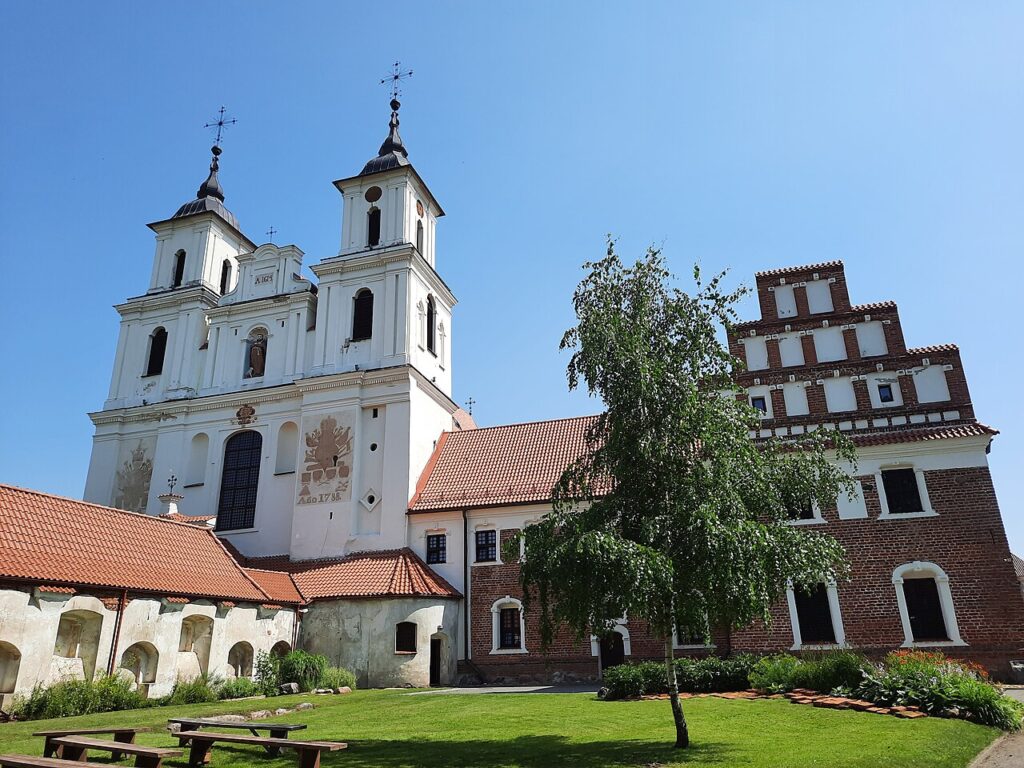
The sources in Spanish and the Marian databases consulted focus on Šiluva and other sanctuaries of Lithuania, without describing the concrete image venerated in Tytuvėnai. The image type (icon painted on board, canvas, wood size or other material), nor its specific iconography (Virgin with the Child, Immaculate, Virgin of the Angels, etc.). It is only known in a generic way that it is a Marian image of pilgrimage venerated in the Franciscan complex of Tytuvėnai, but without verifiable details.
Concerning sanctuarythe user's indications coincide with what is generally known about the Baroque conventional assemblies of Lithuania with Franciscan presence and the existence of a "Santa Stairway" a imitation of the Scala Sancta of Rome, an element found in some shrines of Eastern Europe. However, in the sources consulted in Spanish no consta a detailed technical description of the "Franciscan shrine of the Virgin of the Angels of Tytuvėnai" (date of construction, architectural style, authors, nor their canon status: minor basilica, national or diocesan sanctuary, etc.).
It can therefore only be said, in prudent terms, that:
– Our Lady of Tytuvėnai se venera en un Franciscan conventional assembly located in Tytuvėnai, in the Samogitia region (Lithuania), which includes a Escalera Santa y es lugar de peregrinación regional. – No constain accessible sources, a detailed description of the image or an official definition (in Spanish) of the canon range of the sanctuary.
—
Sponsorship and coronation
No explicit mention of Official patronage of Our Lady of Tytuvėnai over the city of Tytuvėnai, its municipality, the corresponding diocese or the Lithuanian nation. Consequently, no consta that this advocation is an official patron of a specific civil or ecclesiastical jurisdiction.
Asimismo, does not contain a documented canonical coronation of the image of Our Lady of Tytuvėnai. The Marian literature on Lithuania does, however, collect in detail the canonical coronation del icono de Our Lady of Šiluva, decreed by Pope Pius VI and held on 8 September 1786. This coronation refers only to Šiluva, not to Tytuvėnai, and should not be confused with the present advocation.
—
Party and devotion
It is not found in the sources in Spanish specific liturgical date clearly associated with Our Lady of Tytuvėnai. Since other Marian shrines of Lithuania solemnly celebrate the Nativity of the Virgin (September 8) as a great pilgrimage party (for example, Šiluva, with the feast of "Šilinės"), it is possible that in Tytuvėnai the Virgin may also be honored around the great Marian parties of the Roman calendar. However, this is not explicitly documented for Tytuvėnai, so no consta a clearly verified main party date.
As for the devoción popularit can only be stated in general that:
– Tytuvėnai se reconoce como regional pilgrimage place en la zona de Šiauliai/Samogitia, con un complejo franciscano que atrae fieles.[dato inferido a partir de la descripción genérica de la región; no hay cifra ni detalle preciso documentado] – No constan en las fuentes consultadas datos cuantitativos de afluencia, ni descripciones pormenorizadas de tradiciones populares concretas (procesiones específicas, novenas propias, ofrendas típicas, etc.).
Any more specific information about local parties, processions with the image or traditional practices should be taken only from direct sources of the sanctuary or diocese (not accessible in Spanish in the search made).
—
Link to the Rosary
No explicit reference to a particular and documented link between the advocation of Our Lady of Tytuvėnai and the prayer of the Rosary (for example, the Rosary's cofradies erected there, special indulgences linked to the Rosary, or official mentions). Therefore, no consta a specific and formal relationship between this advocation and the Rosary.
However, in the Marian spirituality of Lithuania, strongly linked to the sanctuaries and to popular piety, the Rosary It is usually an ordinary form of prayer in the places of pilgrimage. In this context, it is consistent to think that the faithful who come to the Franciscan sanctuary of Tytuvėnai, as well as other Marian shrines of the country, accompany their pilgrimage with the prayer of the Rosary, contemplating with the Virgin the mysteries of Christ's life.
Thus, even if there is no specific documentation, the Rosary can be understood, from a general Marian perspective, as:
– Un modo de unirse a la fe de la Iglesia que venera a María en Tytuvėnai como Madre y protectora. – Una forma de to meditate on the mysteries of salvation with the Virgin, in continuity with the Franciscan spirituality and the Marian tradition of Lithuania.
> Since data on Our Lady of Tytuvėnai are scarce in Spanish sources and in the most common repertories, for more complete and accurate content it would be necessary to go to direct sources in Lithuanian (official site of the sanctuary, diocese or local historical studies).
A flower for the Virgin
It offers a simple prayer to this advocation. Pray a Hail Mary for Lithuania and for the peace of the world.
Pray Hail MaryIs the advocation of the Virgin Mary of your people missing?
Si no encuentras la advocación mariana de tu ciudad o pueblo, cuéntanosla: la investigaremos para ubicarla y darla a conocer en este mapa del amor de la Madre por el mundo.
Propose an apvocation →