
Marian devotion
Our Lady of Valère
Marian Advocation of Zion (Valais)
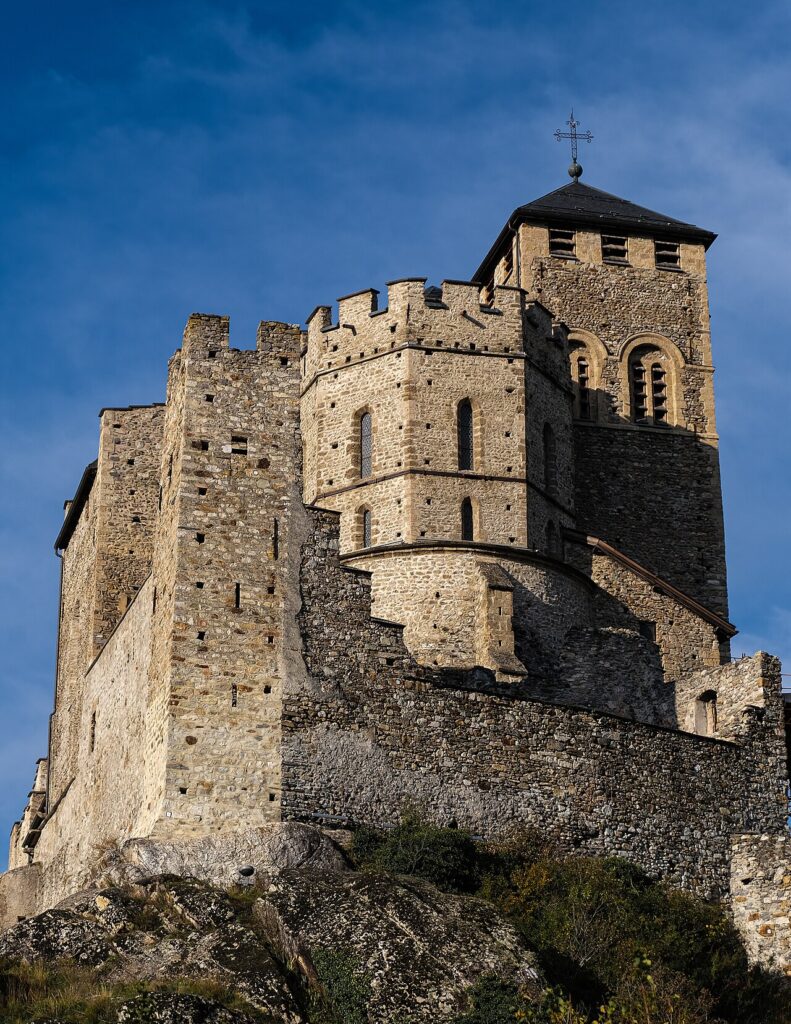
According to the documented historythe church dedicated to the Virgin on the hill of Valère was built between the centuries XII y XIII. The current building corresponds to a Roman-Gothic collegiate church, belonging to the old canon lobby of Sion. The set rises on a fortified hill that, along with the nearby castle of Tourbillion, dominates the city and the Rhône valley, forming one of the most characteristic historical landscapes of the Valais.
Main data
Origin and history
According to the documented historythe church dedicated to the Virgin on the hill of Valère was built between the centuries XII y XIII. The current building corresponds to a Roman-Gothic collegiate church, belonging to the old canon lobby of Sion. The set rises on a fortified hill that, along with the nearby castle of Tourbillion, dominates the city and the Rhône valley, forming one of the most characteristic historical landscapes of the Valais.
En 1984the church of Notre-Dame de Valère was officially elevated to the dignity of minor basilica, which confirms the importance of this place as a center of Marian devotion and ecclesial heritage. The whole of Valère (church, dependencies and fortifications) is now one of the greatest historical and religious attractions of Zion and the canton of Valais.
It does not contain, in the sources consulted, a specific Marian foundation legend (apparition, concrete miracle or singular devotional account) which has given rise to a differentiated advocation of the type "apparition" or "miraculous image." The advocation of Our Lady of Valère is mainly linked to the title of the church and to the secular presence of a Marian schoolgirl on the hill; beyond that, no consta a legendary Marian tradition of its own equal to the great apparitions of other shrines.
The image and the sanctuary
The church has the title of Our Lady of Valère (Our Lady of Valeria) and it is today officially minor basilica. This is a iglesia-colegiata fortifiedda, integrated into a medieval set of walls, turreons and canon buildings, which dominates Sion from the top of Valère hill. The interior features Romanesque and Gothic elements, with a high chorus and a famous organ suspended on the north wall. The temple is part of a complex that covered the canon lobby, with a liturgical and defensive function, and is now an important place of worship and tourist visit.
As for the Marian image concrete venerated under the title of Our Lady of Valère, the sources of public access consulted (including the encyclopedic entry on the basilica and reports on the place) do not provide a detailed description of a main statue or icon (type, material, specific iconography, author, chronology). Therefore, no consta precisely, in the verifiable sources, the concrete iconography of a main image that focuses devotion under this title. Yes, the Marian character of the church (dedicated to the Virgin) and the use of the title Our Lady para referirse a la basílica.
The sanctuary is known internationally for its historical body, dated 1435, considered world's oldest organ still in operation. The instrument, suspended in a mural rostrum, was restored in the 20th century (around the 1960s) and then resounded regularly. This body is one of the most characteristic elements of the sanctuary and attracts many visitors and lovers of sacred music.
Sponsorship and coronation
La advocación de Our Lady of Valère is closely linked to the city of Sion y al cantón del Valaissince the basilica dominates the cantonal capital and has for centuries been a spiritual center of the region. However, the accessible documentation does not find an explicit statement that it presents as official employer of the city of Zion, of the canton of the Valais or of a particular diocese; therefore, beyond its evident symbolic and spiritual weight in the area, no consta a clearly defined formal canonical patronage in the sources consulted.
About a possible canonical coronation of the image of Our Lady of Valère, neither the encyclopedic sources nor the articles of dissemination on the basilica nor the Catholic press consulted refer an act of canonical coronation with date, pontifical authority or delegate. It should therefore be stated that does not contain a documented canonical coronation for this advocation.
Party and devotion
The general sources on the basilica of Valère do not require the date of a own and specific liturgical feast of Our Lady of Valère, different from the usual Marian parties of the Roman calendar. It is reasonable to think that the local community holds with special solemnity certain festivals of the Virgin (for example, the Assumption or the Nativity of Mary), but in the accessible documentation no consta a particular date established as the "main feast" of this advocation.
The devotion is expressed, above all, by the pilgrimage to the sanctuary itselfwhich combines the Marian character of the place with its strong historical and cultural dimension. The rise to the Valère hill is described as a itinerary much appreciated by visitors and faithful, who access the fortified church for prayer, contemplation and participation in the liturgy. The sanctuary receives a constant flow of visitors, especially in the months of good time, during day hours of opening.
In addition to the strictly Marian cult, the basilica is the center of liturgical and musical eventsin particular concerts or demonstrations around the historical organ, which contribute to keeping alive the relationship between art, faith and local tradition. In this context, devotion to Our Lady of Valère is intertwined with appreciation for the religious and musical heritage, strengthening the link between the Virgin and the cultural life of Zion and Valais.
Link to the Rosary
In the documentation consulted on the Basilica of Valère, its history and its organ, no consta a specific relationship of this advocation with the prayer of Rosary (for example, as a rosarian sanctuary, the site of the Rosary's cofradies, the promoter of a feast of the Rosary or the scene of Marian initiatives officially linked to this prayer).
However, because it is a Marian basilica dedicated to Notre-Dame, the Rosary is a natural part of the spiritual life linked to this place, as is the case in most temples consecrated to the Virgin. In the tradition of the Church, the Rosary is a school of contemplation of the mysteries of Christ with the eyes of Maryand it can be said that the silent contemplation before Our Lady of Valère, on the top of the hill that dominates Zion, is easily aligned with the paused meditation of the joyful, painful, glorious and luminous mysteries.
So, though no conste a particular historical or institutional link between Our Lady of Valère and the Rosary, this advocation is inserted into the broader horizon of the Marian spirituality of the Church, where the prayer of the Rosary accompanies the inner pilgrimage of the faithful, illuminates the contemplation of the mysteries of salvation and helps to unite the daily life of the believers of Zion and of Valais to the maternal intercession of the Virgin Mary.
A flower for the Virgin
It offers a simple prayer to this advocation. Pray a Hail Mary for Switzerland and for world peace.
Pray Hail MaryIs the advocation of the Virgin Mary of your people missing?
Si no encuentras la advocación mariana de tu ciudad o pueblo, cuéntanosla: la investigaremos para ubicarla y darla a conocer en este mapa del amor de la Madre por el mundo.
Propose an apvocation →