
Marian devotion
Our Lady of Ransom of Vallardadam
Marian vocation of Kochi (Kerala)
According to the tradition, the image of the Virgin with the Child Jesus in the form of Our Lady of Ransom was brought by Portuguese merchants under the leadership of Vasco da Gama around 1524and enthroned in a church dedicated to Holy Spirit in Vallarpadam, near Kochi. This first church is considered one of the oldest Catholic temples in the area, linked to the Portuguese missionary presence on the coast of Malabar.
Main data
Origin and history
According to the tradition, the image of the Virgin with the Child Jesus in the form of Our Lady of Ransom was brought by Portuguese merchants under the leadership of Vasco da Gama around 1524and enthroned in a church dedicated to Holy Spirit in Vallarpadam, near Kochi. This first church is considered one of the oldest Catholic temples in the area, linked to the Portuguese missionary presence on the coast of Malabar.
En 1676A great flood destroyed the ancient church of the Holy Spirit. The tradition reports that the painting of the Virgin was found floating in the inner waters (backwaters) and rescued by Paliyath Raman Valiyachan, Prime Minister of the Maharajá of Cochin, which reinforced the fame of the image as miraculous. From 1752another well-established tradition speaks of the miraculous rescue of a woman named Palliveettil Meenakshi and her son, saved from dying drowned after three days of supplication to Vallarpadathamma; from this episode is born the devotional practice of becoming "adima" (spiritual slave) of the Virgin.
As for the documented historythe sources agree that there was a Catholic church in Vallarpadam at least from 1524, founded by Portuguese missionaries and dedicated to the Holy Spirit, with a Marian image of lucid origin. It means that the church was rebuilt after the floods in 1676. En 1888The pope. Lion XIII granted the greatest altar of this sanctuary the privilege of being Altare Privileatum in Perpetum (privileged altar for the daily celebration of the Mass), a sign of official recognition of the importance of the place. In 1951the Government of India declared it important pilgrimage center. El 12 September 2004, the Catholic Episcopal Conference of India raised the temple to the rank of National Sanctuary and that same year was proclaimed minor basilica by the Pope San Juan Pablo II.
The image and the sanctuary
The main image is a Table of the Virgin Mary with the Child Jesus, of Portuguese style and origin of the 16th century, entronizado en el Major altar of the basilica. This is a representation of Mary as Our Lady of Ransom, that is, a Virgin with the Child, associated with protection and liberation, very linked to the Marian iconography that the Portuguese spread in their colonial enclaves. The sources consulted describe the image as a "picture" or "miraculous picture," but do not safely detail the material (oil on canvas or board), so that does not accurately contain the support or the pictorial technique.
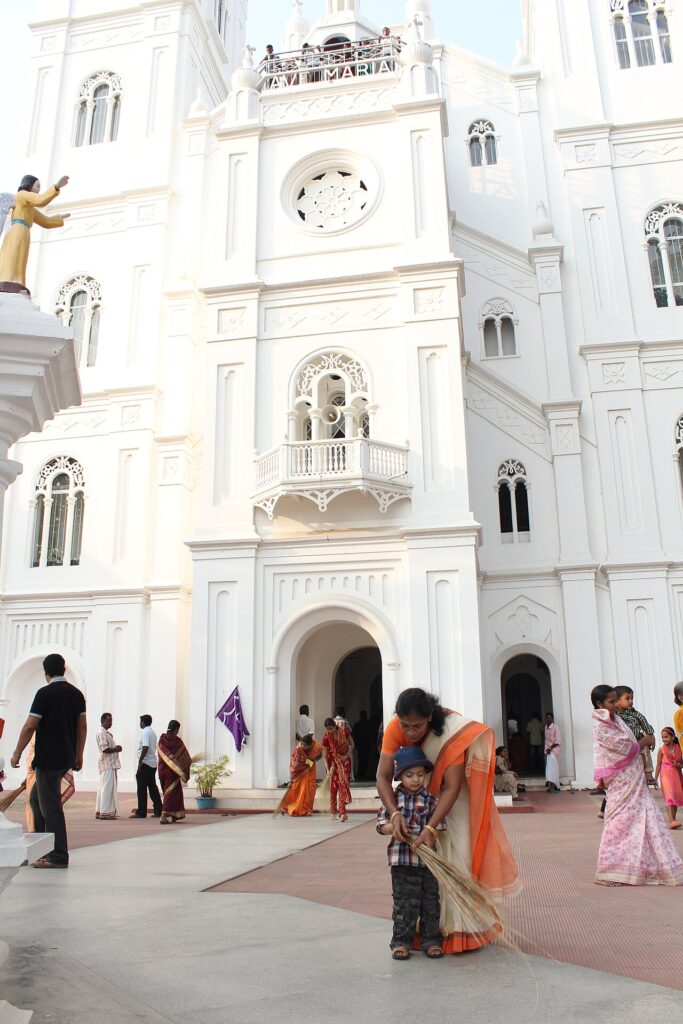
The temple where it is venerated is the National Shrine Basílica of Our Lady of Ransom (Basilica--National Sanctuary of Our Lady of Ransom), popularly known as Vallarpadam Basílica or church of Vallarpadathamma. It is located in the island of Vallardadam, in the backwaters of Lake Vembanad, near the city of Kochi, state of Kerala, and belongs to the Latin Archdiocese of Verapolly. The current building is a simple-style church, with white facade and towers very visible in the landscape, configured as a great center of Christian pilgrimage. It was declared minor basilica y National Sanctuary in 2004, and is estimated to receive around 5 million pilgrims per year. The church, of Latin rite, offers an intense programming of Masses and novies, welcoming faithful of various languages and rites, although the sanctuary as such is linked to Latin jurisdiction.
Sponsorship and coronation
Our Lady of Ransom of Vallardadam is especially venerated as patron of fishermen and sailors of the region, which invoke it for its protection in the waters of mar Arábigo and Kerala's backwaters. The practice of "adima" (to be consecrated as a spiritual "slave" of Vallarpadathamma) has taken root among fishermen, sailors and travellers, who put their life and work under their protection, before going out to sea or taking a journey. For the magnitude of devotion and the 2004 declaration, it is recognized as Marian national sanctuary within the Catholic Church in India.
There is no clear and explicit registration of a canonical coronation of the image (i.e. a specific decree of the Holy See ordering the imposition of crown). Although the image may be crowned in the local cult, does not contain a documented canonical coronation in the usual legal terms of the universal Church.
Party and devotion
The fiesta principal de Our Lady of Ransom of Vallardadam is held each year of the 16-24 Septemberwith special solemnity the September 24the day of the great influx of pilgrims. These days of novena and party, known as the Fiesta de Vallarpadathammathey are one of the greatest Marian events in Kerala, and bring together thousands of faithful of all faiths and castes, attracted by the fame of the Virgin as a powerful intercessor.
Popular devotion is marked by gestures of deep confidence: the faithful come with vows, promises and offerings in thanksgiving for supposed cures, favors and bailouts attributed to the intercession of Vallarpadathamma. It highlights the practice of "adima"in which the devotees consecrate themselves to the Virgin as their "slaves," seeking special protection (especially in situations of risk, at sea, work or travel). The sanctuary has become a place of pilgrimage not only regional but national, with an estimated influx of about five million visitors a year, which places it among the most crowded Marian centres in India.
Link to the Rosary
The historical and official sources on the Basilica- National Sanctuary of Our Lady of Ransom of Vallardadam do not mention a specific and documented link between this advocation and the prayer of the Rosary, not a proper Rosary fellowship associated with this sanctuary.
However, as it is a Marian sanctuary of Latin rite, where the memory of the Virgin is celebrated intensively and there are novies and feasts in her honor, the Rosary In fact it occupies a common place as a classical Marian prayer in the pastoral of the sanctuary, although this is not reflected in historical texts. In a context such as that of Vallarpadathamma - where Mary is invoked as a protector of fishermen, of travellers and of those who are put under their protection through the "adima" delivery - the Rosary is presented as a simple and continuous form of to put life, work and daily dangers in the hands of the Virginwith her, considering the mysteries of Christ. In this way, although there is no "own" or uniquely documented rosarian tradition for this advocation, the Rosary is naturally integrated into the Marian spirituality of trust, consecration and petició.
A flower for the Virgin
It offers a simple prayer to this advocation. Pray a Hail Mary for India and for world peace.
Pray Hail MaryDocumented expansion: the shrine of Vallardadam
The record corresponds to the same shrine of Valladadam, in Kochi, known as Vallarpadathamma and dedicated to Our Lady of Rescue. The historical page of the basilica itself retains a chronology of the place: it presents a church linked to the arrival of the Portuguese missionaries, recalls the destruction caused by the floods of 1676 and places the recovery of the image and the continuity of the cult in Vallardadam. These data come from the institutional memory of the sanctuary and should be distinguished from the miraculous interpretation of some episodes.
The most well-known story tells that Meenakshi-Amma and her son were dragged by a storm on May 23, 1752 and found after three days. The tradition itself explains that the woman had invoked Vallarpadathamma and offered herself as adima, servant of Mary. In this document it is preserved as a devotional tradition of the sanctuary. There is no independent civil or canonical file in the verified sources to present every detail of the rescue as a recognized miracle.
The basilica page also records institutional milestones: an elevation of the altar in 1888, the consideration of the temple as an important pilgrimage center in 1951, the elevation to the national sanctuary in 2004 and its elevation to basilica that same year. These are data on the rank of the temple and its pastoral life. They do not amount to a supernatural approval of the history of the rescue or a statement that extraordinary narrations are approved private revelation.
Vallarpadam conserves a feast of Our Lady of the Rescue, with liturgical preparation and pilgrimage. The practice of entrusted to the maternal protection of Mary expresses a public and local Catholic devotion. When the fact sheet speaks of grace or protection it does so within the language of prayer and intercession: worship corresponds to God, while Mary is venerated and asked to pray for the faithful.
At the base there are also other old records related to Vallarpadam. A third sheet is not created and pages are not merged: the rule of this project requires the retention of published existence and the verification of duplicates and inherited mapping for the specific lot of Claude / M1. This extension has been made only on the canon sheet '3785'; the related record '9941' is preserved without change.
Source added: National Shrine Basilica of Our Lady of Vallarpadam, historia oficial, check HTTP 200 archived in the lot.
Is the advocation of the Virgin Mary of your people missing?
Si no encuentras la advocación mariana de tu ciudad o pueblo, cuéntanosla: la investigaremos para ubicarla y darla a conocer en este mapa del amor de la Madre por el mundo.
Propose an apvocation →