
Marian devotion
Our Lady of Willesden
Marian Advocation of London (Willesden) (England)
La devoción a Our Lady of Willesden it goes back, according to local tradition, to a church dedicated to the Virgin Mary already around the 10th or 11th century, in the area today known as Willesden, to the northwest of London. There is a memory of a place of Marian pilgrimage very often in the Middle Ages, associated with an image of the Virgin and a well or spring, in a then rural environment. Tradition also speaks of a Black Virgin venerated there, within the European stream of dark images of the Mother of God, much appreciated by the faithful people. These references, although constant in devotional memory, are not based on an abundant documentation of the first centuries, and should be considered in large part as a pious tradition.
Main data
Origin and history
La devoción a Our Lady of Willesden it goes back, according to local tradition, to a church dedicated to the Virgin Mary already around the 10th or 11th century, in the area today known as Willesden, to the northwest of London. There is a memory of a place of Marian pilgrimage very often in the Middle Ages, associated with an image of the Virgin and a well or spring, in a then rural environment. Tradition also speaks of a Black Virgin venerated there, within the European stream of dark images of the Mother of God, much appreciated by the faithful people. These references, although constant in devotional memory, are not based on an abundant documentation of the first centuries, and should be considered in large part as a pious tradition.
In the plan of the documented history, it is known that in the Willesden Middle Ages it was one of the main Marian shrines in England, comparable - though less famous - to other centers such as Walsingham. Among his pilgrims is the Saint Thomas Morowho went on foot from his house in Chelsea to pray to the Virgin of Willesden. During English Reform In the 16th century, the image was destroyed and the place of pilgrimage was suppressed, in the context of the dissolution of Marian shrines by order of Henry VIII. Devotion was slowly reborn with the resurgence of Catholicism in England and, as early as the 20th century, the Catholic sanctuary was restored with a new image of Our Lady of Willesden, regaining its character as a place of pilgrimage.
In recent times, the spiritual importance of the sanctuary is confirmed by the visit of great contemporary saints, among them Saint Josemaría Escriva de Balaguer y San Juan Pablo IIwho have prayed before Our Lady of Willesden. These data already belong to the modern phase of the history of the sanctuary, linked to the restoration of Catholic life in London.
The image and the sanctuary
La current image of Our Lady of Willesden is a Marian size venerated as Black Virgin, in symbolic continuity with the ancient medieval image destroyed in the Reformation. The available sources emphasize the nature of dark image of the Virgin, in the traditional position of Mother with the Child, but they do not specify in a precise way the material or the complete iconography (it does not include in the sources consulted whether it is wood or other material, or the exact dating of the size). By historical rigour, on these specific aspects it must be stated: No document.
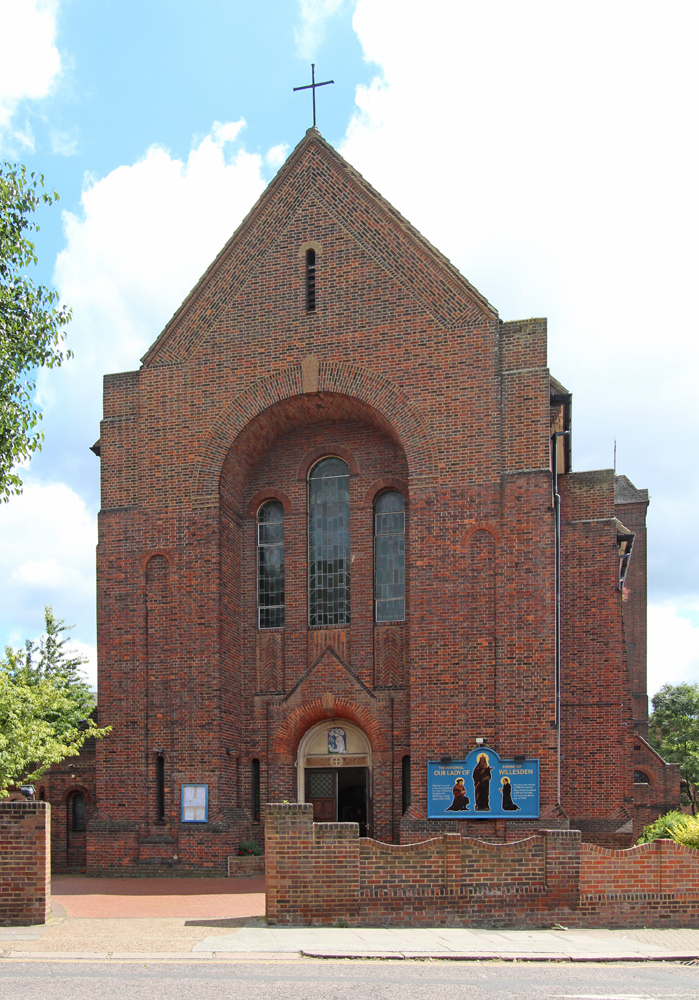
The sanctuary where the image is venerated is found in the Catholic parish known as “Our Lady of Willesden”, in the northwest of London. It is an ancient parish with over a thousand years of Christian history in place, today Catholic temple and focus of Marian pilgrimage. The sources consulted do not indicate that the temple has the title of minor basilicanor is it a national sanctuary of England; it is a Marian sanctuary de ámbito mainly diocesan, very significant for the Catholics of London and for the memory of the ancient English Marian shrines. An official title of "national sanctuary" or similar granted by the Episcopal Conference is not included in the accessible documentation.
Sponsorship and coronation
The available sources point to Our Lady of Willesden as a sanctuary of strong local arraigo in the north-west of London, historically linked to the Marian piety of the city and, in a special way, to the figure of St. Thomas Moro and the recovery of Catholicism in England. However, no explicit mention has been found that Our Lady of Willesden has been proclaimed official employer of the city of London, the district of Willesden or some particular English diocese; therefore, in terms of specific legal and canonical patronage, no consta.
In relation to a possible canonical coronation of the image, the sources consulted (Catholic press articles and historical references) do not record any coronation decree granted by the Holy See or official ceremony recognized as such. Accordingly, and following the criteria of historical rigour requested, it should be indicated: does not contain a documented canonical coronation.
Party and devotion
The documentation consulted underlines the nature of the place of pilgrimage of Our Lady of Willesden, both in the Middle Ages and today. In medieval times, many faithful went to the sanctuary, including St. Thomas Moro, who was on foot from Chelsea. In contemporary times, the restoration of the sanctuary has revived the pilgrimages, especially of London Catholics and Marian groups who wish to link with the English Marian tradition prior to the Reformation.
On a litigation fiesta propiathe sources consulted do not indicate a specific and universally recognized date for the advocation of Our Lady of Willesden in the general calendar; therefore, no constawith available information, an officially established main holiday date for the whole Church. There may be local celebrations (for example, parish parties or annual pilgrimages on specific dates), but these are not clearly documented in accessible sources, and therefore a specific date cannot be affirmed without conjectures.
The current devotion is characterized by the prayer to the Black Virgin of Willesdenorganized pilgrimages, the celebration of the Eucharist and sacramental reconciliation, in continuity with the ancient Marian English piety. The sanctuary is presented as a place of reconciliation, conversion and strengthening of faithespecially significant in a country where the ancient Marian shrines were mostly destroyed in the 16th century. There are no official figures of inflow in the sources consulted.
Link to the Rosary
The specific sources on Our Lady of Willesden do not explicitly mention a particular historical relationship with the prayer of the Rosary (for example, apparitions, promises or co-fradies of the Rosary directly linked to this advocation). In that regard, it should be clearly stated that no consta an own and documented link between the foundation of the Willesden shrine and a unique rosarian practice.
However, as in most of the contemporary Marian shrines, the Rosary It is part of the ordinary life of prayer of the faithful: it prays before the image of the Virgin, accompanies the pilgrimages and serves as a school of contemplation of the mysteries of the life of Christ in the hand of Mary. The tradition of Our Lady of Willesden, marked by the fidelity of English Catholics in times of persecution and reconstruction, is naturally harmonized with the Rosary: by meditating on the joyful, painful, glorious and luminous mysteries, the pilgrim contemplates the history of salvation that Mary kept in her heart, and includes in that prayer the memory of so many Christians who, like St. Thomas Moro and other saints, came entrusted to the intercession of the Virgin of Willesden.
A flower for the Virgin
It offers a simple prayer to this advocation. Pray a Hail Mary for the United Kingdom and for the peace of the world.
Pray Hail MaryDocumented expansion: contemporary restoration
The Catholic parish of Willesden retains an explanation of the modern recovery of the sanctuary. In 1885 a Catholic mission was established in Harlesden to attend to the growing Irish population; devotion to Our Lady of Willesden was reformed and a new statue was blessed by Cardinal Vaughan in 1892.
The same source documents the annual procession of the Black Madonna on 12 May 2002, the creation of the Guild of Our Lady of Willesden and its inaugural mass on 8 December 2002. He also records the coronation of the statue by Cardinal Griffin during the Mariano Year of 1954 in Wembley. These are data from the devotional history of the sanctuary; they do not in themselves amount to a supernatural approval of apparitions.
Source added: Catholic Parish of Willesden, history of Our Lady of Willesden.
Is the advocation of the Virgin Mary of your people missing?
Si no encuentras la advocación mariana de tu ciudad o pueblo, cuéntanosla: la investigaremos para ubicarla y darla a conocer en este mapa del amor de la Madre por el mundo.
Propose an apvocation →