Marian devotion
Our Lady of Wilten
Marian devotion of Innsbruck (Tyrol)
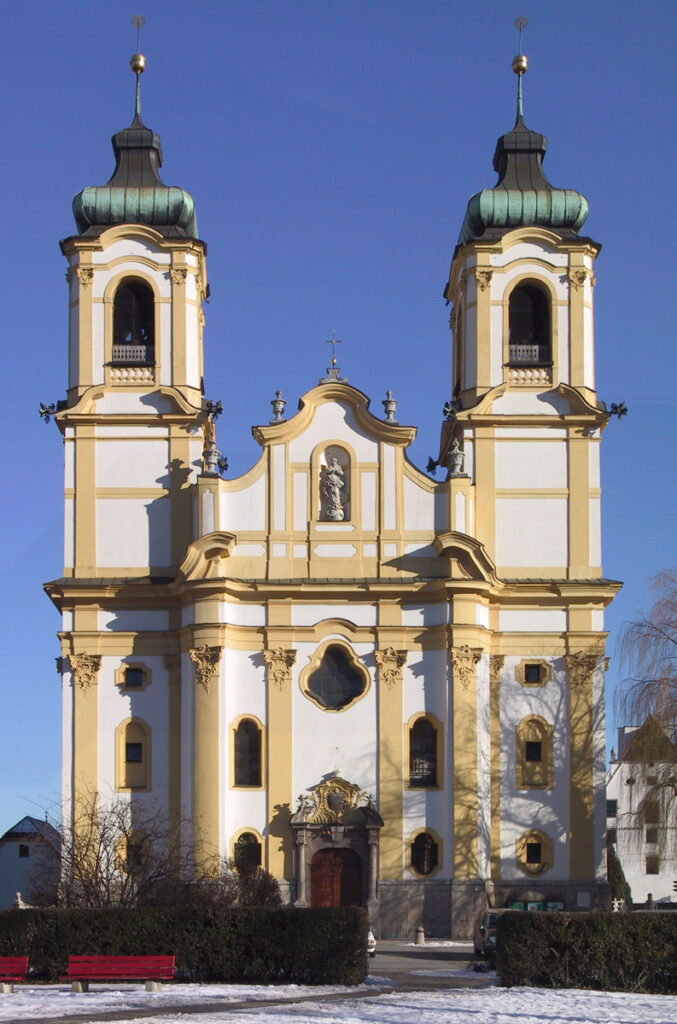
In the Wilten district, south of the historic centre of Innsbruck (Tirol, Austria), there has been a religious enclave of great continuity since medieval times, where today the Basílica de Wilten (Basilika Wilten), one of the most important Baroque-rococo temples of Tyrol. This present church dates from the 18th century (rococo style), built on previous buildings linked to the pre-modern presence of canons and, later, the Order of the Premonstratenses (Norbertines); however, the historical documentation accessible online is very limited and does not allow to reconstruct in detail the earlier phases of the Marian sanctuary.
Main data
Origin and history
In the Wilten district, south of the historic centre of Innsbruck (Tirol, Austria), there has been a religious enclave of great continuity since medieval times, where today the Basílica de Wilten (Basilika Wilten), one of the most important Baroque-rococo temples of Tyrol. This present church dates from the 18th century (rococo style), built on previous buildings linked to the pre-modern presence of canons and, later, the Order of the Premonstratenses (Norbertines); however, the historical documentation accessible online is very limited and does not allow to reconstruct in detail the earlier phases of the Marian sanctuary.
The invocation "Our Lady under the Four Pillars" ("Our Lady under the four columns") refers to an ancient Marian image located under a baldaquine or structure sustained by four columns, which would have enjoyed continued veneration in Wilten. However, there is no precise chronology or easily verifiable primary documents on its establishment, development of the official worship or recognition as a differentiated advocation in the sources consulted; it must therefore be strictly stated that is not documented in the accessible sources the detailed history of the advocation under this specific title.
In the plan of the local tradition, some tourist and devotional descriptions point out that in Wilten a very dear Marian image, linked to the life of the monastery and the city, has been venerated since ancient times in an enclave that would have maintained its religious character for centuries. However, these references are often generic (they speak of "old place of Marian devotion" or "long religious tradition") and do not clearly distinguish between legend, monastic chronicle and archival data, so it is impossible to safely separate tradition / legend from documented history in specific relation to the title "Our Lady of Wilten."
The image and the sanctuary
The open sources of a tourist and general nature describe the Basílica de Wilten like a church of style rococo, considered by many as "the most beautiful church in the country." The interior has a rich decoration of stucco, fresh and altarpiece, with an outstanding Marian iconographic program, although the concrete iconographic details of the image of "Our Lady under the four columns" are not described in the sources consulted. Therefore, no consta in a verifiable manner the exact type of the image (if it is wood size, sculpture of other material or painting), its date, its specific iconography (position, attributes, etc.).
The temple is officially called Basilika Wilten (Basílica de Wilten). It is attached to the Latin Catholic cult and is known, in addition to its rococo architecture, for being the seat of the "Wilten's singing children."A famous children's choir. Various sources in German and in tourist guides agree to describe it as basilica, which implies the granting of the minor basilica by the Holy See, although the exact date of the decree of elevation to basilica and the corresponding pontificate have not been located in the documentation consulted, it can only be stated with certainty that is a Catholic basilica recognized ecclesiasticallywithout more chronological accuracy.
With regard to the status of sanctuary (national, diocesan, etc.), the sources consulted mention it as iglesia/basílica de Wilten, of spiritual and tourist relevance, but no consta have an explicit recognition, in documents accessible, as "national sanctuary" or "diocesan sanctuary" in the technical legal sense. The place, however, works de facto as local and regional Marian devotion center.
Sponsorship and coronation
No official reference to a canonical patronage specific to "Our Lady of Wilten" on the city of Innsbruck, the municipality of Wilten, the diocese or Tyrol as a whole. It should therefore be indicated that no consta a patronage formally defined in the accessible documentation. There may be a devotion of patronage of a popular or local nature (for example, for the neighborhood or the monastic community), but it is not recorded in verifiable sources.
On the canonical coronation of the image under the title "Our Lady of Wilten" or "Unbe Liebe Frau unter den vier Säulen," does not contain a documented canonical coronation in available sources. No reliable data have been found on the Pontifical Decree, year, or delegated authority for eventual coronation.
Party and devotion
The documentation consulted on the Wilten Basilica does not indicate a own party date specific for the title "Our Lady of Wilten" or "Our Lady under the four columns." It is reasonable to assume that the parish and community celebrate the great Marian solemnities of the Roman calendar (Immaculate Conception, Asunción, Nativity of Mary, etc.), and possibly a local day in honor of the headline, but no consta the precise date of a particular party linked to this title.
The nature of place of pilgrimage and visit within Innsbruck, both for its artistic and religious value. The basilica receives numerous visitors, including pilgrims, although the tourist sources do not distinguish between cultural tourism and strictly devotional pilgrimage. No statistics of influx or detailed descriptions of specific traditions (specific Marian processions, votes, novies, etc.) have been found, so any attempt to describe specific popular customs would lack a documentary basis and should be avoided.
In short: it is a significant Marian center in the Tyrolean contextwith a living cult and a coral presence (the children of Wilten) that strengthens the liturgical and community dimension of the place. However, detailed information on specific devotional practices linked to the title "Our Lady of Wilten" is not recorded in the sources consulted.
Link to the Rosary
In any of the accessible sources on the Basílica de Wilten or on the title "Unbe Liebe Frau unter den vier Säulen" is expressly mentioned a particular association with the prayer of the Rosary (for example, the Rosary fellowship erected in the basilica, rosarian pilgrimages or official titles linked to this practice). It must therefore be strictly stated that does not contain a specific documented relationship between this advocation and the Rosary.
From a general Marian perspective, the Rosary It usually accompanies the life of Marian shrines, even when there is no concrete canonical or historical connection. Where the Virgin is honored, the Rosary spontaneously becomes a reference prayer: meditates on the mysteries of Christ in the company of Mary, easily adapts to community or individual prayer and integrates into novies, vigil and pilgrimages. In a sanctuary like Wilten, with a long Marian tradition and a strong liturgical life, it is reasonable to think that the Rosary is a regular part of the piety of faithful, groups and pilgrims, although no specific documentary record about the Rosarian practices of this advocation.
A flower for the Virgin
Offer a simple prayer to this Marian devotion. Pray a Hail Mary for Austria and for world peace.
Pray Hail MaryIs the advocation of the Virgin Mary of your people missing?
Si no encuentras la advocación mariana de tu ciudad o pueblo, cuéntanosla: la investigaremos para ubicarla y darla a conocer en este mapa del amor de la Madre por el mundo.
Propose an apvocation →