
Marian devotion
Nuestra Señora de Žemaičių Kalvarija
Advocate Maria de Žemaičių Kalvarija (Samogitia)
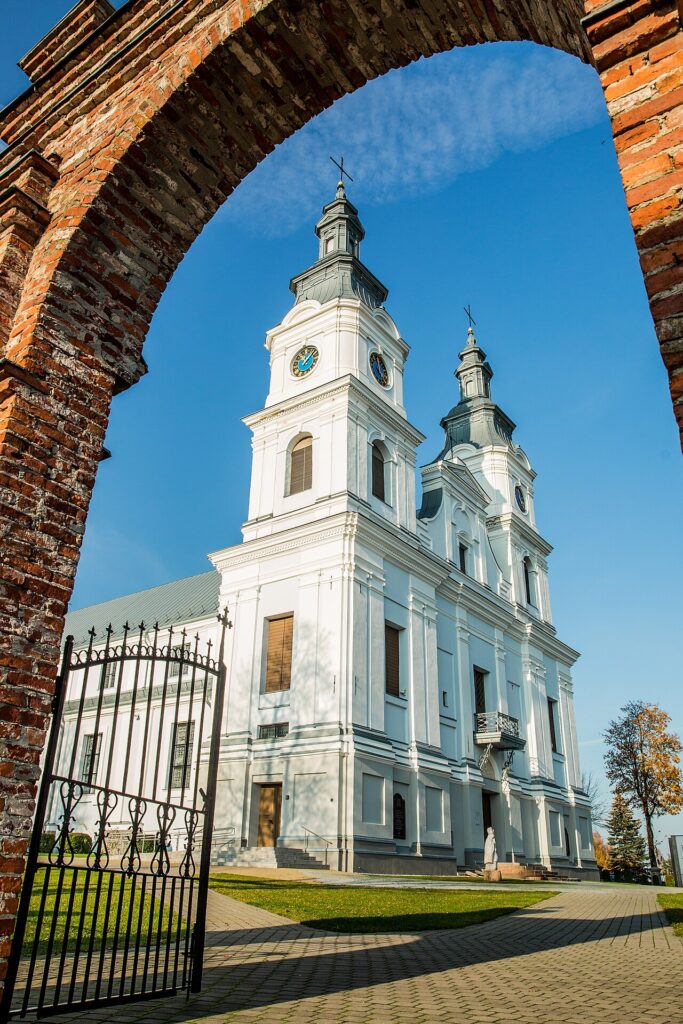
La advocación de Nuestra Señora de Žemaičių Kalvarija is attached to the large complex of calvary raised in Žemaičių Kalvarijain Samogitia, Lithuania, where Marian piety is integrated into a journey of the Passion of Christ on the hills of the place. Local tradition links this devotion to an extraordinary origin of the sanctuary and to the sacraalization of the landscape through prayer stations; however, the reference materials provided do not contain a sufficiently detailed and verifiable historical narrative of the exact beginnings of the image or of the complex.
Main data
Origin and history
La advocación de Nuestra Señora de Žemaičių Kalvarija is attached to the large complex of calvary raised in Žemaičių Kalvarijain Samogitia, Lithuania, where Marian piety is integrated into a journey of the Passion of Christ on the hills of the place. Local tradition links this devotion to an extraordinary origin of the sanctuary and to the sacraalization of the landscape through prayer stations; however, the reference materials provided do not contain a sufficiently detailed and verifiable historical narrative of the exact beginnings of the image or of the complex.
What does appear clearly in the general documentation on Marian sanctuaries is that these claims often arise around places of worship and pilgrimage, and Žemaičių Kalvarija belongs to that type of sanctuaries of strong regional identity. For a rigorous sheet, precise chronological details on the foundation, image transfer or possible miraculous facts should be given as no consta if a specific source of the sanctuary or diocese is not available.
The image and the sanctuary
Devotion focuses on a magen mataras venerada en la Basilica of the Visitation of the Virgin Mary of Žemaičių Kalvarija, in Lithuania. With the available results, the exact type of image - if it is paint, size or other support, or its detailed material or iconography, and that data should therefore be indicated as no consta.
The main temple where it is venerated is the Basilica of the Visitation of the Virgin Mary of Žemaičių Kalvarija, located within a large set of calvary with Passion stations distributed by the surrounding hills. In the sources provided it is not known whether the sanctuary also has an official qualification of National sanctuary o diocesanTherefore, it is safe to mention only the basilica and the calvary set.
Sponsorship and coronation
A Official patronage widely documented for city, municipality, diocese or nation in the sources provided. In a strict sheet it is appropriate to avoid unverified powers and to leave this paragraph as no consta.
It also does not include a documented canonical coronation; it must therefore be written: does not contain a documented canonical coronation.
Party and devotion
The great devotional date is the Relays July, the traditional mass pilgrimages of Žemaičių Kalvarija, which are the most famous moment of the sanctuary. These celebrations combine the pilgrimage, the prayer before the Marian image and the penitential journey through the calvary stations, in a very deep-rooted expression of Lithuanian popular religiosity.
Another distinctive tradition is the singing of the Montes of Samogitia, linked to the spirituality of the place and the community experience of the pilgrimage. The materials provided do not contain a fecha litúrgica principal specific for the advocation other than the holidays and pilgrimages of July; therefore, the wise is to point out as the main devotional date the Atlaidai, July.
Link to the Rosary
A specific historical relationship of this advocation with a the Rosary or with a title of Our Lady of the Rosary. Even so, the spirituality of the sanctuary is well understood within the Marian logic of the Rosary: to contemplate Mary in union with Christ, to travel the mysteries of salvation and to pray with the pilgrim people in a framework of meditation and penance.
In a sheet for a site of devotion to the Rosary, it can be added in a sober way that the Rosary naturally accompanies this advocation because it helps to contemplate, with Mary, the mysteries of Christ's life, passion and glory, just as the calvary of Žemaičių Kalvarija leads orationally through Passion towards Paschal hope.
A flower for the Virgin
It offers a simple prayer to this advocation. Pray a Hail Mary for Lithuania and for the peace of the world.
Pray Hail MaryDocumentary update
The history of Žemaičių Kalvarija is linked to the arrival of the Dominicans to Gardai in 1637. Bishop Samogitio Jurgis Tiškevičius entrusted land to them and promoted the establishment of the Calvary hills; in 1639 small chapels were built and a 20-station itinerary was set, a form of piety that gave the place the name of Calcania Samogitia. The Marian pilgrimage and meditation of the Passion were thus united in the same sanctuary.
The official source also describes a painting of the Visitation of the Virgin Mary, carried from Rome by the Dominican Petras Pugačevskis and placed on the side altar. From 1643 it was considered miraculous and the favors were collected in a book; this expression belongs to the history of the veneration transmitted by the sanctuary and does not become here, without a concrete record, an additional statement on supernatural miracles. The celebration of the Visitation begins on July 2 and can be extended for ten days, joining the celebrations of Calvary.
The Dominicans managed the place until his expulsion by the Tsarist authorities in 1889; between 1927 and 1948 the Marian took care of it. John Paul II granted the title of basilica to the Church of the Visitation in 1988. Benedict XVI blessed the crowns of the painting on June 23, 2006 and the solemn coronation of October 8 of that year introduced her as Queen of Christian Families. These are documented milestones of veneration and institutional history, not an apparition.
Sources of this update: Žemaičių Kalvarija, historia ofical del santuario; OpenStreetMap, Basílica de Žemaičių Kalvarija.
Is the advocation of the Virgin Mary of your people missing?
Si no encuentras la advocación mariana de tu ciudad o pueblo, cuéntanosla: la investigaremos para ubicarla y darla a conocer en este mapa del amor de la Madre por el mundo.
Propose an apvocation →