
Marian devotion
Our Lady of the Abeto
Patrona de Triberg
According to local tradition, the origin of Our Lady of the Abeto (Mary in der Tanne) It dates back to the mid-17th century, linked to several cures considered miraculous in Triberg, in the Black Forest (Baden-Württemberg). A girl would have recovered her view after washing her eyes with the water of a nearby spring, associating that healing with the intercession of the Virgin Mary. Another element of the same tradition states that a tailor, cured of leprosy, placed a small figure of the Virgin in the cavity of a fir in a sign of thanks, and from there would come the title "Mary in the fir." These narrations are preserved as Foundational legends of the sanctuary, very rooted in popular piety, but are not demonstrable in all its details from the historical point of view.
Main data
Origin and history
According to local tradition, the origin of Our Lady of the Abeto (Mary in der Tanne) It dates back to the mid-17th century, linked to several cures considered miraculous in Triberg, in the Black Forest (Baden-Württemberg). A girl would have recovered her view after washing her eyes with the water of a nearby spring, associating that healing with the intercession of the Virgin Mary. Another element of the same tradition states that a tailor, cured of leprosy, placed a small figure of the Virgin in the cavity of a fir in a sign of thanks, and from there would come the title "Mary in the fir." These narrations are preserved as Foundational legends of the sanctuary, very rooted in popular piety, but are not demonstrable in all its details from the historical point of view.
As for the documented historyit is noted that the place became a pilgrimage center around 1644, from which date there are recorded visits of faithful who come looking for the intercession of the Virgin, especially for problems of sight. The primitive devotion around a Marian image linked to a fir and a spring gave rise to the construction of a pilgrimage church, which over time became one of the Marian shrines of the Black Forest region. The sources available online agree to point out this general chronology, although the concrete data prior to the 18th century are scarce and fragmented; several aspects of this early origin therefore remain as Dates to be reinvestigated with file documentation.
The image and the sanctuary
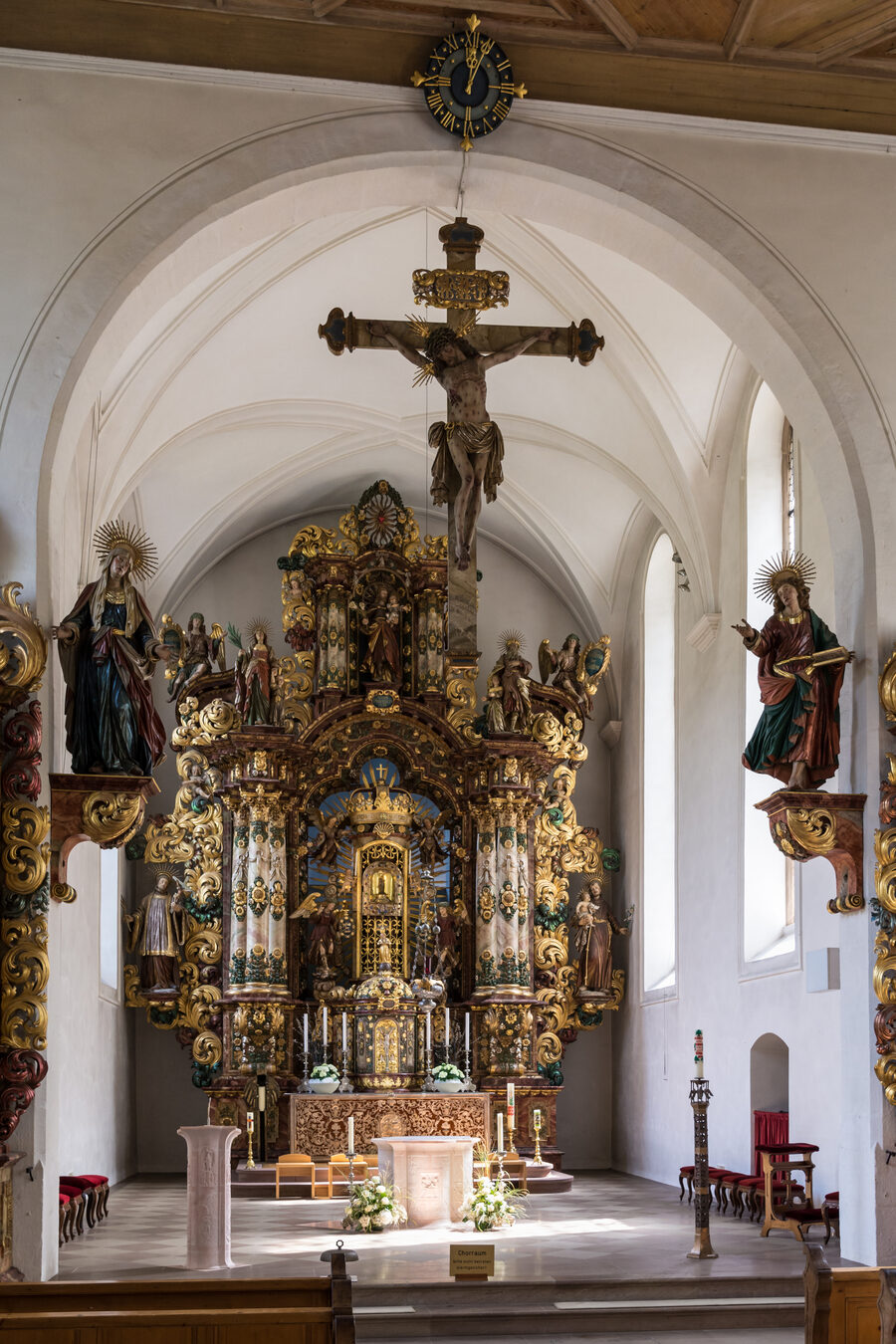
The advocation is venerated in the "Mary in der Tanne" pilgrimage church (Mary in the fir), Catholic temple located on the outskirts of Triberg im Schwarzwald. The building is from Baroque stylewith interior decoration that includes frescoes and sculptures, in the line of the Baroque ornament of southern Germany. It is described as a relatively small church, typical of a regional pilgrimage sanctuary, not as a major basilica or national sanctuary. It does not know that it has the official title of a minor basilica or that it is recognized as a national sanctuary; it is a church of pilgrimage of local and diocesan importance.
The sources consulted mention that the name of the sanctuary comes from a figure of the Virgin placed in the cavity of a fir, but do not provide a detailed and verifiable description of the original image (exact type of size, material, dimensions or precise iconography). It is known that this is a Marian image venerated as a sign of Mary's presence next to the spring of healing, but the technical data (specific wood, sculptural style, author, exact time of size) no constan clearly in accessible sources. A detailed description of the current altarpiece or shrimp where the image is exposed, beyond the generic reference to the baroque ornamentation of the temple's interior, is also missing in the general online documentation.
Sponsorship and coronation
La advocación de Our Lady of the Abeto (Mary in der Tanne) is presented as patron of the faithful who come to the sanctuary, with a special devotion for those who suffer eye conditions, due to the traditional account of eye healing in the nearby spring. Outside this area, no official documentation has been found to present it as a patron of the city of Triberg, a complete diocese or a wider region; therefore, at the level of patronazgo civil or eclesial formal beyond the place of pilgrimage itself, no consta a specific recognition.
As regards a possible canonical coronation, the sources consulted (of historical, tourist and devotional dissemination online) do not mention any decree of the Holy See or crown coronation ceremony granted by the chapter of St. Peter or other competent authority. As a result, and until an ecclesiastical document is located to prove it, it should be indicated that does not contain a documented canonical coronation for this image.
Party and devotion
The date of main party of Our Lady of the Abeto is not clearly fixed in the general sources consulted. The German Marian shrines often celebrate their main parties in some Marian solemnity of the calendar (for example, the Assumption, the Nativity of Mary or some local party), but, in this particular case, for "Maria in der Tanne" no constaon a safe basis, a liturgical date of its own officially attested in the sources available online.
In contrast, the continuity of the pilgrimagesThe church continues to receive visitors and pilgrims, and annual religious ceremonies and community meetings are held in the church that keep alive the tradition of Marian devotion in the Black Forest. The temple remains open to visitors every day, and is accessed by signposted roads across the forest, which reinforces its character as a sanctuary in nature. There are no official figures of influx in the sources consulted, but this is a rather regional pilgrimage place, in contrast to large German shrines such as Altötting or Kevelaer, who receive hundreds of thousands of pilgrims a year.
Link to the Rosary
No explicit reference has been found in the available sources to link in particular the advocation of Our Lady of the Abeto with a Rosary fellowship, specific indulgences for the Rosary prayer in this sanctuary or a documented tradition of own rosarian processions. So, as for a concrete historical or institutional link with the Rosary, no consta.
However, as in most Marian shrines, the prayer of Holy Rosary is naturally integrated into the devotional life of the place. The figure of Mary, remembered as a near Mother who intercede in the specific needs (in this case, especially in the diseases of the eyes and in the physical and spiritual ailments), finds in the Rosary a simple and profound expression: the mysteries of the life of Christ contemplated "with the eyes of Mary" also, symbolically, illuminate the search for light for one's own look and for faith. In this sense, even without a particular rosarian tradition documented, the Rosary constitutes a privileged way to accompany the inner pilgrimage of those who come to Our Lady of the Abeto in Triberg.
A flower for the Virgin
It offers a simple prayer to this advocation. Pray a Hail Mary for Germany and for the peace of the world.
Pray Hail MaryIs the advocation of the Virgin Mary of your people missing?
Si no encuentras la advocación mariana de tu ciudad o pueblo, cuéntanosla: la investigaremos para ubicarla y darla a conocer en este mapa del amor de la Madre por el mundo.
Propose an apvocation →