Marian devotion
Virgen del Carmen de Paucartambo, "Mamacha Carmen," patron of Paucartambo
Marian Advocation of Paucartambo (Cusco)
For the Virgen del Carmen de Paucartambo, "Mamacha Carmen"the historically documented information refers almost always to the famous shrine of Paucartambo, in the department of Cusco (Peru)where this advocation is patron of the town and center of one of the most important Marian parties of the Andean south. It has not been found in ecclesial, academic or Catholic sources would be an equivalent advocation established in Paucartambo, department of Cusco, Colombia; it is not established that there is a municipality with that name and similar Marian characteristics in Colombia. There is, therefore, no verifiable data that will allow a specific, differentiated and documented history of a "Virgen del Carmen de Paucartambo" in Colombian territory.
Main data
Origin and history
For the Virgen del Carmen de Paucartambo, "Mamacha Carmen"the historically documented information refers almost always to the famous shrine of Paucartambo, in the department of Cusco (Peru)where this advocation is patron of the town and center of one of the most important Marian parties of the Andean south. It has not been found in ecclesial, academic or Catholic sources would be an equivalent advocation established in Paucartambo, department of Cusco, Colombia; it is not established that there is a municipality with that name and similar Marian characteristics in Colombia. There is, therefore, no verifiable data that will allow a specific, differentiated and documented history of a "Virgen del Carmen de Paucartambo" in Colombian territory.
According to the tradition and legend referring to the Peruvian Paucartambo, the devotion would have been born of the arrival of an image of the Virgin of Carmen brought by merchants (qollas) or by a Spanish handler, who would have given it to the indigenous and mestiza population of the place as a protector of the people. These oral narrations also explain the presence of the typical characters of the party (saqras, chunchos, qollas) as a symbolic expression of the encounter between the indigenous, Hispanic and Christian world. These elements fall within the scope of tradition, without precise documentary support of dates, names or parish acts that confirm the details.
As regards documented historythe sources agree that the Festival of Carmen in Pucartambo (Peru) is firmly rooted at least since the 19th century, and that the current festive calendar (15-18 July, with solemnity on the 16th) was consolidated over time as a synthesis of Catholic liturgy, popular devotion and traditional dances of the Quechua area of Cusco. In contrast, there is no documentation that would make it possible to strictly affirm the existence of an institutionalized replica of this cult in a Colombian "Paucartambo" with its own features and historical continuity.
The image and the sanctuary
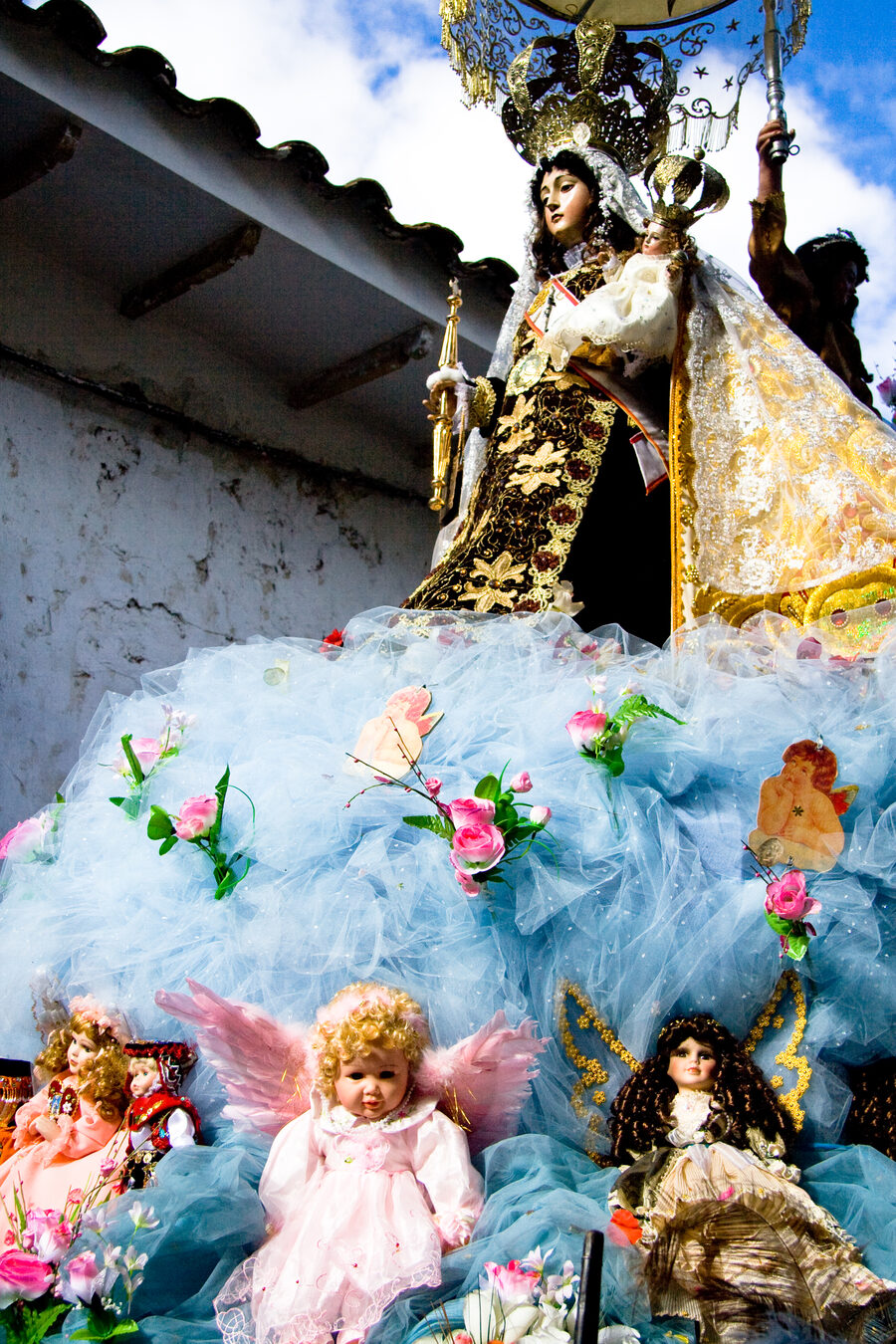
The available descriptions refer to the venerated image in Pauractambo (Cusco, Peru), traditionally known as "Mamacha Carmen". Se trata de una imagen de Virgin of Carmen with a mixed face, richly dressed, that carries the Child Jesus in arms, both crowned and covered with embroidery blankets and Carmelite scapular, according to the classical Carmelite iconography. The Child also appears with scapular, highlighting the dimension of protection and belonging to the Virgin of Carmen.
The main sanctuary described by the sources is the the temple of the Virgin of Carmen in the square of Paucartambo (Cusco, Peru)which acts as the axis of the religious and festive life of the people. From there comes the image in solemn processions through the streets, accompanied by numerous dance comparisons. It is not known that this temple has been declared a minor basilica or national sanctuary; it is mainly recognized as local/diocesan shrine, very significant within the South andine region, but no official mention of a higher canon range has been found.
Concerning "Sanctuary of the Virgin of Carmen de Paucartambo" in Paucartambo, department of Cusco, Colombia, the existence of a temple with its own name and characteristics is not recorded in official sources (dioceses, episcopal conferences, records of Marian sanctuaries or databases on advocacy). In the absence of verifiable data, it is not possible to describe with rigour a specific Marian image or sanctuary in this Colombian location.
Sponsorship and coronation
In the documentation available, the Virgin of the Carmen de Paucartambo appears clearly as Patron of the village of Paucartambo, in the department of Cusco, Peruwhere his feast summons thousands of faithful and organizes the religious and cultural life of the town. There is, however, no canonical patronage of this same title on a city or diocese in Colombia under the title "Paucartambo."
About a canonical coronation specific to the image of the Virgin of Carmen de Paucartambo (both in the Peruvian and, more rightly, in the hypothetical Colombian field mentioned), the sources consulted do not provide secure data of the Pontifical Decree, year or name of the Pontifical Delegate. Accordingly, following the above criteria:
There is no documented canonical coronation.
Party and devotion
La liturgical feast of Our Lady of Carmen in the universal Church the 16 July. In Paucartambo (Cusco, Peru), the popular celebration usually extends from 15-18 July, with the central day on the 16th, and has become one of the most emblematic religious and folklore festivities of the southern Andean, marked by the presence of numerous dancing comparisons (saqras, chunchos, qollas and others), which accompany the image in procession through the streets of the village.
There are no verifiable data on a organized holiday with the same characteristics and structure in a Colombian Pacartambo. If in any community or parish of Colombia an image was venerated under the advocation of the Virgin of Carmen de Paucartambo, it could be assumed - by devotional analogy, not by documented data - that the main celebration would join the Carmelite date of the 16 Julywith elements of popular piety: Solemn Mass, procession with the image, prayer of the Rosary and, in some cases, dances or local cultural expressions inspired by the Andean Peruvian model. However, these practices are not made up of specific sources, so it is not possible to describe them accurately.
In Colombia, the devotion to the Virgin of Carmen It is widespread, especially among carriers, armed forces and popular communities, but this dissemination refers to the advocation of Carmen in general, not to the specific variant of Paucartambo.
Link to the Rosary
The specific sources on the Virgin of the Carmen de Paucartambo They mainly stress the importance of evapulario carmelita as a sign of consecration to Mary and of union with the spirituality of Carmel. There is no document of a unique link between this specific advocation and a practice of the Rosary different from that of the Church.
In general, the Catholic tradition considers the Rosary as one of the most important Marian prayers and as a "compendium of the Gospel," closely linked to the contemplation of Christ with the eyes and heart of Mary. In the spirituality of Carmen, the scapular and the Rosary complement each other: the scapular expresses the belonging to the Virgin as Mother and Protector, while the Rosary helps to meditate on the mysteries of Christ's life with her, feeding faith, conversion and charity.
Applied to devotion to the Virgin of the Carmen de Paucartamboalthough it does not contain a rite of the Rosary, it is consistent with the Marian tradition of the Church that the faithful integrate into the prayer of the Rosary in the novies, vigil and processions, contemplating with Mary the mysteries of Christ and asking for his intercession for the families, the Andean peoples and, in a Colombian context, for peace and reconciliation.
A flower for the Virgin
Offer a simple prayer to this Marian devotion. Pray a Hail Mary for Peru and for all of America.
Pray Hail MaryIs the advocation of the Virgin Mary of your people missing?
Si no encuentras la advocación mariana de tu ciudad o pueblo, cuéntanosla: la investigaremos para ubicarla y darla a conocer en este mapa del amor de la Madre por el mundo.
Propose an apvocation →