Marian devotion
Our Lady of the Palladium of the Czech Land
Marian title of Stara Boleslav (Central Bohemia)
La devoción a Our Lady of the Palladium of the Czech Land (Palladium) is attached to the old city of Old Bloslavthe place of the martyrdom of St Venceslaus, the prince and martyr, the chief patron of Bohemia and of the Czech nation. According to the national tradition, relief mariano de metal was considered very early as a "palladium" or protective shield of the Czech people, especially in times of war and threat to the Catholic faith. The name "Palladio of the Czech Land" precisely highlights this almost "national" protection character linked to Mary under this image.
Main data
Origin and history
La devoción a Our Lady of the Palladium of the Czech Land (Palladium) is attached to the old city of Old Bloslavthe place of the martyrdom of St Venceslaus, the prince and martyr, the chief patron of Bohemia and of the Czech nation. According to the national tradition, relief mariano de metal was considered very early as a "palladium" or protective shield of the Czech people, especially in times of war and threat to the Catholic faith. The name "Palladio of the Czech Land" precisely highlights this almost "national" protection character linked to Mary under this image.
As for the documented history, it is known that the image was venerated for centuries in Stará Boleslav, in relation to the veneration of St Venceslao and his martyrdom, and that over time it became one of the main religious symbols of Bohemia, with a strong identity dimension for Czech Catholics. Given the disparity and fragmentation of the sources available in Spanish on this particular advocation, a detailed chronology (exact date of origin of the relief, donations, transfers, etc.) does not exist with certainty; tradition links it to the high Middle Ages and the ducal house of Bohemia, but these ends belong rather to the legendary sphere than to the positivist history. In Czech historiography, in any case, the role of this Palladium is recognized as object of ancient Marian veneration and religious symbol of the nation; the details of apparitions, wonders or exact circumstances of his arrival at Stará Boleslav move between devotion and legend, so they cannot be affirmed here in a strictly documented manner.
The image and the sanctuary
The image of Our Lady of the Palladium of the Czech Earth is a real mariano and metalin a small format, which presents the Virgin with the Child Jesus; it is therefore a imagen de tipo iconográfico mariano tradicionalnot a sculpture that is exempt. The specific alloy (gold, silver or other precious or overgold metal), or its exact dating, is not safely recorded, so these data should be listed as "not recorded" from the point of view of the accessible documentation. The relief is presented in an artistic and liturgical framework that emphasizes its character as a national relic and object of spiritual protection for the Czech land.
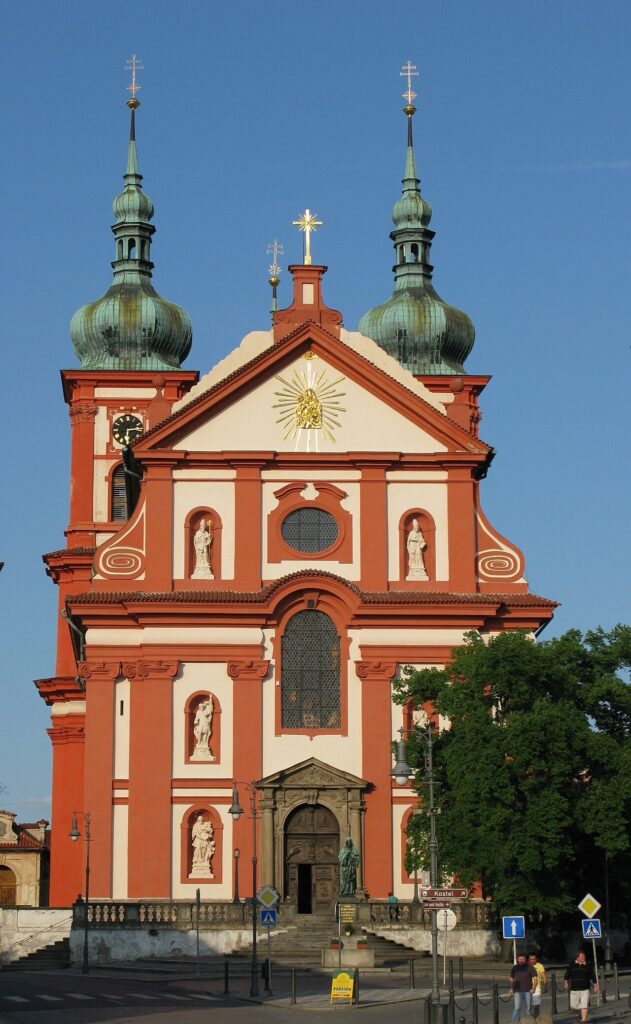
The sanctuary where it is venerated is the Basilica of the Assumption of the Virgin Mary en Old Bloslavin the region of Bohemia Central, en la actual Cheque. This church, directly linked to the place of the martyrdom of St Venceslao, is recognized as minor basilica (the date of concession is not here) and is one of the country's main Marian and pilgrimage centres. It is not found in the consulted sources that the basilica is officially erected as a "Marian national sanctuary" by decree of the Episcopal Conference, although in practice it plays a role as a national sanctuary because of the importance of Saint Venceslao and the Palladium for the Czech Catholic identity.
Sponsorship and coronation
Our Lady of the Palladium of the Czech Earth is traditionally invoked as of the Czech nation, with a marked character of National patronage linked to the history of Bohemia and the figure of St Venceslao. However, the title of the nation's principal patron falls canonically to St Venceslao; the Virgin, under this Palladium, is venerated as spiritual shield and protection of the countryespecially in times of invasions, conflicts and persecution.
As for the canonical coronationin accessible sources there is no certain date, decree or explicit mention of formal canonical coronation of the image by the mandate of a Pope or his delegate. Since the rule here is documentary prudence, it should be indicated: does not contain a documented canonical coronation. If there is a local historical coronation or an act of liturgical coronation not collected from the sources consulted, it cannot be affirmed without the risk of inaccuracy.
Party and devotion
The devotion to the Palladium of the Czech Earth is part of the Feasts of Saint Venceslao and the Assumption of the Virgin, very celebrated in Stará Boleslav. It does not contain, in an unmistakably documented way, a universal liturgical date for "Our Lady of the Palladium of the Czech Land" in the general Roman calendar; the celebration is integrated into the local and national calendar, especially around the annual pilgrimages to Stará Boleslav, in which the faithful of various Czech dioceses participate.
This is a devotion of pilgrimage: the faithful come to the Basilica to pray before the Palladium, ask for protection for the homeland, strength in faith and help in difficulties. The sources consulted do not contain precise figures of annual inflow, although it is known that the great national celebrations attract many pilgrims, civil and ecclesiastical authorities, and that the place has been a reference point at significant times in modern Czech history (in particular after periods of political or religious oppression). The usual devotional practices include participation in the Eucharist, processions with the image in certain solemnities, and silent prayer before the Marian relief.
Link to the Rosary
No consta una specific and documented relationship between the advocation of Our Lady of the Palladium of the Czech Land and and practices directly linked to the prayer of the Rosary, as in other Marian shrines. In the information available on this Palladium the issues of protection of the homeland, historical memory and connection with San Venceslao predominate, rather than a particular tradition of Rosario associated with this image.
However, as in every Marian sanctuary, the Rosary It occupies a natural place in the spiritual life of pilgrims. The meditation of the mysteries of Christ's life together with Mary offers a privileged framework for contemplating the history of salvation also in the concrete history of a people. In the context of the Palladium of the Czech Land, the Rosary can be lived as a prayer of intercession for the nation, for fidelity to the Catholic faith and for peace, putting under the cloak of Mary - represented in this ancient relief - the joys, sufferings and hopes of the Czech people.
A flower for the Virgin
Offer a simple prayer to this Marian devotion. Pray a Hail Mary for the Czech Republic and for world peace.
Pray Hail MaryDocumentary update: Palladium and the pilgrimage
La history published by the shrine of Stara Boleslav It states that the relief was proclaimed Palladium of the Czech lands on August 18, 1609. The construction of the temple of the Assumption began in 1617 and was completed in 1623; the sanctuary itself also documents the theft of the relief during the Thirty Years' War, its rescue and its solemn returns from 1638 and 1646. These data belong to the documented history of the place.
The same source recalls the Via Maria, a pilgrimage road with forty-four chapels raised between 1674 and 1680. The Marian complex also shares space and history with the cult of San Venceslao, linked to Czech national tradition. The legends about the ancient origin of the relief and the stories of favors received are presented as tradition or devotion; they do not in themselves amount to a pronunciation on every extraordinary fact.
Is the advocation of the Virgin Mary of your people missing?
Si no encuentras la advocación mariana de tu ciudad o pueblo, cuéntanosla: la investigaremos para ubicarla y darla a conocer en este mapa del amor de la Madre por el mundo.
Propose an apvocation →