Marian devotion
Our Lady of the Pilar of Cobija, patron of the department of Pando
Marian Advocation of Cobija (Pando)
La devoción a Our Lady of the Pilar in Cobija (Pando, Bolivia) is linked from the beginning to the history of the city and to the memory of the Battle of Bahia (October 11, 1902), decisive in the Acre War and in the conservation of this territory for Bolivia. The population of Cobija was developed from the ancient "Port Bahia," and the Catholic community was consolidating its life of faith around a temple dedicated to the Virgin of Pilar. According to local chronicles, diocesan priests chose this advocation as patron of the new parish, seeing in Mary del Pilar a sign of protection over a people marked by the border conflict.
Main data
Origin and history
La devoción a Our Lady of the Pilar in Cobija (Pando, Bolivia) is linked from the beginning to the history of the city and to the memory of the Battle of Bahia (October 11, 1902), decisive in the Acre War and in the conservation of this territory for Bolivia. The population of Cobija was developed from the ancient "Port Bahia," and the Catholic community was consolidating its life of faith around a temple dedicated to the Virgin of Pilar. According to local chronicles, diocesan priests chose this advocation as patron of the new parish, seeing in Mary del Pilar a sign of protection over a people marked by the border conflict.
From the perspective of documented history, la actual Church Cathedral / Parish Our Lady of the Pilar was inaugurated in Cobija the 12 October 1930, in particular, coinciding with the liturgical feast of the Virgin of the Pilar. The date was also chosen to extend the civil commemoration of the Battle of Bahia (11 October), so that the historical memory of the people would be linked to the Marian memory. The temple belongs to the Apostolic Vicariate of Pando, based in Riberalta.
As regards tradition or symbolic readingthe local accounts present the choice of the Virgin of Pilar as patron of Cobija and of the Pandina region as a response of gratitude for the preservation of the national territory and as a sign of the presence of Mary in the midst of the Bolivian Amazon. In the sources consulted, there are no apparitions, specific foundational miracles or ancient legends of this advocation in Cobija; devotion is rather rooted in the local reception of the traditional advocation of the Pilar, linked to the pillar as a sign of the firmness of the faith and of the maternal protection of the Virgin.
> Note: Although the user mentions "Colombia," the historical and ecclesial sources point out unanimously that Cobija is the capital of the Department of Pando, Bolivia, no en Colombia.
The image and the sanctuary
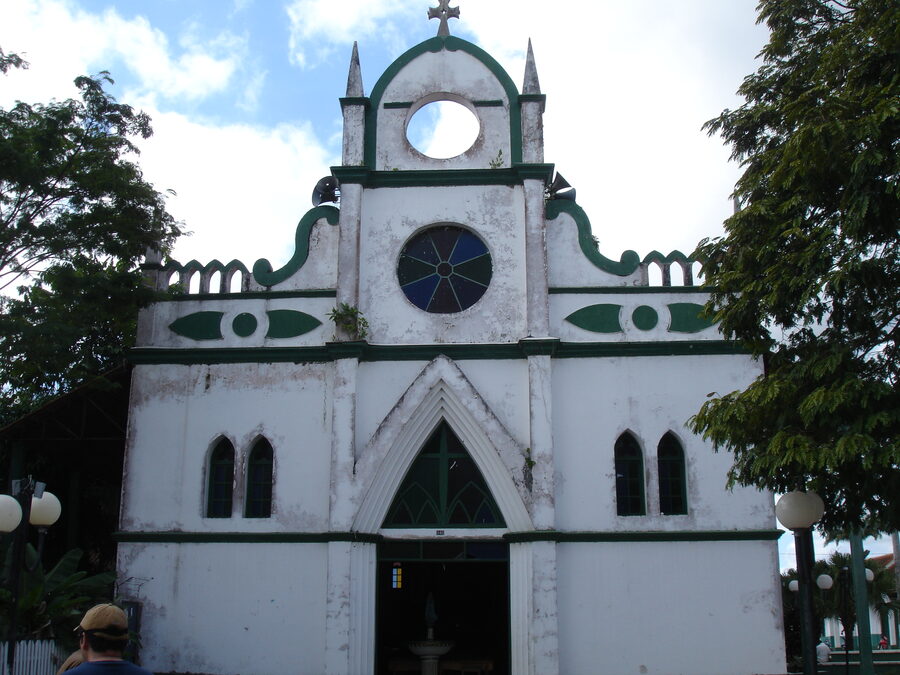
The temple's headline is the Church (Cathedral / Parish) Our Lady of the Pilar, located in the main square of Cobija, General Plaza Germán Busch. It is an emblematic Marian temple in the Bolivian Amazon, described as a "treasure in the Pandina Amazon." The church, completed and opened in 1930, presents a style eclecticowhich combines traditional elements with architectural solutions adapted to the climate and local reality. It is not known that the temple has been elevated to the dignity of minor basilica officially designated as National sanctuary; in the fountains it is called the Marian parish and cathedral, within the Apostolic Vicariate of Pando.
In the interior there are several works of religious art, including a imposing Christ Crucified of the cobijean artist Eloy Añez Marañón, as well as paintings and murals of biblical and Marian theme, also made by this author. These works help to underline the catechetical and devotional character of the temple, which is an obligation reference for the liturgical and pastoral life of the city.
On the concrete image of Our Lady of the Pilar venerated in Cobija, the accessible sources mention the advocation and Marian character of the temple, but do not provide a detailed description of the type of image (size, painting, material or specific iconography). It does not, therefore, consist of a sculpture of a round lump on a column, a dress image or a main picture; the only thing clearly attested is that the parish and its main altar are dedicated to Our Lady of the Pilar and that Marian iconography presides over the life of the temple.
Sponsorship and coronation
Our Lady of the Pilar of Cobija is patron of the city of Cobija y reference pattern of the Pando Departmentwhere his temple has become an emblematic religious sign of the Bolivian Amazon region. The election of the Virgin of the Pilar as the patron was promoted by the diocesan priests responsible for the nascent community, who proposed it as "the patron who is indicated to govern the faith of a people" marked by the memory of the Battle of Bahia.
As for a possible canonical coronation of the image of Our Lady of the Pilar of Cobija, does not contain a documented canonical coronation in the sources consulted (neither in Vicariate documents, nor in local chronicles, nor in the Catholic press available online). No explicit reference has been found to a diocesan coronation or to a special pontifical recognition of the image.
Party and devotion
La main party of Our Lady of the Pilar in Cobija is celebrated the October 12in line with the universal liturgical feast of the Virgin of Pilar. The celebration is also lived in continuity with the civic commemorations of October 11, which remember the Battle of Bahia; thus, the patronal feast takes on a religious and civic tone, linking gratitude to God and the Virgin with the historical memory of the region.
Around October 12, the parish organizes liturgical solemnities, processions and festive actswith the participation of civil and military authorities, as well as delegations from rural communities and urban neighbourhoods. The local and parish social networks show an intense community life and the frequent practice of novena, solemn masses and pastoral activities that are multiplied around the great parties, including the Pilar. There are no official statistical data of influx, but the church is presented as a spiritual reference point for the population of Cobija and for faithful from other parts of the department.
The devotion to Our Lady of the Pilar in Pando is characterized by a strong sense of maternal protection on the Bolivian Amazonby the link with the regional identity and by the trust in the Virgin as a support of the faith in a geographical context of border and great cultural diversity. Processions, Marian songs, floral offerings and the participation of families and young people are constant features of popular piety at the patronal parties, according to recent journalistic and audiovisual testimonies.
Link to the Rosary
The sources consulted do not explicitly mention unique practices of the Rosary own or exclusive of devotion to Our Lady of the Pilar in Cobija (for example, an official "great rosary" or a specific title linked to the Rosary). Therefore, does not contain a special documented tradition of the Rosary associated with this advocation, beyond the usual forms of Marian piety that accompany the parish life (novias, prayers, songs and, presumably, the prayer of the Rosary in groups and families).
From a general mariological perspective, the Rosary It naturally fits the spirituality of Our Lady of the Pilar. The symbol of pillar It refers to the firmness of the faith and the constant presence of Mary in the Church; the Rosary, with the meditation of the mysteries of Christ together with Mary, helps the faithful of Cobija and the whole Pandina Amazon to strengthen faith amid the social, economic and environmental difficulties of the region. In this advocation, the perseverant prayer of the Rosary can be understood as a concrete way of "relying" spiritually on the firm pillar that is the Virgin, to live rooted in Christ and committed to the life of the community and the defense of Amazonian creation.
A flower for the Virgin
Offer a simple prayer to this Marian devotion. Pray a Hail Mary for Bolivia and for all of America.
Pray Hail MaryIs the advocation of the Virgin Mary of your people missing?
Si no encuentras la advocación mariana de tu ciudad o pueblo, cuéntanosla: la investigaremos para ubicarla y darla a conocer en este mapa del amor de la Madre por el mundo.
Propose an apvocation →