Marian devotion
Our Lady of the Pueblus, patron of the state of Querétaro
Marian Advocation of Corregidora (Querétaro)
La advocación de Our Lady of the Pueblus It is closely linked to the Franciscan evangelization of the indigenous peoples of the region of Querétaro, especially of the Ottoman population, in the 17th century. The image is in the context of the Franciscan convent of Santiago de Querétaro and is soon taken to the village then called San Francisco Galileo, today Villa del Pueblito, in the current municipality of Corregidora (state of Querétaro, Mexico).
Main data
Origin and history
La advocación de Our Lady of the Pueblus It is closely linked to the Franciscan evangelization of the indigenous peoples of the region of Querétaro, especially of the Ottoman population, in the 17th century. The image is in the context of the Franciscan convent of Santiago de Querétaro and is soon taken to the village then called San Francisco Galileo, today Villa del Pueblito, in the current municipality of Corregidora (state of Querétaro, Mexico).
Documented history. According to the most accepted written tradition, collected by ecclesial sources and historical dissemination, the image would have been carved in 1631 por el franciscano Fra Sebastian Gallegos in the convent of San Francisco de Querétaro, representing the Virgin in the mystery of the Immaculate Conception. In 1714 The Franciscans build a first adobe chapel for the Virgin of the Pueblus in the place of the ancient pantheon of the people, thus consolidating their local cult. Throughout the 18th and 19th century, the civil and ecclesiastical documents that recognize it as a special protection in times of drought, tabs and public calamities are multiplied.
Tradition and legend. Around the origins of the cult are pious stories that highlight the closeness of the Virgin with the Ottomans, presenting her as a Mother who welcomes her dances, songs and customs, and as a sign of the identity of the "people" who adopt her as Patrona. These devotional elements express the indigenous reception of the image and its role as a cultural mediator, but cannot always be dated or verified accurately in historical documents.
> Important note: although the request refers to "Corregidora, department of Querétaro, Colombia," the available documentation clearly places this title in Villa del Pueblito, municipality of Corregidora, state of Querétaro, Mexico. There is no homonymous advocation with these characteristics in Colombia.
The image and the sanctuary
The image of Our Lady of the Pueblus is described by the sources as a representation of the Virgin Mary in her mystery of Immaculate Conception, small-format, 17th-century work linked to Franciscan spirituality. Tradition states that it was sculpted by Fra Sebastian Gallegos in 1631. Very specific technical details on the material (type of wood, polychrome, etc.) do not safely contain in the sources consulted; it is, in any case, a highly venerated process image, carefully preserved by the Franciscan community.
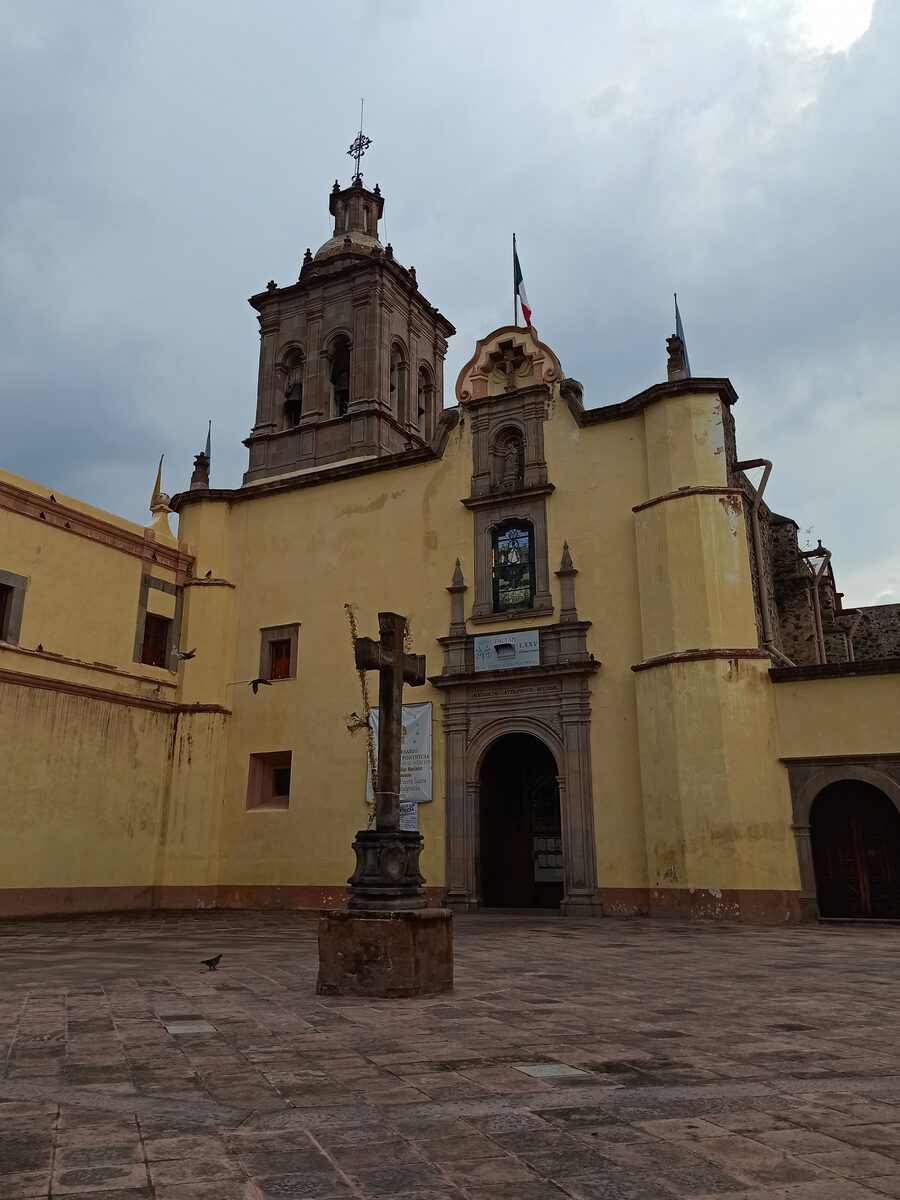
The main place of worship is the Basilica of Our Lady of the Pueblus, also known as Sanctuary of the Virgin of the Pueblus, located in the heart of El Pueblito (Villa del Pueblito), municipality of Corregidora, Querétaro, Mexico. This temple, in a sober and traditional style, has been a regional pilgrimage centre for centuries and currently preserves the "venerated relics" of the image. The Holy See has granted the sanctuary the title of minor basilicarecognition that underlines the historical, liturgical and devotional importance of the place. The whole is presented as a space of welcome, prayer and thanksgiving for the faithful who come on pilgrimage.
Sponsorship and coronation
The Virgin of the Pueblus has been receiving various Title of patronage throughout history, both in the Franciscan, civil and diocesan fields:
– Patron of the Franciscan Province of San Pedro and San Pablo of Michoacán: el patronato fue jurado en 1785 y confirmado por la Sagrada Congregación de Ritos en 1787. – State of Querétaro: the State Congress ordered the governor to swear the State Patron; the oath is made 8 August 1830 en la parroquia de Santiago. – Patron of the diocese of Querétaro: el 13 April 1875, el obispo Ramón Camacho García y el cabildo diocesano la proclamaron Patrona de la diócesis de Querétaro y del cabildo eclesiástico, acto renovado un año después. – Posteriormente, fue reconocida también como Main patron of the Episcopal city of Querétaro (1948, confirmed by Pius XII in 1949). In popular devotion he is still called "Patron of the Queens."
As for the canonical coronationthe documentation consulted (historical, diocesan and divulgative) does not provide a clear and verifiable reference of a canonical coronation in 1946 or in another specific year with a certain indication of the Pontifical Decree and the exact date of the ceremony. The available sources focus on the patronage and recognition as a minor basilica, but do not explicitly mention a formal canonical coronation. Therefore, following the requested criterion:
Canon coronation: there is no documented canonical coronation.
Party and devotion
The festivals in honor of Our Lady of the Pueblus have a strong popular arraigo and combine liturgical elements and indigenous traditions. In the shrine of El Pueblito are celebrated main festivities from 19 to 27 Februarywith great participation of the faithful. In addition, a liturgical feast el Second Saturday of Pascua in the Episcopal city of Querétaro, as the Virgin of the Pueblo Patrona of the city is considered. The specific reference to "second Sunday of February" as the main feast does not appear explicitly in the sources consulted; the February celebrations are documented around these dates.
During these parties they come hundreds and even thousands of pilgrims from different points of the state and other regions, carrying dances, songs and colorful offerings that keep alive the customs of the original peoples. Pilgrims, novies, solemn masses and processions are organized, and a deep-rooted devotion is expressed, which sees in the Virgin of the Pueblus a Mother close to daily needs, especially in situations of drought, disease or social difficulty.
Link to the Rosary
The historical and devotional sources consulted on Our Lady of the Pueblus do not point to a specific or exclusive feature that links it to the prayer of the Rosary, as may have other specifically "rosarian" claims. It is not known, for example, that the official title of the advocation includes an explicit reference to the Rosary or that there is a canonically erected fellowship of the Rosary, particularly linked to this image in the available texts.
However, in the ordinary pastoral life of santuary-basilic el Rosario ocupa un lugar central como oración mariana clásica de la Iglesia: se reza en peregrinaciones, novenas y vigilias, y ayuda a los fieles a contemplar los misterios de la vida de Cristo de la mano de María. En este contexto, el Rosario se convierte en un modo concreto de vivir la cercanía de la Virgen del Pueblito: – ayuda a unir la memoria histórica de la evangelización de Querétaro con la fe de las familias actuales; – sostiene la vida espiritual de los peregrinos que acuden a pedir su intercesión; – y prolonga, en la oración cotidiana de los fieles, la protección maternal que esta advocación simboliza para el pueblo queretano.
En resumen, does not contain an exclusive and documented link between this advocation and a particular form of the Rosarybut the Rosary naturally and constantly accompanies devotion to Our Lady of the Pueblus in the Marian spirituality of the sanctuary and its pilgrims.
A flower for the Virgin
Offer a simple prayer to this Marian devotion. Pray a Hail Mary for Mexico and for all of America.
Pray Hail MaryIs the advocation of the Virgin Mary of your people missing?
Si no encuentras la advocación mariana de tu ciudad o pueblo, cuéntanosla: la investigaremos para ubicarla y darla a conocer en este mapa del amor de la Madre por el mundo.
Propose an apvocation →