Marian devotion
Our Lady of the Rosary of Pomata, venerated in the Baroque Church of James the Apostle of Pomata
Marian Invocation of Pomata (Puno)
La devoción a Our Lady of the Rosary of Pomata it originates in the Andean virreinal area, linked to the presence of the Order of Predicators (Dominicans) in the region of Lake Titicaca, in the current department of Puno, Peru. The original image has been venerated since colonial times in the church of Santiago Apostol de Pomata, on the south-west bank of Lake Titicaca, and from there its cult spread through the altiplano, reaching areas of Peru and Bolivia. The iconography is considered to have been introduced by the Dominicans into the second half of the 16th century, although the exact dating of the sculpture is not accurately documented.
Main data
Origin and history
La devoción a Our Lady of the Rosary of Pomata it originates in the Andean virreinal area, linked to the presence of the Order of Predicators (Dominicans) in the region of Lake Titicaca, in the current department of Puno, Peru. The original image has been venerated since colonial times in the church of Santiago Apostol de Pomata, on the south-west bank of Lake Titicaca, and from there its cult spread through the altiplano, reaching areas of Peru and Bolivia. The iconography is considered to have been introduced by the Dominicans into the second half of the 16th century, although the exact dating of the sculpture is not accurately documented.
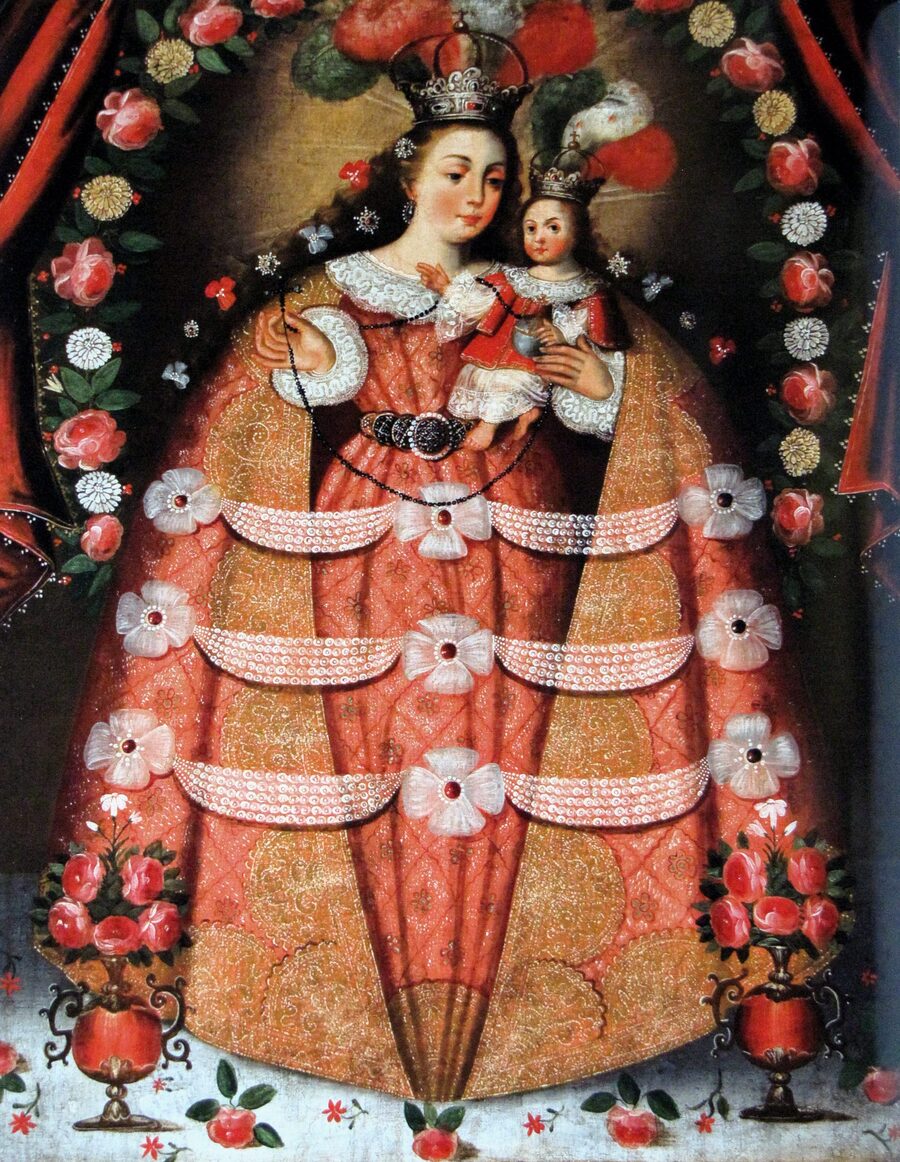
According to the history studies of Andean art, already at the end of the 17th century and during the 18th century the advocation was sufficiently consolidated to inspire numerous paintings of Cuban and AltoPeruvian workshop, which reproduce the miraculous effigy of Pomata and contribute to the expansion of his devotion. These paintings circulated in churches, convents and private houses, strengthening the regional character of the Virgin of the Rosary of Pomata as a protector of the Altiplano and of the surrounding populations of the Titicaca.
As regards legendary origin, various oral and devotional traditions reflect the general narrative of the Rosary: the Virgin Mary appears to Saint Sunday of Guzmán and gives her a crown of roses to promote this prayer among the faithful, a story that is often mentioned in catechesis and popular explanations related to the Virgin of Pomata. However, the sources consulted do not offer a specific local legend (apparition or founding miracle of Pomata) clearly dated and documented; rather, they emphasize the miraculous character of the sculpture and the effectiveness of its intercession, without specifying concrete episodes with historical value.
> Location note: Pomata is located in the Department of Puno, PeruNot in Colombia. There is no homonymous advocation with equivalent sanctuary in Pomata, Colombia.
—
The image and the sanctuary
La original image de Nuestra Señora del Rosario de Pomata is a Marian sculpture of a lump, of a vireinal period, venerated in the church of Santiago Apostol de Pomataon the banks of Lake Titicaca. The museum and art history sources point out that it is a miraculous image, which served as a model for numerous colonial paintings known as "Virgen del Rosario de Pomata." In these representations, the Virgin appears standing, holding the Child Jesus and the Rosary, richly dressed, with abundant embroidery, sumptuous blankets and a long hair adorned, as described by some iconographic fiche. The features respond to the Marian type spread by the Dominicans: Mary as Queen of the Rosary, an interceder close to the Andean faithful.
La iglesia de Santiago Apóstol de Pomata is one of the most remarkable Andean Baroque temples of the altiplano, built in red chair and recognized for the richness of its cover and sculptural decoration. Several studies consider it one of the jewels of the Andean baroque in the Titicaca basin, with an interior that housed altarpieces, paintings and sculptures of high artistic quality, including the Virgin of the Rosary of Pomata, which occupies a prominent place in the devotional set of the temple. The sources consulted do not indicate that the temple has the title of minor basilica ni de National sanctuary; therefore, it only contains its status as a baroque historical parish church dedicated to James the Apostle.
—
Sponsorship and coronation
In the historical-regional context, Our Lady of the Rosary of Pomata is recognized as an advocation circunlacustres, that is, venerated by the populations around Lake Titicaca, especially in the south of the Peruvian altiplano and adjacent areas of Bolivia. In the devotional tradition, it is considered to be a protector of the village of Pomata and of the surrounding communities, with a marked regional character; however, the sources consulted do not explicitly document a formal decree of diocesan or national patronage, nor an official title of patron of the entire diocese.
As for a canonical coronation specific to the image of Our Lady of the Rosary of Pomata (with date, pontifical decree or papal delegate), in the available sources there is no clear and verifiable reference to an act of canonical coronation recognized by the Holy See. Therefore, according to the accessible information:
> There is no documented canonical coronation.
—
Party and devotion
The invocation is intrinsically linked to the feast of the Rosary, traditionally celebrated by the Church on the first Sunday of October (in many places set today on October 7). Various devotional and museographic references point out that the memory of the Virgin of the Rosary of Pomata is celebrated in the framework of this October Marian holiday, without a different or transferred local date being specified in the sources. Therefore, the general link of this advocation to the feast of the Rosary in October is only with certainty.
The devotion to the Virgin of the Rosary of Pomata has been historically intense in the context of Lake Titicaca, with a strong popular roots and traditional manifestations that include procedure and regional pilgrimages. The description of the Pomata church mentions the lacustre character of the environment and the projection of its cult to communities on both sides of the Peruvian-Bolivian border, which has favored shared devotional practices in the basin. However, the sources consulted do not provide reliable quantitative data on the influx of pilgrims, nor do they describe in detail the current organization of specific lacustrous processions, so these aspects cannot be strictly specified.
—
Link to the Rosary
The very vocation, under the title of Our Lady of the Rosary, expresses a direct link with the prayer of the Rosary and with the spirituality promoted by the Order of Preachers. The Dominican tradition, often collected in popular catechesis, presents the Virgin by giving the Rosary to Holy Sunday of Guzmán as a gift for the Church, a theological image that also marks devotion to the Virgin of Pomata. The pictorial and sculptural representations of this advocation usually show it by bearing the Rosary, underlining its role as Master of the contemplative prayer of the mysteries of Christ.
Although there are no specific local rules on the practice of the Rosary in the Pomata shrine, the iconography and the Dominican tradition make it possible to state that the prayer of the Rosary is a natural part of the devotion to this image: it accompanies the October festivities, the processions and the daily piety of the faithful, who come to the Virgin of the Pomata Rosary to meditate, with Mary, on the mysteries of the life of the Lord and to entrust him with his personal and community needs.
A flower for the Virgin
Offer a simple prayer to this Marian devotion. Pray a Hail Mary for Peru and for all of America.
Pray Hail MaryIs the advocation of the Virgin Mary of your people missing?
Si no encuentras la advocación mariana de tu ciudad o pueblo, cuéntanosla: la investigaremos para ubicarla y darla a conocer en este mapa del amor de la Madre por el mundo.
Propose an apvocation →