Marian devotion
Our Lady of the Century of Novgorod
Marian vocation of Novgorod (Russia)
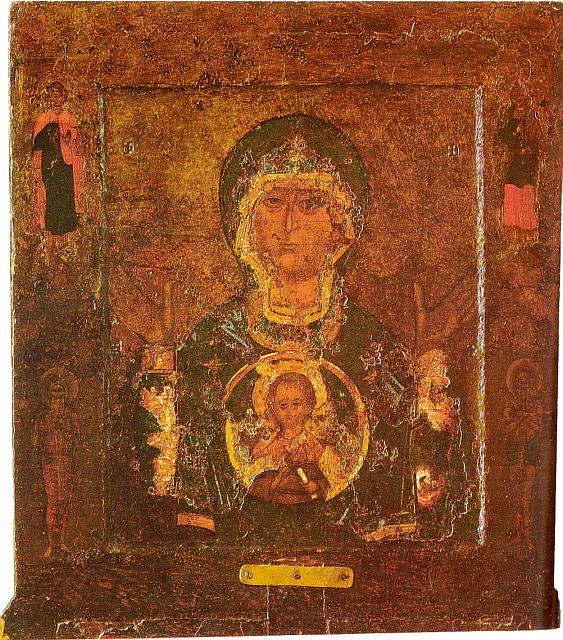
According to the tradition Russian Orthodox, the icon of Our Lady of the Century of Novgorod (Znamenie) It is linked to the siege of the city of Novgorod by the troops of Suzdal in the 12th century, when the icon was placed on the walls and, as it was reached by an arrow, tears sprout from the eyes of the Virgin, causing the confusion of the enemy and the miraculous liberation of the city. Some sources place this event around 1150, others in 1170, always with the same devotional core: the Mother of God, in her icon, protects the besieged city.
Main data
Origin and history
According to the tradition Russian Orthodox, the icon of Our Lady of the Century of Novgorod (Znamenie) It is linked to the siege of the city of Novgorod by the troops of Suzdal in the 12th century, when the icon was placed on the walls and, as it was reached by an arrow, tears sprout from the eyes of the Virgin, causing the confusion of the enemy and the miraculous liberation of the city. Some sources place this event around 1150, others in 1170, always with the same devotional core: the Mother of God, in her icon, protects the besieged city.
From the perspective of the documented historythe icon of the Century was venerated in Novgorod at least since the 12th century and was the object of particular veneration as protector of the city, associated with an old siege and successive releases of dangers. This is one of the oldest Russian examples of the iconographic type "del Signo" (Známenie), derived from Byzantine models, and its liturgical memory was incorporated into the calendar of the Russian Orthodox Church as a specific feast of the icon of the Signo de Novgorod. There is no absolute consensus between the sources on the exact date of the miracle (1150 / 1170), so the chronological detail should be considered a pious tradition rather than a strictly proven data.
Throughout the Middle Ages and modern times, the icon was transferred to various temples within Novgorod and processed in times of danger (wars, epidemics or calamities), consolidating its fame as "Novgorod's protector." Historical criticism accepts the existence of an ancient icon of the venerated Century in the city and its role as a religious-civic symbol, but cannot verify in detail the miraculous account of the tears and all associated military episodes.
The image and the sanctuary
The image belongs to the Byzantine-Slavic iconographic type of the "Mother of God of the Century" (Znamenie): Our Lady in attitude Prayer, standing or half-body, with arms raised in prayer and, on his chest, a medallion or circle in which Christ the Child appears, generally represented as Emmanuel, blessing and holding a roll or book, sign of Wisdom and the incarnate Word. This iconographic type, widely spread in Russia, visually expresses the mystery of the Incarnation and recalls Isaiah's prophecy: "The Lord Himself will give you a sign."
The original icon of Novgorod is a painting on board, of Byzantine tradition, with the technique of medieval icons (temple on wood), covered in later times, as was customary, with curling or metal ornaments to protect and enhance the image. Over the centuries, multiple copies of the icon have been made, all of them venerated as the "sign," but the main reference remains the old icon linked to the city of Novgorod.
As for the place of veneration, different sources point out that the Main shrine of this advocation in the city is the Cathedral of Santa Sofia of Novgorod, which has guarded the icon of the Sign and retains its liturgical memory. It is not known that the temple is erected as a minor basilica or a national sanctuary within the structure of the Catholic Church, since it is a center of worship of the Catholic Church. Russian Orthodox Iglesia. There is no official title within the Catholic organization (as "Marian national sanctuary"), although it is a historical and spiritual reference place for devotion to the icon of the Century in Novgorod.
Sponsorship and coronation
The icon of Our Lady of the Sign is considered, in Russian tradition, as of the city of Novgorodand in general as a sign of protection against harassment, conflict and collective danger. The patronage appears strongly linked to the religious and historical identity of Novgorod, where the icon of the Signo is invoked as an amparo of the city.
There is no evidence of a canonical coronation of the icon of Novgorod by the Catholic Church (with a Pontifical Decree and ceremony recognized by the Holy See), or that a coronation was performed with direct intervention by a Pontiff or his delegate. Therefore, according to the criteria of historical and canonical rigour, does not contain a documented canonical coronation.
Party and devotion
La liturgical feast of the icon of the Mother of God of the Century is celebrated in the Russian Orthodox Church 27 November (according to the Gregorian calendar), I commemorate the miracle of the protection of Novgorod by intercession of the Virgin in her icon of the Century. On that day, solemn offices, processions and acts of veneration are held before the icon or its copies, both in Novgorod and in other communities where this advocation is known.
Devotion is developed mainly by the Icon venerationthe celebration of the Divine Liturgy, the singing of their own hymns and the prayer of intercession in times of danger, war or calamity, following Orthodox spirituality. Around the feast of November 27, we mention the influx of faithful to the Cathedral of St. Sofia in Novgorod and to other temples dedicated to the Mother of God of the Century, although they do not contain, in verifiable sources, precise figures of pilgrims. The presence of the icon or its copies is also common in processions and liturgy of a civic-religious character, where the protection of the Mother of God is implored over the city and over Russia.
Link to the Rosary
In Russian Orthodox tradition, devotion to Our Lady of the Century of Novgorod is expressed mainly by the Icon veneration, la recitación de troparia, Concurrent and other prayers of their own, rather than through the prayer of the Rosary in the Latin form. It does not contain, in verifiable sources, a historical or legal link specific to this invocation with the Rosary as a prayer promoted by the Catholic Church; there are no canonically erected co-fradies of the Rosary around the icon of Novgorod.
However, from a common Marian perspective, the Rosary It allows us to contemplate, in a Catholic key, the same mysteries of faith that the icon of the Century symbolizes: the Incarnation of the Word, the divine motherhood of Mary, her intercession for the Church and for the cities and peoples in danger. To meditate on the joyful mysteries (especially the Annunciation and Nativity) and the mysteries of light (in particular the proclamation of the Kingdom) spiritually harmonizes with the image of the Virgin Prayer that brings Christ into his bosom, "sign" of God's presence in the midst of the people.
Therefore, even without a direct historical link, the prayer of Holy Rosary It can successfully accompany the devotion to Our Lady of the Century of Novgorod, helping to unite the contemplation of the icon with the meditation of the mysteries of Christ and of the Virgin Mary.
A flower for the Virgin
Offer a simple prayer to this Marian devotion. Pray a Hail Mary for Russia and for world peace.
Pray Hail MaryIs the advocation of the Virgin Mary of your people missing?
Si no encuentras la advocación mariana de tu ciudad o pueblo, cuéntanosla: la investigaremos para ubicarla y darla a conocer en este mapa del amor de la Madre por el mundo.
Propose an apvocation →