
Marian devotion
Our Lady of the Verdun, patron of the city of Minas
Marian title of Minas (Lavalleja)
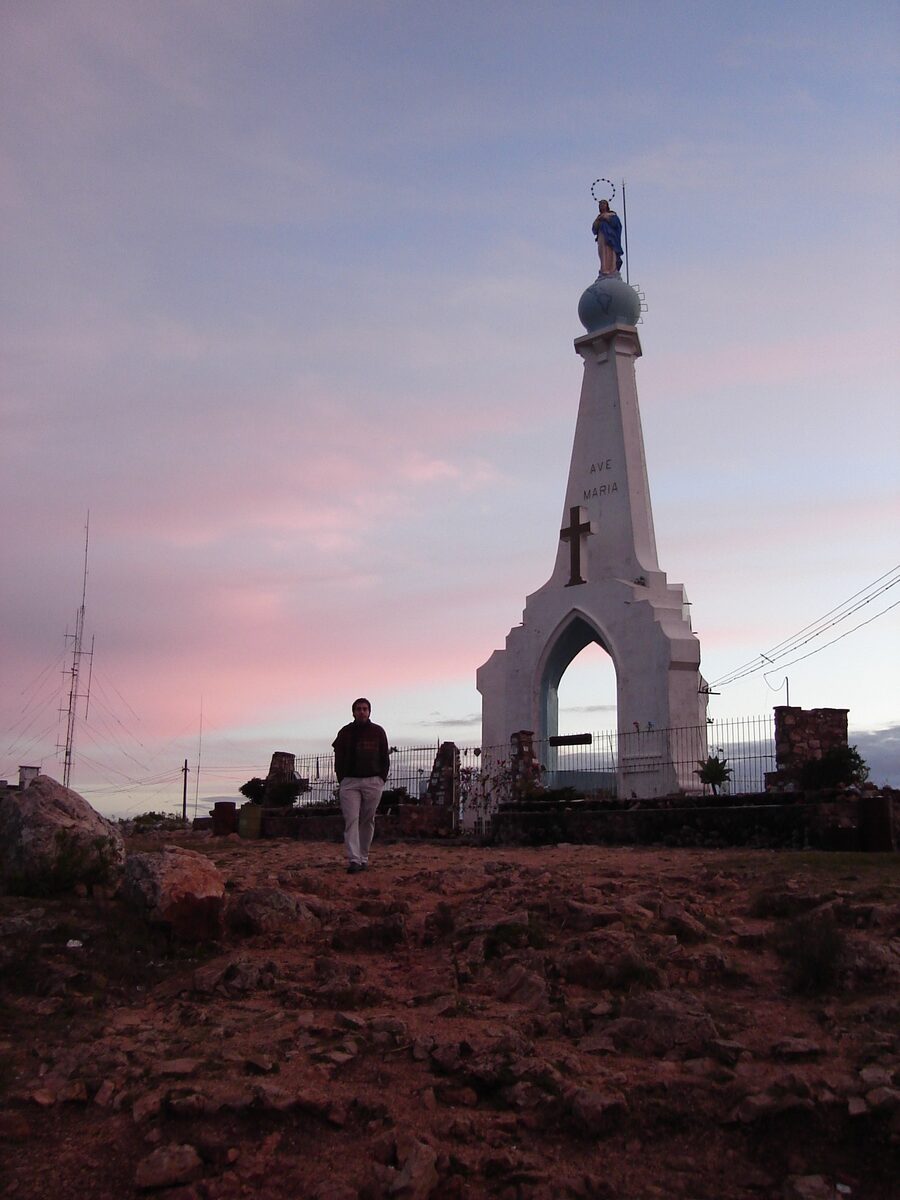
La devoción a Our Lady of the Verdun was born in the context of the Marian piety of the late 19th and early 20th century in the region of Minas, department of Lavalleja, Uruguay. At the top of Cerro Verdun (approx. 326 m s. n. m.), about 5 km from the city, it was decided to lift an image of the Immaculate Conceptionwhich over time would be recognized as Patron of the city and of the diocese of Minas.
Main data
Origin and history
La devoción a Our Lady of the Verdun was born in the context of the Marian piety of the late 19th and early 20th century in the region of Minas, department of Lavalleja, Uruguay. At the top of Cerro Verdun (approx. 326 m s. n. m.), about 5 km from the city, it was decided to lift an image of the Immaculate Conceptionwhich over time would be recognized as Patron of the city and of the diocese of Minas.
According to documented history, the image was placed at the top of the hill and exposed to the veneration of the faithful. 21 April 1901the date on which the opening was to be moved due to heavy rains which prevented the opening of the opening on the scheduled day, 19 April. From 1901the annual pilgrimage and celebration was set for the 19 Aprilin commemoration of the landing of the Thirty and Three Orientals (1825), led by Juan Antonio Lavalleja, born in Minas, thus linking the gestures of Uruguayan independence with the patronage of the Virgin Mary.
In terms of tradition and popular memory, the almost uninterrupted character of the pilgrimage since the beginning of the 20th century is persistently recalled to the point of becoming one of Uruguay's most massive manifestations of faith. The local tradition also highlights the impulse of priests and faithful of the serrana area in the choice of the hill as a privileged place of Marian consecration, although many details of these pastoral origins are not always documented with written precision. What is clear is that, because of the constant influx of pilgrims since 1901, the Conferencia Episcopal del Uruguay built the place like National Sanctuary of Our Lady of the Verdun mediante decreto de 15 April 2010.
(Note: Although "Colombia" is mentioned in the statement, all reliable sources clearly point out that these are Minas, department of Lavalleja, Uruguay.)
The image and the sanctuary
The advocation of Our Lady of the Verdun is reflected in a image of the Virgin Mary under the title of the Immaculate Conception, placed on a high stone base at the top of the hill. The image is type monument to the libre, visible from the city, and represents Mary standing, with her hands together or in a prayer / acolytic attitude, according to the usual iconography of the Immaculate (exact details of gesture and attributes may vary in popular descriptions, but the identification as Immaculate is clearly documented). It means there was a makeover a few years later of the first enronization of 1901, maintaining the same advocation. The specific material of the sculpture (for example, stone, cement, bronze or other) is not officially recorded in the sources consulted, so it is simply indicated that it is a great outer statue of the Immaculate.
The place of worship is officially called National Sanctuary Our Lady of the Verdun, also called the Sanctuary of the Virgin of the Verdun. It is located at the summit of Cerro Verdún, part of the Sierra Grande, about 5 km from the centre of Minas. The sanctuary consists of a temple or pedestal at the top of the hill, where the image is raised, and of various spaces of prayer and reception along the path of ascent, used especially on the multititling pilgrimages.
Por decreto de la Conferencia Episcopal del Uruguayof 15 April 2010, the sanctuary was erected as National Sanctuaryafter having been a diocesan sanctuary for many years. It is not recorded in the consulted sources that the sanctuary has the title of a minor basilica. There is also no mention of a higher legal-liturgical title than that of the National Sanctuary.
Sponsorship and coronation
Our Lady of the Verdun is recognized as Patron of the city of Minas and also Patron of the Diocese of Minas. This status of patronage is reiterated both in the texts of the Conferencia Episcopal del Uruguay as in current devotional presentation and in audiovisual materials of pastoral dissemination. It is not clear that he has been assigned a national patronage for all of Uruguay; his recognized title is mainly local (city) and diocesan.
As for the canonical coronation, the official sources (Episcopal Conference of Uruguay, historical reviews of the sanctuary, articles of Catholic dissemination and the fiche of the general encyclopedia) do not mention a decree of canonical coronation or the explicit intervention of a pontiff or pontifical delegate in this regard. Therefore, with the available data, does not contain a documented canonical coronation of the image of Our Lady of the Verdun.
Party and devotion
The main feast of Our Lady of the Verdun is celebrated 19 April. This date was chosen from the beginning to link Marian devotion to the memory of the landing of the Thirty and Three Orientals in 1825, the key event of the Uruguayan independence process. Although the initial entronization of the image took place on April 21, 1901, the liturgical-popular party remained fixed to April 19.
La annual pilgrimage to Cerro Verdun is one of the most important and popular manifestations of faith in Uruguay. Every 19 April they come tens of thousands of pilgrims from different parts of the country: sources indicate figures above 60,000 pilgrimsand even more than 80.000 in certain commemorations. The whole of the Uruguayan episcopate is usually involved on that day, which highlights the national character of the expression of faith, even if the patronage is local and diocesan.
Throughout the year, especially on Sundays, many faithful go up to the hill to pray, fulfill promises, give thanks or ask for the protection of the Virgin. The usual devotional practices include:
– ascenso al cerro a pie como gesto penitencial y de entrega; – participación en la Eucharist en el contexto de la fiesta; – oraciones personales o en familia ante la imagen; – ofrendas florales y exvotos de gratitud.
The pilgrimage naturally integrates elements of Marian piety, sense of local belonging and patriotic memory, in a climate of strong popular religiosity.
Link to the Rosary
The specific sources on Our Lady of the Verdun focus mainly on the history of the sanctuary, the pilgrimage and the link with the patriotic gestures, but does not contain a particular or exclusive relationship of this advocation with the prayer of the Rosary (for example, an official association with the Rosary or specific promises linked to this practice).
However, in Marian Catholic spirituality it is common that the Rosary accompany almost all great pilgrimages and sanctuaries, especially those dedicated to the Immaculate Conception. It is consistent and very likely - although not always described in detail by the sources - that many pilgrims pray the Rosary during the path of ascending to the hill and in the moments of prayer before the image, as a simple way to contemplate with Mary the mysteries of Christ and intercede for their own needs.
In this sense, the Rosary is presented as a privileged way of to deepen devotion to Our Lady of the Word:: By meditating on the joyful, painful, luminous and glorious mysteries with Mary Immaculate, faith in him is renewed
A flower for the Virgin
Offer a simple prayer to this Marian devotion. Pray a Hail Mary for Uruguay and for all of America.
Pray Hail MaryIs the advocation of the Virgin Mary of your people missing?
Si no encuentras la advocación mariana de tu ciudad o pueblo, cuéntanosla: la investigaremos para ubicarla y darla a conocer en este mapa del amor de la Madre por el mundo.
Propose an apvocation →