
The Holy Family of Bordeaux retains the memory of an apparition of Christ during the blessing with the Most Holy of February 3, 1822, witnessed by fourteen people in the small chapel of rue Mazarin.
The afternoon of February 3, 1822
The story places the event on Sunday of Septuagésima, February 3, 1822, at 4: 30 in the afternoon. The young Association of the Holy Family met in the house of the Ladies of Loreto, in a small chapel of the rue Mazarin of Bordeaux.
Father Pierre- Bienvenu Noailles was unable to preside because he was occupied in his ministry in the parish of Sainte- Eulalie. He asked Abbé Delort, former parish priest of Barie and then retired in Sainte-Eulalie, to come to impart the blessing with the Most Holy Sacrament.
What the witnesses narrated
According to the relationship incorporated in 1831 to the introduction of the General Rules of the Association, shortly after exposing the Most Holy several people said they had seen in the center of the ostensory the bust and head of Christ, surrounded by a luminous halo.
They described him as a young man with a glowing face, with one hand over his heart and the other extended to the assembly in a gesture of blessing. The narrative states that it was leaning towards the present and that the chapel seemed illuminated by an extraordinary glow.
20 minutes during the blessing
The vision would have remained during the Eucharistic anthem, prayers and singing, until the final blessing: approximately twenty minutes. This duration is a constant part of the institutional memory and allowed the phenomenon not to be reduced to a fleeting impression of a single person.
The Holy Family estimates that there were probably twenty-one people, in addition to others whose identity was not recorded. Fourteen testified. The fact sheet therefore speaks of a testified apparition, without turning the number of statements into a scientific demonstration of what happened.
The different experience of Milady Peychaud
Marie-Louise-Françoise Peychaud, known in tradition as Milady Peychaud, did not claim to have seen the figure. He remained with his eyes closed in prayer and said he had heard in the interior words that contrasted the honors, friendships, riches and human pleasures with the divine affirmation "I am the one who is."
Your experience should not be confused with the visual description of others. Tradition conserves both as dimensions of the same moment: a blessing contemplated by several attendees and an inner word received by a person. Distinguishing them helps to transmit the story without mixing testimonies.
A nascent and fragile community
Pierre- Bienvenu Noailles had founded the work in 1820. The first members lived with few means and were in doubt, criticism and difficulty. The 1822 blessing was interpreted by the community as confirmation and encouragement to continue its mission.
The founder did not witness the event. In a letter to the vicar general he explained that he believed in the reality of the fact by the simplicity and fervor of the witnesses whom he had heard. This absence is relevant: his conviction was later and depended on the testimonies, not on a personal observation.
The source of 1831
The current institutional presentation states that it reproduces the relationship included in the introduction of the 1831 General Rules. This temporary closeness - nine years later - makes the text an important internal source to know how the Association set and transmitted the episode.
However, it does not amount to having each original declaration and the complete diocesan file online. The tab identifies the nature of the source so that the reader can differentiate an early institutional testimony from a modern historical research.
The ecclesial discernment transmitted
The tradition of the Sagrada Familia recalls a favorable examination under Archbishop Charles- François d'Aviau du Bois de Sanzay. Devotional repertories present this research as an acknowledgement of the event. The full original decree or file has not been located in the digital sources consulted.
For this reason, the archbishop is not given a literal legal formula or a canonical degree that the primary document does not allow to be checked here. The continuity of memory within the religious family, the preservation of the ostensory and public commemorations can be seen.
It wasn't a material transformation of the host.
The account describes a visible figure in the field of the exposed form and a blessing of Christ. It does not claim that the Eucharistic matter would become tissue, blood or other substance or that the host of 1822 would be preserved as relic.
The historical object that has reached today is the ostensory. This classification differs Bordeaux from cases with analysis of a transformed form. The expression "Eucharistic apparition" better respects the content of the testimony received.
The preserved ostensory
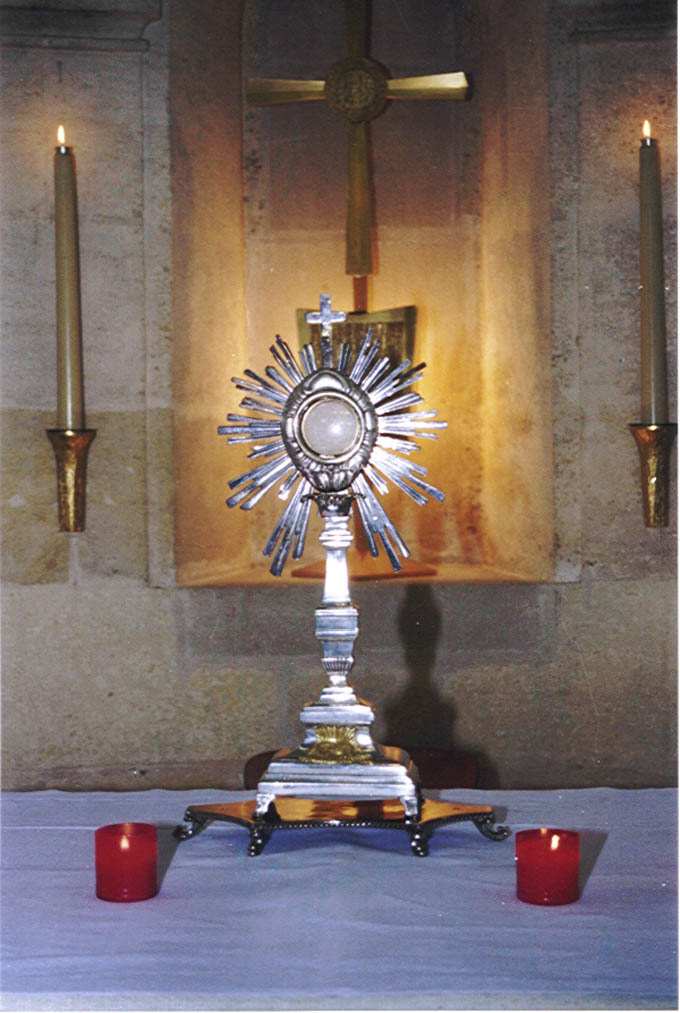
The contemplative community has explained that the Most Holy reappeared in later anniversaries in the same ostensory related to the event. The photograph incorporated in this file is identified in Wikimedia Commons as the "ostensory of the miracle of February 3, 1822" and was provided by the Sagrada Familia de Bordeaux.
To keep the ostensory does not mean to keep the form that was exposed that day. It is a memorial and liturgical object that links the current celebration to the history of the foundation. It must be seen with reverence, but without attributing magic properties.
The missing chapel of rue Mazarin
The episode occurred in the humble chapel of the Sisters of Loreto, in rue Mazarin, Bordeaux. The publication of the bicentennial itself regrets that this particular place could not be preserved. Today there is no untouched historical chapel that can be noted as the destination of the map.
The fact sheet does not therefore invent an exact coordinate on the current urban plot, nor does it direct the visitor to a building without a proven relationship. Bordeaux remains a city of the event, while the marker points to the contemporary custody of memory and ostensory.
Solitude in Martillac
The Solitude, near Bordeaux, is a historical and spiritual center of the Sagrada Familia in Martillac. There the contemplative community has celebrated anniversaries of miraculous Blessing and documented the use of the same ostensory for the Eucharistic exhibition.
The coordinates 44.7066892, -0.5629413 correspond to La Solitude, Route de la Solitude, 33650 Martillac. The point identifies the current institutional custody, not the physical place of the 1822 apparition. This double geography appears expressly on both the map and the text.
The memory of the bicentenary
In 2022 the contemplative community commemorated two hundred years of the event. His publication replaced him in rue Mazarin, explained the role of Father Delort and meditated on the luminous figure contemplated during the blessing.
The bicentennial celebration shows that it is not just an old fact sheet repeated by third parties. The religious family continues to receive the account as part of its spiritual identity, studies it, celebrates it and directs its meaning to worship and mission.
The Eucharist is not a prodigious object
The institutional commemoration itself insists that the Eucharist is not an object, but Christ himself who gives himself. The spiritual center of the case should not be reduced to seeking an extraordinary image in a custody, but to recognizing the sacramental presence of Jesus and allowing himself to be transformed by it.
The Church celebrates the Eucharist by the mandate of Christ, not because a visible sign is repeated. Faith does not depend on contemplating apparitions. Authentic worship leads to praise, humility, communion and service to those who need peace and care.
Responsible classification on the map
Bordeaux is incorporated as "Eucharistic apparition with existing institutional memory." The state explains that there are testimonies transmitted, continued commemoration and preserved ostensory, but that the original episcopal file has not been located online.
The marker does not claim that the apparition occurred in Martillac. He points out where his material and community memory is today. The short description allows you to understand this difference before opening the complete tab.
Sources consulted
- Sagrada Familia de Bordeaux: institutional account of the apparition, based on the 1831 General Rules.
- Contemplative Life of the Holy Family: bicentennial of 2022, historical place and current memory.
- Sagrada Familia: a sense of commemoration, Milady Peychaud experience and spiritual reading.
- Contemplative life: anniversary and use of the same ostensory in La Solitude.
- Exhibition associated with San Carlo Acutis: Bordeaux, secondary devotional repertoire contrasted.
Para orar
Lord Jesus, present in the Eucharist, bless your Church and make us humble before you. May honors, riches and noise not keep our heart from your presence. Give us communion, peace and courage to serve. Amen.
Image credit
Ostensory linked to the Eucharistic apparition of Bordeaux in 1822. Sainte Famille de Bordeaux / Wikimedia Commons, public domain. Archive and public domain statement in Wikimedia Commons.
