
The so-called "Sacramento del Miracle" in Brussels came from unfounded accusations of desecration of harms against Jewish people, followed by executions and expulsions. The local Church recognized the tendentious and legendary character of the story and asked for public forgiveness in 2026.
The essence: an unfounded accusation
In 1370, members of the Jewish community in Brussels were accused of having obtained and desecrated consecrated forms. The narration later stated that the harms bled when they were wounded. The historical research and the local Church itself do not consider this accusation to be proven.
The words matter: there was no "Jewish crime" shown to the one who followed a verifiable prodigy. There was an accusation born in an environment of religious suspicion, a legendary construction and deadly consequences for real people.
The European context of the 14th century
The cathedral explains that the Eucharistic devotion and contemplation of Christ's suffering humanity grew during the 13th to 15th centuries. At the same time, wars, epidemics and hunger encouraged the search for perpetrators among minorities already subjected to discrimination.
In several European territories they circulated stories with a similar scheme: Jewish people stole harms, wounded them and shed blood. The repetition of the motive does not confirm the facts; it reveals an accusatory genre that projected fears and doctrines of the Christian majority over the Jews.
What the legend of Brussels said
The transmitted versions described the alleged removal of forms and their delivery to Jewish people, who would have stabbed them on Good Friday of 1370. The visible blood would have revealed the act and confirmed the sacred character of the hostias.
This fact sheet summarizes the content only to identify the historical account. He does not claim that the actions would occur, does not adjudge guilt to the victims and avoids recreating dramatic details as if they were a reliable judicial chronicle.
Executions and expulsion
The charges triggered persecution. Jewish people were executed at the stake and the Jewish community was expelled from the Brabante ducate. The plaque opened in 2026 expressly recalls that unfounded allegations of desecration caused unjustifiable persecution, massacres and expulsions.
Violence is the historical core that must not be hidden under the language of a prodigy. Those who were punished are not secondary characters in an edifying history, but victims of religious slander and institutions that accepted these slander.
From the story to public veneration
The tradition was known as the "Holy Sacrament of the Miracle." For centuries, processions were held and works were produced to perpetuate it. His liturgical and visual repetition gave the appearance of certainty to a narrative that lacked sufficient historical evidence.
That a devotion has lasted for a long time documents its influence, not the veracity of the original accusation. This distinction makes it possible to study the heritage without legitimizing the prejudice that generated it.
The windows of the cathedral
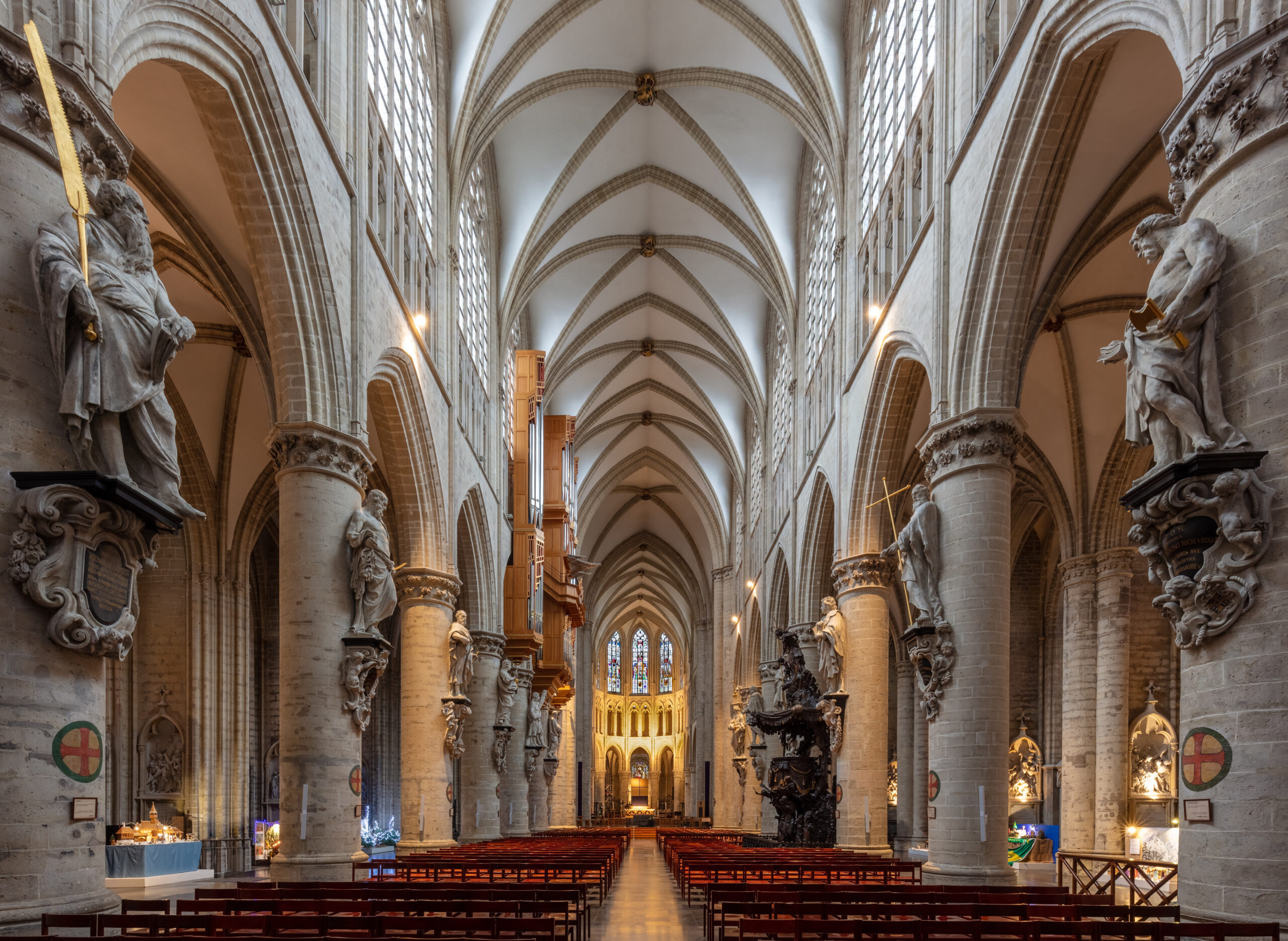
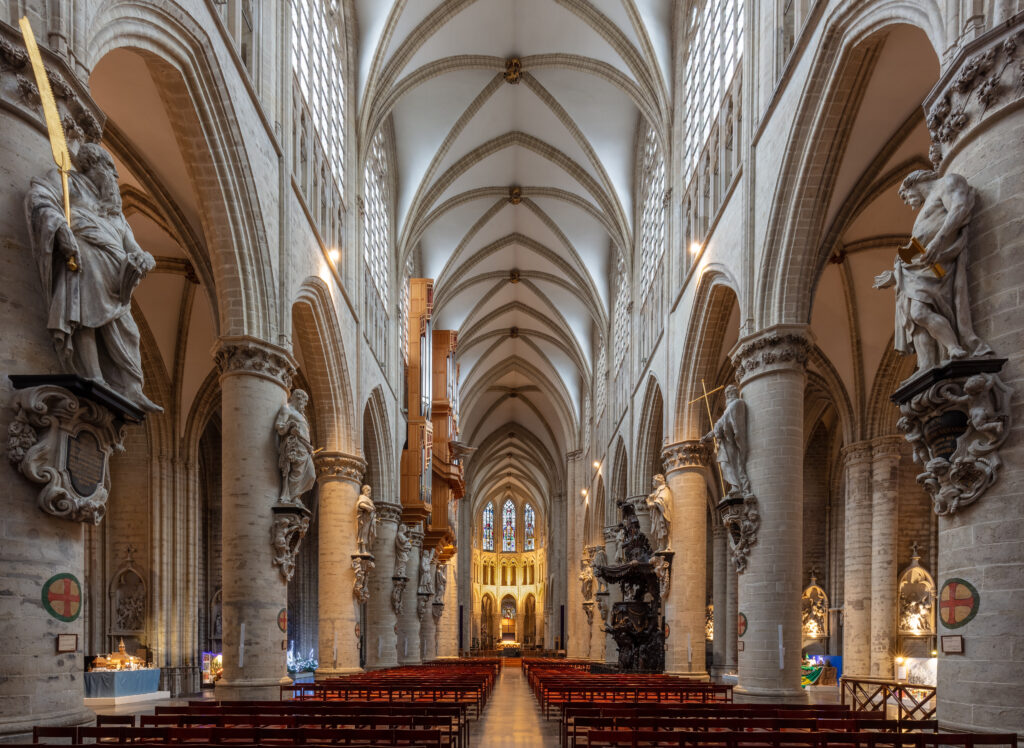
The cathedral of San Miguel and Santa Gúdula conserves glass windows related to the old story. CathoBel recognizes its clearly anti-Semitic character. The works are part of the history of the building, but today they need an explicit context so as not to continue to transmit an accusation as truth.
For this reason the main image of this document shows the cathedral and does not reproduce the offensive scenes. The reader can understand where memory is kept without turning denigratory iconography into devotional illustration.
The diocesan rectification of 1968
In 1968, the diocesan authorities, after considering the available historical investigation, recognized the biased nature of the accusations and the legendary presentation of the alleged miracle. It was a formal ecclesial correction of the way tradition had been received.
A bronze plate placed in 1977 next to the western portal recorded this review. Although it was an important step, it was over time considered too discreet to explain the gravity of the facts and the damage caused.
The pastoral intervention of 2026
On April 22, 2026, in the cathedral, the Jesuit and Bollandist Robert Godding presented the historical context of the "uncomfortable miracle." The later pastoral communication stated that no one can prove the historical veracity of the alleged miracle of 1370, including the religious authorities.
The document both maintains the Catholic faith in the Eucharist and refuses to base it on that narrative. Pastoral authorities disadvise residual devotion to the so-called Sacrament of the Miracle for the anti-Semitism that characterizes and can promote it.
The request for forgiveness
On the same day, the Archbishop of Malinas- Brussels, Luc Terlinden, opened a new commemorative plaque with Jewish and Catholic leaders. It recognizes the unfounded accusations and asks the Jewish people for forgiveness for the suffering they caused.
The gesture was not limited to correcting a date or an academic detail. The Archbishop spoke of sincere repentance and purification of memory, and renewed the commitment to combat all forms of anti-Semitism and to deepen the Judeocrist dialogue.
Shared memory
The great rabbi of Brussels, Albert Guigui, valued the plaque as a significant stage in the rapprochement between the two traditions. Memory can no longer be an instrument of separation and become a place of encounter when it recognizes the truth and dignity of the victims.
Reconciliation does not erase what happened or require the Jewish community to forget. He calls on Christians to take responsibility for their harmful traditions, correct their transmission and build relationships based on respect.
The Eucharist does not need slander
The real presence of Christ in the Eucharist is celebrated by the faith of the Church and does not depend on accounts against other religions. Rejecting a false accusation does not weaken the sacrament; it protects its sense of communion, truth and charity.
Eucharistic worship is incompatible with false testimony, racial or religious hatred and the humiliation of the neighbor. A Christian reading of the case must lead to repentance and the defense of those who suffer prejudice.
Por queé no es un milagro en este mapa
The catalogue associated with San Carlo Acutis included "Brussels, 1370" among its chips. This index helps to locate an influential tradition, but does not replace the historical research and subsequent pastoral judgment of the local Church.
The matrix retains the reference for no case to be hidden, but resolves it as critical historical memory. It does not add to the number of miracles published or appear in the affirmative layer of the world map.
Memory location
The Cathedral of San Miguel and Santa Gúdula is located in Place Sainte-Gudule, 1000 Brussels. The coordinates 50,8478433, 4,3600607 point to the building where the windows are kept, the interventions of 2026 were pronounced and the new plate was installed.
The geographical point belongs to the separate collection of critical Eucharistic memories. This location explains where the past is facing today; it does not certify that there was a miracle.
How to visit the cathedral
Whoever looks at the windows must read them together with contemporary contextualization and not as a neutral chronicle. The visit can become an occasion to remind the victims and to commit themselves against current anti-Semitism.
The cathedral remains a place of worship. Silence, respect for celebrations and attention to the new plaque help to integrate heritage, prayer and historical responsibility.
A teaching for religious publication
Devotional repertories need review when a narrative affects persecuted people. Repeat without warning the old vocabulary can renew a slander, even if the editor has no hostile intention.
The solution is not to erase the case and pretend it never existed. It is to document it with current ecclesial sources, name injustice, recognize pastoral change and clearly separate critical memory from miraculous claims.
Sources consulted
- Brussels Cathedral: Robert Godding's historic conference, European context and diocesan rectification.
- Brussels Cathedral: pastoral intervention of 22 April 2026, impossible to prove the Eucharistic account and orientation.
- CathoBel: Luc Terlinden's request for forgiveness, new plaque and judeocristic dialogue.
- CathoBel: Historical review of the supposed miracle of 1370.
- Repertoire associated with San Carlo Acutis: Brussels, reference subject to critical review.
Prayer for victims and reconciliation
God of Abraham, Father of all, forgives the slander and violence committed in your name. It welcomes the victims of 1370, deliver us from anti-Semitism and make Christians and Jews servants of truth, justice and peace. Amen.
Image credit
Cathedral of San Miguel and Santa Gúdula of Brussels, place of memory and of the request for forgiveness of 2026. Diego Delso / Wikimedia Commons, CC BY-SA 4.0. File and license in Wikimedia Commons.
