
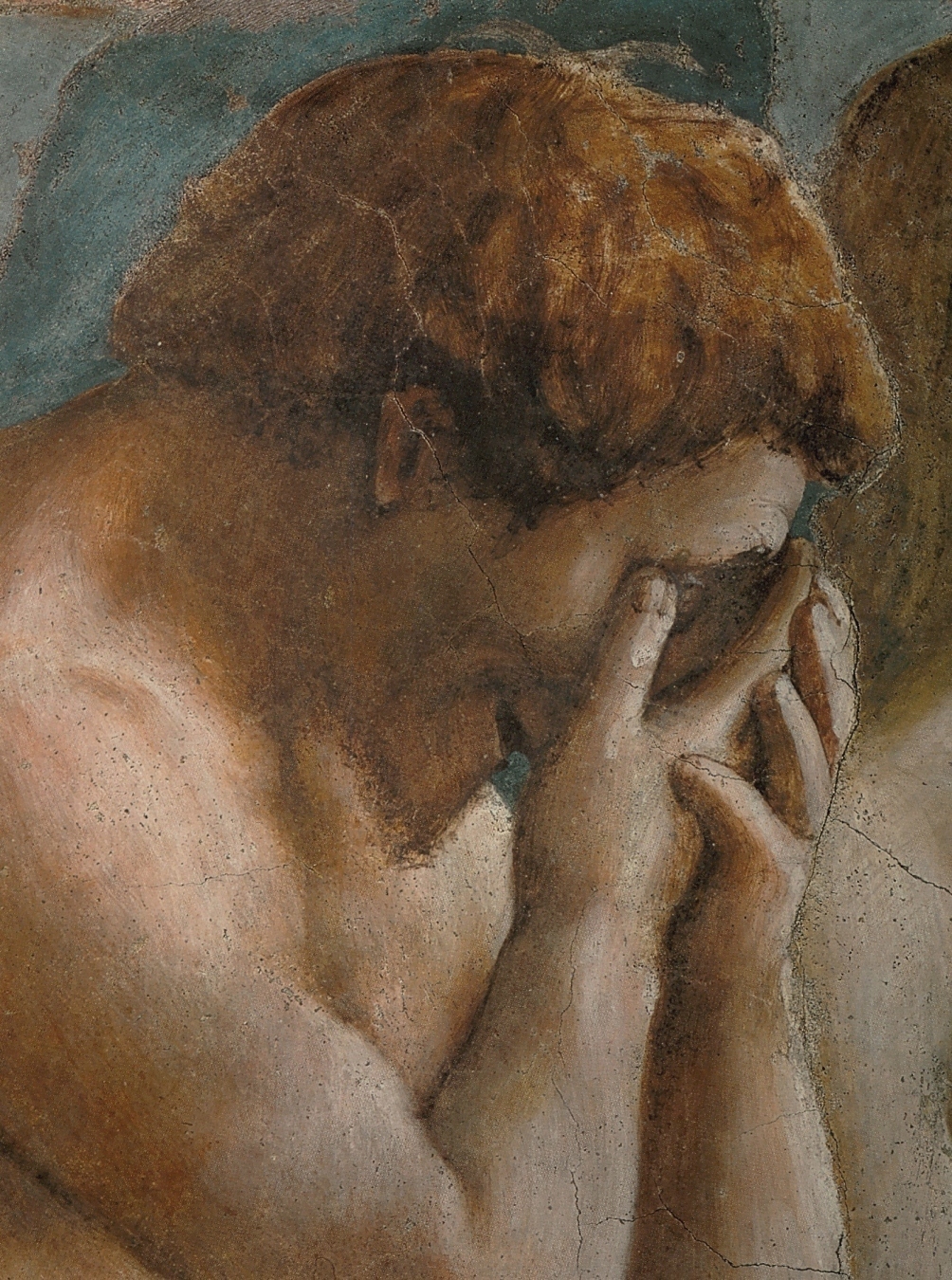
What sin does in the person, in the family, in society and in creation, how the Church has understood it over twenty centuries and on all continents, and why the last word is always the mercy of God.
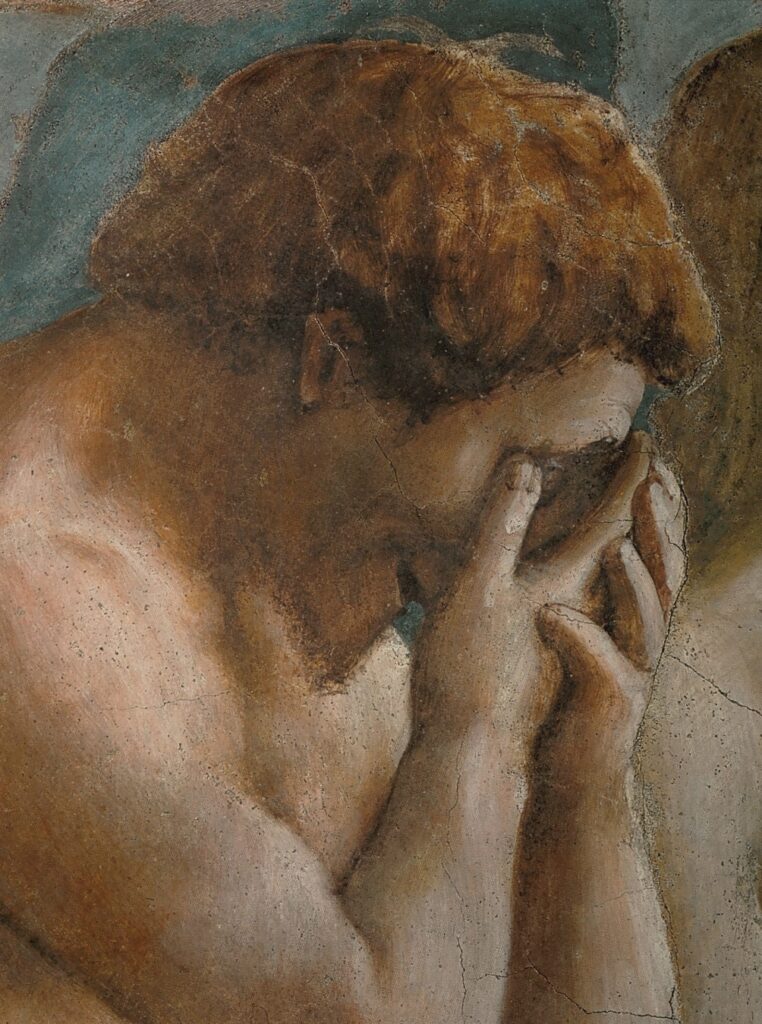

Sin is not an abstract stain or a simple violation of rules: it is a wound in friendship with God that leaves a mark on the one who commits it and extends, like the waves in the water, to the family, to society, to the Church and to the whole creation. This study goes through these consequences rigorously - the Bible in the official version of the Spanish Episcopal Conference, the Catechism with its number, the Fathers and doctors with its work and chapter, the Magisterium with its document - and always looks at them from hope: God does not choose to lose any of his children, and the Virgin Mary, the refuge of sinners, accompanies all on the way back.
In short: the essential in five minutes
This study is long: it takes about two hours to read it whole, and it can be read in parts. If you only have five minutes today, keep this. Each point leads to the part where it is explained in detail.
- What is sin. "A fault against reason, truth, straight consciousness" is "to lack true love for God and for his neighbor" (Catechism, 1849). Before a broken rule, it's a wounded friendship. → Introduction
- Its first consequence is the rupture of communion with God; from it the others arise: inner disorder, rupture with others and creation (Catechism, 399-400; Laudato si’, 66). → Part I
- Blame and pity. Forgiveness erases guilt and eternal punishment, but there can be "temporary penalties": the mark that sin leaves and that must be healed. They are not a vengeance from God, but something that "springs from the very nature of sin" (Catechism, 1472-1473). → Parte III
- Mortal and venial. Mortal sin destroys charity and deprives grace; the venial hurts and weakens it, but does not break friendship with God (Catechism, 1855-1863). → Parte IV
- No one sins alone. Every sin damages the communion of the saints and can crystallize in "structures of sin" (Catechism, 953 and 1869). → Part VI
- The last. Death entered the world by sin; after it comes judgment, purgatory purification for those in need, heaven, or the definitive self-exclusion that the Church calls hell (Catechism, 1008, 1022, 1030-1037). → Parte VIII
- The remedy. "Where sin abounded, grace abounded" (Rom 5: 20): God's mercy, confession, Eucharist, penance, works of charity, indulgences, the Rosary and the intercession of Mary, "Mother of Mercy" (Catechism, 2677). → Part X
- The Bible tells it with stories. Adam and Eve, Cain and Abel, Babel, Saul, David and Nathan, Judas and Peter, the prodigal son, Zacchaeus, the Samaritan, see what happens to the human being when he turns away from God, and how God goes out to seek him. → Part I
- Twenty centuries of reflection. The Fathers of the East stressed the disease and death that sin introduces; those of the West, the disorder of love; Trent defined doctrine, and the saints lived combat and mercy. → Part II
- In the person. Sin hurts nature, soaks the soul, chains will, blinds consciousness and steals peace. A nail calls another nail: this is how habit and vice are born. → Parte III
- Capital sins they are called that because they generate other sins, other vices. Each one is answered with the opposite virtue: to pride, with humility; to greed, with generosity; to envy, to joy for the good of the other. → Part V
- All over the world. The doctrine of sin is one throughout the Catholic Church, but each tradition and every continent has lived it with its own accents. → Part VII
- Lives that changed. The good thief, Saint Augustine, Saint Angela of Foligno, Saint Ignatius, Alfonso Ratisbonne, Saint Charles of Foucauld and Saint Bartolo Longo, numbered by distinguishing the documented from the tradition. → Parte IX
- The last word There is no sin. God is not satisfied with covering holes: it makes wood new. And on the way back no one goes alone: the Virgin Mary, the refuge of sinners, accompanies every step. → Conclusion
Introduction: what sin is
Hablar de las consecuencias del pecado exige, antes que nada, decir qué es el pecado. El Catecismo de la Iglesia Católica empieza por advertir que no se trata de una realidad que se pueda ignorar: «El pecado está presente en la historia del hombre: sería vano intentar ignorarlo o dar a esta oscura realidad otros nombres» (Catecismo, 386). Y añade algo decisivo: para comprenderlo, «[…] es preciso en primer lugar reconocer el vínculo profundo del hombre con Dios, porque fuera de esta relación, el mal del pecado no es desenmascarado en su verdadera identidad de rechazo y oposición a Dios» Magisterium.
That is why the Church prevents the explanations that reduce sin to something else. Without the light of Revelation, "the temptation is felt to explain it only as a flaw of growth, as a psychological weakness, a mistake, the necessary consequence of an inadequate social structure"; instead, in the light of God's design, "it is understood that sin is an abuse of the freedom that God gives to the people created so that they can love and love each other" (Catechism, 387). Psychology, sociology and history help to understand the conditions in which it is sinned; but personal sin, in its core, is a free act that says "no" to love (original sin, as will be seen, is different: a "contracted" state, not an act committed; Catechism, 404).
The classic definition
The Catechism thus defines it: "Sin is a fault against reason, truth, straight consciousness; it is a lack of true love for God and for his neighbor, because of a perverse attachment to certain goods. It hurts the nature of man and attacks human solidarity." And he recollects the formula that goes back to St. Augustine and which St. Thomas made classic: "a word, an act or a desire contrary to eternal law" (Catechism, 1849, quoting St. Augustine, Against Faustum 22, 27, and St. Thomas, Theological sum I-II, q. 71, a. 6).
In this definition, all the consequences of this study are already in germ. Sin "hurts the nature of man": it leaves a wound in the person who commits it. And "he attacks human solidarity": he never stays within himself. But above all it is an offence to God. The Catechism says this with the psalm that King David composed after his fall: "I only sinned against you, against you, I committed the evil you hate" (Ps 51.6, according to the version quoted in the Catechism, 1850). As the first sin, it is "a disobedience, a rebellion against God for the desire to become" as gods, "seeking to know and determine good and evil"; it is, in the words of Saint Augustine, "love of himself to the contempt of God" (Catechism, 1850, citing De civitate Dei 14, 28).
A wounded friendship
Paul VI gave a formulation that illuminates everything else: sin is, at the bottom, the contempt or oblivion of personal friendship between God and man (Indulgentiarum doctrina, 2). The Catechism says this in other words: "Sin is above all an offence to God, a rupture of communion with Him. At the same time, he attacks communion with the Church" (Catechism, 1440). If sin were only the violation of a regulation, its consequences would be external: a fine, a penalty. But since it is the wound of a relationship of love, its consequences are internal and personal, as are those of any betrayal between friends: distrust, distance, shame, fear of looking into the face.
This is the key to the whole study, which Catechism formulates with a precision that should be retained from the beginning: the penalties of sin "must not be conceived as a kind of revenge, inflicted by God from the outside, but as something that springs from the very nature of sin" (Catechism, 1472). Magisterium. God is not stalking to punish. It is sin that, by its own logic, destroys what it touches, like fire burns or sick poison.
An evil that only looks good from mercy
There's one last warning before we start, and it's perhaps the most important. The Catechism does not open his treaty on sin by speaking of punishment, but of mercy: "The Gospel is the revelation, in Jesus Christ, of God's mercy with sinners (cf. Lk 15)" (Catechism, 1846). And it explains why God makes us see sin: "As a doctor who discovers the wound before healing it, God, through his Word and Spirit, projects a living light on sin" (Catechism, 1848). Knowing the consequences of sin is not intended to scare, but to cure. No one's looking for a doctor if they don't know he's sick.
Therefore the Catechism also recalls the phrase of Saint Augustine: "God, who created you without you, will not save you without you" (Catechism, 1847, citing the Sermon 169, 11, 13). Grace does everything, but not by force: it asks for our yes. And that does begin by recognizing the truth: "If we say that we have no sin, we are deceived and the truth is not in us. If we recognize our sins, he is faithful and just to forgive us sins and purify us from all injustice" (1 Jn 1: 8-9, in the version quoted by the Catechism, 1847).
An image for the whole course: the table and nails
An anonymous pastoral account has been circulating for decades - it does not come from any saint, although it is sometimes attributed to one - that helps to understand what follows. The soul is like a good wood board. Every sin is a nail that sinks into it. Confession starts the nail: sin is truly forgiven. But in the wood the hole remains, and that hole is covered with penance, good works, prayer and indulgences, until the table is smooth again.
As every image, it has limits, and throughout the study will be pointed out: mortal sin is not a nail more among others, but the big nail, which crosses the board from part to part; a great love can suddenly close all the holes (Catechism, 1472); and, above all, God is not limited to covering holes, but makes the board new: "O God, create in me a pure heart" (Ps 51,12). Catechetical image
I. Sin and its consequences in Scripture
The Bible does not offer a treaty on sin: it tells stories. And in those stories, more than in any definition, you see what happens to human beings when they turn away from God. The Catechism warns that the reality of sin "is only clarified in the light of divine Revelation" and that its ultimate meaning "is only manifested in the light of the death and resurrection of Jesus Christ": "Christ must be known as a source of grace to know Adam as a source of sin" (Catechism, 387388). Let us look at the main stories with the text of the official Bible of the Spanish Episcopal Conference.
1. Adam and Eve: the mistrust and the four ruptures (Gn 3)
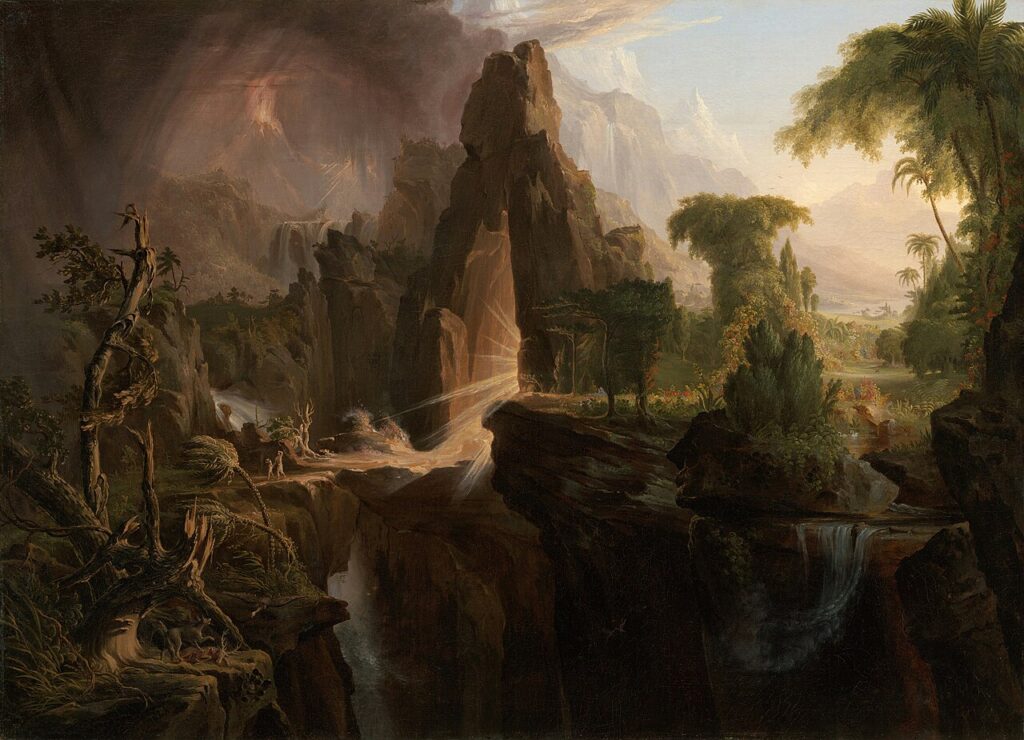

The story of Genesis begins with a poisoned question. The serpent does not deny God: it sows suspicion. "So God has told you not to eat from any tree in the garden?" (Gn 3: 1). And then he insinuates that God is a jealous rival: "No, you will not die; it is that God knows that the day you eat of him, your eyes will be opened, and you will be as God in the knowledge of good and evil" (Gn 3: 4-5). The Catechism thus sums up what happened: "Man, tempted by the devil, let trust die in his heart towards his creator" and, abusing his freedom, disobeyed. "In the future, every sin will be a disobedience to God and a lack of trust in his goodness" (Catechism, 397). Saint Maximus the Confessor, quoted in the Catechism, said this with an admirable precision: man wanted to "be like God," but "without God, before God and not according to God" (Catechism, 398).
What follows is the X-ray of all the consequences of sin. A ray does not fall from the sky: the first thing that happens within them. "They opened their eyes to both of them and discovered that they were naked" (Gn 3.7). Then they hid themselves: "Adam and his wife hid themselves from the sight of the Lord God among the trees of the garden" (Gn. 8). The Catechism explains that "Adam and Eve immediately lose the grace of original holiness" and "are afraid of the God of whom they have conceived a false image, that of a God jealous of their prerogatives" (Catechism, 399). And it lists the ruptures that open: the inner harmony "is destroyed; the dominion of the spiritual powers of the soul over the body is broken"; "the union between man and woman is subject to tensions"; "their relations will be marked by desire and domination"; "the harmony with creation is broken; the visible creation is made for the strange and hostile man"; and "death makes its entry into the history of humanity" (Catechism, 400).
Pope Francis summarized it in a phrase that has become classic: "human existence is based on three fundamental relationships closely connected: the relationship with God, with one's neighbour and with the earth. According to the Bible, the three vital relationships have been broken, not only externally, but also within us. This break is sin" (Laudato si’, 66). John Paul II added the fourth, the break with himself: with sin "his inner balance also breaks and unfolds within himself contradictions and conflicts. In this way, the man almost inevitably causes a break in his relations with other men and with the created world" (Reconciliatia et paenitentia, 15) Magisterium.
Each of those ruptures is seen in the text. The break with the other: asked by God, Adam blames the woman, and in passing to God himself: "The woman you gave me as a companion offered me the fruit and I ate" (Gn 3: 12); the woman blames the serpent (Gn 3: 13). The break with the earth: "the ground is cursed because of you: you shall eat of it with fatigue as long as you live; it shall sprout for you thistles and thorns" (Gn 3: 17-18). And death. But in the midst of drama, God does two things that should not be overlooked. The first one: go out and look. "The Lord God called Adam and said," Where are you? "(Gn 3: 9). St. John Chrysostom commented that God did not ask for ignorance, but because sin closes the mouth of the man who commits it, and wanted to give him confidence to speak and ask for forgiveness (Homilies on statues, 7, 7). The second is a victory. In cursing the serpent, God promises, "I put hostility between you and the woman, between your seed and her seed; it will crush your head when you smite her on the heel" (Gn 3: 15). The Church has read in this verse the first announcement of the Redeemer and his Mother: the Catechism recalls that it has been called "ProtGospel," "because it is the first announcement of the Redeemer Messiah," and that the Christian tradition sees in it the "new Adam," while "many Fathers and doctors of the Church see in the woman announced in the" protGospel "the mother of Christ, Mary, as" new Eve "(Catechism, 410-411). Magisterium. The history of sin begins with a promise of mercy.
Figurative language, real event
The Catechism teaches that the account of the fall "uses a language made of images, but affirms a primordial event, a fact that took place at the beginning of man's history" (Catechism, 390) Magisterium. It is not necessary to imagine an apple - the text speaks only of "fruit" - nor to read the passage as a chronicle; but it is not to reduce it to a myth: the Revelation states that human history is marked from its origin by a free lack of our first parents.
2. Cain and Abel: the lying sin and indifference (Gn 4)
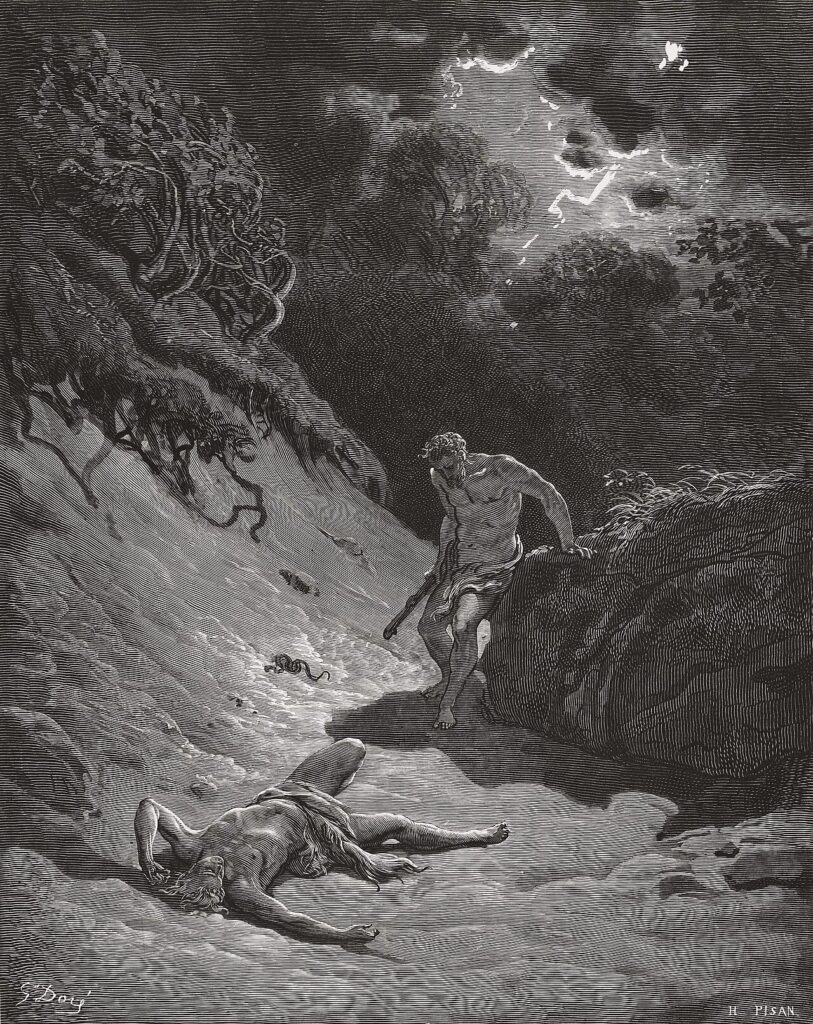

Sin never stands still. The Catechism says that from the first sin, "a true invasion of sin inunites the world: the fratricide committed by Cain in Abel" (Catechism, 401). The striking thing about the story is that God warns Cain before he kills, with an unforgettable image: "if you do not do well, sin lurks to the door and covets you, even though you can rule it" (Gn 4: 7). Sin appears as a crouched beast; but man is not defenceless: "You can rule it."
Cain doesn't listen. After crime, God asks again - like Adam - and the answer shows a new consequence of sin: indifference. "Where's Abel, your brother?" Cain said, "I do not know; am I the guardian of my brother?" (Gn 4: 9). And God says, "Your brother's blood is shouting at me from the ground" (Gn 4: 10). The Catechism lists Abel's blood as the first of the sins that "cry out to heaven" (Catechism, 1867). Pope Francis stressed the chain of ruptures: neglect "in the effort to cultivate and maintain an adequate relationship with the neighbor, to whom I have the duty of care and custody, destroys my inner relationship with myself, with others, with God and with the earth" (Laudato si’, 70).
The consequences for Cain are the same ruptures of Eden, aggravated: the earth ceases to bear its fruit, becomes a fugitive "errant and lost by the earth" (Gn 4: 12), and he himself recognizes: "My fault is too great to bear" (Gn 4: 13). But also here is mercy: God does not allow revenge to be unleashed and "he gave a sign to Cain that, if anyone found him, he would not kill him" (Gn 4: 15). Even on the first homicidal God extends his protection.
3. Babel: the unity without God that ends in division (Gn 11)
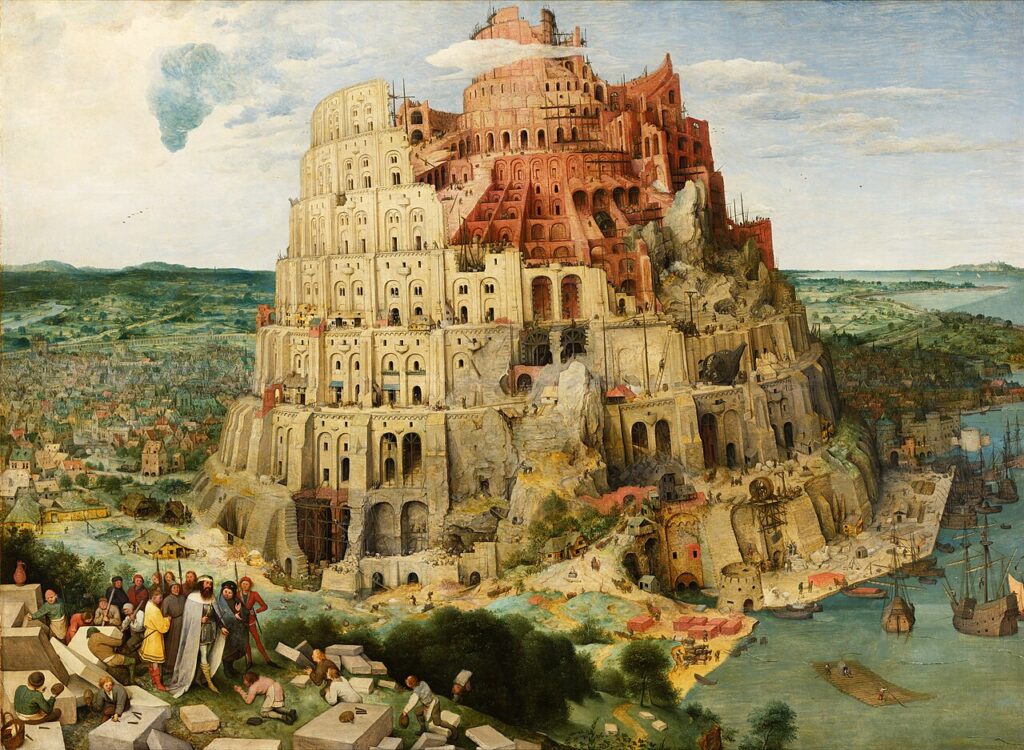

If Cain shows the sin that breaks the fraternity between two brothers, Babel shows the collective sin, that of an entire society that is organized without God. "We will build a city and a tower that reaches the sky, to make us a name, lest we disperse on the surface of the earth" (Gn 11.4). The problem is not technique or cooperation, but the desire to make one's own unity and glory outside of God. The result is just the opposite of the one sought: "We confuse his tongue there, so that no one understands the tongue of his neighbor" (Gn 11: 7), and "the Lord scattered them from there on the surface of the earth" (Gn 11: 8).
The Catechism reads in this account the pride "of a fallen humanity that, unanimous in its perversity, would like to make its own unity in the way of Babel" (Catechism, 57). John Paul II presented it as the second great biblical image of sin, along with that of Eden: the attempt to build without God ends in division and in the impossibility of understanding (Reconciliatia et paenitentia, 14). And Benedict XVI gathered the intuition of the Fathers: they understand sin "as the destruction of the unity of the human gender, as rupture and division" (Save, 14). God's answer to Babel will come in Pentecost, when the Spirit will make each one hear the apostles speak in his own language (Acts 2.6).
4. Saul: the sin that is justified
The story of Saul, the first king of Israel, shows a more subtle consequence of sin: self-deception. God had given him a clear order, and Saul fulfilled it only in half, keeping the best of the loot on the pretext of offering it in sacrifice. The prophet Samuel answers with a phrase that goes through the centuries: "Do the Lord please sacrifices and burnt offerings as much as obey his voice? Obedience is worth more than sacrifice, and docility, than rams' fat" (1 Sam 15: 22).
Saul ends up saying, "I have sinned," but what he adds reveals why his recognition is half-lived: "I have sinned, disobeying the command of the Lord and your words, but I was afraid of the people and listened to him" (1 Sam 15: 24); and shortly after, "I have sinned. But at least make me before the elders of my people and before Israel" (1 Sam 15: 30). The right word is there, but the heart is still pending his image. The comparison with David, his successor, is enlightening: the two say "I have sinned," but only in one of them does the heart truly open.
5. David and Nathan: the blindness, the confession and the consequences that remain (2 Sam 11-12; Ps 51)
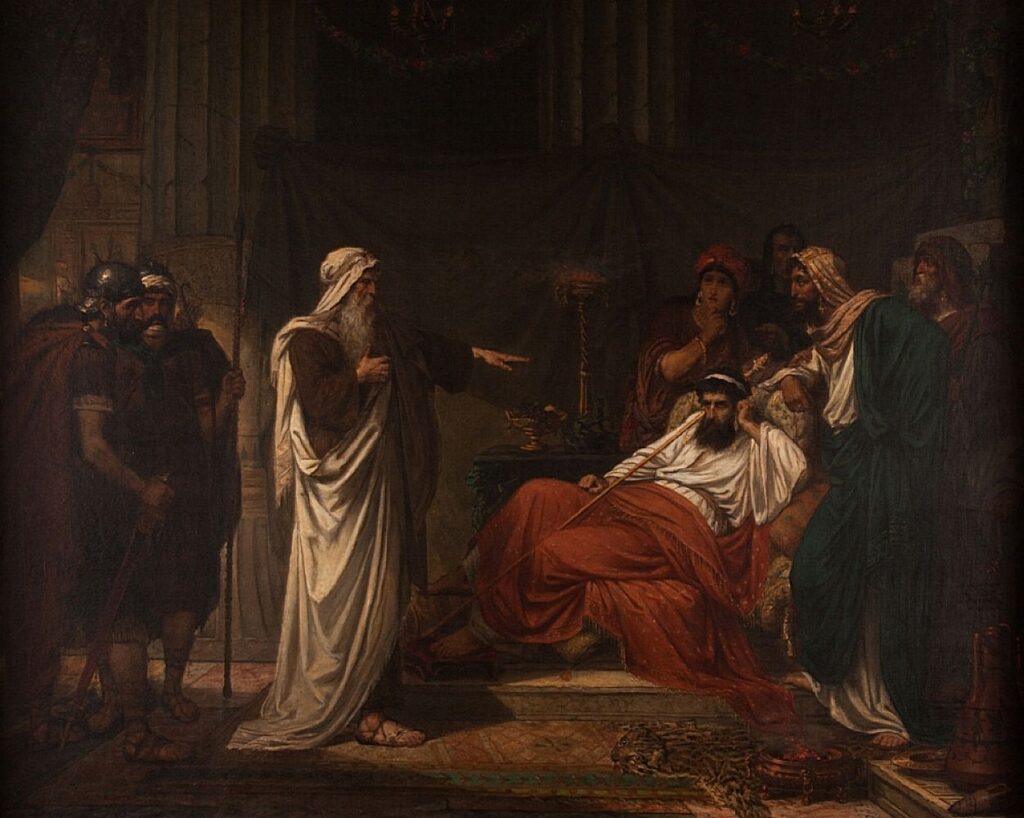

El pecado de David es uno de los más graves que narra la Biblia: adulterio con Betsabé y, para encubrirlo, el asesinato de su marido, Urías. Y lo más inquietante es que David no parece darse cuenta. Hace falta que el profeta Natán le cuente la parábola de un rico que roba la única oveja de un pobre para que David estalle de indignación… contra otro. Entonces llega la frase que lo desarma: «Tú eres ese hombre» (2 Sam 12,7). He aquí una de las consecuencias más serias del pecado: la ceguera. El que peca se acostumbra y deja de ver lo que es evidente para cualquiera que lo mire desde fuera.
David, unlike Saul, does not defend himself: "David answered Nathan," I have sinned against the Lord. "And Nathan said to him," The Lord also has forgiven your sin. You will not die "(2 Sam 12.13). Forgiveness is immediate and complete. And yet the story does not end there: the prophet announces that" the sword will never depart from your house "(2 Sam 12: 10), and the later history of the family of David - with his children facing them - is marked by what happened. Forgiving sin leaves behind consequences in time. It is the intuition that the Church will make as a distinction between guilt, which is forgiven, and temporary punishment, the mark that remains and that must be healed (Catechism, 1472-1473; see Part III). Theological reading.
From this experience comes the most prayed penitential prayer in the history of the Church, Psalm 51, which the Bible itself places "when the prophet Nathan visited him, after he had joined Bethusé" (Ps 51.2): "Mercy, my God, for your goodness, for your immense compassion, erases my fault; wash my crime completely, cleanses my sin. For I know my guilt, I am always aware of my sin. Against you, I only sinned against you, I committed evil in your presence" (Ps 51,3-6). And Psalm 32 describes what unconfessed sin does: "As I was silent my bones were consumed, roaring all day, for day and night your hand weighed upon me; my sap had become a dry fruit as in the heat of summer. There was sin, I recognized it, I did not cover for you my crime; I proposed," I will confess my guilt to the Lord, "and you have forgiven my guilt and my sin" (Ps. 32,3-5). Few pages better describe the loss of peace that produces silent sin and the liberation that brings to confess it.
6. The prophets: graced aljibes and stone hearts
Los profetas describen las consecuencias del pecado del pueblo con imágenes de enorme fuerza. Jeremías lo presenta como un mal negocio: «una doble maldad ha cometido mi pueblo: me abandonaron a mí, fuente de agua viva, y se cavaron aljibes, aljibes agrietados que no retienen agua» (Jr 2,13). El pecado promete agua y deja sed. Isaías habla de la separación: «son vuestras culpas las que os han separado de vuestro Dios; vuestros pecados ocultan su rostro, para que no os oiga» (Is 59,2); y de la inquietud que nunca se calma: «Los malvados son como el mar borrascoso, que no puede calmarse […] “No hay paz para los malvados” —dice mi Dios—» (Is 57,20-21).
But the prophets themselves proclaim healing. Ezekiel promises in the name of God: "I will give you a new heart, and I will give you a new spirit; I will tear the heart of stone from your flesh, and I will give you a heart of flesh" (Ez 36,26). And it makes clear what God wants: "Do I want the death of the wicked - the oracle of the Lord God - and not that it will become of his conduct and live?" (Ez 18: 23). Isaiah, for his part, offers one of the most comforting promises of all Scripture: "Even if your sins are like scarlet, they will be white as snow; even if they are red as purple, they will be like wool" (Is 1: 18).
7. Judas and Peter: remorse and repentance
En la Pasión, dice el Catecismo, el pecado «manifiesta mejor su violencia y su multiplicidad»: la incredulidad y las burlas, la debilidad de Pilato, la crueldad de los soldados, la «traición de Judas tan dura a Jesús», las «negaciones de Pedro» y el abandono de los discípulos. «Sin embargo, en la hora misma de las tinieblas […] el sacrificio de Cristo se convierte secretamente en la fuente de la que brotará inagotable el perdón de nuestros pecados» (Catecismo, 1851).
Dos apóstoles caen esa noche. Judas entrega al Maestro por treinta monedas de plata (Mt 26,14-15). Pedro, que había prometido seguirle hasta la muerte, le niega tres veces. Los dos se dan cuenta de lo que han hecho. De Judas dice el Evangelio: «viendo que lo habían condenado, se arrepintió y devolvió las treinta monedas de plata a los sumos sacerdotes y ancianos diciendo: “He pecado entregando sangre inocente”. Pero ellos dijeron: “¿A nosotros qué? ¡Allá tú!”. Él, arrojando las monedas de plata en el templo, se marchó; y fue y se ahorcó» (Mt 27,3-5). De Pedro: «El Señor, volviéndose, le echó una mirada a Pedro, y Pedro se acordó de la palabra que el Señor le había dicho […]. Y, saliendo afuera, lloró amargamente» (Lc 22,61-62).
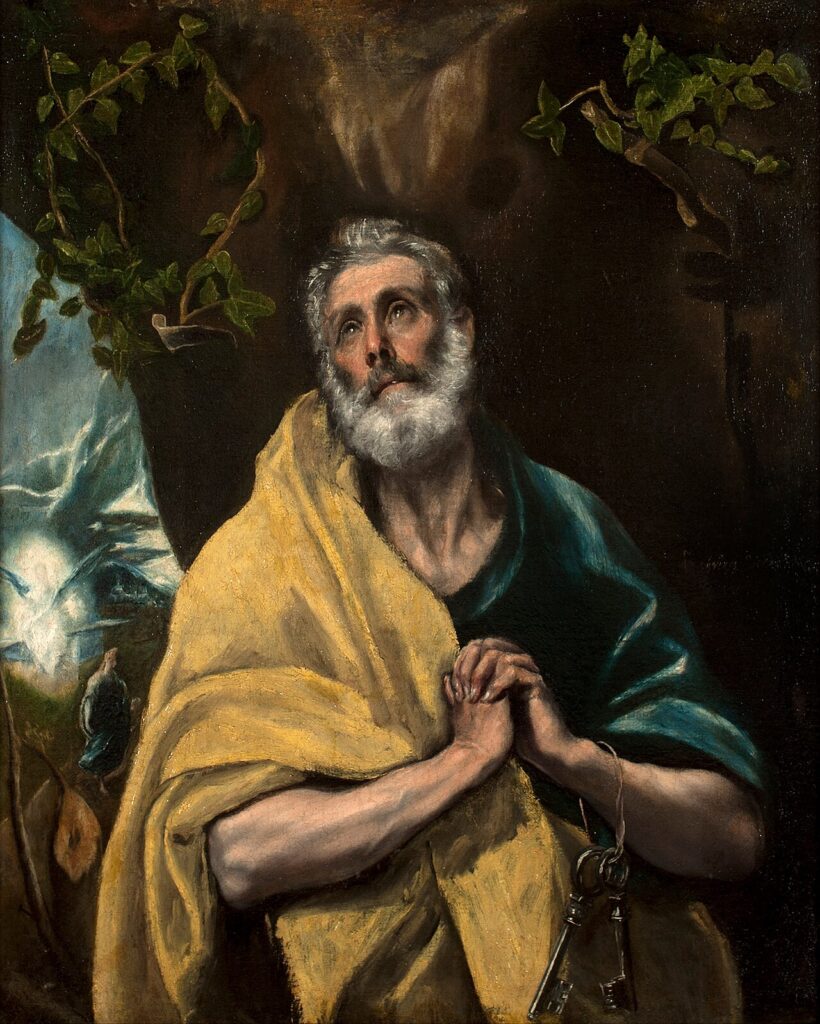

The difference is not in the gravity of sin, not even in the consciousness of having committed it: Judas also says "I have sinned." It's where each one of you goes. Judas is left alone with his guilt, before men who answer him "There you are!" The story can be read as a remorse that does not open to hope, although Scripture does not fully describe his inner state. Theological reading. Peter finds a look: that of Jesus. The Catechism presents Peter as a model of conversion: "The look of Jesus' infinite mercy causes the tears of repentance (Lk 22,61) and, after the resurrection of the Lord, the triple affirmation of his love for him" (Catechism, 1429). On the lake's shore, the triple denial answers the triple confession: "Lord, you know everything, you know I love you" (Jn 21: 17). One of the most dangerous consequences of sin is precisely this: the temptation to believe that it has no remedy.
About the fate of Judas
The Church has never declared that any particular person is condemned. The Catechism teaches that the Church implores the mercy of God, who "wants no one to perish" (Catechism, 1037), and, in speaking of suicide, that "one must not despair from the eternal salvation of those who have been killed" (Catechism, 2283) Magisterium. The contrast between Judas and Peter is a teaching on repentance, not a judgment on no one's soul.
8. The prodigal son: the illusory freedom and the running father (Lk 15)
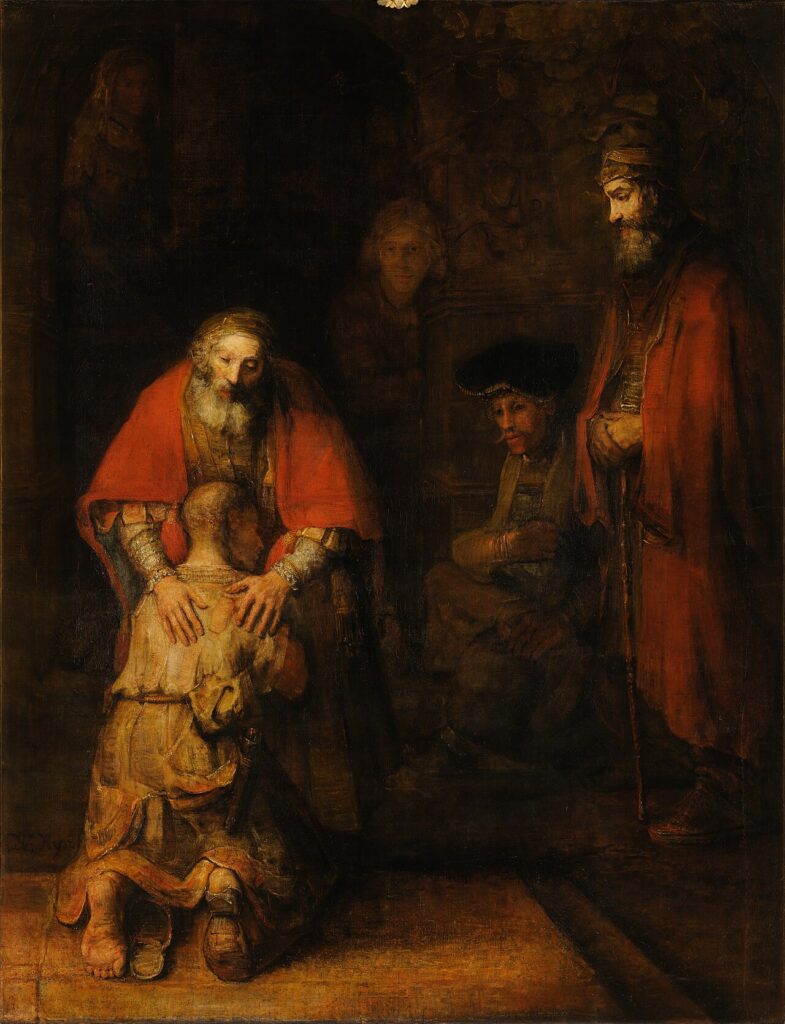

If you had to choose a single page to explain the consequences of sin and its remedy, it would be this. The Catechism expressly says this: "The process of conversion and penance was beautifully described by Jesus in the parable called" the prodigal son, "whose center is" the merciful father "(Catechism, 1439). And it lists its stages:" the fascination of an illusory freedom, the abandonment of the father's house; the extreme misery in which the son is found after having dilapidated his fortune; the deep humiliation of being forced to feed pigs, and even worse, of wanting to feed on the chickpeas that the pigs ate; the reflection on the lost goods; the repentance and the decision to plead guilty to his father, the way of return; the generous welcome of the father; the joy of the father. "
The Gospel text describes the consequences of sin with overwhelming realism. The son asks for his inheritance - that is, he treats his father as if he had already died - and goes "to a far country, and there he wasted his fortune living forgiving" (Lk 15: 13). When he lost everything, hunger, loneliness and humiliation came: "He wished to be satisfied with the chickpeas that the pigs ate, but no one gave him anything" (Lk 15: 16). The consequences of sin are not here a punishment of the father, who does not appear in that part of the story: they are the natural fruit of the son's decision. And the turn begins inside: "And then it was said," How many laborers of my father have plenty of bread, while I am starving here. I will rise up, I will set myself on my way to my father, and I will say to him, Father, I have sinned against heaven and against you "(Lk 15: 17-18).
Lo que sigue desborda toda lógica de castigo: «cuando todavía estaba lejos, su padre lo vio y se le conmovieron las entrañas; y, echando a correr, se le echó al cuello y lo cubrió de besos» (Lc 15,20). El padre no deja terminar el discurso preparado: «Sacad enseguida la mejor túnica y vestídsela; ponedle un anillo en la mano y sandalias en los pies […] porque este hijo mío estaba muerto y ha revivido; estaba perdido y lo hemos encontrado» (Lc 15,22-24). El Catecismo explica que «el mejor vestido, el anillo y el banquete de fiesta son símbolos de esta vida nueva, pura, digna, llena de alegría que es la vida del hombre que vuelve a Dios y al seno de su familia, que es la Iglesia» (Catecismo, 1439). Y san Juan Pablo II subrayó lo que el padre ve en ese momento: que, aunque el hijo había malgastado el patrimonio, había quedado a salvo su humanidad (Dives in misericordia, 6).
9. Zacchaeus: the sin that hurts others and the conversion that repairs (Lk 19)
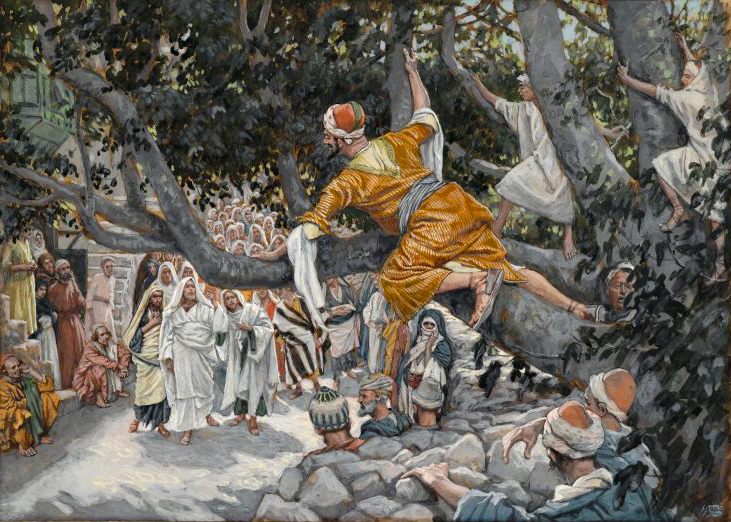

Zaqueo was "chief of publicans and rich" in Jericho (Lc 19.2): a tax collector at the service of Rome, enriched at the expense of its neighbours. His sin had concrete victims, and therefore also had social consequences: the people despised him, and when Jesus entered his house, "they all whispered, saying," He has entered into the house of a sinner "(Lk 19: 7). Curiosity made him go up to a sycomore; Jesus' look changed his life:" Zacchaeus, hurry and go down, for I must stay at your house today "(Lk 19: 5).
La conversión de Zaqueo enseña algo esencial: cuando el pecado ha dañado a otros, el arrepentimiento verdadero busca reparar. «Mira, Señor, la mitad de mis bienes se la doy a los pobres; y si he defraudado a alguno, le restituyo cuatro veces más» (Lc 19,8). Jesús responde: «Hoy ha sido la salvación de esta casa […]. Porque el Hijo del hombre ha venido a buscar y a salvar lo que estaba perdido» (Lc 19,9-10). El Catecismo cita a Zaqueo como ejemplo de la obligación de restituir lo injustamente adquirido (Catecismo, 2412) y enseña que «muchos pecados causan daño al prójimo. Es preciso hacer lo posible para repararlo» (Catecismo, 1459) Magisterium.
10. The Samaritan: the thirst that is not satisfied (Jn 4)
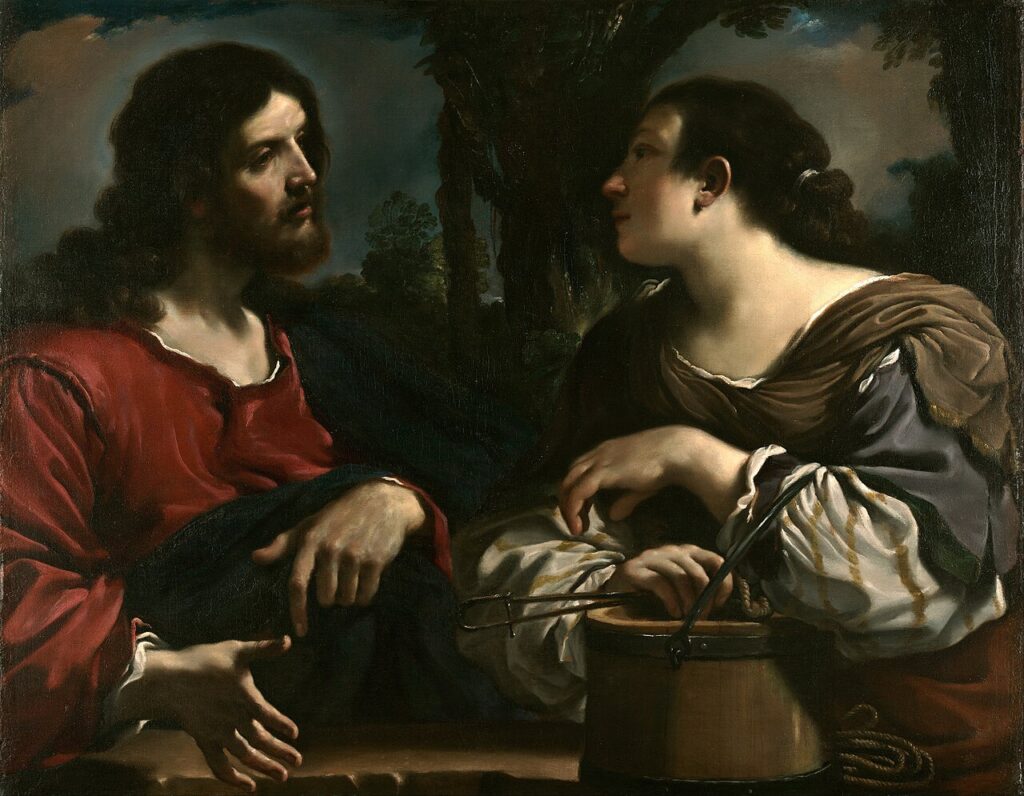

By the well of Jacob, at noon, Jesus asked a woman of Samaria to drink. The conversation gradually discovers a wounded life: "You have already had five, and now it is not your husband" (Jn 4: 18). Jesus does not humble her; he appoints the truth with delicacy, after offering her something better: "He that drineth of this water shall be thirsty again; but he that drineth of the water which I will give him shall no more thirst: the water which I will give him shall become within him a water supply that jumps to eternal life" (Jn 4: 13-14).
The scene illuminates a consequence of the sin that the prophets had already pointed out: the thirst that is not satisfied, the sour aljibes of Jeremiah. The Catechism reads it as the two-seat meeting: "Prayer, let us know or not, is the encounter of God's thirst and man's thirst. God is thirsty for man to thirst for Him" (Catechism, 2560, collecting Saint Augustine). And the end is bright: the woman "left her pitcher, went to the people and said to the people," Come and see a man who has told me all that I have done; will this be the Messiah? "(Jn 4: 28-29). The one whose life was ashamed becomes the first missionary of her people.
Next to it, the Gospel presents other women with wounds that find forgiveness: the sinner who unites the feet of Jesus, of whom He says: "His many sins have been forgiven, for he has loved much" (Lk 7: 47), and the woman who is surprised in adultery, whom he forgives with these words, "Nor do I condemn you. Go on, and henceforth do not sin" (Jn 8: 11). Forgiveness does not deny sin; it opens up a future.
11. St. Paul and James: slavery, inner division and death
St. Paul offers the deepest reflection of the New Testament on sin. In the letter to the Romans it teaches its origin and its universal reach: "As for one man sin entered the world, and for sin death, and so death was spread to all men, for they all sinned" (Rom 5: 12); "all sinned and are deprived of the glory of God" (Rom 3: 23). And his outcome: "the pay of sin is death, while the gift of God is eternal life in Christ Jesus, our Lord" (Rom 6: 23).
Pablo describe además, como nadie, la división interior que el pecado deja: «no hago lo que quiero, sino que hago lo que aborrezco; […] no hago lo bueno que deseo, sino que obro lo malo que no deseo» (Rm 7,15.19). Y termina con un grito que es a la vez desesperación y esperanza: «¡Desgraciado de mí! ¿Quién me librará de este cuerpo de muerte? ¡Gracias a Dios, por Jesucristo nuestro Señor!» (Rm 7,24-25). Jesús mismo había hablado de esclavitud: «todo el que comete pecado es esclavo. […] Y si el Hijo os hace libres, seréis realmente libres» (Jn 8,34.36).
The letter of James describes, for its part, how sin grows, as a gestation: "Each person is tempted by his own desire when he is dragged and seduced; then desire conceives and gives birth to sin, and then sin, when he matures, begets death" (St 1: 14-15). And the letter to the Hebrews warns of the hardening: "Encourage one another, on the contrary, every day, as long as this day lasts, that none of you may be hardened, deceived by sin" (Hb 3: 13).
But Paul's last word is not that of sin: "where sin abounded, grace abounded" (Rom 5: 20). The whole New Testament is summarized in John the Baptist's announcement to Jesus: "This is the Lamb of God, who takes away the sin of the world" (Jn 1: 29). And in the assurance that God "wants all men to be saved and to come to the knowledge of the truth" (1 Tm 2.4).
| Report | Consequence showing | Sign of mercy |
|---|---|---|
| Adán y Eva (Gn 3) | Fear, shame, accusation, dominion, fatigue, death | "Where are you?" and the promise of Gn 3: 15 |
| Cain (Gn 4) | Violence, indifference, wandering life | "You will be able to dominate it"; the sign that protects it |
| Babel (Gn 11) | Collective pride, incommunication, dispersion | Pentecost in response (Acts 2) |
| Saúl (1 Sam 15) | Self-justification, mid-recognition | The call to obedience of the heart |
| David (2 Sam 11-12) | blindness, cover-up, family consequences | Immediate forgiveness; psalm 51 |
| Judas and Peter | Remorse that encloses / repentance that opens | The look of Jesus; "you know I love you." |
| Hijo prodigo (Lc 15) | Libertad ilusoria, miseria, soledad | The father who runs and has a party |
| Zaqueo (Lc 19) | Damage to others, social exclusion | The salvation that comes into the house; the restitution |
| Lititana (Jn 4) | Be that nothing satious, life hurt | Living water; mission |
II. Twenty centuries of reflection of the Church
What Scripture tells in the form of stories, the Church has meditated, explained and lived for twenty centuries. Each epoch has emphasized one aspect: the Fathers of the East, the disease and death that sin introduces; those of the West, the disorder of love; medieval theologians, the precise analysis of guilt and punishment; the Council of Trent, the definition of doctrine against the disputes of its time; the saints, the living experience of combat and mercy; and the recent Magisterium, the social, ecological and ecclesial dimension of sin. They are not competing looks, but facets of the same truth.
1. The Fathers of the East: sin as disease and death
The Greek and Syrian Fathers consider sin first and foremost as a fall from divine life to corruption. Saint Athanasio of Alexandria (about 296-373) explains in your treaty On the Incarnation of the Word that man had been called from nothing to existence and had also received the grace of a divine life; by transgression he lost that life and fell back into corruption, and with it sin and misery filled the world (De Incarnatione, 3-4). The remedy could not be only moral: the Word itself needed to assume our flesh to overcome corruption from within. Hence his famous formula, gathered by the Catechism: "The Son of God became man to make us God" (Catechism, 460, citing De Incarnatione, 54, 3).
San Ireneo de Lyon (about 130-202) had read the whole history of salvation as a "recapitulation": what was bound in the beginning by disobedience is unleashed in Christ by obedience. And in that logic it places Mary. The Second Vatican Council, gathered in the Catechism, cites its words: Mary, "by her obedience was the cause of self-salvation and that of the whole human race," and recalls that many Fathers agreed with him in saying that "the knot of Eve's disobedience unleashed her obedience" (Catechism, 494, citing Lumen gentium, 56, y Adversus haeres 3, 22, 4) Magisterium.
San Gregorio Nacianceno (329-390) offers a surprising intuition. Commenting on the expulsion from paradise, he notes that there too man gained something: death, which cuts sin so that evil is not immortal; and concludes that thus the punishment becomes mercy, for God, when he punishes, does it by mercy (Speech 38, 12, on Theophany). It is a patristic interpretation, not a doctrinal definition: for him, death, the consequence of sin, is also a providential limit to evil. Father of the Church.
San Juan Crisóstomo (about 347-407), the great preacher of Antioch and Constantinople, speaks of sin with the language of the doctor. Invites the priest to show the wound as shown to the doctor (Homilies on statues, 3) and leaves a phrase that could serve as a motto for this whole study: for health it is not enough to have taken out the dart, we must also apply remedies to the wound; and it gives concrete examples, such as that of those who have lived in excess and must be cured by fasting (Homily 10 on St Matthew, 7). It is, almost in the same words, the image of the table and nails: forgiveness starts the dart; penance cures the wound.
Saint Maximus the Confessor (about 580-662) finely analyzed the core of sin. The Catechism collects its formula: man wanted to "be like God," but "without God, before God and not according to God" (Catechism, 398). And in the wilderness of Egypt, Evacrio Pontico (345-399) described the "thoughts" or fundamental temptations that attack the soul - gula, lust, greed, sadness, anger, acedia, vanagroria and pride -; that list, transmitted to the West by Casiano, is at the origin of the capital sins, and Pope Francis followed it in his cycle of catechesis on the vices and virtues (2023-2024). The whole Syrian tradition, for its part, was marked by san Efrén (about 306-373), a doctor of the Church, whose penalized prayer is even prayed in Byzantine Lent, asking, among other things, to see one's own sins and not to judge the brother Traditional attribution.
2. The Fathers of the West: The Disorder of Love
Ya a finales del siglo I, Saint Clemente Romano He urged the Christians of Corinth: "Let us keep our eyes fixed in the blood of Christ and understand how precious it is to his Father, for, having been shed for our salvation, he has obtained for the whole world the grace of repentance" (Catechism, 1432, citing the Letter to the Corinthians, 7, 4). Saint Ambrose of Milan (about 340-397) summarized the Christian's two conversions into a precious image: "in the Church, there is water and tears: the water of Baptism and the tears of Penance" (Catechism, 1429). And san Jerónimo (about 347-420) left a warning that the Council of Trent would take over: "If the sick person is ashamed to discover his wound to the doctor, medicine does not cure what he ignores" (Catechism, 1456).
But the great Western master of sin is Saint Augustine of Hipona (354-430), son of Saint Monica, who knew him inside before explaining him. Your Packaging start with the phrase that sums up the whole human drama: "You have made us for you and our heart is restless while not resting in you" (Catechism, 30, citing Packaging 1, 1, 1). Sin is, for Augustine, to seek in the creatures what only God can give; therefore it always leaves the heart restless. He defines it as a disorderly love: two loves made two cities, the love of God even the contempt of himself and the "love of himself even the contempt of God" (Catechism, 1850, citing De civitate Dei 14, 28).
Augustine also describes, with a precision that has not been overcome, how sin chain. In the Packaging writes that the enemy had his love in prison and had made him a chain: "quippe ex voluntate perverta facta is libido, and dum servitur libini, facta is consuetuto, and dum consuetudini non resistitur, facta est necessias". That is, from the twisted will is born the disorderly desire; when you serve the desire, custom is born; and when you do not resist the custom, necessity is born. And he adds that he was bound not with foreign iron, but with his own will of iron.Packaging 8, 5, 10) Father of the Church.
En The city of God He shows why the penalty of sin does not come from outside: in the punishment of that first sin, he wonders, what else was paid to disobedience but to disobedience? Since then man does not obey himself: as he did not want what he could, now he wants what he cannot (De civitate Dei 14, 15, 2). Es exactamente lo que el Catecismo enseñará siglos después: las penas del pecado son «algo que brota de la naturaleza misma del pecado» (Catecismo, 1472). Y sobre los pecados pequeños de cada día dejó una advertencia y un consuelo que el Catecismo recoge: «Muchos objetos pequeños hacen una gran masa; muchas gotas de agua llenan un río […] ¿Cuál es entonces nuestra esperanza? Ante todo, la confesión» (Catecismo, 1863, citando In epistulam Iohannis ad Parthos 1, 6).
Augustine is also the authentic, but not literal, origin of the saying "hate sin and love the sinner": in one of his letters he asks that fraternal correction be done with love for people and hatred for sin (Letter 211, 11; paraphrase since the English translation of the collection Nicene and Post-Nicene Fathers). And Pope Leo XIV quoted in Lourdes, in September 2026, another sentence of his that describes the dynamism of conversion: "May it always displease you what you are if you want to reach what you are not yet" (homily in Lourdes, 27-9-2026, citing the Sermon 169, 18).
Finally, san Gregorio Magno (about 540-604) ordered the doctrine of the capital vices and their "daughters" (see part V) and transmitted to the Latin Church the teaching on purification after death, which the Catechism collects when speaking of purgatory (Catechism, 1031, citing the Diálogos 4, 41, 3).
3. The Middle Ages: from public penance to frequent confession
In the first centuries, certain serious sins committed after Baptism - especially apostasy, murder and adultery - led to the "order of the penitents": a long time of prayer, fasting and exclusion from communion, which ended with public reconciliation by the bishop. That discipline strongly expressed a consequence of sin that is easily forgotten today: serious sin hurts the whole community, and so reconciliation was also ecclesial. Documented history.
Between the 6th and 8th centuries, the Irish and Anglo-Saxon monks spread a private, repetitive and penalized practice in Europe, which was reflected in the so-called "penitential books." In time the order we know today - confession, acquittal and penance - was consolidated, and in 1215 the Fourth Council of Lateran, in its canon 21, sent every faithful to the use of reason to confess their sins at least once a year and to communicate at least by Easter, severely protecting the secret of the confession Documented history. The precept remains in force in the Church: "Every faithful person who has reached the age of reason must confess, at least once [a] year, faithfully his serious sins" (Catechism, 1457, citing the Code of Canon Law, c. 989).
In that world the synthesis of Saint Thomas Aquinas (1225-1274), a doctor of the Church, who devoted questions 71 to 89 of the first part of the second part of his Theological sum. It distinguishes sin itself (questions 71-74), its causes (75-84) and its effects (85-89). When dealing with the effects it lists three: the corruption of the good of nature, the stain of the soul and the reat or debt of penalty (I-II, q. 85, prologue). His analysis, which is set out in Part III of this study, remains the basis of Catholic theology on the consequences of sin. Common education.
4. The Council of Trent: the defined doctrine
In the face of the disputes of the 16th century, the Council of Trento (1545-1563) solemnly defined several points that fully affect our theme. Defined doctrine:
- The original sin (session V, 1546): Adam lost the original holiness and justice, and transmitted to the whole human race not only the death and suffering of the body, but sin; Baptism truly erases it. The Catechism collects this teaching (Catechism, 403-406, with references to DS 1511-1515).
- La concupiscencia: in the baptized one inclination to sin remains that tradition calls concupiscence or, metaphorically, fomes sins; but, left for combat, "cannot harm those who do not consent to it and resist it with courage for the grace of Jesus Christ" (Catechism, 1264, citing DS 1515).
- The temporary penalty:: The forgiveness of guilt does not always erase any temporary penalty, which can be paid in this life or in purgatory (session VI, canon 30: DS 1580; the Catechism, 1031, quotes it together with DS 1820 by exposing the doctrine of purgatory; see also Catechism, 1472-1473).
- Penance as medicine (session XIV, 1551): The council teaches that the works of satisfaction turn away from sin and hold it back as with a flange; that they are remedy for the remains of sin and that, with acts of the contrary virtues, they remove the evil habits acquired; and it states that no Catholic ever thought that this sacrament was a court of anger or punishment (chapter 8, according to the English translation of Waterworth, 1848). He also states that satisfaction is not ours to the point of not being one through Jesus Christ (Catechism, 1460, citing DS 1691).
- Peace of conscience: the fruit of reconciliation is "the peace and tranquillity of consciousness, to which a deep spiritual comfort accompanies" (Catechism, 1468, citing DS 1674).
5. The saints and doctors: the experience of combat
The saints did not write about sin from the outside: they fought it in themselves and accompanied many in that fight. Their descriptions have the strength of experience.
St. Theresa of Jesus (1515-1582): the castle in the dark and the sun that remains within
En las Addresses, Saint Teresa compares the soul to a glowing castle in whose center God dwells. He asks to consider "what it will be like to see this castle so bright and beautiful, this eastern pearl, this tree of life that is planted in the same living waters of life, which is God, when it falls into a mortal sin: there is no more dark darkness, nor so dark and black, that it is not much more" (First abode 1). But he immediately adds the key of hope: "the source and that shining sun that is at the center of the soul does not lose its brightness and beauty that is always within it, and it cannot take away its beauty. But if a very black cloth was put on a glass in the sun, of course, even if the sun is in it, it will not do its clear operation in the glass" (First abode 2, 3). Sin does not turn God off in the soul: it covers his light. The thing to remove is the cloth.
San Juan de la Cruz (1542-1591): the five damages of appetites
The mystic of Fontiveros analyses in the Up from Mount Carmelo what "appetites" do in the soul, that is, voluntary and disorderly attachment. They cause, he says, "two main damages: the one is that they deprive it of the spirit of God, and the other is that the soul in which they live the weary, they torment, they obscure, they dirty and they flatter and they call it" (Subida I, 6, 1). And he devotes a chapter to every damage: the appetites torment it "as he who is in the torment of the lambs" (I, 7, 1); "they blind and darken it" (I, 8, 1); "they dirty and taint it" (I, 9, 1); and "they entiban and flatter it so that it does not have the strength to follow virtue and persevere in it" (I, 10, 1).
His most famous image explains why even a small, voluntary and consented attachment prevents flying: "That gives me a bird to be nodded to a thin thread than to a thick one, because, even if it is thin, it will be as roasted to him as to the thick one, while I will not break it to fly. It is true that the thin one is easier to break; but, as easy as it is, if it does not break, it will not fly" (Subida I, 11, 4). The saint carefully distinguishes: he does not speak of spontaneous movements that do not consent, but of the loved and maintained attachment. And in the dark night of sense and spirit it is presented as the loving work of God that purifies those attachments. He himself left the phrase that the Catechism gathers when speaking of the judgment: "In the afternoon they will examine you in love" (Catechism, 1022, citing Avisos y sentencias, 57).
Saint Ignatius of Loyola (1491-1556): the meditation of sins
The first week of the Spiritual exercisesSaint Ignatius proposes to look at one's own sin, but always before Christ crucified. In the first exercise, the final colloquium is to imagine Christ "before and on the cross" and to ask "what I have done for Christ, what I do for Christ, what I must do for Christ" (Exercises53). The second exercise invites "to bring to memory all the sins of life, looking from year to year or from time to time" (Exercises56) and to "ponder sins by looking at the ugliness and malice that every mortal sin committed has in itself" (Exercises, 57).
But the movement does not end in fear. Ignatius calls for an "adventive scry with crescent affection" by seeing all creatures leave him in life and hold him, and concludes "with a colloquium of mercy, reasoning and giving thanks to God our Lord, for he has given me life even agora, proposing amendment with his grace forward" (Exercises, 60-61). And the third exercise begins with a colloquium to the Virgin, "so that I may receive grace from her Son and Lord" for three things: "internal conversation of my flocks and abhorrence of them," to feel "the disorder of my operations" to be amended, and "conversation of the world" (Exercises63). In Saint Ignatius, knowing sin is the first step in a grateful friendship.
San Francisco de Sales (1567-1622): the affection of venial sin
En la Introduction to devout life (Part I, chapter 22), the Bishop of Geneva explains, with the image of a mirror in which the spots are better seen as the light increases, that we cannot be completely free of venial sins, but of all affection to them. One thing is to fall for fragility or neglect, and another very different to be pleased with a lack and to maintain the deliberate intention to continue to commit it. This consented affection is what cools devotion and opens the way to major falls (translation of work from the English version of the Christian Classics Ethereal Library).
The Holy Cura of Ars (1786-1859): God who goes after the sinner
St. John Mary Vianney spent much of his life in the confessional of a small French village, where penitents came from all over France. Benedict XVI, in his letter for the Priest Year, collected one of his most well-known teachings: "It is not the sinner who returns to God to ask for forgiveness, but God himself who goes after the sinner and makes him return to Him" (Benedict XVI, letter of 16-6-2009). It's the same logic as "Where are you?" of Genesis and the father running in the parable.
Santa Faustina Kowalska (1905-1938): mercy greater than sin
St. John Paul II, by canonizing it on April 30, 2000, recalled a few words of his Journal: "Humanity will not find peace until it is confidently directed to divine mercy" (homily of canonization, 30-4-2000). And in it Journal "The soul who confesses and receives Holy Communion will receive the total forgiveness of guilt and sorrow" (Journal, 699, edition of the Marian Fathers) Private disclosure. The Church does not impose faith on anyone in these revelations, but has recognized the holiness of Faustina and instituted for the whole Church on the Sunday of Divine Mercy.
6. The Magisterium of the 20th and 21st centuries
In 1946, the Pope Pius XII He gave a warning to the catechists of the United States that it became famous: perhaps the greatest sin in today's world is that men have begun to lose the sense of sin (radio-learning at the Boston Catechistic Congress, 26-10-1946). John Paul II took it back: the sense of sin "has its root in man's moral consciousness and is like his thermometer," and "just as the sense of God cannot be completely eliminated or the consciousness extinguished, the sense of sin is never completely deleted" (Reconciliatia et paenitentia, 18).
San Pablo VI explicó en Indulgentiarum doctrina (1967) the doctrine of temporary punishment and the communion of the saints. San Juan Pablo II He dedicated an entire exhortation to sin and reconciliation, Reconciliatia et paenitentia (1984), the fruit of the 1983 Synod, with its teaching on "social sin" (n. 16) and the distinction between mortal and venial sin (n. 17); Dominum et vivificantem (1986) showed that the Holy Spirit "convinces in the matter of sin" to save, not to condemn; and in Dives in misericordia (1980) presented mercy as the face of God revealed in Christ. Benedict XVI, en Save (2007), he spoke of judgment and purgatory as a meeting with Christ, and in a 2008 audience he summarized Christian hope in three words: "man is curable" (general audience, 3-12-2008).
Francisco extended the look to creation in Laudato si’ (2015), called the Jubilee of Mercy with Misericordiae vultus (2015) and repeated as a chorus that "God never gets tired of forgiveness, we are the ones who get tired of going to his mercy" (Evangelii gaudilii, 3). Y Lion XIVelected in May 2025, he has taken up these issues in his magisterium: "Faith does not prevent us from the possibility of sin, but it always offers us a way out: that of mercy" (general audience, 13-8-2025); "Recognizing our sins to become us is already an omen and a witness of resurrection" (Homily of Ash Wednesday, 18-2-2026). His teachings are cited throughout this study.
III. What does sin do in the person
The first consequences of sin fall upon the one who commits it. John Paul II said this: sin has first and foremost consequences "on the sinner himself," weakening his will and obscuring his intelligence (Reconciliatia et paenitentia, 16). Tradition has analysed these consequences with almost clinical accuracy. It is appropriate to distinguish between the wound that we all inherit - the original sin and its sequels - and the wounds that each one adds with his personal sins.
1. The wound of origin: original sin and concupiscence
The original sin is not a personal fault that everyone has committed. The Catechism explains it carefully: "Adam and Eve commit a personal sin, but this sin affects human nature, which they will transmit in a fallen state"; therefore it is called sin "in a similar way: it is a sin" contracted, "" not committed, "a state and not an act" (Catechism, 404). And it states its scope: "human nature is not completely corrupted: it is wounded in its own natural forces, subject to ignorance, suffering and the empire of death and inclined to sin (this inclination to evil is called" concupiscence ")" (Catechism, 405) Magisterium.
This precision is decisive in the face of two opposite errors: that of those who think that man is naturally good and do not need salvation, and that of those who believe that human nature was completely corrupted and freedom, annulled. The Catholic faith says something else: man is wounded, not destroyed. That is why the Catechism warns that "ignoring that man has a wounded nature, inclined to evil, leads to serious errors in the domain of education, politics, social action and customs" (Catechism, 407).
Baptism erases original sin, but not all its consequences. "In the baptized there remain certain temporal consequences of sin, such as the suffering, disease, death, or fragments inherent in life as the weaknesses of character, etc., as well as an inclination to sin that Tradition calls concupiscence, or metaphorically fomes sins"(Catechism, 1264). This inclination is not in itself sin; it remains" in order to serve as a test in them in the fight of Christian life assisted by the grace of God "(Catechism, 1426). And the Council of Trent adds a word of encouragement: the concupiscence," left for combat, cannot harm those who do not accept it and resist it with courage for the grace of Jesus Christ "(Catechism, 1264, citing DS 1515) Defined doctrine.
2. The four wounds of nature
St. Thomas Aquinas, following St. Beda, describes the consequences of sin on the faculties of the soul as four wounds (Theological sum I-II, q. 85, a. 3) Common education:
| Faculty | Your own order | The wound | How it is noted |
|---|---|---|---|
| The reason | To the truth | Vulnus glatianae: wound of ignorance | It is difficult to see clearly what is good and what to do |
| The will | Towards good | Vulnus malitiae: malice wound | It's hard to want good even if it looks |
| The irascible appetite | Towards the arduous good | Vulnus infirmitatis: weakness wound | It lacks strength in the face of the difficult; it is soon abandoned |
| Concubescible appetite | Towards pleasure moderated by reason | Vulnus concupicutiae: Concupiscence wound | Desire pushes beyond reasonable |
These wounds come from the original sin, but every personal sin enlarges them. St. Thomas sums it up in a phrase of enormous density: "for peccatum et ratio hebetatur, praecipue in agendis; et voluntas induratur ad bonum; et maior difficultas bene agendi accrescit; et concupiscentia magis exardescit". In other words, by sin reason is laid on, especially to act; will is hardened for good; difficulty of doing good grows; and desire is kindled more (I-II, q. 85, a. 3). Here is, in germs, the explanation of blindness, hardening and habit described below.
But St. Thomas himself puts a limit that fills with hope. Sin does not destroy nature or its principles; it diminishes the natural inclination to virtue, for every evil act inclines to repeat it; but that inclination can never go away at all, for then man would not be able to even sin (I-II, q. 85, a. 1-2). It uses a mathematical image: it is like a amount that is divided in half over and over; it decreases without end, but it never reaches zero. The Catechism says it with his words: sin "cannot destroy moral sense until its root" (Catechism, 1865). In the image of the table: by many nails you have, there is always healthy wood where God can work.
3. The stain: the soul that loses its brightness
Tradition speaks of the "stain" of sin. St. Thomas explains that it is a metaphor taken from the bright bodies, which lose their brightness by touching something that makes them soak. The soul has a double glow: that of the natural light of reason and that of the divine light of wisdom and grace. When it is attached to things against that light, it loses its glow; that is the stain (I-II, q. 86, a. 1). And he adds that the stain remains even though the act has passed, until man returns to the light by grace; and he does not come back at once, but with a movement of the will contrary to the first, as he who has gone away is not only close to no longer walking, but has to go back walking (I-II, q. 86, a. 2).
It is the same intuition of Saint Teresa with his black cloth on the glass, and that which Pope Leo XIV expressed at the beginning of Lent 2026: with prayer, fasting and alms we can work with the Lord "to make our life an unrepeatable masterpiece. It is a question of allowing him to remove the stains and cure the wounds that sin has caused in it, and of committing to making it flourish with all its beauty until he reaches the fullness of love" (Angelus, 22-2-2026). God does not look at the stained soul as a waste, but as a masterpiece to restore.
4. Blame and sorrow: the nail and the hole
Here is the heart of the doctrine on the consequences of sin, and it should be presented with the exact words of the Catechism. Magisterium:
"To understand this doctrine and practice of the Church, it must be remembered that sin has a double consequence. Serious sin deprives us of communion with God and thus makes us incapable of eternal life, whose deprivation is called the" eternal punishment "of sin. On the other hand, every sin, even venial, involves disorderly attachment to the creatures that it is necessary to purify, whether down here, or after death, in the state called purgatory. This purification frees from what is called the" temporary penalty "of sin. These two sorrows should not be conceived as a kind of revenge, inflicted by God from the outside, but as something that springs from the very nature of sin."
Catechism of the Catholic Church, 1472
And the following number explains what forgiveness does: "The forgiveness of sin and the restoration of communion with God involve the remission of the eternal sorrows of sin. But the temporal sorrows of sin remain" (Catechism, 1473). In speaking of confession, the Catechism states: "Absolution takes away sin, but does not overcome all the disorders that sin caused. Free from sin, the sinner must still recover full spiritual health" (Catechism, 1459).
St. Paul VI spoke of the "relics of sin": the penalties to be paid or the relics of sin to be purified "can remain, and in fact often remain, after the remission of guilt" (Indulgentiarum doctrina, 3). And Pope Francis explained it in a very close language: "In the sacrament of Reconciliation God forgives sins, which are actually cancelled; and yet the negative print that sins leave in our behaviors and in our thoughts remains. God's mercy is even stronger than this" (Misericordiae vultus, 22).
That is the truth that expresses the pastoral image of the table: the confession starts the nail - the guilt is truly forgiven, and with it the eternal penalty - but the hole remains in the wood - the print, the disorderly attachment, the custom -, which must be healed. And the hole does not God: the nail does. But the image has a limit that the Catechism expressly points out: "A conversion that comes from a fervent charity can reach the total purification of the sinner, so that no penalty would remain" (Catechism, 1472). A very big love can suddenly close all the holes. It is what Jesus said about the sinner who washed his feet: "His many sins have been forgiven, for he has loved much" (Lk 7: 47).
5. The habit and vice: a nail calls another nail
One of the most real consequences of sin is that it tends to be repeated. The Catechism describes it this way: "Sin creates an ease for sin, generates vice through the repetition of acts. From this are deviated inclinations that obscure consciousness and corrupt the concrete assessment of good and evil. Thus sin tends to reproduce and strengthen, but it cannot destroy moral sense until its root" (Catechism, 1865). He adds that the reiteration of sins, "even venial, begets vices" (Catechism, 1876).
It is the chain that Saint Augustine described in his Packaging: twisted will, desire, custom, necessity. Pope Francis, in his catechesis on lust, spoke of the unordered desire that "becomes a chain that deprives man of freedom" (general audience, 17-1-2024). And Jesus said it with the utmost clarity: "everyone who commits sin is a slave" (Jn 8: 34). The paradox of sin is that it is presented as freedom - "you will be like God" - and it ends in slavery. But the same word of Jesus opens the way out: "If the Son makes you free, you will be truly free" (Jn 8: 36).
6. The blindness and hardening of the heart
El pecado repetido no solo debilita: acostumbra, y la costumbre ciega. Lo vimos en David, que necesitó al profeta Natán para ver lo que todos veían. La carta a los Efesios describe a quienes viven alejados de Dios «con la razón a oscuras y alejados de la vida de Dios; por la ignorancia y la dureza de su corazón. Pues perdida toda sensibilidad…» (Ef 4,18-19). San Juan Pablo II habló del riesgo de un «eclipse», una «deformación», un «entorpecimiento» o una «anestesia» de la conciencia (Reconciliatia et paenitentia, 18). The consciousness that is used to sin stops feeling, like an anesthetized member who no longer warns of the harm.
The ultimate degree of this consequence is the hardening, which the Catechism describes with serious words and at the same time full of hope: "There are no limits to God's mercy, but who deliberately refuses to accept God's mercy through repentance rejects the forgiveness of his sins and the salvation offered by the Holy Spirit. Such hardening can lead to final condemnation and eternal perdition" (Catechism, 1864). John Paul II explained that the so-called "blasphemy against the Holy Spirit" - the sin that, according to Jesus, is not forgiven - "does not consist in the fact of offending the Holy Spirit with words; it consists, on the contrary, in the rejection of accepting the salvation that God offers," while the sources of Redemption are "always open" (Dominum et vivificantem, 46) Magisterium. A pastoral consequence, which is not quoted from any document but is derived from this teaching: who fears to have committed that sin and desires forgiveness, shows with his own desire that he has not committed it. Common education.
7. The loss of peace and joy
Perhaps the most experienced consequence is the loss of peace. We saw it in Psalm 32: "While I was silent my bones were consumed." Isaiah said this in no way: "There is no peace for the wicked," says my God "(Is 57,21). St. John of the Cross spoke of the appetites that" sing "and" tormenting. "And Saint Augustine summarized the cause: the heart is restless while not resting in God.
By contrast, St Paul lists the fruits that the Spirit makes grow when sin does not choke them: "love, joy, peace, patience, kindness, goodness, loyalty, modesty, self-control" (Ga 5,22-23). And the Catechism describes what brings reconciliation back: "the peace and tranquility of consciousness, to which a deep spiritual comfort accompanies" (Catechism, 1468). Therefore David asked, "Give me back the joy of your salvation" (Ps 51,14). What sin dries, grace makes it flourish again.
8. Internal fragmentation
Benedict XVI summarized the universal experience of this wound: "The empirical fact is that there is a contradiction in our being" (general audience, 3-12-2008), the same one that Paul confessed: "I do not do as good as I wish, but I do as bad as I do not want" (Rom 7: 19). Sin divides the person within: what he thinks, what he feels and what he does stop going together. John Paul II spoke of the "torn man" (Reconciliatia et paenitentia, 15). But the same catechesis of Benedict XVI ended with an affirmation that is the key to everything: as evil comes from a created freedom that abuses itself, "evil can be overcome. Therefore the creature, man, is curable" (general audience, 3-12-2008).
Sin and psychological health
The Church distinguishes between moral guilt and psychological disorders. It recognizes that "the impulses of sensitivity, passions can also reduce the voluntary and free character of lack, as well as external pressures or pathological disorders" (Catechism, 1860). The sacrament of Penance does not replace professional help when there is disease, and professional help does not replace God's forgiveness when there is sin. Who lives the consciousness of sin with anguish or scruple will do well to speak it calmly with a priest Pastoral policy.
IV. Death sin and venial sin
Not all sins have the same consequences. The distinction between mortal and venial sin is, says the Catechism, "perceptible already in Scripture" and has been imposed in the tradition of the Church (Catechism, 1854). St. John insinuates it in writing that "there is sin that is not of death" (1 Jn 5: 16-17). John Paul II summarized the essential: "the essential and decisive distinction is between sin that destroys charity and sin that does not kill supernatural life" (Reconciliatia et paenitentia, 17) Magisterium.
The mortal sin: the broken friendship
"The mortal sin destroys charity in man's heart for a serious violation of the law of God; it turns away man from God, who is his ultimate end and bliss, preferring a lower good" (Catechism, 1855). For a sin to be mortal, three conditions must be given at the same time: "It is a mortal sin which has as its object a serious matter and which is also committed with full knowledge and deliberate consent" (Catechism, 1857, citing Reconciliatia et paenitentia, 17). The Ten Commandments (Catechism, 1858) require serious matter; knowledge implies knowing that the act is opposed to the law of God, and consent, having wanted it with sufficient freedom (Catechism, 1859).
Its consequences are the most serious that a person can suffer: "It involves the loss of charity and the deprivation of the sanctifying grace, that is, the state of grace. If it is not rescued by God's repentance and forgiveness, it causes the exclusion of the Kingdom of Christ and the eternal death of hell" (Catechism, 1861). That is why it requires "a new initiative of God's mercy and a conversion of the heart that is usually carried out in the framework of the sacrament of Reconciliation" (Catechism, 1856), and that who is aware of being in grave sin must not commulate without first confessing, except for a serious reason and without the possibility of confession, in which case he must do a perfect act of contrition in order to confess as soon as possible (Catechism, 1457).
But the Catechism adds, in that same number, a warning that must never be forgotten: "Although we can judge that an act is in itself a serious fault, the judgment of people must be entrusted to the righteousness and mercy of God" (Catechism, 1861). And it recognizes that there are factors that reduce responsibility: "Involuntary ignorance can reduce, and even excuse, the imputability of a serious lack"; passions, external pressures or pathological disorders can also reduce the voluntary character of the lack (Catechism, 1860). No one can look at another's heart.
Venial sin: the wounded friendship
"A venial sin is committed when the measure prescribed by moral law is not observed in a light matter, or when it is disobeyed by moral law in serious matter, but without full knowledge or without full consent" (Catechism, 1862). "Venial sin allows charity to survive, though it offends and injures it" (Catechism, 1855).
Its consequences are real, although they do not break friendship with God: "Venial sin weakens charity; it involves disorderly affection for created goods; it prevents the progress of the soul in the exercise of virtues and the practice of moral good; it deserves temporary penalties. The deliberate, unrepentant, venial sin makes us gradually ready to commit mortal sin." And at the same time, "venial sin does not break the Covenant with God. It is humanly reparable with the grace of God"; "it does not deprive of sanctifying grace, of friendship with God, of charity, nor, therefore, of eternal bliss" (Catechism, 1863, with Reconciliatia et paenitentia, 17).
St. Augustine, quoted in that same place, puts the just balance between the carelessness and the scruple: "These sins, which we call mild, do not consider them little: if you have them for such when you weigh them, it trembles when you count them. Many small objects make a large mass; many drops of water fill a river. A lot of grains do a lot. So what is our hope? First of all, confession" (Catechism, 1863). The Church therefore strongly recommends the confession of venial sins, which "helps to form consciousness, to fight against bad inclinations, to be cured by Christ, to progress in the life of the Spirit" (Catechism, 1458).
In the image of the table
Mortal sin is the great nail, which crosses the table from part to part, because the life of grace is lost, and only God can redo it. The venial does not pass through it, but every small nail weakens it, and many together end up breaking it. In both cases, the good news is the same: God is a carpenter and knows how to restore. Catechetical image
V. Capital sins and their fruits
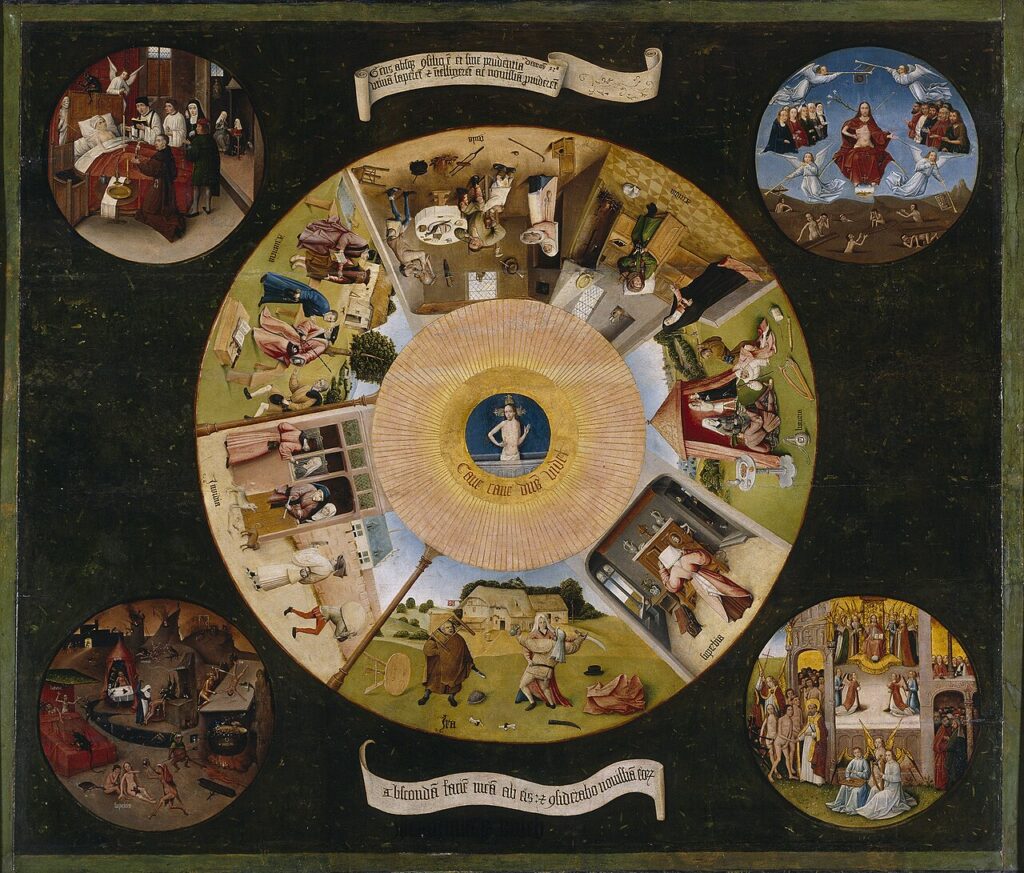

The Christian experience soon discovered that some sins are the root of others. The Catechism explains that vices can be catalogued according to the virtues to which they oppose, "or can also be referred to the capital sins that the Christian experience has distinguished following Saint John Casiano and Saint Gregory the Great. They are called capital because they generate other sins, other vices. They are pride, greed, envy, anger, lust, gula, laziness" (Catechism, 1866) Magisterium.
A long story: from the desert monks to the current list
The list has history. In the fourth century, he described eight "thoughts" or fundamental temptations; St. John Casiano took them to the West and dedicated to each one a book of his Instituciones. Saint Gregory the Great reorganized them in his Moralia in Job (book 31, chapter 45): He set aside the pride, as the root of all, and pointed out seven main vices - vanagroria, envy, anger, sadness, greed, gula and lust -, comparing them with the captains of an army. St. Thomas Aquino explains that "capital" comes from caput, head: the capital vice is the beginning and guide of others, and remember that Gregorio compares them to the heads of an army (Theological sum I-II, q. 84, a. 3). The current list, which gathers the Catechism, reorganizes the old one: it integrates the vane into the pride and expresses the spiritual sadness or acedia above all as laziness Common education.
On pride, St. Thomas literally quotes St. Gregory: ‘ipsa vitiorum regina superbia, cum devictum plene color ceperit, mox illud septem principalibus vitiis, quasi quibusdam suis ducibus, devastandum tradition’. In other words, the pride, queen of vices, as soon as it is completely taken over by a defeated heart, gives it away to be devastated to seven main vices, as to its captains (Theological sum II-II, q. 162, a. 8). Pope Francis described it in his catechesis as the vice in which "radical sin is hidden, the absurd claim to be like God" (general audience, 6-3-2024): it is the sin of Eden that is repeated.
Los vicios y sus "hijas"
The most revealing thing about St Gregory's teaching is that every capital vice begets a family of sins, his "daughters." St. Thomas collects them one by one in the Amount. The following table gives them in translation of work from Latin Father of the Church:
| Vicio capital | His "daughters," according to St. Gregory | Where St. Thomas collects it | Virtue that cures it |
|---|---|---|---|
| Vagroria (today, pride) | Disobedience, boasting, hypocrisy, strife, stubbornness, discord, a desire for new | II-II, q. 132, a. 5 | Humiliates |
| Envidia | Hate, murmur, defamation, joy for the evil of the neighbor, sadness for his good | II-II, q. 36, a. 4 | Brotherhood, joy for the good of others |
| Ira | Rows, swelling of the mood, insults, cries, indignation, blasphemy | II-II, q. 158, a. 7 | Meekness, patience |
| Tristeza o acedia (hoy, peresis) | Malice, rancor, put in the uncleanness, despair, wreak before the commandments, wander from the mind toward the wrongdoing | II-II, q. 35, a. 4 | Diligence, hope, spiritual joy |
| Avaricia | Betrayal, fraud, deception, perjury, restlessness, violence, hardness of heart against mercy | II-II, q. 118, a. 8 | Generosity, detachment |
| Sugar | Foolish joy, colliding, impurity, speech, bottling of the mind | II-II, q. 148, a. 6 | Temperance, sobriety |
| Lucaria | Blindness of mind, unreflection, inconstancy, precipitation, self-love, hatred of God, attachment to this world, horror or despair of the future world | II-II, q. 153, a. 5 | Castidad |
The table clearly shows why sin is never alone. The greed ends in hardness of heart against mercy; la lujuria, en blindness of the mind; envy, to rejoice in the evil of others. The internal consequences described in Part III - blindness, hardening, loss of peace - appear here as concrete fruits of concrete vices.
Pope Francis's Word on Vices
Between December 2023 and spring 2024, Pope Francis dedicated a cycle of catechesis to vices and virtues, following the list of Evagrio. He proposed to look closely "those vices that chain us" to walk, with the grace of God, "towards those virtues that can flourish in us" (general audience, 3-1-2024). Some of his sentences condemn the consequences of each vice:
- On gula and consumerism: "We have abjured the name of men, to assume another," consumers "" (10-1-2024).
- On lust: an unordered desire "becomes a chain that deprives man of freedom," and lust "drives people to use, to depredate them" (17-1-2024).
- On greed: "It is a heart disease, not a portfolio" (24-1-2024).
- On anger: "Anger is a vice that destroys human relations" (31-1-2024).
- On pride: "radical sin, the absurd claim to be like God, is hidden in it" (6-3-2024).
The remedy: the opposite virtue
Tradition is not limited to diagnosing. The Council of Trent teaches that the works of penance remove the bad habits with acts of the opposite virtues, and St. John Chrysostom put concrete examples: who has sinned by excess, who is cured by fasting (see part II). St. Paul contrasts "the works of the flesh" - among them "enmity, discord, envy, anger, ambitions, divisions" - with the "fruit of the Spirit" (Ga 5: 19-23). To pride is answered with humility; to greed, with generosity; to envy, with joy for the good of the other; to anger, with meekness; to lust, with chastity; to gula, with temperance; to laziness, with diligence. In the picture of the table: the hole that left a nail is filled with the wood of the opposite virtue.
The sins that "cry out to heaven"
The catechetical tradition also points to sins whose injustice is so serious that, according to Scripture, "they cry to heaven": "the blood of Abel; the sin of the Sodomites; the cry of the oppressed people in Egypt; the lament of the alien, the widow and the orphan; the injustice towards the wage-earner" (Catechism, 1867). They all have victims, and with them the following part of this study is opened: the consequences of sin beyond the one who commits it.
VI. Beyond the person: family, society, creation and Church
Una de las ideas más extendidas en nuestra época es que el pecado, si existe, es un asunto privado: «mientras no haga daño a nadie…». La fe cristiana dice lo contrario. San Juan Pablo II lo formuló con toda claridad: «No existe pecado alguno, aun el más íntimo y secreto, el más estrictamente individual, que afecte exclusivamente a aquel que lo comete» (Reconciliatia et paenitentia, 16) Magisterium. Y explicó por qué: «En virtud de una solidaridad humana tan misteriosa e imperceptible como real y concreta, el pecado de cada uno repercute en cierta manera en los demás». Si existe una «ley de la elevación», por la que toda alma que se eleva eleva consigo al mundo, «a esta ley de la elevación corresponde, por desgracia, la ley del descenso […] un alma que se abaja por el pecado abaja consigo a la Iglesia y, en cierto modo, al mundo entero» (Reconciliatia et paenitentia, 16).
1. In the family
The first victims of sin are often the closest. We saw it in Eden: the union between man and woman "is subject to tensions" and their relations are "marked by desire and domination" (Catechism, 400). We saw him in Cain, who kills his brother, and in the house of David, where the sword does not depart after the king's sin. The infidelity, lie, anger, selfishness or vices of a family member hurt everyone, and especially children.
The Catechism speaks of the scandal, which is precisely this consequence of sin over others: "The scandal is the attitude or behavior that induces another to do evil. He who scandalizes becomes tempting his neighbor," and his gravity is particular "when it is caused by those who, by nature or function, are obliged to teach and educate others" (Catechism, 2284-2285). But the family is also the first place of healing. Benedict XVI, speaking to Africa but with words valid for all, wrote: "The family is certainly the place to learn and practice the culture of forgiveness, peace and reconciliation" (African munus, 43). To ask for forgiveness at home is one of the most concrete ways of repairing the consequences of sin.
2. In society: the sin that is made structure
The sins of many people, together with and repeated, end up creating customs, institutions and ways of living that push others to evil. The Catechism describes it this way: sin "makes men accomplices to each other, makes between them the concupiscence, violence and injustice. Sin causes social situations and institutions contrary to divine goodness." The structures of sin "are the expression and effect of personal sins. They encourage their victims to commit evil in turn. In an analog sense they constitute a" social sin "(Catechism, 1869).
John Paul II explained the mechanism: the structures of sin "are based on personal sin and are therefore always linked to concrete acts of people, which introduce them, and make it difficult to eliminate them. And so these same structures are strengthened, spread and are the source of other sins" (Sollicitudo rei sociali, 36). But he also warned against the error of dissolving personal responsibility: sin, "in the true and proper sense, is always an act of the person," and it cannot be downloaded into the structures, systems or others the sin of individuals (Reconciliatia et paenitentia, 16). Therefore the Catechism recalls that we have responsibility for the sins of others when we cooperate with them: "by participating directly and voluntarily; by ordering them, by advising them, by praising them or by approving them; by not revealing them or by preventing them when they are obliged to do so; by protecting those who do evil" (Catechism, 1868).
Pope Leo XIV has returned to this teaching. In the exhortation Dilexi te (2025) recalls that the conference of Puebla "described the structures of injustice as" social sin "" (n. 90) and, with Pope Francis, that the structure of sin "is inserted into a dominant mentality that considers normal or rational what is but selfishness and indifference" (n. 93). And in the homily of Ash Wednesday, 2026, he joined him with the life of every day: "Sin is certainly personal, but it takes shape in the real and virtual environments that we frequent, in the attitudes with which we are mutually conditioned, not rarely within true" structures of sin "of an economic, cultural, political and even religious order" (18-2-2026). In the examination of consciousness there is also what we consent, shut up or buy.
3. In creation
From the beginning, Scripture unites man's sin with the suffering of the earth: "the ground is cursed because of you" (Gn 3: 17). St. Paul says that creation lives in the hope of being "freed from the slavery of corruption" and that "to this day all creation is moaning and suffering labor pains" (Rom 8: 21-22). Pope Francis developed this dimension in Laudato si’: "The violence that is in the human heart, hurt by sin, is also manifested in the symptoms of disease that we warn in the soil, in the water, in the air and in living beings" (n. 2). And he gathered a few words from the Ecumenical Patriarch Bartolomé: "a crime against nature is a crime against ourselves and a sin against God" (n. 8).
Benedict XVI had summarized it in a phrase of his homily of the beginning of the pontificate, which Francis cites: "The outer deserts multiply in the world because the inner deserts have spread" (Laudato si’, 217). And Leo XIV has repeated it in his message for the World Day of Prayer for the Care of the Creation of 2025: "These various wounds are a consequence of sin. This is certainly not what God had in mind when he entrusted the Earth to the man created in his image." Here, too, the "ecological conversion" of which Francis spoke begins by "recognizing one's own mistakes, sins, vices or negligence, and repenting in heart, changing from within" (Laudato si’, 217-218).
4. In the Church: the communion of the saints
La dimensión más honda de esta solidaridad es la eclesial. Los cristianos forman un solo cuerpo: «Y si un miembro sufre, todos sufren con él; si un miembro es honrado, todos se alegran con él» (1 Co 12,26). El Catecismo saca la consecuencia: «El menor de nuestros actos hecho con caridad repercute en beneficio de todos […]. Todo pecado daña a esta comunión» (Catecismo, 953). San Pablo VI lo dijo con palabras paralelas: el pecado de uno daña a los demás, de la misma forma que la santidad de uno beneficia a los otros (Indulgentiarum doctrina, 4).
Por eso la confesión no es solo un asunto entre el alma y Dios. «El pecado menoscaba o rompe la comunión fraterna. El sacramento de la Penitencia la repara o la restaura», y tiene «un efecto vivificante sobre la vida de la Iglesia que ha sufrido por el pecado de uno de sus miembros» (Catecismo, 1469). El penitente perdonado, dice san Juan Pablo II citado en ese mismo número, «se reconcilia consigo mismo en el fondo más íntimo de su propio ser […]; se reconcilia con los hermanos, agredidos y lesionados por él de algún modo; se reconcilia con la Iglesia, se reconcilia con toda la creación» (Catecismo, 1469, citando Reconciliatia et paenitentia, 31).
This same communion is the foundation of hope: just as one's sin hurts all, one's holiness sustains all. "The Christian who wants to purify himself from his sin and to sanctify himself with the help of God's grace is not found alone" (Catechism, 1474). The Virgin Mary, the saints and the whole Church push with him. In the image of the table: the tables are not loose, they form the same floor; a nail in one is seen on the side, and a healthy table holds the others.
VII. Una mirada a todos el mundo
The doctrine of sin is one throughout the Catholic Church, but each tradition and every continent has lived it with its own accents. Walking them helps to see facets that are often lost.
1. The Christian East: sin as disease and Christ as a doctor
The Eastern Catholic Churches - Byzantine, Syriac, Coptic, Armenian, Caldeas, Maronite, Syrian-Malabar and others - keep with special viveza the look of the Greek and Syrian Fathers: sin is above all a disease that disfigures the image of God in man, and penance is medicine. This look is the heritage of the whole Church: the Catechism calls Christ "a doctor of our souls and of our bodies" (Catechism, 1421) and says that in confession "it is the doctor who is inclined over each of the sick who need him" (Catechism, 1484). John Paul II, in his letter on the Churches of the East, wrote that man, even experiencing "the bitter taste of his limit and of his sin, is not abandoned to recrimination or anguish, because he knows that within him the power of divinity acts," and that Christ "puts the divinity in the sick heart of humanity" (Orientale lumen, 15).
This spirituality is expressed in the liturgy. In Byzantine tradition, the Gran Canon de san Andrés de Creta (VII-VIII centuries), which is sung in the Great Lent, goes through all the Scripture in the first person - Adam, Cain, David, the publican, the sinner - so that the faithful can read in those stories his own sin and his possible conversion. The the prayer of Jesus, transmitted by the monks of Sinai, Syria and Mount Athos, condemns all the penitential attitude: "Lord Jesus Christ, Son of God, have mercy on us sinners" (Catechism, 2667). The Code of Canons of the Eastern Churches describes penance as the sacrament in which the faithful who have sinned after Baptism, moved by the Holy Spirit, turn to God with pain and purpose of new life, and are reconciled with God and the Church, whom they wounded with their sin (CCEO, c. 718, paraphrase). East underlines that sick sin and the sacrament cure; West, that sin leaves a debt and that it must be repaired. The Catholic Church holds the two views, which do not compete Common education.
2. Europe: public penance, co-fradies and awareness examination
Europe was the stage of the long evolution of the penitential discipline described in Part II: from public penance, from ancient to private and frequent confession. Since the 13th century, there has been a multiplication of the co-fradies of laity that united prayer, penance and works of mercy: the care of the sick and poor, the burial of the deceased, the visit to the prisoners. In Spain, the penitential cofradies of the Vera Cruz and the Blood of Christ, with their penitence stations in Holy Week, express from the end of the Middle Ages a public and community awareness of sin and the need for conversion; their extreme forms were limited by the civil and ecclesiastical authorities - a real cédula of Charles III of 1777 banned disciplinants - and today the penitence station is lived with silence, prayer, sacrifice and charity. Documented history. No outside gesture, however beautiful, replaces confession or buys forgiveness; but it can express and feed the conversion of the heart.
Europe has also been the stage of Pius XII's warning about the "loss of the sense of sin" and the image of Benedict XVI on "inner deserts." Secularization has spread the idea that sin does not exist, but only errors or conditions. But, as John Paul II recalled, the sense of sin is never completely erased, because it is linked to the consciousness (Reconciliatia et paenitentia, 18).
3. America: evangelization and "social sins that cry out to heaven"
In the evangelization of America, confession took a central place and forced missionaries to learn indigenous languages. Saint Toribio of Mogrovejo, Archbishop of Lima, presided over the Third Limense Council (1582-1583), from which the Doctrina christiana trilingual - in Spanish, quechua and aimara - printed in Lima in 1584, and a confessional for Indian priests (1585) in the same languages Documented history. The historiography also points to the enormous communication effort of these instruments and their limitations, specific to the time.
In recent times, the Church in America has developed above all the social dimension of sin. St. John Paul II, in his exhortation to the Synod of America, spoke of "the social sins that cry out to heaven, because they generate violence, break peace and harmony between the communities of the same nation, between nations and between the various parts of the continent," and listed among them "the drug trade, the laundering of illicit profits, corruption in any environment, the terror of violence, weaponism, racial discrimination, inequalities between social groups, the unreasonable destruction of nature." But he also recalled that "sins and social virtues do not exist in abstract, but are the result of personal acts" (Ecclesia in America, 56) Magisterium.
4. Africa: God's Family and Reconciliation · Global Voices
St. John Paul II observed that in Africa "the reality of sin in its individual and social forms is quite present in the consciousness of those peoples, and the need for rites of purification and atonement is also felt" (Ecclesia in Africa, 42). The African Church thinks of itself as "the family of God," and therefore lives with strength that sin hurts the family and the community. Benedict XVI, after the second Synod for Africa, wrote that "reconciliation overcomes crises, restores the dignity of people and opens the way to development and stable peace among peoples at all levels" (African munus21); that "it is not an isolated act, but a long process by which each one is restored in love, a love that heals" (n. 34); and that the sacrament of Reconciliation "renews the broken ties between the human person and God, and restores the bonds in society" (n. 155).
The recent history of Africa has also shown, dramatically, how far the social consequences of sin can go: wars, ethnic hatred and genocides, such as that of Rwanda in 1994, in a country that is mostly Christian. The Church has had to remember there that the confession heals the sinner, but does not replace justice, truth or reparation to the victims, and that Christian forgiveness is not impunity.
5. Asia: persecution, contrition and martyrdom
St. John Paul II, in the exhortation on the Church in Asia, recalled that Jesus came to reconcile with God to humanity "after the original sin had introduced a rupture in the relationship between the Creator and creation," and that "he took upon himself the wounds inflicted by sin to humanity and offered the liberation of them through conversion, whose first fruits were clearly manifested in the repented thief" (Ecclesia in Asia, 11-12).
Asia also offers moving testimonies of how the consciousness of sin is lived in extreme circumstances. In Japan, after the prohibition of Christianity in 1614, communities of hidden Christians kept faith for more than two centuries without priests; among the texts they kept was a treaty on the contritation prepared by the Jesuit mission in 1603, known as Conchirisan no rhyaku (del portugués contrition), because, without confessors, they had only the perfect act of contrition. Documented history. In Korea, where faith came through lay people in the late 18th century, and in Vietnam, thousands of Christians died for not apostating; St. John Paul II canonized 103 Korean martyrs in 1984 and 117 Vietnamese martyrs in 1988. In these Churches, penance also included welcoming again those who had given in under torture: mercy with the fallen, one of the oldest issues in the history of the Church.
VIII. The ultimate consequences
The Christian faith does not stop in this life. Sin also has consequences that look to eternity, and the Church teaches them seriously and with sobriety. St. John Paul II warned that "it is always necessary to maintain some sobriety in describing these last realities, since their representation is always inadequate" (general audience, 21-7-1999). What follows follows is what the Church teaches, without adding images that are not doctrine.
1. Death
Scripture and Tradition teach that death, as we know it, entered the world by sin: "for the envy of the devil death entered the world" (Sb 2: 24); "the pay of sin is death" (Rom 6: 23). The Catechism thus formulates it: "Death is a consequence of sin. The Magisterium of the Church teaches that death entered the world because of man's sin. Although man possessed a mortal nature, God destined him not to die" (Catechism, 1008) Magisterium. That is why death is "the last enemy" to be defeated (Catechism, 1008, with 1 Cor 15.26).
But Christ has transformed death. "For those who die in the grace of Christ, it is a participation in the death of the Lord so that they can also participate in his Resurrection" (Catechism, 1006). And, as St. Gregory was intubated, even death can be a mercy that limits evil (see part II). For this reason the Church asks Mary, in every avemary, to pray for us "at the hour of our death," and the Catechism explains: "May she be present at that hour, as she was at the death on the Cross of her Son, and may she welcome us as our mother in the hour of our transit to lead us to her Son Jesus, to Paradise" (Catechism, 2677).
2. The trial
"Death puts an end to man's life as a time open to the acceptance or rejection of the divine grace manifested in Christ" (Catechism, 1021). "Every man, after death, receives in his immortal soul his eternal retribution in a particular judgment that refers his life to Christ, either through a purification, or to enter immediately into the bliss of heaven, or to condemn himself immediately forever" (Catechism, 1022). The Catechism supports this teaching in the Second Council of Lyon, in the constitution Benedictus God. of Benedict XII and at the Council of Florence (DS 856-858, 1000-1002, 1304-1306) Defined doctrine. And the Catechism closes that number with the phrase of St. John of the Cross: "In the afternoon they will examine you in love."
At the end of history, when Christ becomes glorious, the final judgment will take place, which "will reveal that God's righteousness triumphs from all the injustices committed by his creatures and that his love is stronger than death" (Catechism, 1040). Benedict XVI dedicated to the judgment some bright pages of his encyclical on hope. He explained that grace and justice go together: "Grace does not exclude justice. It does not turn injustice into law" (Save, 44). The trial is therefore a hope for the victims of all the injustices of history: evil will not have the last word.
3. Purgatory: the purification of love
What about those who die in friendship with God, but with holes still open in the table? The Church answers: "Those who die in the grace and friendship of God, but imperfectly purified, even though they are sure of their eternal salvation, suffer after their death a purification, in order to obtain the holiness necessary to enter into the joy of heaven" (Catechism, 1030). It is a "final purification of the elect that is completely different from the punishment of the condemned" (Catechism, 1031). The existence of this purification was defined by the councils of Florence and Trento Defined doctrine.
What is not defined is its nature or its "duration." The language of "purifying fire" belongs to tradition (Catechism, 1031, with 1 Co 3.15 and 1 P 1.7) Common education. Benedict XVI noted, as the opinion of some recent theologians, that this fire is Christ himself, whose look cures us "through a transformation, certainly painful," but that "it is a blessed pain, in which the holy power of his love penetrates us as a flame, allowing us to be at last totally ourselves and, with it, totally of God"; and he warned that we cannot measure with the chronometric criteria of this world the duration of that burning that transforms (Save, 47) Theological opinion. That is why this study does not speak of days or years of purgatory, nor does it describe torments: they are not Church doctrine.
The communion of the saints also reaches the dead. The Church has offered for them "from the early days," "in particular the Eucharistic sacrifice," and recommends "alms, indulgences and works of penance for the deceased" (Catechism, 1032). In the image of the table, purgatory is the last sanding and varnishing that the Carpenter gives to the wood before placing it in his house: what was not finished here, God ends it there with love, and what we do here for us and for the deceased advances that work. Catechetical image.
4. Hell: definitive self-exclusion
The most serious consequence that sin can have is the definitive separation of God. The Church teaches it because it is taught by Jesus, who often speaks of "gehenna" and "fire that never goes out" (Catechism, 1034). But the Catechism explains it with a very precise vocabulary, which should be mentioned in full. Magisterium:
«Salvo que elijamos libremente amarle no podemos estar unidos con Dios. Pero no podemos amar a Dios si pecamos gravemente contra Él, contra nuestro prójimo o contra nosotros mismos […]. Morir en pecado mortal sin estar arrepentido ni acoger el amor misericordioso de Dios, significa permanecer separados de Él para siempre por nuestra propia y libre elección. Este estado de autoexclusión definitiva de la comunión con Dios y con los bienaventurados es lo que se designa con la palabra “infierno”».
Catechism of the Catholic Church, 1033
"The teaching of the Church affirms the existence of hell and its eternity," and "the main punishment of hell consists in the eternal separation of God in whom man can only have the life and happiness for which he has been created and to which he aspires" (Catechism, 1035, which refers to the symbols of faith and to the reconciliaries contained in DS 76, 409, 411, 801, 858, 1002, 1351 and 1575). Defined doctrine. And above all, "God does not predate anyone to go to hell; for that to happen, a voluntary aversion to God (a mortal sin) is necessary, and to persist in him until the end" (Catechism, 1037). The Church implores in every mass the mercy of God, who "wants no one to perish, but all to come to conversion" (2 P 3.9, quoted in Catechism, 1037).
John Paul II explained this doctrine in a catechesis that avoids all truce. "It is not a punishment of God inflicted from the outside, but the development of premises already put by man in this life"; "hell, more than a place, indicates the situation in which those who are free and definitely away from God, the source of life and joy, come to be found; and" condemnation remains a real possibility, but it is not given to us to know, without special divine revelation, which human beings have been effectively involved in it. "Therefore, he concluded," the thought of hell - and much less the improper use of biblical images - should not create psychosis or anguish; but it represents a necessary and healthy exhortation to freedom "(general audience, 28-7-1999). The Catechism says the same: these teachings are" a call to responsibility "and" an urgent call to conversion "(Catechism, 1036).
Pope Leo XIV expressed it in Lourdes with words that summarize this part: "grace is within our reach, but it is for us to welcome it freely, to hold on to it and not to put obstacles to it; and the obstacle to grace and eternal life, the only obstacle to this love, is sin, to withdraw itself, that rejection of God that encloses us in our own darkness" (homily in Lourdes, 27-9-2026).
5. The sky: what sin made us lose
All the consequences of sin are better understood in the light of what we have been created for. "This perfect life with the Most Holy Trinity, this communion of life and love with it, with the Virgin Mary, the angels and all the blessed are called" heaven. "Heaven is the ultimate end and the realization of man's deepest aspirations, the supreme and definitive state of bliss" (Catechism, 1024). St. John Paul II specified that heaven "is not an abstraction, nor is it a physical place between the clouds, but a living and personal relationship with the Most Holy Trinity" (general audience, 21-7-1999).
There will be fulfilled the promise with which the Bible ends: "And every tear from his eyes shall be put on, and there shall be no death, no mourning, no crying, no pain, for the first thing has disappeared. And he that is sitting on the throne said," Look, I make all things new "(Rev. 22: 4-5). All the ruptures that opened sin in Eden - with God, with self, with others, with creation - will be definitely healed.
IX. Conversion stories
The consequences of sin are truly understood when seen in concrete lives, and God's mercy is understood when you see how those lives changed. The stories that follow are told by carefully distinguishing what is documented - by Scripture, by the testimony of the protagonist himself or by documents of the time - from what belongs to the later tradition.
1. The good thief: the last minute
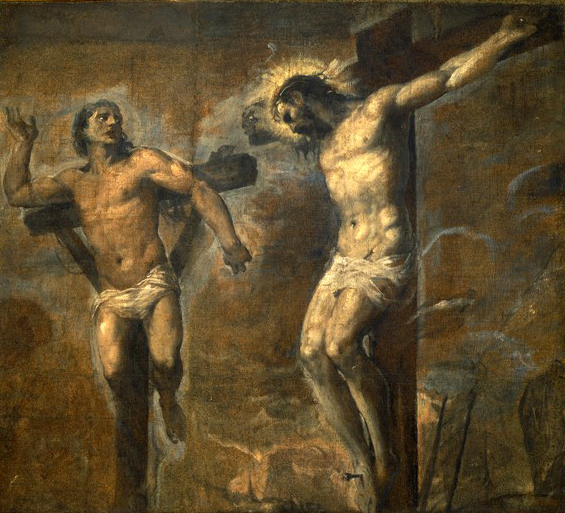

What the Scripture says. Luke says that one of the two evildoers crucified with Jesus insulted him, "but the other, responding and increasing him, said to him," Do you not even fear God, being in the same condemnation? We, in truth, are right, because we receive the just payment of what we did; instead, it has done nothing wrong. "And he said," Jesus, remember me when you come to your kingdom. "Jesus said to him," I tell you, you will be with me today in heaven "(Lk 23: 40-43). Writing.
In short, there is all the way to conversion: to recognize one's own sin without excuses ("we are just it"), to accept its consequences, to recognize the innocence of Jesus and to trust Him. And Jesus' answer is proof that it is never late. The Catechism cites this scene as a witness to the immediate retribution after death (Catechism, 1021), and St. John Paul II saw in the repented thief the "first fruits" of the conversion that Jesus offers (Ecclesia in Asia, 12).
Which belongs to tradition. The Gospel does not give its name. The name of Dimas comes from late apocryphal writings, the Acts of Pilatetransmitted as part of the call Evangelio de Nicodemowhich are not part of the Bible Tradition. Christian piety has venerated it by that name for centuries, but it is worth knowing that it is not a biblical fact.
2. Saint Augustine: the divided will and the "takes and reads"
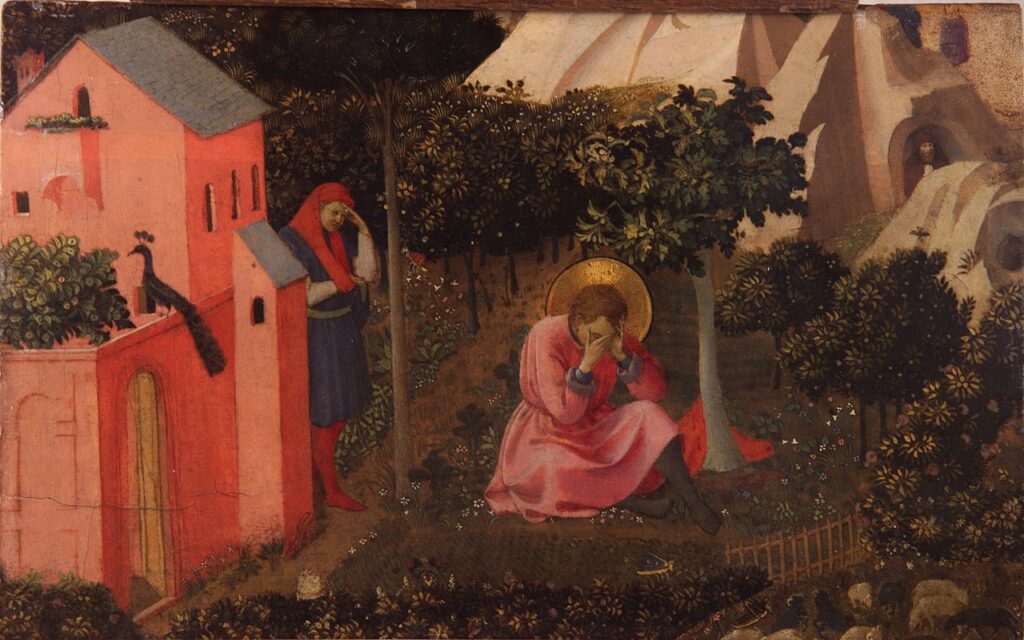

Lo documentado. Augustine (354-430), son of Saint Monica, told his own conversion into the Packagingwritten around the years 397-400, more than a decade after the events Autobiográfico testimony. He had led a disorderly youth, bound by desire and ambition; he sought the truth, but had no strength to change his life. Benedict XVI summarized the decisive moment: "In the torment of his reflections, having retired to a garden, he suddenly heard a child voice that repeated a canteen that he had never heard before:" tolle, lege; tolle, lege, "" takes, reads; takes, reads "(VIII, 12, 29)." He opened the letters of Saint Paul and read the passage of Romans, which calls for the abandonment of the works of the flesh and for the provision of Christ (Rom 13-14); "thus he felt the darkness of doubt dissipated and was free to give himself fully to Christ" (Benedict XVI, general audience, 27-2-2008). It happened in Milan in the summer of 386; Saint Ambrosio baptized him in the Paschal Vigil of 387.
Benedict XVI stressed that the conversion of Augustine "was not sudden or fully realized from the beginning, but can rather be defined as a true path," which he humbly continued until the end of his life (general audience, 27-2-2008). It is a comfort for all: conversion, like sin, is made by steps. And the intercession of a mother who prayed for years for her son is an inseparable part of this story.
3. St. Angela of Foligno: from the knowledge of sin to love
Lo documentado. Angela was born about 1248 in Foligno, in Umbria. Benedict XVI told his story in an audience: married and mother, he led a worldly and unconcerned life, until a series of events led him to take "progressively awareness of his sins, until a decisive step"; "we are in 1285; Angela confesses with a friar in San Feliciano" (general audience, 13-10-2010). His experience was collected in writing by his confessor, a Franciscan friar, in the call Book of Blessed Angela Testimony collected by his confessor. He died in 1309 and Pope Francis inscribed it in the catalogue of the saints in 2013.
Su itinerario es una lección sobre las consecuencias del pecado y su curación. El primer paso, según ella misma, «fue el conocimiento del pecado […] a consecuencia del cual el alma tuvo un gran temor de condenarse; en este paso lloró amargamente». Benedicto XVI explica que ese temor correspondía a una fe todavía pobre en amor, y que «arrepentimiento, miedo del infierno y penitencia» le abrieron un camino que terminaría en «el camino del amor». Ángela comprendió poco a poco que no tenía nada que dar a Dios para reparar sus pecados, salvo su propia nada, y que solo «el amor verdadero y puro, que viene de Dios, está en el alma y hace que reconozca sus defectos y la bondad divina» (audiencia general, 13-10-2010). Lo que empieza en el temor termina en el amor.
4. San Ignacio de Loyola: the vanagroria wound in Pamplona
Lo documentado. Iñigo de Loyola, a gipuzcoan gentleman, was wounded by a cannon bullet in the Pamplona defense on 20 May 1521. During his long convalescence in the house of Loyola, in the absence of books of cavalry, he read a life of Christ and lives of saints, and began to notice that the thoughts of worldly glory left him dry and dissatisfied, while those of imitating the saints left him joyful: it was the beginning of his discernment. He told him himself, already old, in the account he gave to Father Luis Gonçalves da Câmara between 1553 and 1555, known as Autobiography o Pearl Relate Autobiográfico testimony. In Montserrat he made a general confession and watched his weapons before the Virgin on the night of March 24-25, 1522, leaving his sword there.
Ignatius presents his main sin as the vane, the desire for honor. And his experience of conversion also went through the suffering of the scruples in Manresa, until he understood that he should not continue to confess over and over again the sins already forgiven. From that experience the Spiritual exerciseswith his meditation of sins that ends in a "colloquium of mercy" (see Part II).
5. Alfonso Ratisbonne: a conversion to the Virgin of the Medal
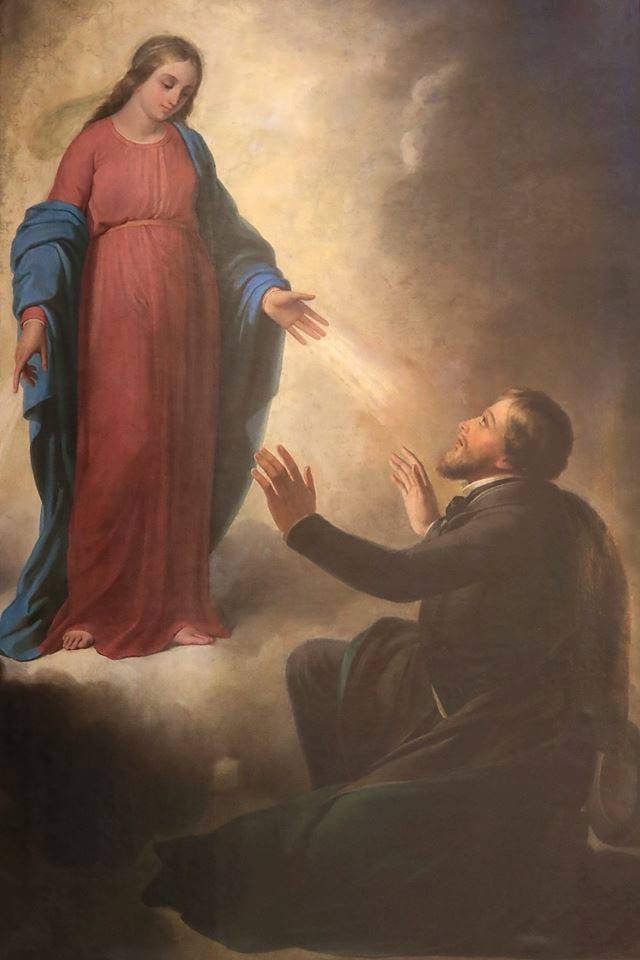

Lo documentado. Alfonso Ratisbonne (1814-1884), abogado y banquero de Estrasburgo, de familia judía, estaba de paso por Roma cuando, el 20 de enero de 1842, entró con su conocido Théodore de Bussierre en la iglesia de Sant’Andrea delle Fratte. Al volver Bussierre, pocos minutos después, lo encontró de rodillas y llorando: Ratisbonne declaró haber visto a la Virgen tal como aparece en la Medalla Milagrosa, que había aceptado llevar al cuello Contemporary testimony. His story and that of Bussierre were published that same year; the Vicariate of Rome opened a canonical process that concluded in June 1842, recognizing the miraculous character of conversion. He was baptized on January 31, 1842, eleven days later; later he was a priest and founded with his brother Theodore the congregation of Our Lady of Zion.
En su testimonio, Ratisbonne contó que en aquel momento comprendió de golpe su propio estado y la realidad del pecado, que antes apenas conocía. La Virgen, según su relato, no dijo nada; pero él salió de la iglesia pidiendo el Bautismo. La capilla de Sant’Andrea delle Fratte conserva hoy el cuadro de la aparición. La realidad sobrenatural del hecho es objeto de fe, no de demostración histórica; lo documentado es el testimonio, su inmediatez y el cambio radical de su vida.
6. San Carlos de Foucauld: the confession that precedes the faith
Lo documentado. Carlos de Foucauld (1858-1916) lost his faith in adolescence and gave himself, according to the official biography published for his canonization, to a disorderly life that, however, left him unsatisfied (book of canonization, 15-5-2022). An officer of the Moroccan army and explorer, the search for truth led him, in late October 1886, to the church of St. Augustine in Paris, where he sought Abbé Henri Huvelin to instruct him. There he confessed and received communion; the same document qualifies that conversion as total and definitive. Documented history. Foucauld later wrote that, as soon as he believed that there was a God, he understood that he could do nothing but live only for Him (phrase in the book of canonization). He died in Tamanrasset, in the Algerian desert, on 1 December 1916, and was canonized on 15 May 2022.
His story teaches something that he sometimes forgets: we don't always have to understand everything before he confesses. Sometimes it is the confession that returns the light.
7. Saint Bartolo Longo: from Spiritism to the Apostle of the Rosary
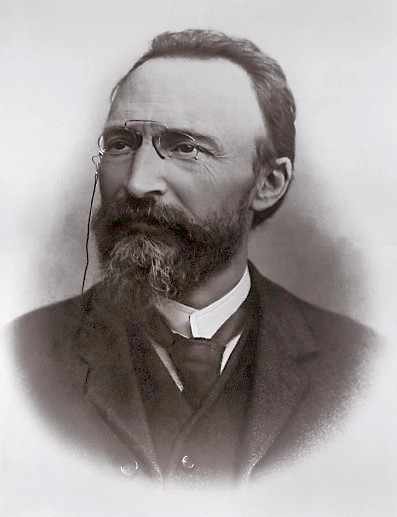

Lo documentado. Bartolo Longo was born in Latiano, in Apulia, on February 10, 1841, and studied Law in Lecce and Naples. The official biography published for his canonization says that, after a time of distance from faith, in 1865 he became a member of the practices of Spiritism, committed himself to works of good and became a Dominican tertiary and propagator of the Rosary (book of canonization, 19-10-2025) Documented history. The biographies on the Internet sometimes present him as "satanic priest"; official documentation speaks of spiritualism, which he himself, years later, interpreted as something very close to the satanic. We should not exaggerate what sources do not say.
But the sin of the past left him a mark: the fear for his salvation. In October 1872, in the Pompeii valley, where he had gone to manage the lands of Countess Marianna Farnararo De Fusco, he lived the decisive moment. According to the same official biography, he prayed to the Virgin, saying that if it was true that she had promised that whoever propagates the Rosary would be saved, he would be saved, because he would not leave that land of Pompeii without having spread his Rosary there; at that time the bells of the Angelus rang, and he understood that that would be his mission (the book of the canonization, 19-10-2025; paraphrase of the original Italian). St. John Paul II recalled that inspiration in his letter on the Rosary: the path of holiness of Bartolo Longo "is based on an inspiration felt in the deepest of his heart:" Whoever spreads the Rosary is saved! "(Rosarium Virus Mariae, 8).
From this imprint of sin, turned into a desire to repair, all the rest was born: the arrival in Pompeii of the image of the Virgin of the Rosary (November 13, 1875), the first stone of the sanctuary (May 8, 1876), the supplica to the Virgin of Pompeya (1883), the orphanages and the houses for the children of the prisoners. He died on October 5, 1926; John Paul II beatified him on October 26, 1980, and Pope Leo XIV canonized him on October 19, 2025, presenting him as one of the "beatitudes of humanity with their hearts lit with devotion" (canonization homily, 19-10-2025). His life is perhaps the best example of what this study wants to show: the consequences of sin are not the last word; penance can become love, and love, works that bless thousands of people. His story is more detailed in Bartolo Longo and the Virgin of the Rosary of Pompeya.
What they have in common
- All recognize their sin without excuses: the thief ("we are just"), Augustine, Angela, Ignacio, Longo.
- In all there is a mediation: the look of Jesus, a reading of Scripture, a confessor, an image of the Virgin, the sound of the Angelus.
- None stay in remorse: the fear of the beginning becomes trust and love.
- Several of them go through the confession - Angela, Ignacio, Foucauld, Longo - which is not the end of the road, but its beginning; in all there appears the recognition of sin and the openness to grace.
- The imprint of sin becomes missionThe Samaritan evangelizes her people; Zacchaeus distributes her goods; Longo raises Pompeia.
X. The remedy: God's mercy
Everything said up here would be unbearable if I ended up in the diagnosis. But the Christian faith is not the doctrine of sin, but the good news of his forgiveness. The Catechism opens its treaty on sin with these words: "The Gospel is the revelation, in Jesus Christ, of God's mercy with sinners" (Catechism, 1846). And Saint Paul sums it up in a phrase: "where sin abounded, grace abounded" (Rom 5: 20).
1. God is the first to look
La iniciativa es siempre de Dios. Lo vimos en el Edén («¿Dónde estás?»), en el padre que corre al encuentro del hijo, en la mirada de Jesús a Pedro y a Zaqueo. «¿Acaso quiero yo la muerte del malvado —oráculo del Señor Dios—, y no que se convierta de su conducta y viva?» (Ez 18,23). Dios «quiere que todos los hombres se salven y lleguen al conocimiento de la verdad» (1 Tm 2,4). Jesús mismo lo explicó: «No tienen necesidad de médico los sanos, sino los enfermos. […] no he venido a llamar a justos sino a pecadores» (Mt 9,12-13). El Catecismo añade que «la conversión es primeramente una obra de la gracia de Dios que hace volver a Él nuestros corazones»: «Conviértenos, Señor, y nos convertiremos» (Catecismo, 1432).
No sin is greater than this mercy. "There is no fault however serious that the Church cannot forgive" (Catechism, 982). And John Paul II, in the sacrament, sees the whole Trinity leaning over the sinner: it is the moment when "the Most Holy Trinity becomes present to erase his sin and return his innocence" (Reconciliatia et paenitentia, 31). Pope Francis repeated it without getting tired: "God never gets tired of forgiving, it is we who get tired of going to his mercy" (Evangelii gaudilii, 3).
2. Confession: rip the nail
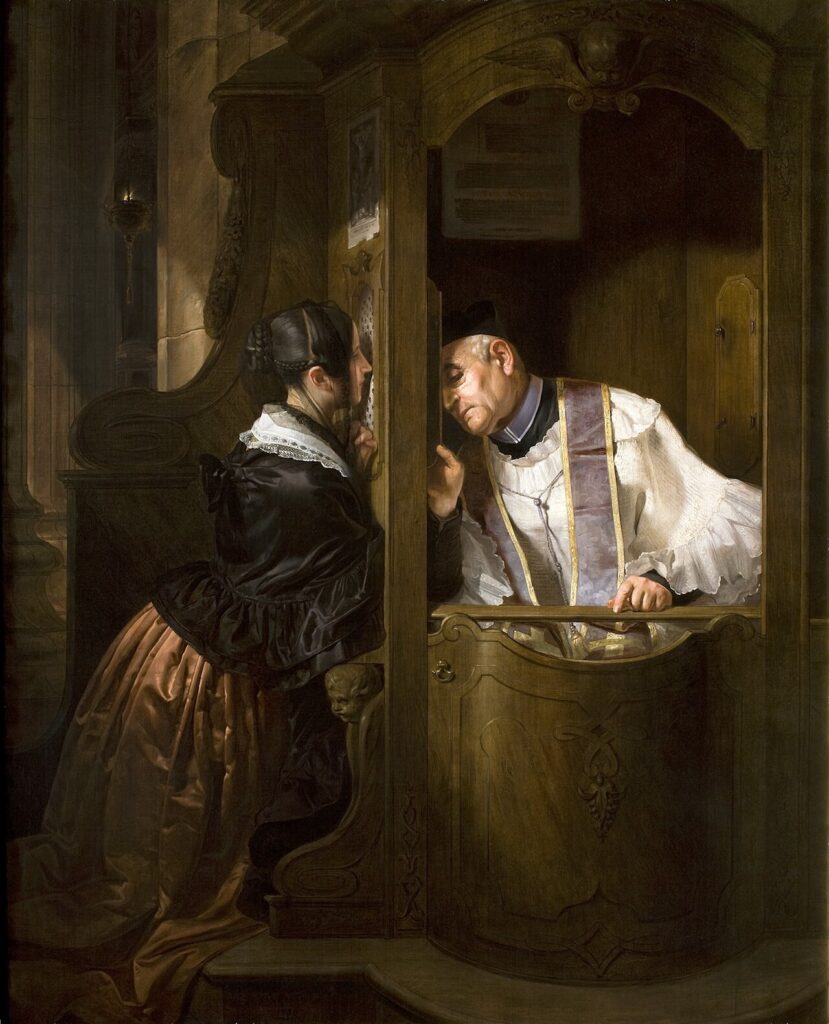

Christ entrusted to his Church the power to forgive sins: "Receive the Holy Spirit; those who forgive sins are forgiven" (Jn 20: 22-23). The sacrament of Penance is the ordinary way to receive the forgiveness of serious sins: "Individual and complete confession and absolution continue to be the only ordinary way for the faithful to reconcile with God and the Church, unless a physical or moral impossibility excuses this way of confession" (Catechism, 1484). Scripture promises it with words of absolute security: "If we confess our sins, he, who is faithful and just, will forgive us sins and cleanse us from all injustice" (1 Jn 9: 9).
The effects of the sacrament are exactly the reverse of the consequences of sin that this study has been through. In the face of broken friendship, reconciliation with God: the sacrament produces "a true" spiritual resurrection, "a restitution of the dignity and property of the life of the children of God, the most precious of which is the friendship of God" (Catechism, 1468). In the face of the loss of peace, "the peace and tranquility of consciousness, to which a deep spiritual comfort accompanies" (Catechism, 1468). In the face of the wound to communion, reconciliation with the Church (Catechism, 1469). In the face of eternal punishment, his remission (Catechism, 1473). In the face of the inner fragmentation, the penitent "reconceived himself in the most intimate background of his own being" (Catechism, 1469).
And in the face of shame, which is one of the most immediate consequences of sin - Adam and Eve hid - Pope Francis had a few words that have helped many: who is in the line to confess feels all these things, even shame, "but then, when the Confession ends, it comes out free, great, beautiful, forgiven, white, happy"; "every time we confess, God embraces us, God makes a feast." And he encouraged: "Be brave and see the Confession" (general audience, 19-2-2014).
3. The Eucharist: the medicine of every day
The Eucharist is not ordered to forgive mortal sins - that is proper to the sacrament of Reconciliation - but it is great medicine against the consequences of sin. Magisterium. "Communion separates us from sin"; "the Eucharist cannot unite us to Christ without purifying us at the same time from the sins committed and preserving us from future sins" (Catechism, 1393). St. Ambrosio, quoted there, said this: "I always sin, I must always have a remedy." The Eucharist "strengthens the charity that, in everyday life, tends to weaken; and this vivified charity erases venial sins," and Christ, giving himself to us, "makes us able to break the disorderly ties with the creatures and to take root in Him" (Catechism, 1394). Moreover, "the Eucharist preserves us from future mortal sins" (Catechism, 1395). If sin is a disordered attachment, the Eucharist is the love it orders.
4. Penance and works: cover the hole
Cast the nail, it remains to heal the wound. The Catechism teaches that, after acquittal, the penitent must "satisfy" in an appropriate way or "atone" his sins (Catechism, 1459), and that such satisfaction can consist "in prayer, in offerings, in works of mercy, services to others, voluntary deprivation, sacrifices, and above all, the patient acceptance of the cross that we must carry" (Catechism, 1460). Scripture and the Fathers insist above all in three ways: "fasting, prayer, alms, which express conversion in relation to themselves, in relation to God and in relation to others" (Catechism, 1434). And when sin has damaged others, justice asks to repair it: "to restore the stolen things, to restore the reputation of the slander, to compensate for the wounds" (Catechism, 1459), as Zacchaeus did.
But none of this is a purchase. "our satisfaction, which we realize for our sins, is only possible through Jesus Christ," in whom we give "fruits worthy of penance" that "receive their strength from Him" (Catechism, 1460, citing the Council of Trent). Good works do not pay a debt alone: they are the love that Christ makes possible. That is why St Peter can say: "love covers a multitude of sins" (1 P 4.8). And the suffering offered with love acquires an immense value: "so complete in my flesh what is lacking in the sufferings of Christ, in favor of his body that is the Church" (Col 1: 24), text that John Paul II considered almost the last stage of the spiritual itinerary regarding suffering (Healthy pains, 24). Pope Leo XIV said in Lourdes: "Penance is a work inspired by love in solidarity with humanity" (homily in Lourdes, 27-9-2026).
5. The indulgences: the treasure of the communion of the saints
indulgences are perhaps the most misunderstood doctrine about the consequences of sin, and also one of the most comforting. "The indulgence is the remission before God of the temporary penalty for sins, already forgiven in terms of guilt, which a faithful willing and fulfilling certain conditions achieves through the Church, which, as the administrator of redemption, distributes and applies with authority the treasure of the satisfaction of Christ and of the saints" (Catechism, 1471, citing Indulgentiarum doctrina, rule 1). It is partial or plenary "as it frees from the temporary penalty due for sins in part or entirely," and can be obtained for yourself or applied by the deceased (Catechism, 1471) Defined doctrine in terms of its existence and utility (Catechism, 1478, with DS 1835).
A indulgence does not forgive sins - that is what confession does - nor is it a shortcut. St. John Paul II explained this: "The indulgences, far from being a kind of" discount "with regard to the commitment to conversion, are rather an aid for a more firm, generous and radical commitment"; therefore, for the plenary, the exclusion "of all affection for any sin, even venial" is required, and "it would be wrong for anyone who thought that he could receive this gift simply by doing some external activities" (general audience, 29-9-1999). The usual conditions of plenary indulgence are, in addition to the prescribed work and this detachment from sin, sacramental confession, Eucharistic communion and prayer for the Pope's intentions (Enciendion indulgentiarum, rule 20).
For a devotee of the Rosary there is a precious fact: the Enciendion indulgentiarum gives the full indulgence, fulfilled the conditions, to whom the Rosary prays devout in a church or prayer, in family, in a religious community, in an association of faithful or, in general, when several meet for an honest purpose (concession 17, § 1, 1). Pope Francis summarized the meaning of all this: the Father's indulgence "reaches the forgiven sinner and frees him from all residue, a consequence of sin, enabling him to act with charity, to grow in love rather than to fall into sin" (Misericordiae vultus, 22). In the image of the table, indulgence is the wood of the saints, and above all that of Christ, which the Church places at our disposal to cover up the holes that we alone would not know how to close.
6. Mary, the refuge of sinners

A page dedicated to the Virgin and the Rosary cannot end without it. In each oatmeal the Church puts on our lips a request that is, in itself, a confession: "pray for us, sinners." The Catechism comments this: "By asking Mary to pray for us, we recognize ourselves sinners and address the" Mother of Mercy "to the Holy Whole. We put ourselves in their hands" now, "in today's life. And our trust is extended to give him from now on," the hour of our death "(Catechism, 2677). Magisterium.
Among the invocation of the laurethane litanies there is one that summarizes this part of the study: Refuge peccatorum, "Refuge of sinners." Mary is not a refuge because she protects us from God, as if God were an enemy, but because, like every mother, she welcomes the son who returns in shame and takes him by the hand home. The Church teaches it precisely: her maternal mission "in no way diminishes or sheds the only mediation of Christ, but it manifests her effectiveness," and all her influence "comes from the overabundance of Christ's merits, it is based on her mediation, it is entirely dependent on her and it takes out all her effectiveness" (Catechism, 970, citing Lumen gentium, 60). God is worshipped; Mary is venerated and asked for her intercession, which always leads to Christ.
She is the new Eve: where the first woman distrusted, Mary believed; "the knot of Eve's disobedience unleashed Mary's obedience" (Catechism, 494). She was at the foot of the cross when her Son was carrying the sin of the world, and there she received everyone as children: "Woman, there is your son" (Jn 19: 26). That is why Saint Ignatius, before asking the Son and the Father for the knowledge of his own sins, addressed the first colloquium to "Our Lady, that I may receive grace from her Son and Lord" (Exercises63). And Pope Leo XIV, in Lourdes, recalled the Virgin's call to Bernadette - "Penance! Penance! Penance!" - and explained: "Our Lady asks us to do penance, not only for ourselves, that we need it, but also" for sinners, "for a world that goes wrong" (homily in Lourdes, 27-9-2026).
There are many ways to go to Mary the refuge of sinners, and on this website some are collected: Novena to Mary, Refuge of sinners; the history of this advocation in Mexico; the jaculatory that the Virgin entrusted to Saint Catherine Labouré and that has recorded the Miraculous Medalwith which Mary is called conceived without sin to pray for those who turn to her. And above all, the Rosary.
7. The Rosary: the sweet chain that frees
Saint Augustine described sin as a forged chain link to link. The tradition of the Rosary has used the same image in the opposite sense. St. John Paul II concluded his letter on the Rosary by endorsing the words with which Saint Bartolo Longo closes his famous supplica to the Queen of the Holy Rosary: "O Blessed Rosary of Mary, sweet chain that unites us with God, bond of love that unites us to the Angels, tower of salvation against the assaults of hell, safe port in the common shipwreck, we will never leave you. You will be our comfort in the hour of agony. For you the last kiss of life that goes out. And the last whisper of our lips will be your soft name, O Queen of the Rosary of Pompeia, O Mother our dear, O Refuge of sinners, O Sovereign consolation of the sad" (Rosarium Virus Mariae, 43).
The Rosary is a remedy against the consequences of sin because it puts before the eyes, mystery to mystery, the love of Christ that overcomes sin. In the light mysteries it is precisely Jesus who announces the Kingdom of God "and invites conversion, forgiving the sins of those who approach Him with humble faith, thus initiating the ministry of mercy that He will continue to exercise until the end of the world, especially through the sacrament of Reconciliation entrusted to the Church" (Rosarium Virus Mariae, 21). In the painful, the price of that forgiveness. In the joyful and glorious, the new life that awaits us. And in every avemaria, fifty times, the same humble supplication: "pray for us sinners." Anyone who wants to start can do it in Begin the Rosary.
Hail, Mary, full of grace, the Lord is with you.
Blessed are you among all women, and blessed is the fruit of your womb, Jesus.
Holy Mary, Mother of God, pray for us, sinners,
now and at the time of our death. Amen.
Conclusion: last word
This study has gone through the consequences of sin with all the seriousness they deserve. We have seen how it breaks the four relationships that sustain human life - with God, with oneself, with others and with creation -; how it hurts nature, soaks the soul, chains will, blinds consciousness and steals peace; how it leaves a mark that remains even after forgiveness; how it extends to the family, society, the Church and the earth; how it can become a structure; and how, at its end, it can lead to the definitive self-exclusion of communion with God.
But we have also seen that none of those consequences is the last word. In Eden, before any punishment, God asks, "Where are you?" and promises that the seed of the woman will crush the head of the serpent. Cain is assured that he will be able to master sin and protect it with a sign. He forgives David the moment he says "I have sinned." Peter looks at him, and that look makes him cry and returns the mission. The prodigal son sees him from afar and runs away. Zachaeus is called by his name. The Samaritan is offered living water. The thief promises "today" paradise. And each one of us is waiting for us in the confessional, in the Eucharist, in prayer, in the communion of the saints and in the lap of his Mother.
The image of the table and nails helps to understand that forgiveness and healing go together: God starts the nail and helps us close the hole. But faith says even more. God is not satisfied with covering holes: it makes wood new. "O God, believe in me a pure heart, renew me within with a firm spirit" (Ps 51,12). "I will give you a new heart" (Ez 36,26). "Look, I make all things new" (Ap 21.5). Pope Leo XIV said this at the beginning of Lent of 2026: "to recognize our sins to become" means not to stay in the ashes, but to rise and rebuild "(Homily of Ash Wednesday, 18-2-2026).
Who has read up to here may have recognized on these pages some wound of his own. It's not to be discouraged: it's to get on the way. As the prodigal son, it is enough to rise up: "I will rise up, I will set myself on the way to my father" (Lk 15: 18). And in that way no one goes alone. The Virgin Mary, a refuge for sinners and Mother of Mercy, who has sought us throughout the centuries and throughout the world, accompanies every step. We entrust this work to her, with the prayer that the Church repeats millions of times every day: pray for us, sinners, now and at the time of our death.
Bibliography and sources
All the literary quotes of this study have been collated at their primary source. Bible quotes follow the Holy Bible, an official version of the Spanish Episcopal Conference, except when it is indicated that they are quoted according to the Catechism. The documents of the Magisterium are cited for their Spanish text on the website of the Holy See (vatican.va).
Holy Scripture and Magisterium
- Holy Bible, official version of the Spanish Episcopal Conference (conference episcopal.es / bible).
- Catechism of the Catholic Church (1992; typical Latin edition of 1997), Spanish text in vatican.va: nn. 30, 57, 386-411, 460, 494, 953, 970, 982, 1006-1008, 1021-1024, 1030-1037, 1040, 1264, 1393-1395, 1421, 1426-1434, 1439-1440, 1456-1460, 1468-1479, 1484, 1846-1869, 1876, 2283-2286, 2412, 2561, 2561, 2661.
- Concilio de Trento: session V, decree on original sin (1546); session VI, decree on justification (1547), canon 30; session XIV, doctrine on the sacrament of Penance (1551), chapter 8 (consulted in the English translation of J. Waterworth, London, 1848, and through the quotations of the Catechism: DS 1511-1515, 1580, 1674, 1680, 1690-1691, 1712-1713, 1820, 1835).
- Vatican Council II, dogmatic constitution Lumen gentium (1964), No. 56, 60, 62 (through the Catechism).
- Pius XII, radio to the National Catechistic Congress of the United States, Boston, 26-10-1946.
- San Pablo VI, apostolic constitution Indulgentiarum doctrina, 1-1-1967, n. 2-5 and rules 1-2.
- San Juan Pablo II: encyclical Dives in misericordia, 30-11-1980, n. 6; Apostolic exhortation Reconciliatia et paenitentia, 2-12-1984, nn. 14-18 and 31; Apostolic Letter Healthy pains, 11-2-1984, n. 24; encyclical Dominum et vivificantem, 18-5-1986, n. 46; encyclical Sollicitudo rei sociali, 30-12-1987, n. 36; Apostolic Letter Orientale lumen, 2-5-1995, n. 15; postsynodal exhortations Ecclesia in Africa, 14-9-1995, n. 42; Ecclesia in America, 22-1-1999, n. 56; Ecclesia in Asia6-11-1999, 11-12; general hearings of 21-7-1999 (heaven), 28-7-1999 (hell), 4-8-1999 (purgatory) and 29-9-1999 (indulgences); homily of canonization of Saint Faustina Kowalska, 30-4-2000; apostolic letter Rosarium Virus Mariae, 16-10-2002, nn. 8, 21 y 43.
- Benedict XVI: encyclical Save, 30-11-2007, nn. 14, 44 and 47; general hearings of 27-2-2008 (Saint Augustine, the conversions), 3-12-2008 (Saint Paul and the original sin) and 13-10-2010 (Blessed Angela of Foligno); letter for the convening of the Priest Year, 16-6-2009; postsynodal apostolic exhortation African munus, 19-11-2011, nn. 20-21, 34, 43, 155.
- Francisco: Apostolic exhortation Evangelii gaudilii, 24-11-2013, n. 3; general hearing of the 19-2-2014 (the sacrament of Reconciliation); Misericordiae vultus, 11-4-2015, n. 22; encyclical Laudato si’, 24-5-2015, nn. 2, 8, 66, 70, 217-218; cycle of catechesis "Victions and virtues," general audiences of 3-1, 10-1, 17-1, 24-1, 31-1 and 6-3-2024.
- Lion XIV: message for the World Day of Prayer for the Care of Creation, 2025; general audience of 13-8-2025; Apostolic exhortation Dilexi te, 4-10-2025, nn. 90 and 93; canonization homily, 19-10-2025; ash Wednesday homily, 18-2-2026; Angelus, 22-2-2026; mass homily, 27-9-2026.
- Apostolic Prison, Enciendion indulgentiarum, 4th edition (1999), Latin text in vatican.va: standards 17-20 and concession 17.
- Code of Canon Law (1983), c. 989 (a través del Catecismo, 1457); Code of Canons of the Eastern Churches (1990), c. 718.
- Official releases of canonization masses (Office of the Liturgical Celebrations of the Supreme Pontiff): 15-5-2022 (Saint Charles of Foucauld) and 19-10-2025 (Saint Bartolo Longo and other saints).
Fathers of the Church
- San Clemente Romano, Letter to the Corinthians 7, 4 (in the Catechism, 1432).
- San Ireneo de Lyon, Adversus haeres 3, 22, 4 (in Catechism, 494).
- San Atanasio, De Incarnatione Verbi 3-4 and 54, 3 (English translation of the collection) Nicene and Post-Nicene Fathers, newadvent.org; y Catecismo, 460).
- San Gregorio Nacianceno, Speech 38 (on Theophany), 12 (English translation NPNF, newadventi.org).
- San Juan Crisóstomo, Homilies on statues 3 y 7, 7; Homily 10 on St Matthew, 7 (English translation NPNF, newadvent.org).
- San Ambrosio, Epistula extra collectionem 1 [41], 12, y De sacramentis 4, 28 (in the Catechism, 1429 and 1393).
- San Jerónimo, Commentarius in Ecclesiasten 10, 11 (in the Catechism, 1456).
- San Agustín: Packaging 1, 1, 1; 8, 5, 10; 8, 12, 29-30 (texto latino, thelatinlibrary.com; Catecismo, 30); De civitate Dei 14, 15, 2 and 14, 28 (Latin text; Catechism, 1850); In epistulam Iohannis ad Parthos 1, 6 (Catechism, 1863) Letter 211, 11 (NPNF translation); Sermon 169, 11, 13 and 169, 18 (Catechism, 1847; Lion XIV, 27-9-2026).
- San Gregorio Magno, Moralia in Job 31: 45 (through St. Thomas and the Catechism, 1866); Diálogos 4, 41, 3 (Catechism, 1031).
- San Juan Casiano, Conlatio 5, 2 (Catechism, 1866). Saint Maximus the Confessor, Ambiguorum £ (Catechism, 398).
Theology and spirituality
- St. Thomas Aquinas, Summa Theologiae I-II, qq. 71-89 (especially q. 71, a. 6; q. 84, a. 3; q. 85, prologue and aa. 1-3; q. 86, aa. 1-2; q. 87); II-II, qq. 35, 36, 118, 132, 148, 153, 158, 162 (Latin text of the Latvian edition in corpusthomisticum.org).
- Saint Teresa of Jesus, Inner castle dwellings, First Purposes, Chapter 2 (digital transcription; it is appropriate to contrast with a critical edition before playing it printed).
- Saint John of the Cross, Up from Mount Carmelo, book I, chapters 6-11 (collated in two independent digital transcripts: mercaba.es and sanjuandelacruz.online); Avisos y sentencias57 (Catechism, 1022).
- San Ignacio de Loyola, Spiritual exercises, nn. 53-63 (Spanish autograph text published by spiritual exercises); Autobiography o Pearl Relate.
- San Francisco de Sales, Introduction to devout life, part I, chapter 22 (English translation of the Christian Classics Ethereal Library).
- Saint Faustina Kowalska, Diary. The Divine Mercy, n. 699 (edition of the Marian Fathers).
- Book of Blessed Angela of Foligno (through the hearing of Benedict XVI of 13-10-2010).
Attributions that this study does not use
Interface phrases attributed to saints that have not been verified at any primary source or have been found to be from other authors. By fidelity to the truth, this study does not use them. Among them: "Each saint has a past and every sinner has a future" (not of any saint, but of Oscar Wilde, A woman of no importance1893); "The Church is a hospital for sinners, not a museum for saints" (modern aphorism without a patristic source); "Love the sinner and hate sin" as a literal phrase of St. Augustine (it is not; its antecedent is the Letter 211, 11); "The way of hell is paved with good intentions" attributed to Saint Augustine (without source); and various phrases attributed to the Holy Cura of Ars, to Father Pio or to Saint Teresa of Lisieux who have not been able to cross. There are no figures of days or years of purgatory or descriptions of torments, which are not Church doctrine.
Image credits
All the images of this study are works of public domain reproduced from Wikimedia Commons, where you can see your full tab. The author, work, date, location and licence are indicated in each case.
- The expulsion from Paradise (detail: Adam covers his face) - Masaccio, h. 1424-1428, fresh. Brancacci Chapel, church of Santa Maria del Carmine, Florence. License: Public domain. Wikimedia Commons.
- The expulsion from the Garden of Eden - Thomas Cole, 1828, oil on canvas. Boston Museum of Fine Arts. License: Public domain. Wikimedia Commons.
- Cain kills Abel, illustration for the Bible - Gustave Doré (drawing) and H. Pisan (engraving), 1866, engraved in wood. The Sainte Bible, an edition illustrated by Doré (Tours, 1866). License: Public domain. Wikimedia Commons.
- The Tower of Babel - Pieter Brueghel el Viejo, 1563, oil on board. Kunsthistorisches Museum, Vienna. License: Public domain. Wikimedia Commons.
- The prophet Nathan rebukes King David - Eugène Siberdt (1851-1931), undocumented date (between the late 19th and 1931), oil. Current undocumented location in Commons. License: Public domain. Wikimedia Commons.
- The tears of Peter - El Greco (Doménikos Theotokopoulos), h. 1587-1596, oil on canvas. Greco Museum, Toledo. License: Public domain. Wikimedia Commons.
- The return of the prodigal son - Rembrandt Harmenz. van Rijn, h. 1668, oil on canvas. Hermitage Museum, St. Petersburg. License: Public domain. Wikimedia Commons.
- Zacchaeus in the sycomore waiting for the passage of Jesus - James Tissot, 1886-1894, opaque watercolor over graphite. Brooklyn Museum, New York. License: Public domain. Wikimedia Commons.
- Christ y latanita — Guercino (Giovanni Francesco Barbieri), h. 1619-1620, óleo sobre lienzo. Kimbell Art Museum, Fort Worth. Licencia: Públic domain. Wikimedia Commons.
- Table of capital sins and the four postrimonies - The Bosco (Jheronimus Bosch) or a follower; the Prado Museum attributes it to the Bosco, h. 1505-1510, oil on board. Museo Nacional del Prado, Madrid. License: Public domain. Wikimedia Commons.
- Christ and the good thief — Tiziano Vecellio (y heeler), h. 1566, óleo sobre lienzo. National Picture Gallery, Bolonia. Licencia: Públic domain. Wikimedia Commons.
- The conversion of Saint Augustine - Fra Angelico and his workshop, h. 1430-1435, temple on board. Musée Thomas- Henry, Cherburg. License: Public domain. Wikimedia Commons.
- The Virgin of the Miracle (apparition to Alfonso Ratisbonne) - Domenico Bartolini, 1870, oil. Rome; according to his record in Wikimedia Commons, in the chapel of the Virgin of the Miracle of Sant'Andrea delle Fratte. License: Public domain. Wikimedia Commons.
- Photo gallery of Bartolo Longo - Photographer unknown, h. 1900, photography. Proceed: Wikipedia in English, transferred to Commons. License: Public domain. Wikimedia Commons.
- The confession — Giuseppe Molteni, 1838, óleo sobre lienzo. Gallerie d'Italia, Piazza Scala, Milán (colección Fondazione Cariplo). Licencia: Públic domain. Wikimedia Commons.
- Refuge peccatorum - Luigi Nono, 1883, oil on canvas. Special collection. License: Public domain. Wikimedia Commons.