
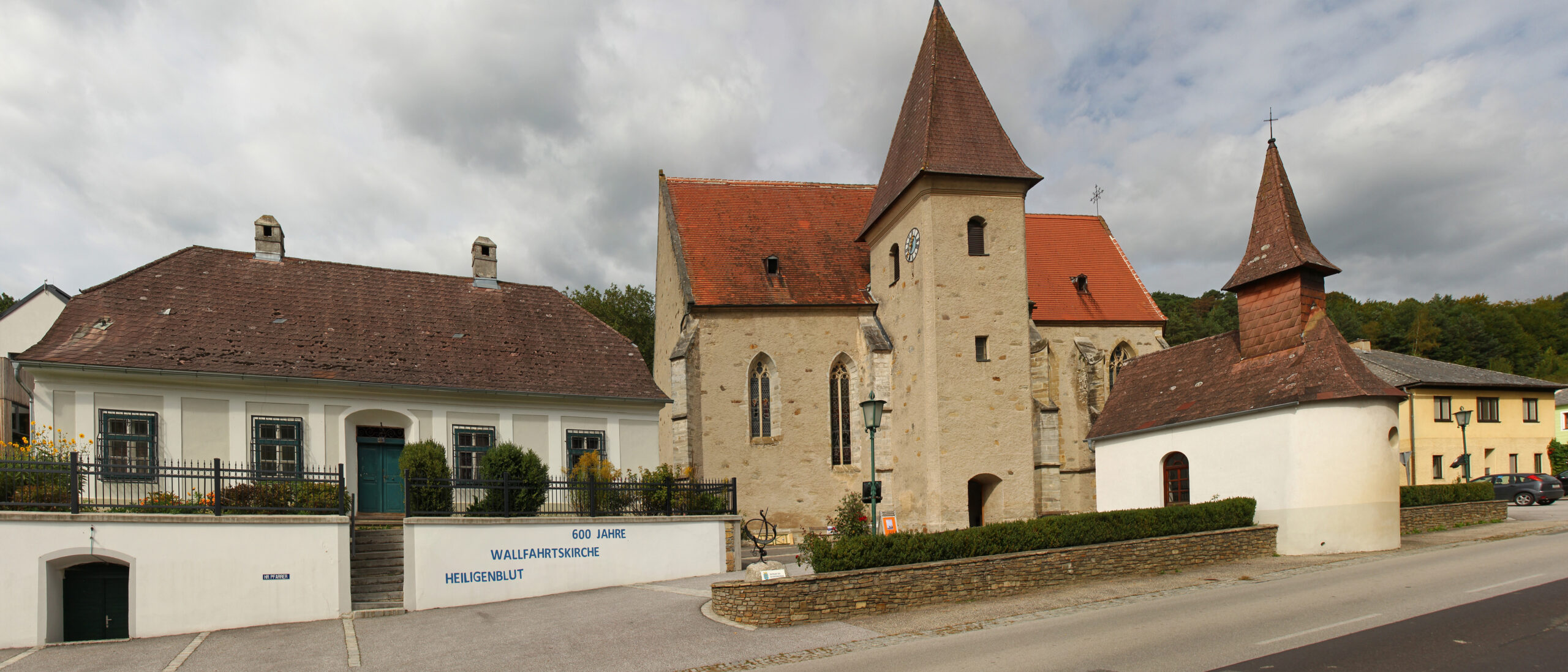
The chapel of origin of Heiligenblut, in the Austrian municipality of Raxendorf, has been documented since 1411. The municipal source explains that its foundation is attributed to the legend of a stolen host that fell in that place and could only be collected with the help of a priest.
Heiligenblut, entre Weiten y Raxendorf
The case sometimes appears under the name "Weiten-Raxendorf," but the precise place is Heiligenblut, a small town in Lower Austria belonging to the municipality of Raxendorf. The original chapel and the pilgrimage church are located in Heiligenblut 16. This precision avoids placing the marker in the city centre of Weiten or in Raxendorf, separate from the sanctuary.
The name Heiligenblut means "Holy Blood." It should not be confused with the well-known Alpine town of Heiligenblut am Großglockner or other Germanic sanctuaries of the same name. The file refers exclusively to Heiligenblut, Melk district, in the diocese of St. Pölten.
The tradition of the lost host
The local narrative speaks of a stolen consecrated host that the responsible would have lost in this place. When they tried to lift her off the ground, it would only have been possible to do so with the intervention of a priest. The memory links that finding to the construction of a chapel in 1411 and the birth of the pilgrimage.
Some subsequent compilations add details about blood, transformations or circumstances of the theft. The municipal source consulted does not make these statements: it speaks expressly of a foundational legend and a miracle of the Hostia. This fact sheet is therefore not documented as a bleeding form and does not speak of a material relic preserved.
The chapel of origin of 1411
To the south of the church is preserved the so-called Ursprungskapelle, literally "chapel of origin." The municipality was built in 1411 and attributed to the noble family Scheck vom Wald. The existence and antiquity of this building are verifiable property data, different from the historical degree of the legend that explains its location.
The small building physically points to the place to which tradition associates the host. Its presence allows us to understand how a religious memory can model the landscape for centuries without the building itself showing every supernatural detail transmitted.
From the chapel to the church of pilgrimage
The influx of pilgrims led to the construction of a church next to the chapel. The temple, dedicated to the Apostle Andrew, is a church in the late 15th century. Among its elements are the sacred petreous, the cross and net vaults, the Gothic windows and the strong inclination of the deck.
The pilgrimage is the most important living ecclesial data of memory. The regional itinerary of the Three Churches links Heiligenblut with Weiten and Maria Laach. The patrimonial and pilgrim continuity attests to the local reception of the story, although it does not replace a canonical file on the alleged prodigy.
What is documented and what belongs to the legend
It's documented. that the chapel has existed since 1411, that the church grew next to it, that the whole was a place of pilgrimage and that the municipality retains the tradition of a miracle of the Hostia as a foundational explanation.
It belongs to tradition the narrative development of the theft, the fall of the form and the impossibility of collecting it without a priest. A preserved host, a material report, a historic decree of recognition and a digital primary source have not been located to reconstruct the event as a contemporary chronicle.
World map classification
Heiligenblut is incorporated as "Eucharistic tradition with historical chapel and pilgrimage." It is not equal to cases with preserved relic, contemporary examination or formal episcopal declaration. This category shows the breadth of the world Eucharistic memory without erasing the differences between history, tradition, veneration and recognition.
Spiritual feeling
Tradition recalls the reverence due to the Eucharist and the responsibility to repair a desecration. It does not invite you to look for prodigious objects or to treat the Sacrament as an amulet. Catholic faith leads to mass, worship, reconciliation and charity; the outer sign only makes sense if it guides Jesus Christ.
The journey of pilgrimage adds a concrete dimension: walking, stopping, praying and returning to ordinary life with greater care towards God and others. The ancient chapel can thus become a school of memory, discernment and peace.
Location and visit
Sanctuary of Heiligenblut, Heiligenblut 16, 3654 Raxendorf, Austria. The marker is located in the whole church and the chapel of origin, at coordinates 48.3243000, 15,2754000. It is appropriate to consult with the community or the municipality before travelling.
Sources consulted
- Municipality of Raxendorf: Heiligenblut pilgrimage church, main source for chapel, temple, direction and legendary formulation.
- Official Tourism of Lower Austria: route of the Three Churches, patrimonial and pilgrim context.
- International exhibition associated with San Carlo Acutis, starting point contrasted with local sources.
Para orar
Lord Jesus, living bread delivered by us, give us a reverent and true heart. May the memory of this place lead us to repair the damage, care for the sacred, accompany the suffering and turn our worship into charity. Amen.
Image credit
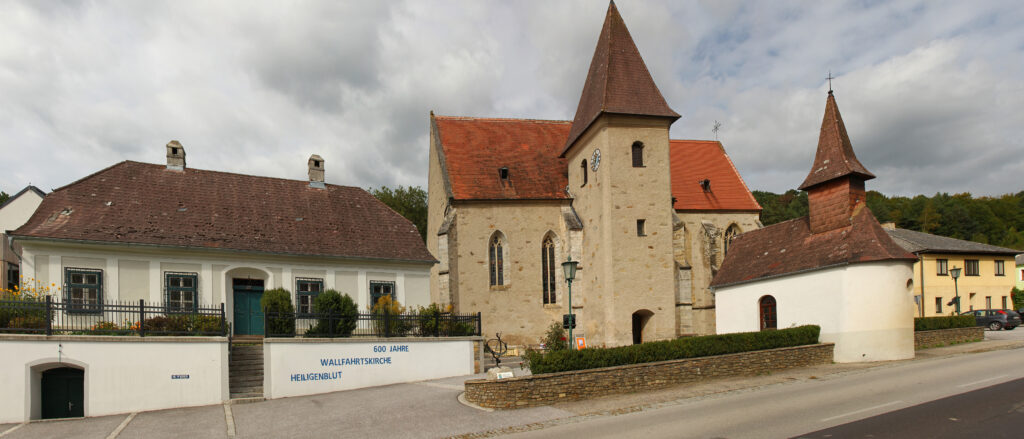
Church of pilgrimage, parish house and chapel of origin of Heiligenblut. Duke of W4 / Wikimedia Commons, CC BY-SA 3.0 AT. File and license in Wikimedia Commons.
_Pfarrhof_Pfarrkirche_Ursprungskapelle.jpg)