
A documented story of the miracle of the Holy Blood of Alkmaar: the account of 1429, the medieval veneration, the relic recognized in 1897, the current procession and the two places that should not be confused.
What is commemorated in Alkmaar
The tradition of the Holy Blood of Alkmaar dates back to May 1, 1429. Its core is a fragment of a casulla associated with three spots which, according to the account received, appeared during the first mass of the Folkert priest and ended up being venerated as the blood of Christ.
The file does not reduce six centuries of history to an anecdote. It distinguishes the account of the event, the historical news about the cult, the material trajectory of the relic, the decisions of the ecclesiastical authority and the devotional practice that continues in the city.
The first misa of the priest Folkert
The chronicle attributed to Jan van Leiden, one of the old news cited by local documentation, presents Folkert as a former soldier who had taken part in struggles near Hoorn. He then embraced the clerical state and celebrated his first Mass in Alkmaar.
The moral account adds that he had not confessed to deaths committed during that military stage. This element explains the penitential tension of tradition, but it must be read within the medieval religious narrative and not as a fully preserved contemporary judicial record.
The three drops on the casulla
During the celebration, Folkert would have spilled three drops of white wine on his casulla. We tried to clean the fabric without success. According to tradition, the stained piece was cut and burned; after repairing the dress, the three signs reappeared and had acquired red.
The again cut fragment was saved. The traditional language interpreted the spots in the light of the Eucharistic consecration. Modern sources describe what the community believed and venerated; they do not provide a scientific analysis carried out in 1429.
The Sailors of Zealand
In the winter of 1429 to 1430, several sailors found themselves in danger among ice trees near Vlissingen. The narrative states that they received an apparition that showed them the lost fragment and promised them help if they came to Alkmaar to honor the Holy Blood.
After they were saved, they traveled to the city. His arrival led the parish priest Volpert Schult to look for the piece of the casulla, which would have been located. Thus begins, within local memory, the pilgrimage linked to relic.
The beginning of the pilgrimage
The repertoire of the Meertens Institute has recorded pilgrims since 1430. Among them are Machtell van der Does, Abbess of Leeuwenhorst, who visited Alkmaar several times during the next decade.
The existence of such early devotional movements helps to document the receipt of the case. It is different to say that there was veneration, something historically studable, than to consider with identical degree all the extraordinary details of the narrative.
Medieval church permit
Alkmaar then belonged to the diocese of Utrecht. The local documentation indicates that the bishop recognized the veneration of the Holy Blood and allowed an annual celebration with procession on May 1.
At first the procession was taking place within the church. In 1501 the urban government authorized a tour of the streets. The celebration included prayer, music, performances and the presence of pilgrims from other locations.
The letter from the administrators of 1545
The so-called letter from the kerkmeesters or church administrators, dated 1545, helped to set and spread the story. Its text is kept in an epitaph exposed in the current Sint-Laurentiuskerk.
This testimony is valuable for studying how the 16th century community explained the miracle. Like any post-episode source, it requires to distinguish the consolidated memory from a written relationship at the moment of the events.
Reformation and interruption of veneration
The medieval public veneration ended about 1572 in the context of the Reform and the Dutch religious conflicts. The Meertens repertoire differs a first stage, approximately from 1429 to 1572, and a restoration from 1897 to the present.
The relic survived, according to the tradition of custody, although Catholic life had to develop for centuries under very different conditions. This interruption explains why the current place of veneration is not the church where the episode is located.
The Catholic Recovery of the 19th Century
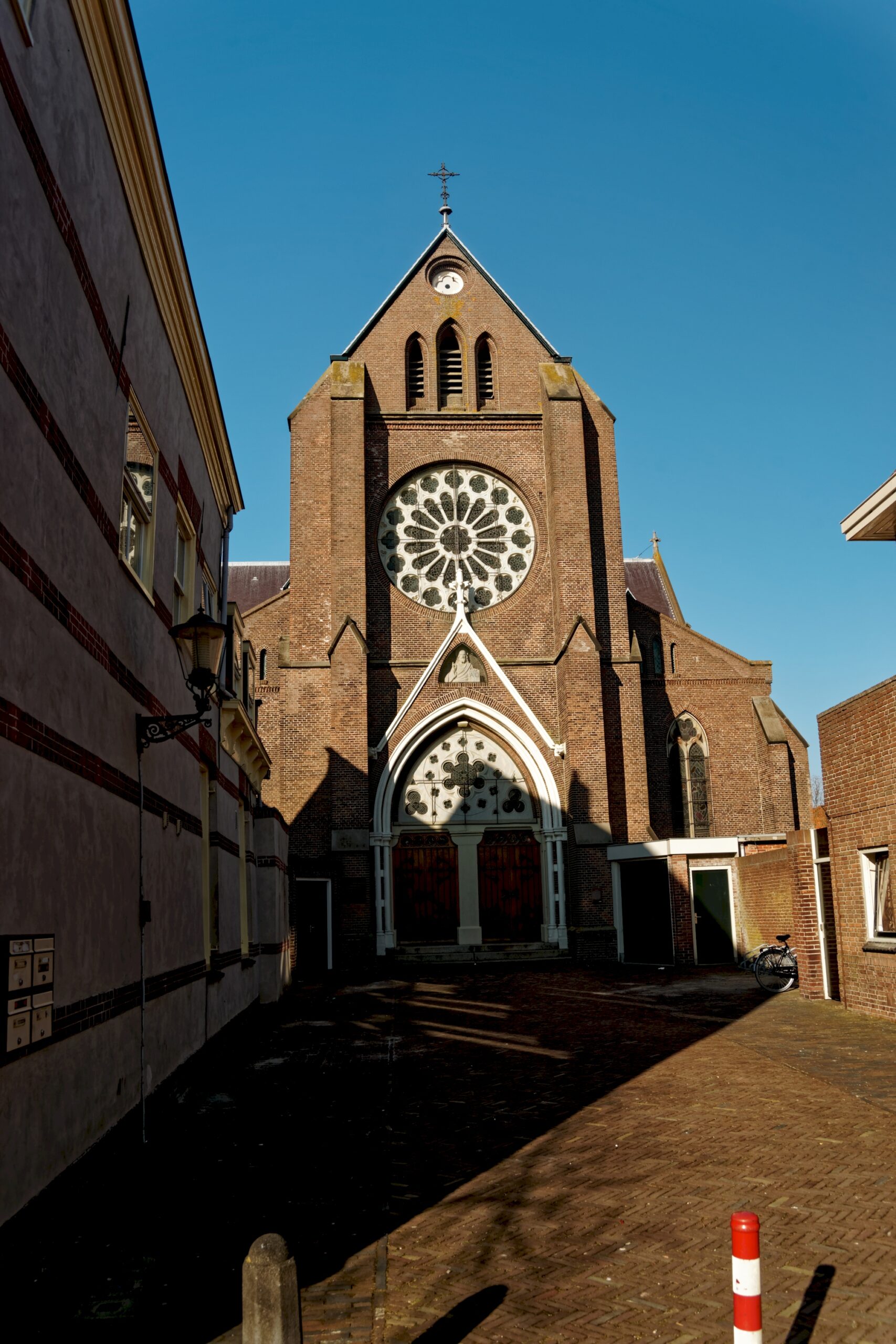
The current Catholic church of San Lorenzo, in Verdronkenoord, was built between 1859 and 1861 according to the project of Pierre Cuypers. His artistic program consciously incorporated the memory of Alkmaar's miracle.
Between 1874 and 1880, J. A. Kläsener made mural paintings on the account of the Holy Blood. The temple also has an altar dedicated to relic and retains the epitaph with the historical letter of the administrators.
The recognition of 1897
The bishop of Haarlem Gaspard Bottemanne examined the tradition and in 1897 declared the preserved relic authentic, allowing its public veneration. That year an external pilgrimage to Alkmaar was reregistered.
This ecclesiastical recognition refers to relic and its veneration. It should not be mistranslated as if it were a contemporary biomedical analysis or a dogmatic definition that required each narrative detail to be accepted with the same degree of certainty.
The procession and its continuity
From 1917 there was a sille omgang or silent tour, which remained until the early 1960s. The practice was recovered at the beginning of the 1980s and after 2009 it was again taking the form of a public procession.
Bishop Jozef Marianus Punt himself reported his participation in the May 1, 2016 procession and presented it as a living tradition of the diocese. The current continuity allows for the classification of Alkmaar as an existing historical ecclesial cult.
The historical place of the episode
The miracle is not located in the current Gothic building of the Grotte Kerk, but in its Romanesque predecessor, who occupied the same location. The tower of that church collapsed in 1468; the temple was replaced from 1470 by the great church that today dominates the centre of Alkmaar.
The historical marker is placed at 52.6325580, 4.7438626, Grotto Sint-Laurenskerk, Koorstraat. It points to the episode's site, does not claim that the visible building is materially that of 1429.
Where is the relic today
The current custody and veneration are found in the Sint-Laurentiuskerk of Verdronkenoord 68, 1811 BG Alkmaar. Its coordinates are 52.6298616, 4.7522513.
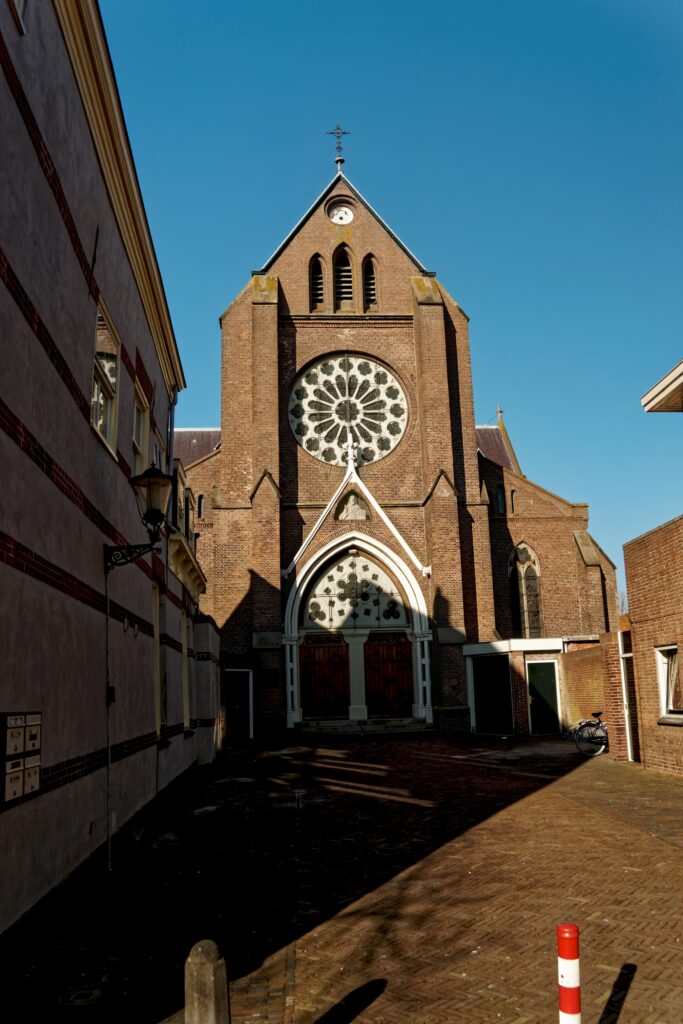
Anyone who wishes to visit the devotional place must go to this Catholic church and check in advance times and conditions of access. The main image shows precisely this temple to prevent the visitor from seeking relic in the Grotte Kerk.
Why the map needs two references
A single point can mislead: placing it only in Verdronkenoord would erase the place of origin; placing it only in the Grotte Kerk would hide where the cult continues. That is why the main marker answers the historical question and its description immediately offers the second destination.
This form of mapping respects the real movement of relics and communities. The map is not a collection of isolated bugs, but a guide that explains what happened, what remains and what can be visited.
The Eucharist beyond the extraordinary
Catholic tradition does not make the real presence of Christ dependent on visible signs. The Eucharist is sacrament by the words of Christ and the liturgical action of the Church, even if no extraordinary phenomenon appears.
The stories like that of Alkmaar may arouse reverence, but their fruit must be a more conscious participation in the mass, the desire for reconciliation and charity with those who suffer. Curiosity should not displace the sacramental center.
Penance without fear or sensationalism
Folkert's story was transmitted as a call to sincere confession and not to hide the damage caused. This teaching can be exposed without presenting God as someone who stalks a ritual error to punish.
A mature pastoral reading unites truth and mercy: to recognize sin, to ask for forgiveness, to repair what is possible and to trust in grace. The three stains should not become a resource of fear for children or a separate spectacle of the Gospel.
What is documented and what is transmitted
The development of a medieval pilgrimage, ecclesiastical decisions and celebrations, the letter of 1545, the reformed interruption, the recovery of the 19th century, the episcopal recognition of 1897 and the contemporary procession are documented.
The transformation of the drops, the reappearance of the spots and the vision of the sailors belong to the traditional account. To present both levels clearly strengthens the fact sheet: devotion does not need to hide the nature of its sources.
A shared memory in a plural city
The ancient church of the episode today belongs to a religious and cultural context other than the Catholic. The contemporary procession runs through a city marked by the history of the Reformation and the coexistence between communities.
To remember that division invites sobriety and respect. The celebration of the Eucharist should not feed confessional rivalries, but rather prayer for unity, peace and the reparation of violence committed in the name of religion.
How to prepare a visit
In order to understand the complete history, it is necessary to go through both places: the surroundings of the Grotto Sint-Laurenskerk, where the 1429 temple was located, and the Verdronkenoord Sint-Laurenuskerk, where the material and liturgical memory is preserved.
Before you travel you have to consult the web of the temple and the diocese, because the times of veneration, opening and procession can change. The tab provides coordinates, but does not replace the updated pastoral information.
Sources consulted
- Instituto Meertens, Pilgrimage Places in the Netherlands: Alkmaar, Holy Blood, topography, veneration, periodization and bibliography.
- Stichting Alkmase Cuyperskerk: the epitaph and the letter of the administrators, historical account and places.
- Stichting Alkmaarse Cuyperskerk: Interior of San Lorenzo, altar and paintings of the miracle.
- Diócesis de Haarlem-Ámsterdam, TogetherChurch 2016Episcopal testimony of the living procession.
- Repertoire associated with San Carlo Acutis: Alkmaar, starting point contrasted with local sources.
Para orar
Lord Jesus, present in the Eucharist, give us a true, penitent and confident heart. May we, when we receive you, grow in unity, mercy and service; and may every extraordinary memory lead us to the daily mystery of your dedication. Amen.
Image credit
Sint-Laurentiuskerk of Verdronkenoord, the current place of custody and veneration of the relic. Txllxt TxllxT / Wikimedia Commons, CC BY-SA 4.0. File and license in Wikimedia Commons.
