
A documented story of the Eucharistic miracle of Amsterdam of 1345: the host in the fire, the Heilige Stede, the medieval recognition, the loss of the relic and the current Stille Omgang.
El Mirakel de Ámsterdam
The so-called Sacrament of the Miracle made medieval Amsterdam one of the great Eucharistic pilgrimage centers of the Netherlands. The tradition places the event on March 15, 1345 in the room of a Kalverstraat patient.
The story left a mark on documents, streets, processions, art and urban memory. This fact sheet separates the extraordinary account, the historical consolidation of the cult and the present places so as not to confuse faith, heritage and geography.
The sick and the last communion
According to the old version, a severely ill man feared death and asked for the last sacraments. After confessing, he received the holy host, but an involuntary nausea made him return it.
The sick person's name is not known. The repertoire of the Meertens Institute warns that later reported identifications are not demonstrated and does not allow to know whether it survived thanks to the episode.
The host thrown into the fire
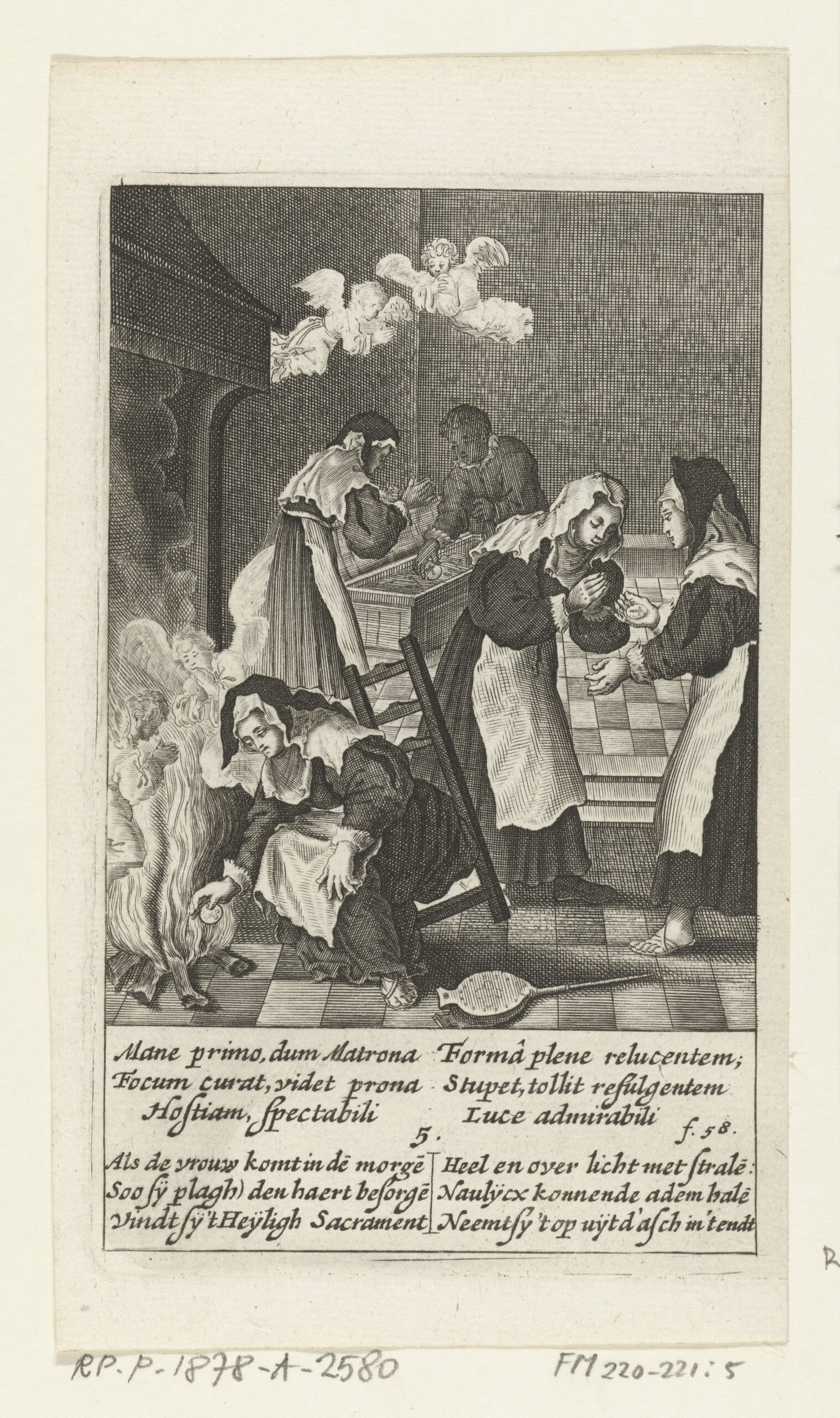
The content was thrown into the fire of the room, as was understandable hygienic practice in that situation. The narrative states that the host was not consumed by the flames and that a woman was able to remove it intact.
The picture of the Rijksmuseum chosen to illustrate the page represents precisely that scene. It is a later work intended to transmit tradition and not a visual testimony produced during the event.
The return to the house
The expanded story tells that a priest took the host to the Oude Kerk and that it returned inexplicably to the house. The repetition would have indicated that the place itself should become sacred space.
Meertens identifies this reason for return as a resource known in the literature of pilgrimage. To declare it allows to narrate the complete tradition without presenting each subsequent development as if it were from the oldest source.
Civil confirmation of 1345
The devotional history was quickly consolidated. A document of March 31, 1345 attributed to the Baljuw of Amstelland and the city government stated as true the story that circulated about the miracle.
This is an early and remarkable institutional reception. It does not amount to a modern scientific protocol, but it proves that a few weeks later the authorities already treated the event as a relevant public reality.
La indulgencia episcopal de 1346
On 19 October 1346, the bishop of Utrecht Jan van Arkel granted forty days of indulgence to those who visited the Heilige Stede and collaborated with its maintenance and access.
The episcopal decision documents the ecclesial approval of the pilgrimage. The route followed by many walkers ended with the name of the Heiligeweg, the holy way into the city.
The capillary of the Heilige Stede
The house and home linked to the miracle were incorporated into a chapel. The Heilige Stede was consecrated in October 1347 and grew to occupy the apple between Kalverstraat, Rokin, Wijde Kapelsteeg and Enge Kapelsteeg.
The original home was integrated into the sanctuary. There was the Sacrament of the Miracle and pilgrims from many territories arrived, making Amsterdam a city of Eucharistic reference.
The medieval processions
The city celebrated two great sacramental days. One specifically remembered the miracle and another coincided with the general solemnity of Corpus Christi. The host was taken through the streets with prayer and blessings.
The tour linked the Heilige Stede, the Dam, Nieuwendijk, Nieuwebrug and Warmoesstraat. The procession expressed an urban devotion involving authorities, clergy, inhabitants and pilgrims.
What happened to the material host
A letter from an auxiliary bishop of Utrecht of November 1346 already describes the host as deteriorated and allows to consecrate new ways to maintain the veneration. Therefore the material object could be replaced once or several times.
The last copy probably disappeared during or immediately after the assault on the chapel on May 29, 1578. The page does not therefore state that today there is the same physical host of 1345.
La Alteratie de 1578
When Amsterdam became a Protestant government in 1578, the Catholic public veneration was suppressed. The Heilige Stede later became a Protestant church with the name Nieuwezijds Kapel.
The disappearance of the object did not end the memory. Catholics from the city kept prayers, texts and tours in a context in which they could not publicly perform the old procession.
El Begijnhof as second Heilige Stede
From the second quarter of the 17th century, the Catholic chapel of the saints John and Ursula in the Begijnhof assumed the center of veneration. The diocese describes it as a second Heilige Stede.
There the liturgy, devotional literature and the memory of the miracle remained. Today the Begijnhofkapel is the stable Catholic reference to understand and pray this tradition.
The birth of the modern Stille Omgang
Since 1881, pilgrims have been walking the historical itinerary in silence at night. The Stille Omgang recovered the memory of the procession without external insignia, music or proclamations.
Silence is not empty: it offers space for prayer, inner examination and encounter with God in the middle of the city. Every March, faithful from different parts of the Netherlands participate.
A tradition in force in 2026
The diocese of Haarlem- Amsterdam announced in March 2026 a new Stille Omgang and activities in the Begijnhofkapel, including worship and eve. This current practice confirms that it is not just a museum memory.
Dates and programmes change annually. Anyone who wishes to attend must consult the organization and the diocese before travelling, without making this historical record a permanent calendar.
The demolition of 1908
The former Nieuwezijds Kapel, an architectural successor to the Heilige Stede, was demolished in 1908 despite a strong controversy. The medieval volume of the sanctuary can no longer be visited.
There are urban references and a commemorative stone located in 2001 near Wijde Kapelsteeg and Kalverstraat. The solar is now recognized for uses completely different from its religious history.
The historic site on the map
The main marker is located in Rokin 78, coordinates 52.3701984, 4.8921680, within the area occupied by the Heilige Stede. It points to the place of the event and the missing sanctuary.
The precision is of historical building and solar, but it is not intended to locate at the centimeter the home of the medieval room within a deeply transformed plot.
La capilla actual del Begijnhof
The reference for the current Catholic cult is Begijnhofkapel, Begijnhof 30, 1012 WT Amsterdam, coordinates 52.3692964, 4.8896053.
The tab provides both points because responding "where it happened" and "where devotion is preserved today" requires two answers. The visitor should not seek a surviving material relic, but a living liturgical memory.
Why the map distinguishes places
Placing only the chincheta in the Begijnhof would displace the miracle outside its site. Placing it alone in Rokin 78 might lead to the thought that there is still a visiting Catholic sanctuary there.
The main marker and the supplementary description make the historical transfer visible. This methodology also applies to other fact sheets where the site of the episode and subsequent custody do not match.
The imperial crown and historical prudence
Tradition links the pilgrimage of the Maximilian Emperor and his gratitude to Amsterdam with the imperial crown of the city's shield. It is an important episode of civic and devotional memory.
A simplified causation should be avoided: heraldic concession belongs to a broader political history. The tab retains the traditional link without using it as a demonstration of the Eucharistic phenomenon.
What is documented
The rapid local affirmation, the indulgence of 1346, the construction of the chapel, the pilgrimage, the processions, the rupture of 1578, the transfer of the devotional center to the Begijnhof and the Stille Omgang since 1881 are well documented.
The infuerbility of the host and its returns belong to the content of the account received. This difference does not empty devotion; it allows to communicate it honestly and to offer the reader sources to deepen.
The Eucharist and the care of the sick
The story begins with a community that serves a seriously ill person. Before any prodigy are the presence of the priest, reconciliation and sacramental food in fragility.
Devotion can lead today to accompanying the sick and dying, seeking the sacraments when they ask for them and supporting their families. That fruit of mercy avoids reducing the miracle to curiosity.
The spiritual meaning of silence
The Stille Omgang crosses streets full of trade, leisure and transit without being imposed by noise. The pilgrim walks, remembers and prays. This discretion was born of historical restrictions, but it acquired a spiritual language of its own.
Silence can open space to worship, reparation and unity. It does not erase the conflictive history of the city; it invites it to go through without aggressiveness and with hope.
Sources consulted
- Instituto Meertens: Ámsterdam, Sacramento del Milagro, sources, object of veneration, indulgence, places and continuity.
- Amsterdam Municipal Archivo: Mirakel, story, Heilige Stede, processions and demolition.
- Diócesis de Haarlem-Ámsterdam, continuity of the Begijnhof and Stille Omgang in 2026.
- Silent Society, history and current devotional practice.
- Repertoire associated with San Carlo Acutis: Amsterdam, initial reference contrasted.
Para orar
Lord Jesus, living bread, accompany those who suffer and teach us to receive you with humble faith. May silence pay attention to your presence and may the Eucharist make us servants of unity, truth and mercy. Amen.
Image credit
A woman finds the host in the fire, a picture of the series on the Mirakel of Amsterdam. Rijksmuseum / Wikimedia Commons, CC0. Ficha de la estampa y dedicación CC0 en Wikimedia Commons.
_Amstelredams_eer_ende_opcomen_door_de_denckwaerdighe_miraklen_aldaer_geschied_aen_ende_door_het_H._Sacrament_des_Altaers_Anno_1345_(s,_RP-P-1878-A-2580.jpg)