
Les Ulmes recalls the apparition of a figure of Christ in the form exposed during the blessing of June 2, 1668. Henri Arnauld, Bishop of Angers, investigated the testimonies and declared the event authentic; the form ceased to be preserved in 1832.
The event of June 2, 1668
The episode is located in the parish church of San Vicente de Les Ulmes, a small town in Anjou near Saumur. It was Saturday within the eighth of Corpus Christi. At night, about two hundred people participated in the blessing of the Most Holy Sacrament, a celebration dedicated to the worship of the Eucharist exposed in custody.
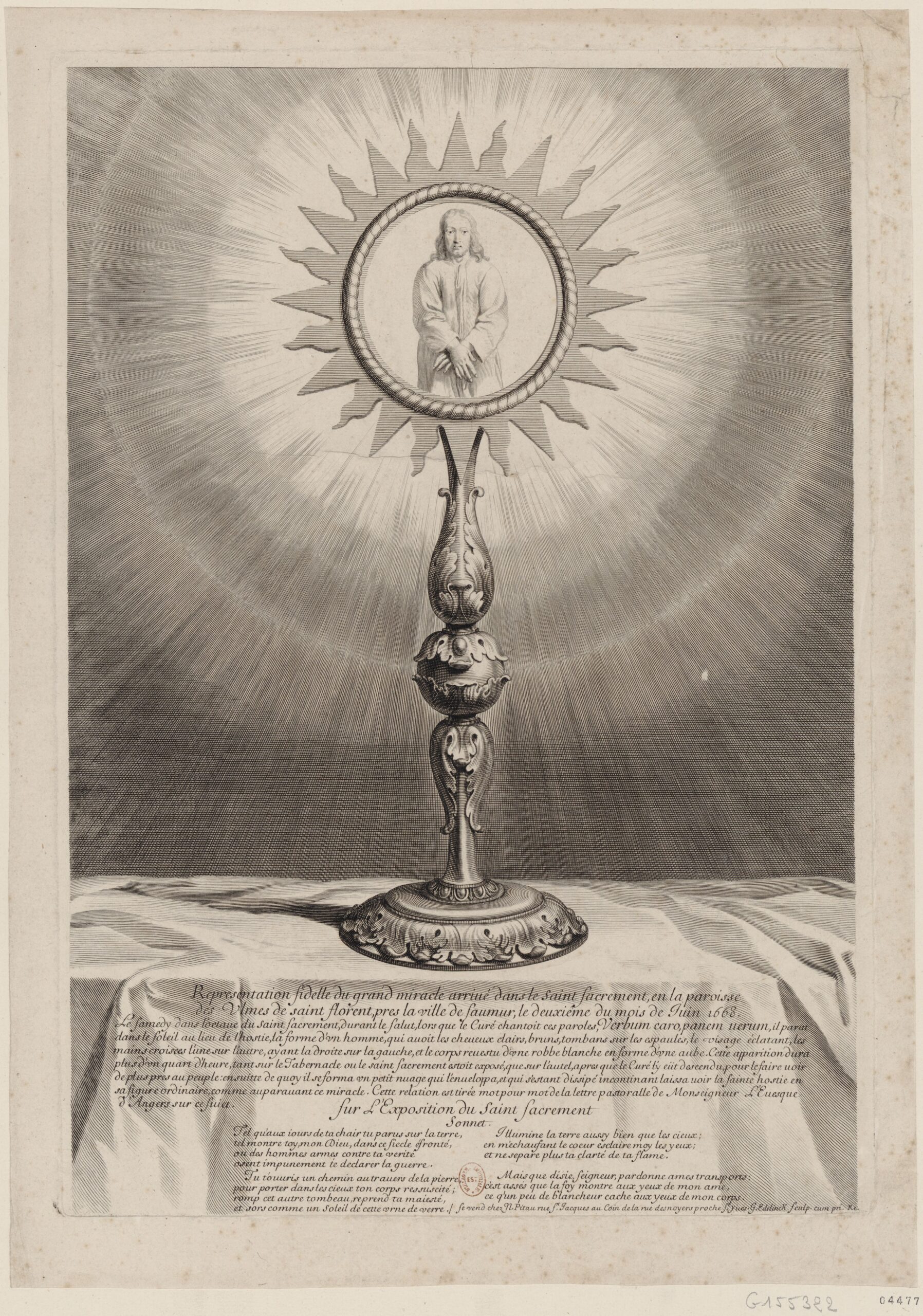
According to the pastoral letter issued that same month, while the parish priest sang the Latin words Expensive verbum, panem verum, the attendees claimed to see in the place of form the figure of a man. The story describes clear brown hair, bright face, crossed hands and a white robe like a dawn. The demonstration would have lasted more than a quarter of an hour.
What did the priest and the witnesses say
Nicolas Nezan, parish priest of Les Ulmes, placed the beginning around seven in the afternoon. Other witnesses recalled somewhat different hours, an understandable variation in statements about a collective event. They agreed, on the other hand, on the approximate duration and in which the figure occupied the visible space of the form in custody.
The priest went down the temple from the tabernacle to the altar to bring him closer to the assembly. The stories speak of tears, admiration, joy and reveential fear. Finally, a small cloud would have covered the figure and, as it dissipated, the form was again seen with its usual appearance. This description belongs to the historical testimonies collected and not to a modern scientific observation.
La prudencia de Henri Arnauld
The news came to Henri Arnauld, Bishop of Angers. Before his decision he sent Nicolas Charpy, priest of the Oratory and parish priest of Saumur, to carry out a first investigation on the ground. He then announced his own visit for June 20, 18 days after the episode.
The bishop came with his promoter René Bréchu. He celebrated the mass, examined the form, altar and conditions of the building, and received formal statements from twelve people: the parish priest, his vicar, eight inhabitants of Les Ulmes and two justice officers who were passing from Saumur. A verbal process was lifted and later lost.
The pastoral letter of June 25
Five days after that hearing, Henri Arnauld issued a pastoral letter that declared the event authentic. The document ordered that the form be preserved in a safe and ornamented furnace next to the main altar on the side of the Gospel. It also established an annual solemn commemoration on the Saturday of the eighth of Corpus Christi.
The letter was printed in Angers in 1668 and was reprinted in other cities. A copy is quoted by Isabelle Bonnot's academic study with the symbol of the National Library of France. The existence of a contemporary episcopal decision distinguishes Les Ulmes from other stories transmitted only by late compilations.
The limits of the kept documentation
The original verbal process of June 20 is not preserved. Joseph Grandet systematically gathered the pieces known since 1708 and published them in 1715 in an apogytic work. He included the episcopal letter, references to the lost act, memories of contemporaries and certificates written decades later.
The historian Isabelle Bonnot warns that several late testimonies were written forty-two or even forty-six years later. Their value is not identical: some come from eyewitnesses and others went through several intermediaries. There is also a copy, possibly from the 18th century, of a statement attributed to the parish priest and dated 13 June 1668. This documentary inequality requires avoiding a false certainty about every detail.
A historical research that does not judge faith
The study published in 1983 in Annales of Brittany and Western countries It is not intended to decide whether the supernatural phenomenon occurred. He analyses what the historian can know from the sources, how they were gathered and what religious and controversial interpretations they aroused.
The competence of the historian is to rebuild documents, dates, witnesses and subsequent uses. The declaration of authenticity belongs to the pastoral government of the bishop in his time. Neither of these two dimensions should be presented as an optical, medical or contemporary laboratory test.
The image commissioned after the event
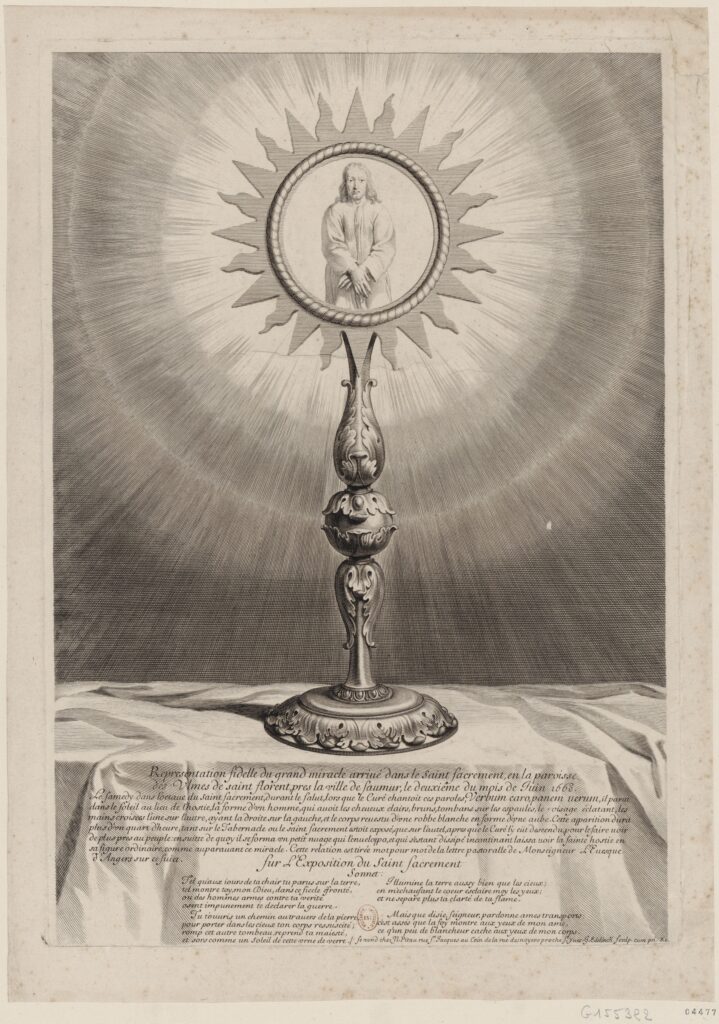
André Lanier, priest of the Angers Trinity and future episcopal promoter, commissioned a representation of the apparition. The model was sent to Paris and spread by engraving. The picture of Gérard Edelinck reproduced custody with the figure of Christ and included an extract from the pastoral letter and a devotional sonnet.
The Collective Catalogue of France also describes a colorful 1668 drawing, preserved in the Municipal Library of Angers, which could be the original one in charge of the painter Poupard de Longué. The outstanding image of this page is a historical picture digitized by the Bibliothèque nationale de France and declared public domain in Wikimedia Commons.
Devotion, pilgrimages and local memory
After the episcopal declaration, Henri Arnauld returned several times to Les Ulmes. They also attended clerics, nobles and pilgrims. The sources studied record visits in 1668, 1674, 1695, 1710 and 1712, as well as stories of favors attributed to prayer before the form.
The hornat ordered by the bishop remained in the church, closed with double wooden door and accompanied by painting and commemorative inscription. In 1907 a brotherhood was erected and the memory had celebrations until the three-year anniversary of 1968. These data show the historical continuity of the cult, although its intensity has changed over the centuries.
The disputes of the 17th century
The event arose in a context of strong disputes about Christ's real presence in the Eucharist, the practices of exposition of the Most Holy and the divisions between Catholics and Protestants. Saumur then hosted a Protestant Synod, a circumstance that Catholic authors interpreted as part of the providential meaning of the episode.
The page retains this context without turning the 17th century confessional controversy into language against other Christians. The later history also shows that jansenists, adversaries of the bishop and apologists used the case to defend different positions. Knowing these uses helps to distinguish the documentary core from party interpretations.
Objections and consideration of the place
Critics suggested optical or mechanical explanations: solar reflections, mirrors, papers, a flashlight or a double form. Grandet responded by studying the position of the sun, the architecture of the temple and the examination carried out by the bishop. His work defended authenticity and sought to respond to those who accused Arnauld of having approved a deception.
The moral conduct of the parish priest Nicolas Nezan, who was judged by the ecclesiastical authority a few months later by a scandalous relationship, was also used against the case. A personal lack does not by itself prove the truth or the falsehood of what other witnesses said they saw. The tab does not hide this difficulty, but does not make it an automatic conclusion.
The form is no longer preserved
During the French Revolution, the form was taken to Le Puy- Notre- Give me by a constitutional priest. Bonnot's study states that the priest Peltier consumed it in 1832. Therefore, today there is no host attributed to the event that can be venerated or contemplated in Les Ulmes.
This clarification is essential for the global map. The marker points to the building where the episode was located and where its historical memory remains, not a sanctuary with a preserved Eucharistic relic. Hornaine, documents and iconography are different testimonies of the missing form.
The church of San Vicente and its location
The church of San Vicente is located in Rue du Prieuré, 49700 Les Ulmes, Maine and Loira, Loire Countries region, France. The coordinates 47.2197265, -0.1784811 corresponds to the Catholic building identified in open mapping as Saint Vincent Church.
Whoever visits the place must remember that it is a church and a memorial place. The parish or municipal hours should be checked in advance. He should not go to the city waiting to see the form of 1668, as it was consumed in 1832.
Responsible classification on the map
Les Ulmes is classified as "a recognized Eucharistic miracle with missing relic." The formula brings together the two documented statements: the Bishop of Angers declared the event authentic by pastoral letter, and the form ceased to exist in the 19th century.
The category avoids two opposite errors. It does not reduce the case to a legend without historical record, but it does not imply that there is a material relic or a recent scientific check today. The map serves to locate a documented ecclesial history and to guide a critical and believing reading.
Spiritual feeling
The accounts of 1668 insist on worship, tears and the call to conversion. The most sober reaction attributed to Jean Hubert is particularly significant: he preferred to remain in his place and stated that faith was sufficient to believe in the presence of Christ in the Most Holy.
The memory of Les Ulmes can lead to a Eucharistic faith that does not depend on looking for extraordinary phenomena. Christ gives himself up in the Mass, reunites the Church and calls to recognize him also in the poor, the sick and those in need of reconciliation.
Sources consulted
- Collective Catalogue of France / BnF: faithful representation of the event of Les Ulmes, manuscript of 1668 and description of the pastoral letter.
- Isabelle Bonnot, «A Eucharistic miracle in Anjou in the 17th century: The miracle of the Ulmes», Annales of Brittany and Western countries, 1983, pp. 7–18.
- DOI 10.3406/abpo. 1983.3109, permanent academic reference of the study.
- Exposure associated with San Carlo Acutis: Les Ulmes, secondary devotional source contrasted with the heritage catalogue and the historical study.
Para orar
Lord Jesus, present in the Eucharist, awakens our faith and makes us worshippers in spirit and truth. Deliver us from seeking signs out of curiosity and teach us to meet you in Mass, in the conversion of the heart and in humble service to our brothers. Amen.
Image credit
Historical representation of the Eucharistic event of Les Ulmes, published from 1668. Recorded by Gérard Edelinck, editor N. Pitau; Bibliothèque nationale de France / Wikimedia Commons, public domain. Original file and public domain statement in Wikimedia Commons.
