
On March 25, 1907, a Copon was stolen from the parish of Our Lady of the Angels of Silla. The forms appeared two days later between wet land and were preserved. Archbishop Miguel Roca declared them authentic and in good condition in 1983 and regulated his Eucharistic cult.
A Eucharistic Event of the 20th Century
The history of the Sacred Forms of Silla belongs to a close time and to a concrete community. It does not begin with a vision, but with a sacrilegious robbery, a collective search and the prolonged conservation of the recovered host. The parish of Our Lady of Angels remains its place of custody and worship.
Paraula, a publication of the Church in Valencia, reconstructed the episode with parish sources during the Jubilee Year of the Holy Chalice. His account allows us to distinguish dates, protagonists and later ecclesiastical decisions.
25 March 1907: the robbery
On March 25, 1907, the Solemnity of the Incarnation and Holy Monday coincided. Someone entered the parish and removed from the sacred a copon with consecrated forms. The parish priest Miguel Zaragozà had the bells played and the neighborhood went out to find the responsible and the most holy.
The thief wasn't arrested. For the faithful, loss was not just that of a valuable object: it affected the consecrated species that the Church venerated as the Body of Christ. This conviction explains the mobilization of the entire people.
The rain and the finding
It rained on Tuesday 26th. On Wednesday 27, several day workers working in an orange garden found the forms mixed with wet land. The parish account states that they remained whole despite the rain and the conditions of the land.
The place was then outside the city centre, about 250 meters from the last house. There women prepared a provisional altar on a table and the priest deposited the copon and the forms wrapped in a handkerchief.
The procedural return
The community immediately organized the return to the parish. The four day-laborers carried the pallium's varals with their working clothes, an image that the local memory has preserved as an encounter between the Eucharist and daily life.
The forms were left in the sacred. It was reasonable to expect that, damaged by water and land, they would break down over time. On 7 April, acts of disgust were held and since then an annual Eucharistic feast was held.
Conservation in the early years
The parish presented the forms on the first Sunday of May for worship. When he found that they were still preserved, in 1930 the parish priest Salvador Espin informed his superiors and a file was started in the Valencian country. Guillermo Hijarrubia intervened as an ecclesiastical delegate.
According to the published reconstruction, on 4 May 1930 the curia recognized the conservation and ordered them to receive Eucharistic veneration. The original file was later lost in the fire of the archbishopric palace. That is why we must attribute these data to memory and parish copies, without pretending that today we consult an original missing.
El Taroncheret
The community cost by subscription and donation of jewels an orange-shaped custody, known as el Taroncheret. The design recalls the garden where the host appeared and transforms an element of the Silla landscape into a symbol of repair and worship.
The forms were placed in a relicary, closed and lacquered teak in the presence of the faithful. The custody itself does not demonstrate the nature of the phenomenon, but it documents the community force of veneration.
The Civil War and the Hidden Custody
During the religious persecution of 1936, attempts were made to protect the forms of destruction. They were hidden in a door hole and remained there for about three years, exposed to changes in temperature and humidity. When they were recovered, the parish tradition stated that they were still intact.
The loss of the 1930 papers and the material survival of the forms later led to a further review. This documentary discontinuity explains why the 1983 process is decisive for talking about the current ecclesial state.
La salida a Torrent de 1949
In 1949, at the conclusion of the Great Holy Mission of the Artebrance of Torrent, the forms first left Silla. They were moved to Torrent and venerated by many faithful. The experience boosted the Brotherhood of the Most Holy Forms.
The brotherhood was born to sustain veneration and spread devotion. Like any Eucharistic association, its purpose is understood from mass and veneration, not from curiosity for an extraordinary object.
The Decree of Miguel Roca of 1983
On 2 October 1983, as a priest Fernando Gómez, Archbishop Miguel Roca Cabanellas signed a new decree. Paraula reproduces its core: in view of expert, documentary and testifying evidence, it declared the forms "authentic and in good condition of conservation" and ordered to give them the veneration provided for in canon 898 of the then-in-force Code.
A week later, the Archbishop himself presided over a concelebration of thanksgiving. The formulation is precise: it confirms identity, conservation and regime of veneration. The fact sheet does not transform it into statements about biological composition, physical impossibility, or supernatural cause that the above-mentioned decree does not detail.
The cult at present
The Archdiocese continues to record the feast of the Holy Forms. The Official Gazette of 2023 states that the Archbishop presided over the Eucharist in Our Lady of Angels on the occasion of this celebration. It is a contemporary evidence of pastoral continuity.
Anyone who wishes to visit the parish must consult the times and conditions of veneration. Custody must not remain exposed continuously, and the silence of the temple deserves the same respect as any liturgical celebration.
The Church of Our Lady of the Angels
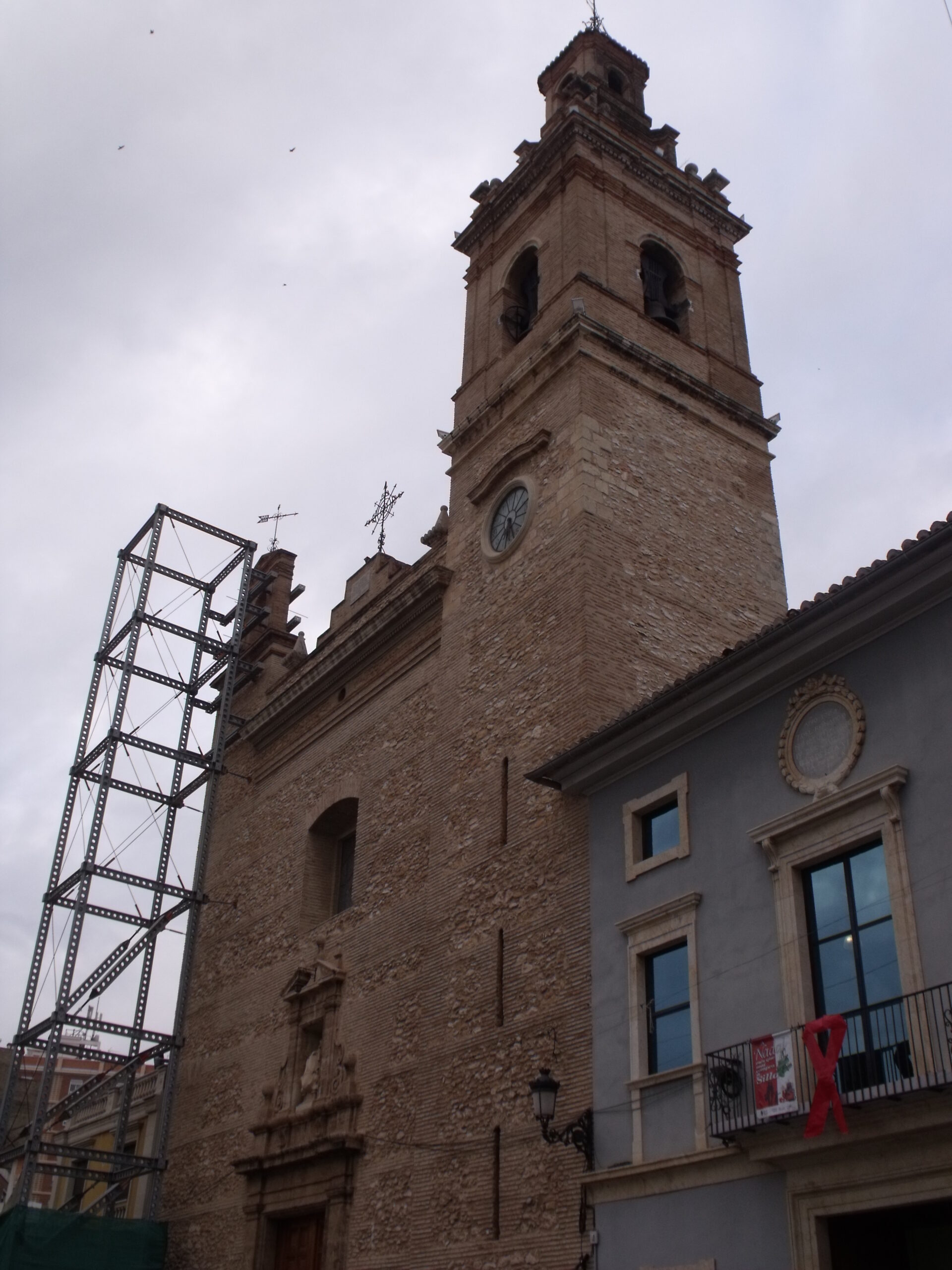
The present temple was built since the mid-18th century and is part of the religious heritage of Silla. His chapel of Communion, the history of the Most Holy Christ and the Eucharistic devotion place the forms within a wider parish life.
The selected photo shows the exact building and comes from Wikimedia Commons. A generic image of a custody or artificial recreation of the finding is not used.
exact location
The marker points to the parish church of Our Lady of Angels in the center of Silla. The coordinates 39.362876, -0.412264 correspond to the building registered in Wikimedia and OpenStreetMap and require slightly the previous reference 39.3629559, -0.4124295.
The 1907 garden is not marked because urban growth and the sources consulted do not allow for the safe identification of the historical plot. The map leads to the verifiable place of custody.
Classification and limits
Silla is incorporated as "Eucharistic miracle with relic and veneration regulated by the archdiocese." The category reflects material conservation and the 1983 decree. It does not replace a full publication of the expert evidence, which would be necessary to technically assess its methods and conclusions.
This prudence avoids both denying a living tradition and exaggerating what available sources can say.
Spiritual feeling
The theft and finding remember that the Eucharist is not a private possession. The people came together to seek it and turned pain into worship, reparation and community commitment.
The preserved forms guide each mass, where Christ is given as food. True devotion is recognized in reconciliation, the care of the poor and the unity of those who share the same bread.
Sources consulted
- Parasula · Church in Valencia: history, file and decree of 1983.
- Official Bulletin of the Archbishop of Valencia: Feast of the Holy Forms in 2023.
- Exposure associated with San Carlo Acutis: Silla, contrasted with the diocesan source.
Para orar
Jesus the Eucharist, make us humble custodians of your presence. It turns our faults into reparation, our searches into encounter, and our worship into concrete love for the brothers. Amen.
Image credit
Church of Our Lady of the Angels of Silla. B25 / Wikimedia Commons, CC BY-SA 3.0. File and license in Wikimedia Commons.
