
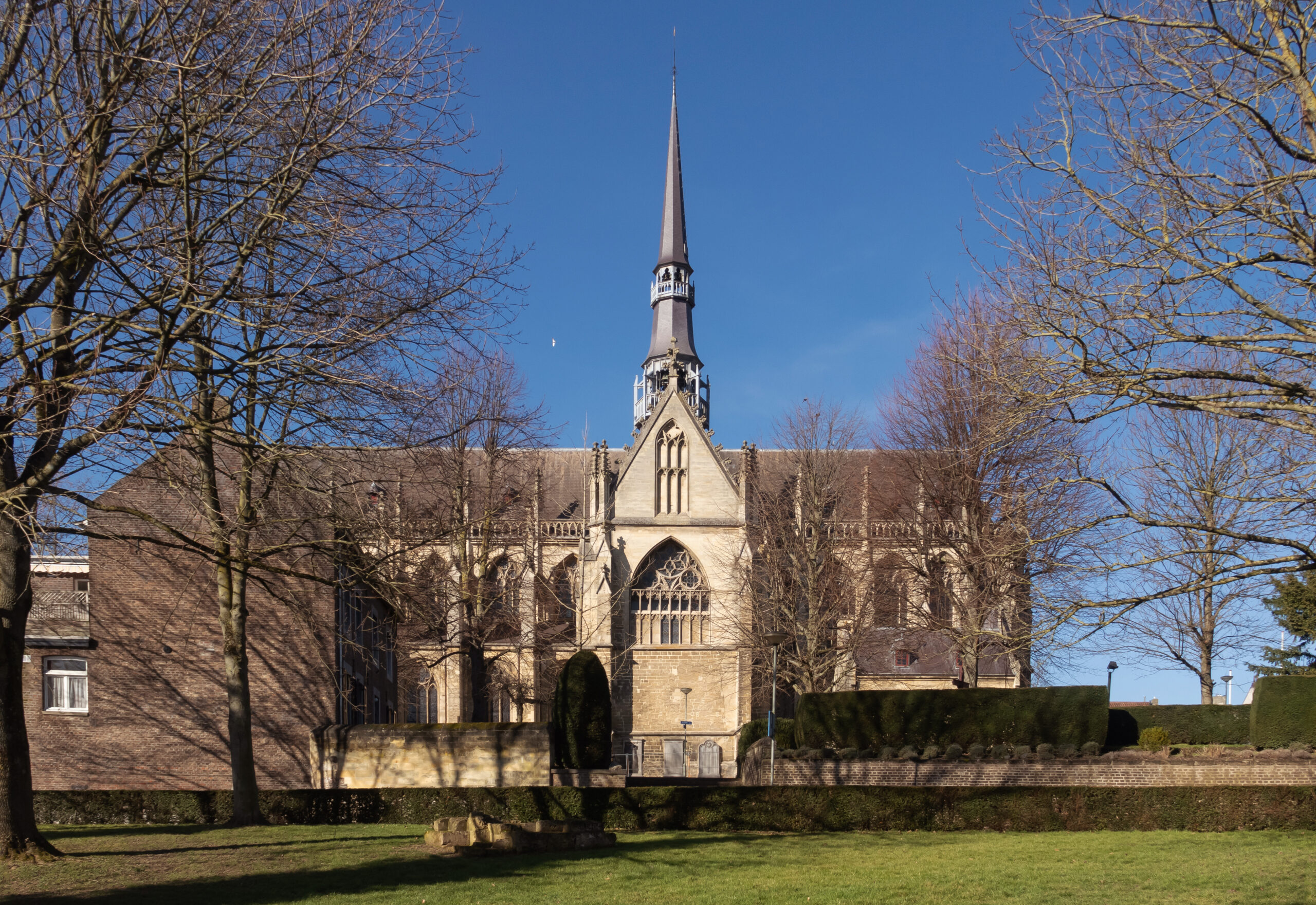
Documented history of the two Eucharistic traditions of Meerssen: the account of blood and water of 1222, the rescue during the fire of 1465, the destruction of the ancient relic in 1578 and the sacramental cult in force.
Meerssen and its two traditions
Meerssen brings together two separate Eucharistic accounts for more than two centuries. The first is dated in 1222 and is related to the celebration of the Mass; the second is located in 1465 and tells the salvation of the Most Holy during a fire.
Both contributed to a lasting pilgrimage, but do not describe the same phenomenon or object. Publishing them together requires keeping your chronology clear.
The church of the Benedictine
In 1222 the church was attended by four Benedictine monks linked to the abbey of Saint- Remi de Reims. The community cared for the cult and administered the rights and rents of the territory.
The building at that time was before the current Gothic basilica. The successive works, fires and enlargements profoundly transformed the temple without changing the central solar of tradition.
El relato de 1222
According to the devotional version, a priest discovered during the Mass that he had not prepared wine and water in the chalice. At the end of the consecrated host, there would have been blood and water that filled the vessel.
The image refers to the side of Christ in the Gospel of John. The story was known as the Bloedwonder or miracle of Meerssen's blood.
Caesarius de Heisterbach
The news appears in a collection of religious examples written by the Caesarius Cistercian of Heisterbach. His work collected narrations for teaching and preaching.
The chronological closeness makes its text a relevant medieval source. Its gender, however, is not that of a clinical or chemical report, but of a theological example of the Eucharist.
The pilgrimage after 1222
The tradition attracted visitors and favored works in the church. In the following decades the building was expanded, although it was again subjected to fires and reconstructions.
The indulgences granted to those who helped the temple show a close relationship between pilgrimage, financing and architecture. The cult became part of the local identity.
The medieval temple in transformation
A large part of the church burned in 1288. In 1340 another constructive phase began and, towards the end of the 14th century, a Gothic church was formed dedicated to the Most Holy Sacrament and Mary.
The interventions of the 15th and 16th centuries gave the building much of its character. The title of San Bartolomé as a patron is documented at least since the 17th century.
The fire of 1465
In 1465, in a context of violence and regional conflict, the church suffered another fire. The fire made the tabernacle where the Most Holy was reserved inaccessible.
This episode does not repeat the alleged spilling of 1222. Its center is the preservation of the Sacrament and the action of a person who entered the burning building.
The peasant of Raar
Tradition tells that a young peasant from nearby Raar saw the smoke while working. He made the sign of the cross, ran to the temple, went through the fire and gave the Sacrament intact to the priest.
When he returned to the field, he would have found the work done by an angel. This second motive belongs to the pious narrative that highlights the courage and priority given to the Eucharist.
The strength of the second story
The fire of 1465 gave new impetus to the pilgrimage, even more visible than the memory of 1222 for several centuries. Whole groups arrived in procession from neighbouring locations.
The sources mention such a large influx that it was sometimes necessary to have additional spaces to attend to confessions. Meerssen's memory became regional.
Incidences and reconstruction
Bishops of Liège granted indulgences in 1472, 1479, 1501 and 1504 to support works and devotion. These letters provide institutional support to the pilgrimage site.
They are not analysis of the material of the miracle, but pastoral and economic decisions of a medieval sanctuary in reconstruction.
The destruction of 1578
During the Dutch revolt, the object venerated as Holy Blood was stolen and destroyed in 1578. Sources relate the loss to mutiny troops.
This data prevents talking about a material relic preserved since 1222. From then on, devotion was directed to the Most Holy Sacrament exposed and to the memory of the episodes.
Continuity without the old object
A pastoral visit of 1673 states that the popular influx continued. The community held celebrations during the octave and its own forms of veneration.
The continuity of worship does not require pretending that the lost object survived. It is a liturgical, community and spatial continuity around the Eucharist.
The great custody
The basilica has a large cylindrical custody of the 16th century, later restored and partially renewed. It is used to expose the Sacrament.
The file distinguishes that custody from the missing object of the Holy Blood. Their material presence belongs to the present cult, does not prove that it contains remains of 1222.
El Sacramentsoctaaf
The celebrations reach their main point around Corpus Christi and its eighth. Masses, processions and the devotional journey known as Meerssener Ganck are part of the living religious heritage.
Recognition as an intangible cultural heritage documents the community's transmission of practice. It does not replace ecclesial discernment, but it shows its social continuity.
La vuelta alrededor del altar
The pilgrims make several turns around the main altar, with prayer and a gesture of contact in the back of the tabernacle. This use is often presented as old.
Meertens' research warns that its current form may have consolidated around 1900. The tab avoids automatically attributing to the Middle Ages all the details of contemporary practice.
The lower basilica of 1938
In 1938 the church received the title of a minor basilica of the Most Holy Sacrament. This recognition reflects the historical relevance of devotion and the temple.
The title does not canonize every narrative detail, but confirms that the Eucharistic cult of Meerssen occupies a recognized place within the ecclesial life.
The exact place of the map
The marker is located at Markt 17, coordinates 50,8837154, 5,7550452. It is the basilica of Saint Bartholomew and the Most Holy Sacrament.
Although the building has changed since 1222 and 1465, the site retains the historical continuity of both traditions and the current cult. There is no need to create two bedbugs for episodes in the same subsequent temple.
How to prepare a visit
The basilica allows you to know the architecture, the representations of both accounts and the sacramental devotion. The dates of procession and the eighth must be checked each year.
Whoever visits the place must know that he will not see the ancient relic of blood. You will find a community that celebrates the Eucharist and preserves its historical memory.
Two stories, one sacramental faith
The first story speaks of blood and water; the second, of rescue and fire. Fuse them erases their meaning and can create the false impression that the same host went through both events.
His common bond is the Eucharistic faith of Meerssen. The fact sheet brings them together only because they led to the same place of pilgrimage and a shared community tradition.
Prudence to danger
The courage of the peasant must not be used to encourage entry into burning buildings. In a current emergency, the rescue services must be alerted and life protected.
Spiritual teaching is the availability to serve and reverence, not the literal imitation of a dangerous conduct narrated in another context.
The Eucharist and the Community
The true fruit of devotion is recognized in a reconciled community, attentive to the sick, poor and single people. The procession does not end upon return to the temple.
To worship Christ in the sacrament calls to recognize him also in those who need care. Thus the extraordinary memory unites to the daily Gospel.
How to read artistic representations
The basilica contains paintings, badges and objects that refer to both episodes. Some images of the fire show the peasant carrying a white host, while other texts speak of the reserved Body and Blood of the Lord.
These differences remember that art interprets tradition and adapts its symbols. A late painting does not allow to decide on its own which concrete container came out of the fire in 1465.
In the same way, the images of blood and water teach the link with the Passion of Christ, but they are not present reproductions of the year 1222. Their credits and dates should be read as part of the history of devotion.
Sources consulted
- Meertens Institute: Meerssen, Most Holy Sacrament, sources, two episodes, veneration, lost object and practices.
- Diocese of Roermond: eight hundred years of the miracle of 1222, contemporary ecclesial memory.
- Intangible Cultural Heritage of the Netherlands: Sacramentsoctaaf, continuity of celebrations.
- Church buildings in Limburg: basílica de Meerssen, building and chronology.
- Repertoire associated with San Carlo Acutis: Meerssen, initial reference contrasted.
Para orar
Lord Jesus, Bread of life, make us brave to serve and prudent to care for life. May Meerssen's memory increase our love for the Eucharist and lead us to reconciliation, worship and charity. Amen.
Image credit
Basilica of the Most Holy Sacrament of Meerssen, place of the traditions of 1222 and 1465 and of the present cult. Michielverbeek / Wikimedia Commons, CC BY-SA 4.0. File and license in Wikimedia Commons.
