
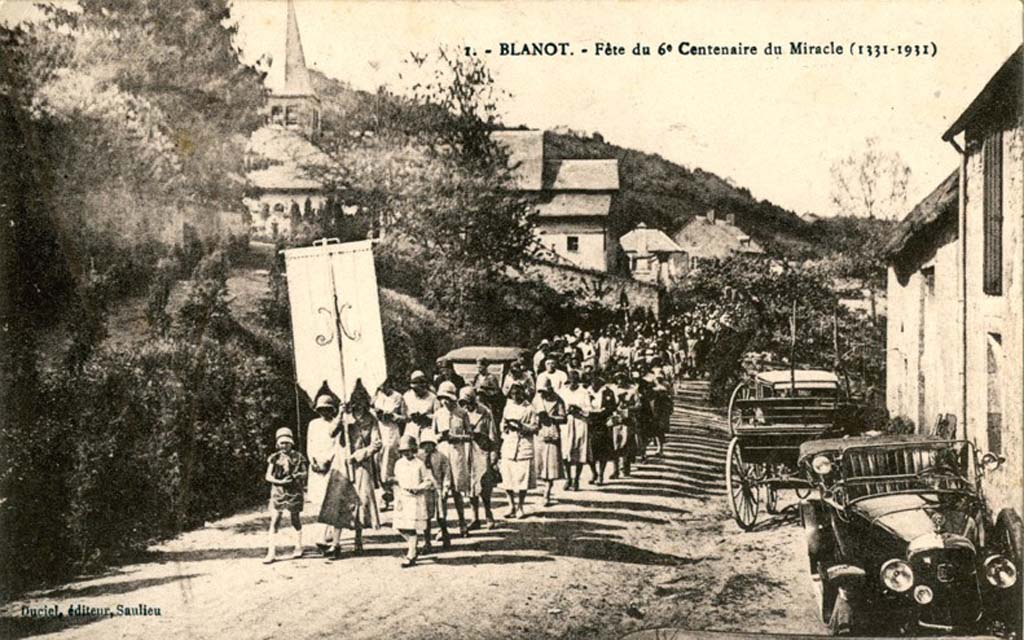
Blanot retains a fragment of cloth related to the Eucharistic event narrated on Easter Sunday of 1331. The sources document a medieval canonical research, the historical development of its cult and the feast of the Holy Hostia.
What happened according to the historical record
The tradition places the event on March 31, 1331, Easter Sunday, during the first Mass held in the small church of Blanot. The vicar Hugues de la Baume distributed communion to the faithful. As was the case in busy celebrations, two attendees held a cloth under those who received the Eucharist to prevent a particle from falling to the ground.
Al comulgar Jacquette, widow of Regnaut d'Effour, a fraction of the form would have fallen on that canvas. Thomas Caillot, one of those holding him, warned the priest. The story states that, as this one approached to collect it, he no longer found the particle and saw instead a red sign. These names and circumstances belong to the historical testimony transmitted; they are not a contemporary reconstruction.
The cloth and the signal that didn't disappear
The narrative received adds that the priest took the cloth to the sacristy and tried to wash it. The signal remained attached to the tissue. Then he cut off the affected part and reserved it for his custody. Over time, that fragment was placed in a relic and was associated with the Eucharistic memory of the parish.
The fact sheet carefully distinguishes between verifiable facts and statements of devotional account. It is verifiable that there is an ancient tradition, a textile relic, archival documentation and an organized cult. There is no modern scientific analysis to define the composition of the stain; therefore there is no material diagnosis here.
The canonical research of 1331
Bishop Pierre Bertrand arranged an ecclesiastical investigation in the same year of the event. The preserved versions mention a commission that heard the witnesses and left a written record. Among its members are Jean Jarossier or Javroisier, officer of the curia, Hugues Chapelot, argitaría de Lucenay, and Étienne Angovrand, notary and apostolic.
The medieval original has not come to us. Historical knowledge depends on an old copy of the record, archival notes and later works. This transmission chain does not make the document irrelevant, but it requires an explanation of its limits. The investigation shows that the ecclesiastical authority examined the case early; it does not amount to a laboratory test or allows the same certainty to be attributed to every detail.
How documents were kept
The historian Delphine Landaud studied Blanot within an academic work dedicated to the history of the Eucharist and the Eucharistic miracles. He explains that priest Augustine-Albert Mazille found in Dijon's diocesan files an old paper copy of the verbal process. He also worked with unpublished notes from the bishopric of Autun and with documents preserved by a family of the people.
The diocesan Archives of Dijon today record a specific file: main documents relating to the Easter event of 1331, a record of twenty-one leaves, the article of Mazille published in 1901, a provision of 1887 to establish the feast of the Holy Hostia of Blanot and a photograph. This inventory allows checking the existence and continuity of the dossier without pretending that all its materials are digitized and available online.
Incidences and expansion of devotion
The historical tradition attributes to Pope John XXII the granting of indulgences linked to mass held in Blanot. The news shows that devotion soon transcended the strictly local realm. Over the centuries, the relic was exposed and carried out in Easter celebrations, Pentecost and, in a very special way, in the solemnity of Corpus Christi.
indulgences must be understood within the spiritual discipline of the Church: they do not buy grace or make a visit an automatic guarantee of favors. They express the call to conversion, prayer and sacramental life. The center of devotion is never an isolated stain, but Jesus Christ present in the Eucharist.
The relic during the French Revolution
The local memory maintains that, in 1793, the faithful of Blanot hid the relic in a nearby house to protect it from the plunder of the church. La familia que la habría custodiado facilitó después documentos al Padre Mazille. This episode is part of the history of transmitted conservation and helps explain why the fragment returned to the temple.
The material continuity of the cloth should be distinguished from the documentary preservation of each episode. Academic research studies precisely how a medieval devotion was reactivated and explained in later times. The survival of relic, the writings of the 19th century and the centenary celebrations are different layers of the same memory.
The feast established in 1887
The diocesan inventory retains a disposition of Monsignor Victor- Lucien- Sulpice Lécot for the establishment of the feast of the Holy Hostia of Blanot, printed in Dijon in 1887. This is important because it documents a concrete ecclesiastical intervention in the renewal of contemporary veneration.
In 1931, on the sixth centenary, the community held a procession of Corpus Christi. The historical photograph that illustrates this page shows precisely the way out of that procession from the true church of Blanot. It replaced the above image, which represented a crucifix of Naples and had no geographical relation to the tab.
The church of San Andoche and San Tirso
The right place is the Catholic church of San Andoche and San Tirso, in Blanot, department of Côte-d'Or, region of Burgundy-Franco Condado. The building, of medieval origin, is dedicated to the saints Andoche and Tirso and belongs to the diocese of Autun. It should not be confused with another Blanot located in Saona and Loira or called the church of San Martín.
The regional heritage information dates the temple in the 12th century and notes that its chorus was restored in 1957. Inside are contemporary windows installed in 1994, paintings, a 16th century wooden Christ and a major altar of 1997. It is a living church, not just a container of a historical piece.
exact location on the map
The marker is located on the church of San Andoche and San Tirso, at the Route of Liernais, 21430 Blanot, Côte-d'Or, France. The corrected coordinates are 47.1713597, 4,2342416 and correspond to the building identified in open mapping and in the temple's heritage category.
The previous version mistakenly pointed to another Blanot, approximately 89 kilometres south, in Saona and Loira. Correglo avoids driving the pilgrim to a different location. Time and conditions for access should be consulted before travelling, as openings and celebrations may vary.
What the pilgrim can venerate today
The church retains the fabric fragment associated with the 1331 story, presented in a relic. Local tradition maintains a commemoration linked to Corpus Christi. The presence of the relic does not replace participation in the Mass or turn the visit into a spectacle: it invites the renewal of faith in the sacrament and the treatment of the Eucharist with reverence.
Those who come can stop in silent prayer, participate in the liturgy where appropriate and know history without demanding an extraordinary sign. The Church teaches that the Eucharistic faith is based on the word of Christ and the sacramental celebration, not on the need for sensitive wonders.
How to read the story responsibly
The history of Blanot brings together a narrated event, a canonical research, a complex documentary tradition, a preserved relic and successive renovations of veneration. A rigorous presentation does not have to choose between acrylic credulity and contempt. It can respect devotion and at the same time indicate what comes from the copied act, what belongs to later testimonies and what is physically proven today.
For this reason, this fact sheet does not claim that a scientific test has certified human blood or provides details not supported by the sources consulted. He does recognize that the Christian community of Blanot has been seeing in that cloth a call to worship Christ and to live the celebrated mystery more consistently.
Spiritual feeling
The cloth held to protect the consecrated particles recalls the delicacy with which the Church receives the gift of the Eucharist. True reverence is not limited to external gestures: it continues in the care of the weak, reconciliation, truth and charity.
The Easter of 1331 places memory in the heart of the Christian faith. The dead and risen Christ gathers his people and gives himself up as food. Blanot can help the pilgrim to ask for a more conscious faith, to communicate with dignity and to transform worship into daily service.
Sources consulted
- Dijon diocesan Archives: repertoire of parish records, inventory of the dossier of Blanot, the historical record and the festive provision of 1887.
- Delphine Lannaud, «Black in Burgundy: a medieval miracle with devotional revivals of the contemporary era», Presses universitaires de Franche-Comté, estudio histórico y documentary.
- Bourgogne Tourisme: iglesia de San Andoche y San Tirso, identification of the temple, direction and preserved heritage.
- Exposure associated with San Carlo Acutis: Blanot, used as a secondary devotional source and contrasted with the above.
Para orar
Lord Jesus, living bread down from heaven, increases our faith and teaches us to receive you with reverence. May the worship of your presence lead us to conversion, to unity and to the service of those who need your love most. Amen.
Image credit
Procession of the feast of Corpus Christi of 1931, sixth centenary of the event, leaving the church of San Andoche and San Tirso de Blanot. Unknown author / Wikimedia Commons, public domain. Original form and public domain statement in Wikimedia Commons.
