
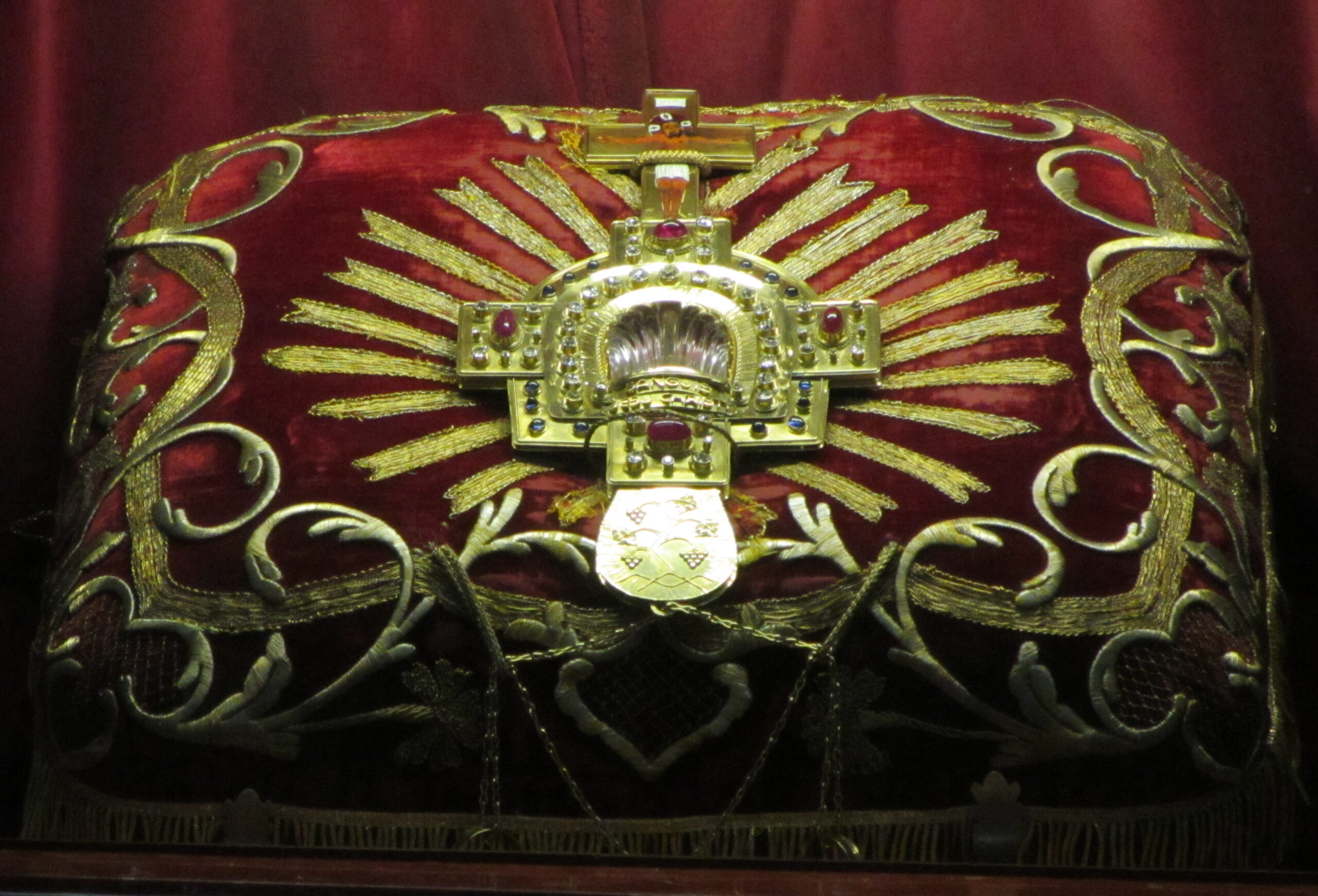
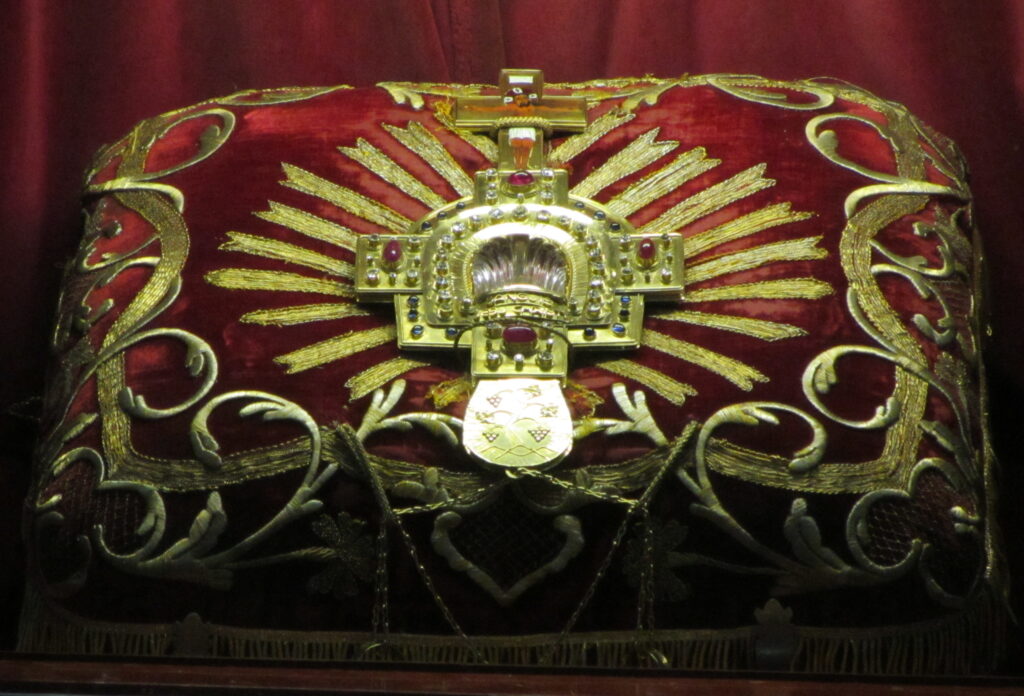
The Basilica of Weingarten holds a relic which, according to tradition, contains the land of the Golgotha mixed with the Blood of Christ. He arrived at the monastery in 1094 and every Friday after the Ascension presides over the Blutritt, a great equestrian pilgrimage. It is a relic of the Passion, not a local Eucharistic miracle.
Qué se venera en Weingarten
The center of devotion is a small content protected by glass and mounted in a cross-shaped relic, enriched with gold and stones. The Catholic community calls it the relic of Holy Blood.
According to tradition, it contains land collected in the Golgotha and soaked with blood from the wound of the side of Jesus. The expression "according to tradition" is essential: veneration is based on a history received and on the continuity of worship, not on a modern scientific identification of material.
The tradition of Longines
The story links the relic to the soldier who passed through the side of Christ. The Christian tradition called it Longinos and said it collected blood mixed with earth, turned and carried that memory of the Passion to Mantua.
The Gospels mention the launched and the exits of blood and water, but do not narrate the collection of the earth or the later itinerary. These elements belong to a hagiographic tradition developed over time and should be read as such.
De Mantua a Weingarten
The devotional history places in Mantua the main repository of the relic. A part would have gone through imperial and dynastic hands until it reached Judith de Flanders, wife of Welf IV.
In 1094 Judith delivered the portion to the monastery of Weingarten. Medieval transmission and donation to the abbey are a documented part of the identity of the place. From then on the monastery became the center of veneration of the Blood of Christ.
Relic of the Passion, not Eucharistic miracle
Weingarten appears in some repertories of Eucharistic miracles for his strong devotion to the Blood of Christ. However, the local account does not describe a host or consecrated wine that would transform, bleed or be preserved prodigious.
The alleged matter comes directly from the Passion according to tradition. That is why this sheet remains on the map of Devotions of Jesus and leaves the map of Eucharistic Miracles. Recycling does not deny or reduce worship: it places it in its correct category.
The relic and his custody
The content is protected in a horseshoe-shaped glass, integrated into a precious cross. A chain and rings allow to secure the relic during the horse procession, avoiding a fall.
Outside the main acts he is held in the Basilica of San Martín. The visitor must attend to the liturgical times and the indications of the parish; the physical proximity to a relic does not replace prayer or sacramental participation.
The Basilica of Saint Martin
The great Baroque church was raised as a monastic and pilgrimage temple. Its dimensions, the dome, frescoes and the famous organ express the historical importance of the ancient abbey and devotion to Holy Blood.
The relic is under the dome, on the altar dedicated to it. The city reports that the basilica can often be visited daily outside the trades, although the hours must be checked before travelling.
El Blutritt o Cabalgata de la Sangre
The Blutritt is held on the Friday following the Ascension. A designated rider carries the relic and blesses the city and the fields, accompanied by numerous groups on horseback. The written tradition dates back to at least the 16th century and was already considered old.
The procession is not an equestrian spectacle separate from the faith. It is surrounded by mass, night prayer, procession of lights, blessing and pontifical celebration. The parish and the city present it as a public confession of faith.
Participation of women
Since 2022 women also participate on horseback. This change is part of the living history of a tradition that retains its religious core and adapts its community organization.
The presence of thousands of riders, pilgrims and spectators requires safety, respect for animals and attention to public instructions. Those who come must understand that they enter a large-scale religious and citizen celebration.
On Blood Friday
The eve, solemnity of Ascension, includes mass and procession of lights. In the early morning, hours of prayer and celebrations take place; in the first hour the relicary is delivered to the rider and the journey begins.
After the ride, the relic returns to the atrium and the basilica. The program includes liturgical celebrations and individual blessing. The hours change each year and are to be consulted on the official pages.
The July party
In addition to Blutritt, the community holds a Holy Blood party in July. These two quotes show that devotion is not reduced to a single mass procession.
The ordinary life of the basilica, parochial prayer and catechesis give continuity to worship. The Christian celebration directs the look to the surrender of Christ and does not attribute an autonomous power to the relic.
exact location
The Basilica of St. Martin is in Kirchplatz 1, 88250 Weingarten, Baden-Württemberg. The coordinates 47.8091968, 9,6446178 correspond to the building itself, identified in OpenStreetMap as way 24504064.
The marker is kept in the Devotions layer of Jesus with the category "relics of Passion and related devotion." It no longer appears in the directory or in the specific map of Eucharistic miracles.
How to understand a relic
The Church distinguishes the worship due only to God from the veneration of relics. The object is not divine or acts for itself; it refers to Christ and helps to remember his Incarnation and his Passion.
Historical prudence is also not opposed to piety. A tradition received can be honoured by clearly recognizing what is documented, what belongs to a transmission chain and what has not been tested by contemporary analysis.
Spiritual feeling
The Blood of Christ expresses a life given out of love. Contemplating it calls to reject violence, to accompany those who suffer, to forgive and to offer their own life in daily service.
The journey through the fields recalls that creation, work and the fruits of the earth are received as a gift. Blessing calls for responsibility: to care for life, to share goods and to work for peace.
The link with Mantua
The Weingarten tradition is not isolated. It is presented as a portion of the venerated relic in Mantua, and the Italian city maintains a symbolic relationship with the Blutritt. Delegations recall that origin and the European dimension of devotion.
This link does not make the medieval chain a scientific certification of the content. It documents how communities, dynasties and monasteries transmitted a relic and built memory practices around it.
Horses, fields and blessing
The equestrian route passes through urban and rural areas. Horses are not decoration: they require preparation, well-being, responsible riders and an organization capable of protecting participants and spectators.
The blessing of the fields expresses gratitude for the creation and request for help for human work. It does not guarantee crops or automatically avoid misfortunes; it commits to taking care of the land, respect the animals and share their fruits.
A classification that protects meaning
To place Weingarten among the devotions related to Jesus allows us to explain his wealth without forcing it into a Eucharistic transformation that local tradition does not affirm. The venerated Blood is attributed to the crucifixion, not to the chalice of a mass held in Weingarten.
Precision makes it easier to compare cases on the world map. A user can distinguish relics from Passion, Eucharistic phenomena, foundational legends and derived devotions, and then read the complete tab to know sources and limits.
The Basilica after the Abbey
The closing of the last modern Benedictine convent did not mean the departure of the relic or the end of the pilgrimage. The basilica continues under Catholic attention and the city maintains a deep relationship with the Blutritt.
This institutional change shows that the custody of a devotion can go through different stages. For the current visitor the appropriate reference is the Catholic community of Weingarten, not a monastic community that no longer resides there.
Sources consulted
- Weingarten Catholic Community: relic of the Holy Blood, description and custody.
- Weingarten City: relic and pilgrimage, local history.
- Weingarten City: Blutfreitag and Blutritt Program, current practice.
- Exposure associated with San Carlo Acutis: Weingarten, used as a starting point and reclassified.
Para orar
Jesus, who delivered your Blood for love, make us instruments of reconciliation. May this memory of your Passion lead us to the Eucharist, to the care of creation and to the generous service of those who suffer. Amen.
Image credit
Sailor of the Holy Blood of Weingarten. Wald-Burger8 / Wikimedia Commons, CC BY 3.0. File and license in Wikimedia Commons.
