
The Basilica of the Holy Blood of Bruges holds an ancient relic linked to the Passion of Christ. His presence has been documented since 1256 and his procession since 1304, although the tradition of his arrival in 1150 is discussed by historians.
A relic of Passion, not a miraculous host
The Holy Blood of Witch is preserved in a small glass container and is venerated as a relic linked to the blood shed by Jesus Christ during the Passion. It does not come from a consecrated form that would have bled during the mass or from a phenomenon that occurred with the Eucharistic species.
This difference is decisive. Some modern repertories include it with the Eucharistic miracles for its spiritual relationship with the Blood of Christ, but the history of the object belongs to the field of the relics of the Passion. That is why this fact sheet does not incorporate it into the affirmative map of Eucharistic miracles.
Qué kept himself in Brujas
The relic is presented as a portion of fabric with a dark matter, stored inside an ampoule of rock glass. The cylinder is protected by an ornate mount and is kept in the upper chapel of the Basilica of the Holy Blood.
The veneration is addressed to Christ and his redeeming dedication, not to the material value of the vessel. The Church distinguishes between worship, which corresponds only to God, and the respectful veneration of a relic for its relationship with the Lord and with the memory of faith.
The tradition of arrival in 1150
The traditional account states that Theodorico of Alsace, Count of Flanders, received the relic in the Holy Land after participating in the Second Crusade. On his return, he allegedly entered Bruges on April 7, 1150, accompanied by his wife Sibila de Anjou.
The narrative is part of the devotional identity of the city and is represented in the procession. However, a tradition transmitted for centuries should not be confused with a contemporary documentary data to the alleged transfer.
The first known documentation: 1256
Kerknet points out that the oldest known written testimony of the presence of the relic in Bruges is 1256, approximately a century after the traditional date of 1150. This documentary distance leads most historians to question the classic form of the arrival story.
Recognizing this difficulty does not destroy the later history of veneration. Since the 13th century the presence of relic, the organization of its custody and citizen devotion are documented. Prudence consists in distinguishing the attributed origin from the historically verifiable trajectory.
The hypothesis of Constantinople
Several scholars relate the type of ampoule and its content to relics from the Byzantine field. According to this hypothesis, the piece was able to reach the West after the looting of Constantinople of 1204, during the Fourth Crusade, and to reach Bruges later.
The hypothesis helps explain why there is no news of the relic in Bruges before the mid-13th century. It is not in itself a definitive reconstruction, but it shows why the date of 1203 used in some panels should not be presented as the proven year of a miracle.
The basilica and its two chapels
The sanctuary rises on Burg Square, next to the City of Bruges. The whole consists of the Romanesque chapel of San Basilio on the lower level and the chapel of the Holy Blood on the upper floor, transformed over the centuries and currently decorated with a rich neo-Gothic language.
Both chapels were raised to basilica in 1923 due to the antiquity and continuity of veneration. The lower chapel conserves one of the best preserved Romanesque spaces in Western Flanders; the upper chapel concentrates the veneration of relic.
The Holy Blood Brotherhood
The Noble of the Holy Blood is involved in the custody and public presentation of the relic. His service has given institutional continuity to devotion and occupies a visible place in the annual procession.
The brotherhood does not turn the relic into a private piece. His mission is carried out within a living sanctuary, with celebrations, prayer of the faithful and a heritage responsibility linked to the city.
The procession since 1304
The city of Bruges documents the origin of the Holy Blood Procession in 1304 as a public expression of faith and gratitude. Since then, the historical center has been around almost every year during the solemnity of Ascension.
The procession combines scenes of the Old and New Testament, the traditional memory of the arrival of the relic and its solemn accompaniment for the brotherhood. It does not represent a historical demonstration of the origin of the object: it expresses through religious and theatrical language the believing memory of witches.
Inmaterial cultural patrimonio
In 2009, UNESCO registered the procession on the Representative List of the Intangible Cultural Heritage of Humanity. The celebration mobilizes approximately one thousand eight hundred participants among actors, musicians, singers and volunteers.
The recognition of UNESCO refers to the cultural value of a living tradition transmitted between generations. It is not a pronunciation about the physical authenticity of relic or a doctrinal statement about a miracle.
The presentation of the relic
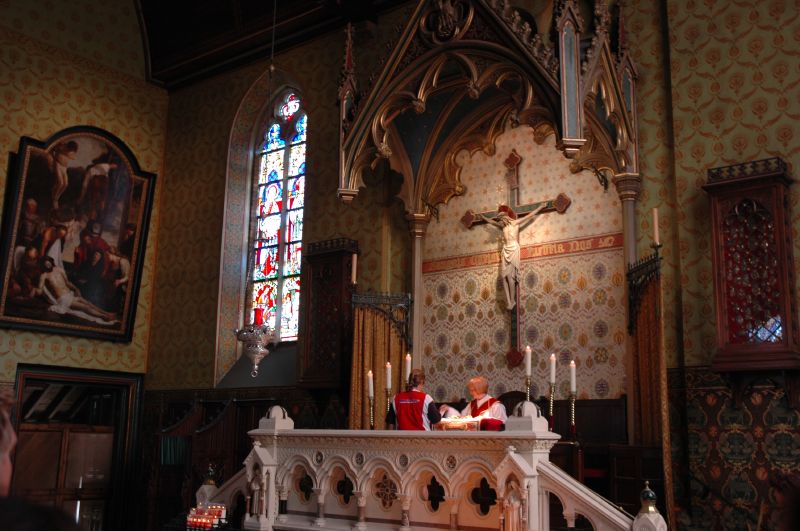
Outside the great procession, relic is presented at certain times to the veneration of those who visit the Basilica. The side altar photographed on this page is the space prepared for that devotional practice.
The hours may be changed by celebrations, building maintenance or pastoral needs. Those who travel specifically to participate must consult the current information of the Basilica and maintain an attitude of silence, prayer and respect for the liturgy.
The Blood of Christ in the Catholic Faith
The devotion to the Blood of Christ contemplates the love led to the giving of life. In the New Testament, the blood of the covenant expresses the reconciliation and communion offered by Jesus, and the liturgy makes sacramental memory of his Passover.
The Eucharist does not need a relic to be true. The real presence of Christ in Mass belongs to the sacramental faith of the Church and does not depend on extraordinary signs. The Witch relic can help meditate on the Passion, but does not add or replace the sacrament.
How to understand the date of 1203
The catalogue associated with the work of San Carlo Acutis rotates the case as "Bruges, 1203." This date may guide the context of the Crusades and the Eastern relics, but it does not identify a documented Eucharistic event that occurred that year in the city.
The responsible presentation retains the reference so that the visitor can recognize the case of the catalogue and, at the same time, correct it through historical sources: tradition of 1150, secure documentation from 1256 and procession attested from 1304.
exact location
The Basilica of Holy Blood is in Burg 13, 8000 Bruges, West Flanders, Belgium. The coordinates 51.2081273, 3.2267027 place the cult building and not a generic point in the historical centre.
The marker is incorporated into the devotions map of Jesus as a relic of the Passion. It does not appear in the layer "Eucharistic miracles," so that the world map does not mix different historical categories.
Discernment to relics
Catholic veneration does not make every tradition of origin an archaeological certainty. It is possible to pray before a historical relic, to receive his call to contemplate Christ and to admit with honesty that the itinerary before 1256 is not fully demonstrated.
The mature faith avoids two ends: to despise a devotion only because its origin has uncertain areas, or to present as a proven fact what sources allow to affirm only as tradition. Historical truth and piety serve each other when expressed accurately.
A prayer-oriented visit
The basilica is part of a very visited urban centre, but its first identity is religious. To enter it invites you to move from artistic interest to recollection, to contemplate the Passion and to ask for a reconciled heart.
The procession and the relic find their Christian fruit when they lead to mass, charity and forgiveness. The blood shed by Christ does not justify enmity: it proclaims an alliance of mercy open to all.
Sources consulted
- Kerknet:, tradition of 1150, first news of 1256 and historiographic caution.
- Visit Bruges: religious heritage of the Basilica, chapels, veneration and elevation to basilica.
- Visit Bruges: Procession of Holy Blood, structure, continuity and participation.
- UNESCO: Procession of the Holy Blood in Bruges, registration as intangible cultural heritage.
- Catalog asociado a san Carlo Acutis: Bruges, contrasted and reclassified baseline reference.
Para orar
Lord Jesus, who you shed your blood for love and reconciliation, teach us to contemplate your Passion with humble faith. May this memory lead us to the Eucharist, to forgiveness and to the service of those who suffer. Amen.
Image credit
Altar lateral where the relic of the Holy Blood is presented in Bruges. Matt Hopkins / Wikimedia Commons, CC BY-SA 2.0. File and license in Wikimedia Commons.
