
The Bavarian monastery of Andechs custody three ancient hostias that tradition attributes to the potatoes of Saint Gregory the Great and Lion IX. They were rediscovered with the treasure of relics in 1388 and remain in a 15th century custody within the Holy Chapel; the Roman origin is received as tradition, not as a proven material chain.
What are the Three Hostias of Andechs
The core of the call Healing o The sacred treasure of Andechs is made up of three ancient forms guarded in a great custody-relicary. The monastery calls them "the Three Holy Hostias" and integrates them among the relics of the Lord, that is, objects that tradition directly relates to Jesus Christ.
Two show signs of blood color interpreted as a cross and a finger; the third one contains the monogram of Jesus. The description belongs to the devotional presentation of the monastery. The fact sheet does not deduce its composition, age or physical cause from the form of those marks.
The attribution to Saint Gregory the Great
Tradition attributes two hartias to Pope Gregory the Great, who lived between the 6th and 7th centuries. The panel of the exhibition associated with San Carlo Acutis connects this story with Rome and with a sign that occurred during the Mass.
Andechs keeps the objects and transmits that attribution, but does not offer a documented chain of continuous ownership from the pontificate of Gregorio to Bavaria. This is why the map points to Andechs, a verifiable place of custody, and not a Roman church whose material identification is uncertain.
The host attributed to Lion IX
The third form is related by tradition to Pope Leo IX of the 11th century, and shows the monogram of Jesus in blood color. His presence introduces a different chronology from that attributed to the other two.
Talking about the "Three Hostias" does not necessarily mean that they come from a single event. The relic brings together different traditions that came to form a devotional unit in the treasure of Andechs.
The treasure of the Andechs Counts
The origins of the whole are linked to the Andechs- Merania dynasty and its legendary ancestor, Count Rasso. It was said that he brought relics of a pilgrimage to the Holy Land; in time the treasure increased with fragments related to Passion, saints and venerated textiles.
The dynastic history explains how a castle and its chapel became the center of a religious memory. Not all objects have the same degree of documentation, seniority or relationship to the events they represent.
The loss of treasure
When the line of the Andechs-Merania was extinguished in the mid-13th century, the treasure was considered lost. The old fortress fell and for more than a century the location of many of its relics was unknown.
This interval is important for assessing the provenance. The later tradition rebuilds a spiritual continuity, but the physical disappearance of the whole creates a documentary void that should not be hidden.
The rediscovery of 1388
According to the monastic tradition, during a mass of 1388 a mouse brought to light a fragment of an ancient inventory of relics. The excavations under the altar of the castle chapel discovered a box with parts of the treasure, including the Three Hostias wrapped in the wedding dress attributed to St. Elizabeth.
The mouse scene belongs to the story transmitted; the recovery of the treasure in 1388 is the great historical milestone around which the pilgrimage was reorganized. The distinction allows to narrate the color of memory without turning every detail into an archaeological act.
Transfer to Munich and return
At the end of 1389 the relics were taken to the ducal chapel of Alter Hof of Munich. There they were shown during the Holy Year of 1392, and the later offerings and foundations helped to prepare the religious establishment on Mount Andechs.
The Three Hostias returned before other parts of the treasure. Its importance led to the construction of a church capable of welcoming pilgrims and helped the place to receive the name "Monte Santo."
The church and the monastic foundation
The Augustine canons of Dießen raised between 1423 and 1427 a Gothic church of three ships. In 1438 a priest's lobby was organized and in 1455 the Duke Albrecht III founded the Benedictine abbey.
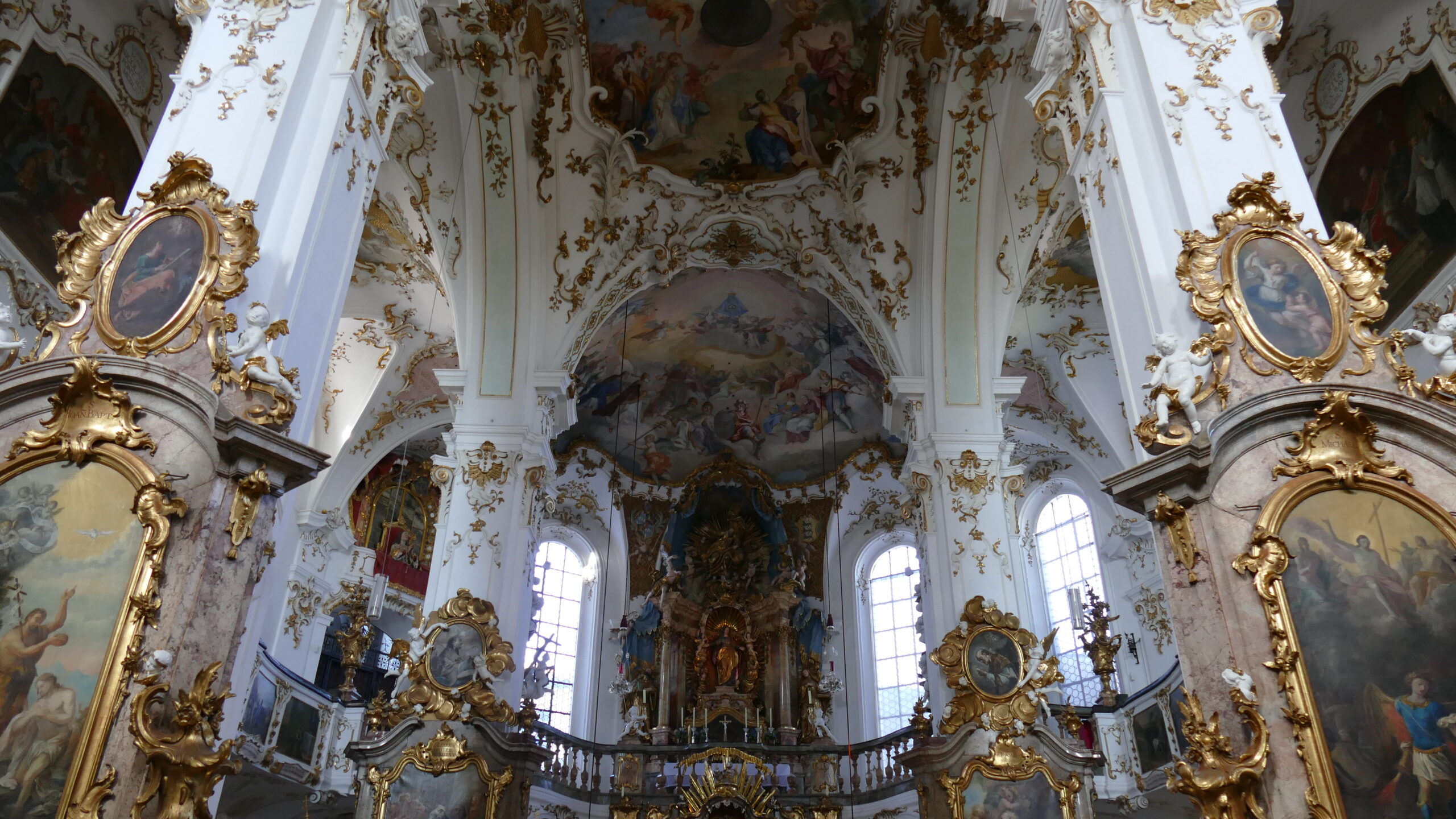
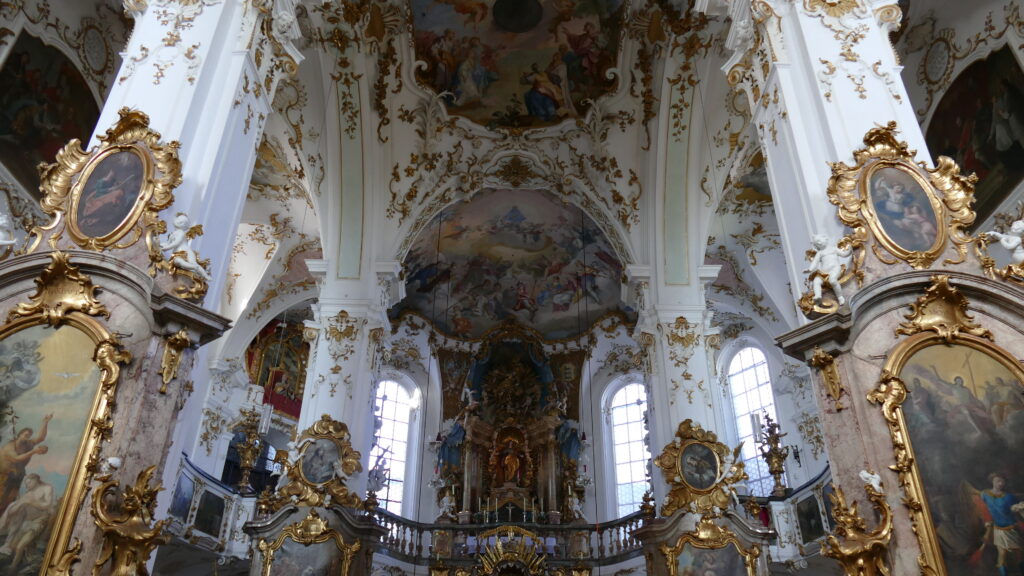
The church was transformed in the later centuries, especially with its rococo ornamentation. Despite fires, secularization and institutional changes, the pilgrimage and treasure continued to be linked to the place.
The custody of the siglo XV
The forms are preserved in a care-relicary made around 1432 or 1433. This object does have a concrete medieval artistic dating and allows to study how the Three Hostias were shown and protected after their recovery.
The date of the relic does not in itself demonstrate the Roman antiquity of its content. It documents, however, that in the 15th century the relics already occupied a central place on the pilgrimage of Andechs.
The Holy Chapel
La Holy Chapel is on the upper northern floor of the church and was consecrated in 1472. His reinforced door and three locks protected the treasure; the chapel survived the great fire of 1669.
In the center is a 1757 rocky altar- relicario that houses medieval custody. Access to the treasure is not free and permanent: the monastery shows it to small groups within concerted guided tours.
What the monastery retains today
In addition to the Three Hostias, the treasure contains relics related to the crown of thorns, the scepter of mockery and various holy figures. The monastery clearly explains that, for current veneration, it is less important to demonstrate historically every attribution than to recognize objects as visible testimonies of faith.
This institutional explanation is particularly valuable: it calls for a conscious piety of historical boundaries. A relic refers to God and to Christian memory; it is not adored as if it had its own power.
Pilgrimage and party of the Three Hostias
Andechs remains one of the great pilgrimage destinations of Bavaria. Parish groups go up to Mount Santo with various intentions, celebrate the Eucharist and visit the church.
The feast of the Three Hostias particularly preserves the memory of the treasure. At times noted the relic leaves the Holy Chapel for the celebration. The dates and conditions should be checked in the official calendar of the monastery.
Corrected location
The pilgrimage church is within the monastery of Andechs, Bergstraße 2, 82346 Andechs. The marker is corrected to 47,9743665, 11,1825272, centre of the building identified in OpenStreetMap as way 445725453.
The previous coordinate, 47,9740, 11,1847, pointed to a bank next to Seefelder Straße about 170 meters east. Precision matters because the treasure is not in a generic point of the people, but in the Holy Chapel of the church.
World map classification
Andechs remains "Eucharistic relics of ancient tradition." Unlike a devotion of the Passion like Weingarten, here the guarded objects are hostile and monastic cult presents them expressly as the Eucharistic center of the treasure.
The category does not claim that the Roman origin is proven. It combines two data: the verifiable reality of the present host, custody and pilgrimage, and the caution over the powers of Gregorio the Great and Lion IX.
Spiritual feeling
The Three Hostias lead to the mystery that the Church celebrates in every mass. Faith does not depend on being able to demonstrate all the itineraries of a medieval object; it is based on Christ, the living bread, who gathers his people and sends them to serve.
Up to Andechs can be the occasion for reconciliation, listening and thanksgiving. The pilgrimage reaches its truth when worship becomes concrete charity and respect for those who share the path.
Sources consulted
- Andechs Monastery: relics and Three Holy Hostias, institutional presentation of the treasure.
- Monastery of Andechs: Capilla Santa, custody, architecture and relicary.
- Andechs Monastery: treasure recovery and foundation, 15th century chronology.
- Diocese of Augsburg: church and pilgrimage of Andechs, contexto eclesial.
Para orar
Lord Jesus Christ, living bread down from heaven, increases our faith. May the Eucharist bring us together, heal our divisions and become concrete charity with those who need food, comfort and hope. Amen.
Image credit
Interior of the pilgrimage church of the monastery of Andechs. Hermann Luyken / Wikimedia Commons, CC0. Ficha y declaración CC0 en Wikimedia Commons.
