
This fact sheet is a hagiographic reading related to the Eucharist, not a Eucharistic miracle that occurred in Egypt. Mary was born in Egypt and lived for years in Alexandria, but the episode of her last communion is located on the Jordan bank. The geographical and documentary distinction is necessary to respect both the Christian tradition and the reader.
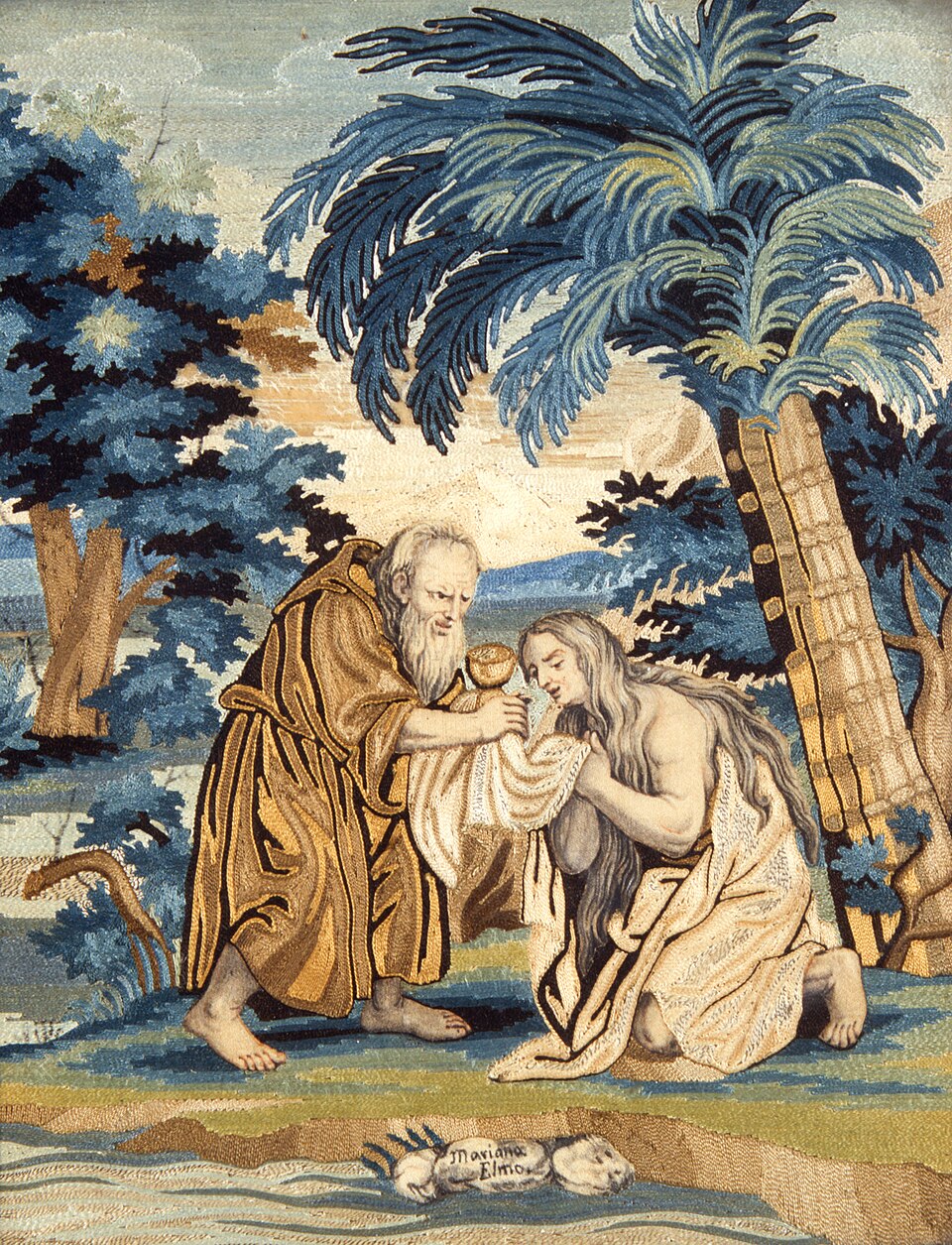
What tradition counts
The Life of Holy Egyptian Mary presents a woman born in Egypt who, still a teenager, left her home and went to Alexandria. The story without complacency describes a disorderly existence and a long distance from God. Years later he joined pilgrims sailing to Jerusalem for the feast of the Exaltation of the Holy Cross. He did not travel yet by a penitential intention; precisely because of this, the change that continues to occupy the spiritual center of narration.
When he tried to enter the temple of the Resurrection, an invisible force would have prevented him from crossing the threshold. Looking at an image of the Mother of God understood her situation, she asked for help and promised to change her life. Then he was able to enter, he venerated the Cross, and heard an indication within: to cross the Jordan to find peace. He confessed, communicated and passed to the desert on the other side of the river.
Forty-seven years in the desert
The narrative states that Mary lived forty-seven years in solitude. The number and details belong to the hagiographical genre: they express a radical transformation sustained by prayer, fasting and inner struggle. We do not have a newspaper written by it or a contemporary act that will allow us to rebuild each date. The source transmits spiritual memory, not a modern biography subject to archiving criteria.
This caution does not make the story irrelevant. For centuries, Christians from the East and the West have recognized in Mary a powerful image of conversion. His past is not hidden, but he does not define it forever. Tradition insists that no life is closed to mercy and that Christian penance is not a contempt of the person, but a patient return to communion with God.
The meeting with Zósimo
Zósimo was a monk of a Palestinian community near the Jordan. According to Life, during the Great Lent the monks went out into the desert to pray in solitude. There she found Mary, aged for decades of ascetic life. She told her story after asking her not to reveal her identity yet and asked her for a very concrete service: the following year, on Holy Thursday, she was to bring the Body and Blood of Christ to the Jordan bank.
The request shows the true Eucharistic center of history. Mary is not looking for a show or a test for curiosity. After years away from the sacramental life, he wants to receive communion. Zósimo appears as the minister of that meeting and at the same time as a surprised disciple: the monk who believed he knew the summits of ascetic life discovers holiness in an unknown woman.
Communion by the Jordan
On Holy Thursday, Zósimo took the Holy Dones and waited by the river. Mary appeared on the opposite shore. Life states that it drew the sign of the cross on the water and walked on it until it reached the priest. Then the Creed and the Father recited, received communion and said the words of Simeon: "Now, Lord, you can let your handmaid go in peace."
Walking on the Jordan is the prodigious element that explains the inclusion of the story in the repertoire associated with San Carlo Acutis. However, the host does not change its appearance, it does not bleed or be preserved as a relic. The extraordinary surrounds the displacement of the saint; the Eucharistic act is a communion received with reverence. Therefore the most accurate classification is "related Eucharistic hagiographic account."
The death of Mary and the lion
Mary asked Zósimo to return a year later to the place of the first meeting. When she came back, she found her dead. A inscription in the sand would have indicated his name and that he had died the same night he received communion, even if for Zósimo a year had passed. The narrative adds that a lion helped the monk dig the grave.
These motives underline the reconciliation of the person with creation, hidden holiness and Easter transit. They should be read within the language of the lives of saints. The page does not transform them into scientific results or invent non-existent certificates; it retains its religious meaning and declares the nature of the source.
The source attributed to Saint Sopinio
The Greek language is traditionally attributed to Saint Sopinio, Patriarch of Jerusalem in the 7th century. The prologue himself explains that the story had been transmitted by the monks. The distance from the time when Mary was supposed to have lived and oral mediation make it necessary to distinguish tradition received from contemporary documentation.
The Orthodox Church in America retains an extensive liturgical version that clearly places the monastery of Zósimo in Palestine, the departure of the monks into the desert and awaits it in the Jordan. This location coincides with the inner logic of Life. The name "Mary of Egypt" points to its origin, not the stage of the last communion.
Why doesn't he have a score in Egypt
There is no Egyptian church at the source identified where the episode would take place, nor an altar, a Eucharistic relic or coordinates that can be verified. Placing the point in Alexandria would confuse Mary's place of youth with the bank where she received communion. To place it at an arbitrary point of Wadi el-Natrun would also mix two different traditions.
Nor is an exact point in Jordan or Palestine, because the text only speaks of the bank and the desert. A serious map must show degrees of precision and know to give up a marker when the information is not enough. The tab remains accessible in the related historical section of the great world catalog.
What he teaches about the Eucharist
The scene unites conversion, reconciliation, profession of faith and communion. Mary waits for a year, asks for the sacraments and receives the Holy Dones without appropriating them. The Eucharist appears as a food of a reconciled life, not as a prize for an impeccable biography. Zósimo, for his part, serves with obedience and learns not to measure grace with social categories.
It also teaches that Eucharistic devotion needs truth. Honoring the mystery does not require calling the whole story "Eucharistic miracle of Egypt." On the contrary, distinguishing the hagiographic prodigy, the narrated place and the sacramental communion allows to contemplate the message without adding statements that the source does not make.
Egyptian Mary in art and liturgy
The saint is celebrated on April 1 in Byzantine tradition and also on the fifth Sunday of the Great Lent. Eastern Churches read their life as an invitation to penance before Easter. In the West, many painters represented the encounter with Zosimo, the last communion and the burial assisted by the lion.
The image chosen for this sheet is a work by Marianna Elmo preserved as a reproduction in the public domain. It helps to immediately recognize the core of the episode: a penitent woman receives the communion of the hands of an old priest. Your license allows you to show it with transparency, authorship and link to the source file.
Alexandria, Jerusalem and Jordan: three different places
The spiritual biography is deployed in three spaces that should not be merged. Alexandria represents youth and the years before conversion. Jerusalem is the place of the threshold, the veneration of the Cross and the decision to change. The Jordan bank is the stage of the last communion. The desert beyond the river welcomes the penitent life and, according to the narrative, the burial.
This sequence explains why the Acutis catalogue can order the panel under Egypt and, at the same time, why our map should not place the prodigy there. The printed repertories are usually grouped by the origin of the person or by a national tradition; a digital map raises a different question: where does the source that happened? When there is no precise enough response, honesty consists in leaving the field without coordinates.
Ecclesial recognition and nature of the story
The Egyptian Mary is venerated as a saint and her memory has an ancient liturgical reception. This recognition refers to his testimony of repentance and holiness; it does not amount to a separate decree that certifies every prodigious detail as a "Eucharistic miracle" in contemporary classification. There is also no modern canonical process dedicated to walking on water.
The difference is important. The Church can propose a holy life and keep a story in her prayer without making it a scientific record. The page respects this reception and avoids giving the ecclesial authority a more specific statement than the sources offer. Thus, devotion does not depend on exaggeration and the reader knows exactly what kind of tradition it has before it.
A pedagogy of mercy, not stigma
The ancient versions describe Mary's initial life hard. By transmitting them today it is appropriate not to recreate on labels that reduce a woman to her sins or to use her history to humiliate other people. The hagiographical purpose is to show a transformed freedom, not to make a permanent stigma. Mary speaks of herself from penance, while Zósimo learns to contemplate it with reverence.
The Eucharistic scene ends that investment. Whoever seemed to be out is received; who considered himself a teacher discovers that he must learn. Communion does not magically erase history, but it integrates it into a reconciled life. This approach offers a pastoral reading faithful to the center of the story and respectful to those who approach the web seeking comfort.
How to read this tab within the catalog
The global project brings together very different cases: preserved relics, local traditions, contemporary research, medieval stories and patratic texts. Not all have the same historical value and do not require the same type of map. This tab works as a contextual reading, related to the Acutis repertoire, but separated from the affirmative layer of localized miracles.
The separation protects Mary's memory and the usefulness of the catalogue. He who seeks his history finds a comprehensive study; he who consults the map does not receive an invented coordinate. Thus, devotional beauty is maintained without sacrificing precision.
Sources consulted
- Orthodox Church in America: the life of the Holy Egyptian Mary, liturgical tradition, Zosimo, Jordan and communion.
- Repertoire associated with Saint Carlo Acutis: Saint Mary of Egypt, starting point of the review.
- Wikimedia Commons: work by Marianna Elmo, authorship and public domain.

Para orar
Lord Jesus, Bread of life, who you sought from those who were far away and welcomed Mary's humble desire, give us a true conversion. Let us be patient with our falls, sincere with history and reverent in your presence. When we receive you, we learn to walk towards peace, to serve without judgment and to trust in your mercy. Amen.
Image credit
The communion of Holy Egyptian Mary, the work of Marianna Elmo (18th century). Wikimedia Commons, public domain. File and conditions of use.