
This document studies an apotegma of the Desert Fathers, not a Eucharistic relic investigated with modern methods. The story is linked to Scete, the monastic region of the current Wadi el-Natrun, but does not identify monastery, church or altar. The map therefore uses a clearly differentiated regional marker.
The story in a few words
A monk of Scete, a worker and a respected life, held for simplicity that the bread received in the liturgy was not really the Body of Christ, but only its symbol. Two elders heard the statement. As they knew their good intention, they did not treat him as an enemy: they explained the faith of the Church and agreed to pray that God would enlighten the three.
The next Sunday they went to church together. According to the apotegma, a child appeared for them in the place of bread. When the priest stretched out his hand to break the host, an angel came down with a sword, divided the child and poured his blood into the chalice. As the monk approached to commulgar, the dubious monk saw bloody flesh; after confessing the faith, it appeared again as bread and was able to receive it with reverence.
Daniel the Faranite and Arsenio
The alphabetical collection of the Apotegmas introduces the episode with a transmission chain: Daniel the Farite says that "our father Arsenio" spoke of a Scete inhabitant. This formula does not amount to a notarial record. It is the way in which monastic tradition attributes teaching to recognized elderly people and retains their memory for the formation of communities.
Daniel should not necessarily be confused with any monk named Daniel or the word Farita with a place of the episode. Arsenio the Great lived among the Desert Fathers and his name gives spiritual authority to the saying. The protagonist remains anonymous, a sign that the purpose of the text is not to build a personal sanctuary, but to teach about faith and humility.
What was Scete?
Scete, Scetis or Shiheet designates the great monastic region of the current Wadi el-Natrun, in the western desert of Egypt, between Cairo and Alexandria. Since the 4th century it has gathered erects and small communities linked to figures such as Macario el Grande. It was not a single compact population or a single monastery, but an extended spiritual landscape.
The Orthodox Coptic Church recalls Wadi el-Natrun as one of the cots of the monacate. Four former active monasteries remain in the region: Baramous, San Macario, San Bishoy and the Virgin of the Sirios. Its current buildings have been reconstructed and later stages; the apotegma cannot be assigned to one of them without a specific source.
Los siglos III a V
The repertoire associated with San Carlo Acutis presents the case under a broad chronology, between the third and sixth centuries This amplitude reflects the difficulty of dating a story born in a monastic and written environment within collections that they circulated in different languages. The file does not make up a specific year.
The tradition of the words was formed by oral memory, selection, translation and ordination. The historical value of an apotegma does not depend on the fact that we can date every sentence a day: it reports on concerns, practices and convictions of the first monks. But that utility does not allow all its details to be treated as independent forensic observation.
The doubt of the monk
The protagonist is not presented as malicious. He works, leads a remarkable life and has a simple faith, but he incorrectly formulates what the community celebrates. The elders begin with the word, not the punishment. They remind him that Christ, born of Mary, truly delivered his body and that the Church confesses a real presence under the sacramental signs.
Dialogue is a pastoral lesson. The fraternal correction respects the dignity of the one who doubts, hears his request for a test and becomes a shared prayer. Even the elders ask for light; they are not placed outside the need for grace. This tone deserves to be preserved when the story is communicated today.
The child, the sword and the chalice
The vision uses intense images. The child expresses the identity between the Christ born of Mary and the one offered sacramentally. The sword, division and blood make the sacrifice dramatically visible. In the end, the ordinary appearance of bread allows communion: the text adds that God knows human nature and that we could not consume raw flesh.
Reading the scene literally without attending to gender can turn ascetic teaching into macabre curiosity. The Apotegmas condemn doctrine and experience in short, memorable and sometimes extreme narrations. Its purpose is to lead to faith, not to describe a repeatable physical protocol.
Real presence and sacramental sign
The monk contrasts in the wrong way reality and symbol. The answer to the account does not eliminate the signs of bread and wine; it states that what is received is truly the Body and Blood of Christ. The conclusion returns the vision to the bread, because the sacrament is received in a form adapted to the human condition.
In the later theological vocabulary, different Churches will explain the mystery with their own nuances. This fact sheet does not project any more scholastic terminology about an ancient account, but it does recognize its unequivocal intention: to defend the reality of the Eucharistic gift and to form a reverent reception.
Why is it a patristic source and not a modern file
There is no preserved host, scientific research, specific episcopal decree or pilgrimage based on material remains. Nor is the name of the priest or of the temple offered. What we possess is a monastic tradition account included in a spiritual collection.
To call it "Eucharistic patristic account" does not diminish its importance. It correctly defines the kind of testimony. Editorial truth requires not to wear an apotegma with the evidence of a contemporary case, just as we should not reduce a spiritual tradition to an anecdote without context.
The regional map marker
Wadi el-Natrun can be located and corresponds to the former Scete region. This is why the catalogue retains an approximate regional point, with an explicit warning: it does not point to the altar of the episode or identify one of the four present monasteries. Its coordinates serve to understand the historical landscape.
The marker is outside the affirmative layer of Eucharistic miracles with a verifiable relic or sanctuary. This solution makes it possible to meet the aspiration to travel country by country without producing false precision. Whoever opens the point will immediately see its category and scope.
Wadi el-Natrun today
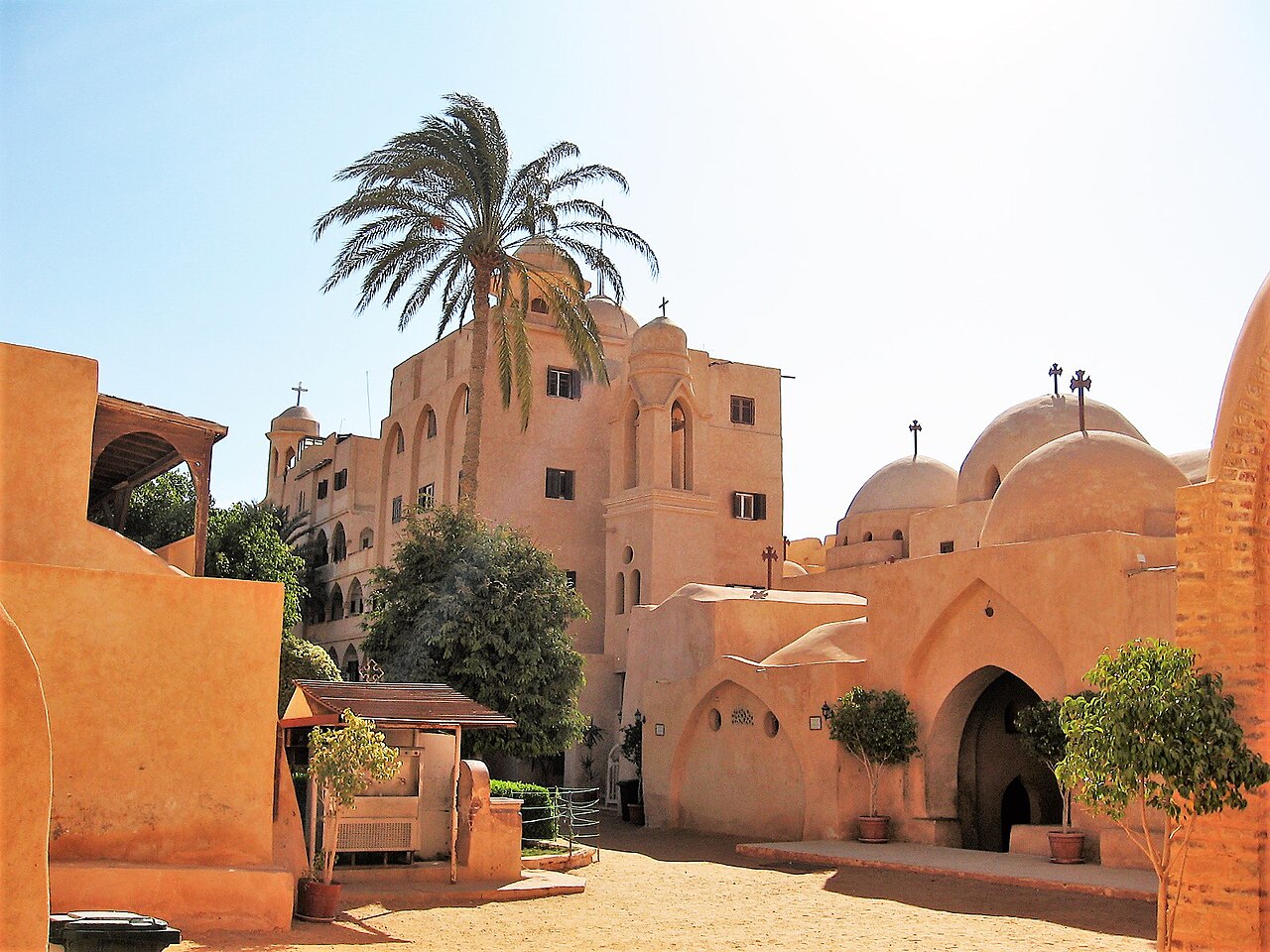
The monastic continuity of the region helps to imagine the framework of prayer, work and liturgy from which the words emerged. The monasteries retain the living heritage of the Coptic Church, but none should automatically receive the attribution of this apotegma. The photograph of Deir al-Surian illustrates the current monastic territory, not the exact building of the narrative.
An image with an open license and known author has been chosen. The foot and text explain its contextual function. This avoids using images of the repertoire without a clear license or presenting modern reconstructions as old tests.
How to read the prodigy
A reader can approach the episode from faith, the history of the monacate or the literary study. In all cases it is necessary to distinguish three levels: the Christian confession of the Eucharist, the teaching transmitted by apotegma and the historical verification available. The file links them without confusing them.
For prayer, the vision invites us to receive communion with astonishment and humility. For history, it documents how a community explained the real presence. For the map, only the Scete region is located. These three responses are compatible when expressed clearly.
Los Apotegmas as monastic memory
The sayings of the Desert Fathers do not form a book once and for one author. These are collections of sentences, encounters and small narrations that circulated, translated and ordered in various ways. The alphabetical collection brings together materials under the name of each old man; other textual families organize them in a thematic way. This story of transmission explains variants and advises not to demand the account data that its gender never wanted to provide.
Its brevity facilitates memory and concentrates teaching. A gesture, an answer or a vision show how monks understood prayer, obedience, discernment and charity. In the case of Scete, the narrative links the Eucharistic doctrine with a concrete attitude: the yerra can be accompanied, and the accompanying one must pray rather than rely only on its intellectual superiority.
The Sunday Celebration in the Desert
The apotegma presupposes a community that meets on Sunday for the liturgy. Although many monks lived in separate cells, the desert did not mean absolute sacramental isolation. Weekly meetings, listening to the Scriptures and communion held a way of life that combined solitude and ecclesial belonging.
This context helps to understand why doubt is not resolved in an endless private discussion. The three come to the celebration, where the faith confessed is made prayer and food. The vision is found within this Community framework. He does not authorize the search for extraordinary experiences outside the liturgy, but returns the monk to ordinary communion under the species of bread and wine.
What do we know?
We know that the said figure under Daniel the Farite and refers to Arsenio; that his protagonist is an anonymous inhabitant of Scete; that the historical region corresponds to Wadi el-Natrun; and that the text aims to affirm the reality of the Body and Blood of Christ. We also know the survival of the coptic monacate in that landscape.
We do not know the name of the monk, the priest, the monastery or the church; neither do we know the exact year, the duration between the event and its writing, nor whether there was any associated material memory. There is no preserved relic or specific episcopal recognition. To declare these limits does not empty the story: it responsibly delimits what the source allows to affirm and prevents a conjecture from being repeated as a data.
Sources consulted
- The Sayings of the Desert Fathers, colección alfabética, saying of Daniel the Faranite attributed to Arsenio.
- Orthodox Coptic Church: Coptic and Monacate History, context of Wadi el-Natrun and Scete.
- Repertoire associated with San Carlo Acutis: Scete, initial reference contrasted.
- Wikimedia Commons: Deir al‑Surian, authorship and license of the image.

Para orar
Lord Jesus, living bread down from heaven, illuminates our intelligence and purifies our heart. Give us the humility of the monk who agreed to be corrected, the patience of the elders who prayed with him and the respect of those who come to your table. May faith be not hardness, but truth accompanied by charity. Amen.
Image credit
Deir al-Surian Monastery, one of the historical monasteries of Wadi el-Natrun. Lumen roma / Wikimedia Commons, CC BY 3.0. File and license.