
Documented history of the tradition of the Holy Blood of Bergen: the flood of 1421, the finding of the hostias, the red substance of 1422, the prudent judgment of the examiners, the pilgrimages and their three places.
Why are we talking about 1421 and 1422?
The catalogue associated with San Carlo Acutis usually rotated Bergen with 1421, because then the flood occurred and the objects from Petten were found. The phenomenon of the red substance, however, is located around Pentecost of 1422.
The tab conserves both years so as not to compress two different moments. This precision also helps to understand why several places are involved: coast and landscape of Zanegeest, parish church of Bergen and later temples.
The flood of Santa Isabel
In November 1421 a large north-west storm and the flood of Santa Isabel hit the Dutch coast. Petten suffered a devastating destruction and his church was reached by the sea.
The numbers of victims transmitted by local sources reflect the magnitude attributed to the disaster, although they vary according to the narrations. The secure historical background is a serious flood that displaced people, remains and liturgical objects.
The finding of the box
Joannes o Jan van Prucen, local authority of Bergen, had found among the remains a wooden box from the church of Petten. It contained a chalice or cyborium, consecrated hostias and other ecclesiastical objects.
The find is located in the surroundings of Zanegeest, approximately 1.6 km north-east of Bergen church. Then there was a chapel of the Holy Blood.
The surviving priest of Petten
Amelius, a priest of Petten who had survived, went to recover the treasure. According to tradition, he consumed the hostias by reverence and separated the marine water that had come into contact with them.
The water was poured into a wooden squirrel and stored in a closet of Bergen church. This detail is decisive: the subsequent phenomenon did not occur on the beach or within a preserved host, but in that vessel.
The red substance of 1422
About six months later, around Pentecost 1422, Gerartis attended the parish while Amelius was absent. When he checked the spit he observed that the water had disappeared and there was a matter of color similar to coagulated blood.
The news spread like the Heilig Bloed or Holy Blood of Bergen. Tradition states that people from different places began to go for comfort and help.
The trial of the reviewers
The academic repertoire of the Meertens Institute remains essential. Ecclesiastics and educated men, including the Auxiliary Bishop of Utrecht Henricus, studied the case and discussed its meaning.
They concluded that the red substance was not the Sacrament and did not contain the Blood of Christ. Yet they considered his apparition extraordinary and allowed it to be kept with relics as a venerable object.
Why this accuracy changes the tab
It would not be correct to say that an ecclesiastical investigation literally declared human blood or blood of Christ. The institutional source says otherwise. The popular name "Holy Blood" expresses the devotion developed, not the material result attributed by the examiners.
This correction does not eliminate history. It allows it to be published more faithfully, distinguishing the popular interpretation, the prudent judgment and the cult that really existed.
The spit and custody
The wooden spit was covered in silver and was shown to visitors. A part of the substance was moved to custody for exposure.
These objects remained linked to the church of Bergen during the medieval stage. Its historical existence as pieces of veneration alone does not demonstrate the physical nature of the material contained.
The growth of the pilgrimage
Fame attracted pilgrims and helped to expand the church. Jacuba de Bavaria visited Bergen in 1432 and his later will mentions an obligation related to a glass window for the Holy Blood.
There are also reports of pilgrimages imposed as penance and of a cult guild. The influx left an economic, architectural and social footprint in the village.
The indulgence of Eugene IV
In 1436, Pope Eugene IV granted a indulgence to those who visited and held the parish. The document referred to the flood, the recovery of objects, the narrated wonders and the daily influx of faithful.
The indulgence attests ecclesial support to the pilgrimage and the temple. It should not be transformed retrospectively into a scientific statement on the red substance.
The medieval church and the current Ruïnekerk
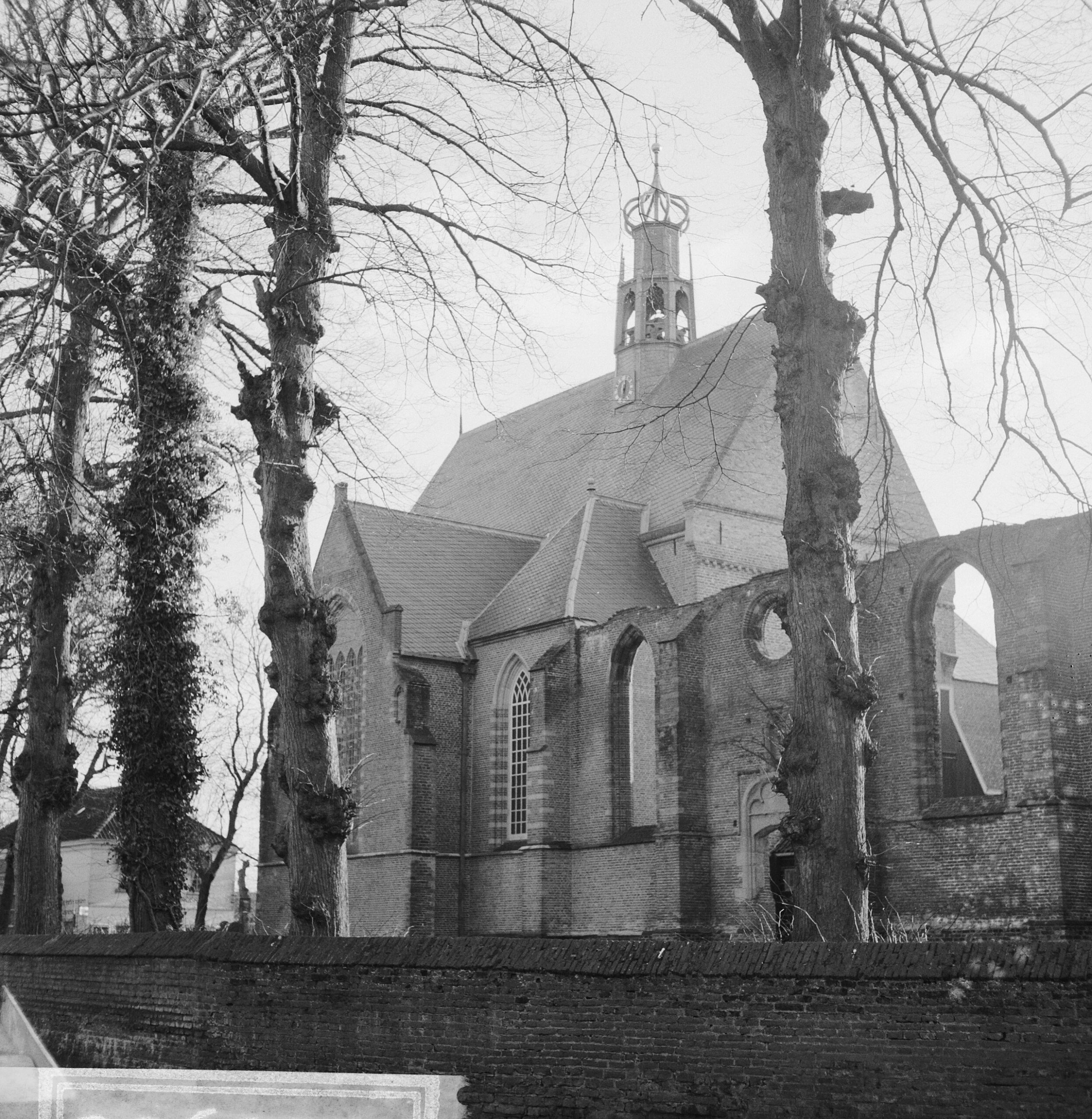
The phenomenon of 1422 and the first custody are located in the ancient church of the village. The building was expanded to become an important pilgrimage church.
After destruction and transformation, the whole known today as Ruïnekerk remained. Its address is Raadhuisstraat 1 and its verified coordinates are 52.6693424, 4.7004425.
La Capilla de Zanegeest
In the place attributed to the finding of the objects a small chapel of the Holy Blood was built. The building disappeared after the Reformation, although its foundations and remains were still remembered in the 17th and 18th centuries.
Kapellaan conserves the toponymic trail of the sanctuary. The approximate reference used for the environment is 52.6744260, 4.7215821; it does not represent the centimetric position of a missing chapel.
The perdida of the reliquia
In 1566 the treasure was seized by Henrick van Brederode and later returned. The objects could disappear when Catholics lost the church in 1574 or during the 17th century.
A research promoted in 1631 by the chapter of Haarlem sought possible remains of the Holy Blood, but found none. Therefore, there is no relic today whose material continuity can be affirmed.
The devotion after the Reformation
Despite repeated prohibitions, the pilgrimage continued discreetly. Documents from the late 16th and 17th century show that Bergen continued to attract devotees.
In the first half of the 18th century memory was still honored near the ruins of the chapel. By the end of that century the practice was turned off until almost completely lost from popular memory.
The Recovery of the 20th Century
The new Catholic church of the Saints Peter and Paul was consecrated in 1924. Since 1925, a local sille omgang was held the Sunday before Pentecost, a tradition that remained until 1966 and recovered again in 1993.
The temple, in Dipsstraat 20-22, houses a Jaap Min fresco made around 1948 with scenes of the story. Its coordinates are 52.6679188, 4.7011941.
The ecumenical commemoration
In 2022, the sixth centenary of tradition, the journey had a particularly ecumenical character. About 30 people participated and the relationship with the Ruïnekerk and the historical landscape was maintained.
The local scale and the ecumenical dimension recommend classifying the case as a commemorative cult, not as a great active sanctuary with exposed relic.
What point does the main map occupy?
The main marker is placed in the Ruïnekerk because there are the phenomenon of 1422, the escuilla and historical custody. It is the most accurate narrative and documentary center.
The description also links Zanegeest as a place of discovery and the modern Catholic church as a space of memory. Thus a single marker does not remove essential displacements.
A three-location route
Those who study tradition can go through the Ruïnekerk, the Kapellaan environment in Zanegeest and the church of St. Peter and Paul. Each place responds to a different stage.
It is necessary to consult local times before visiting the interiors. The landscape and toponymy remain accessible, but there is no need to seek a preserved physical relic or guaranteed visible remains of the old chapel.
Memory, disaster and solidarity
History is born of a catastrophe that caused death and displacement. Christian reading should not remain in the red matter, but should remember the victims and those who are now suffering from floods, loss of home and fear.
The Eucharist calls for the sharing of bread and the care of life. A mature devotion turns the memory of the disaster into solidarity, prevention and closeness with the beaten communities.
Prudence as a form of respect
Recognizing what the examiners said really doesn't cool the faith. It avoids attributing to them a conclusion that they did not hold and protects the reader from a sensationalist statement.
The page may invite prayer and at the same time explain that the substance was not identified as the Blood of Christ. Historical truth and devotional respect are not enemies.
The same prudence avoids confusing a contemporary ecumenical commemoration with the possession of medieval objects. What remains alive is shared memory, journey and spiritual reflection.
Sources consulted
- Instituto Meertens: Bergen, Heilig Bloed, topography, object, examination, veneration and bibliography.
- Ruïnekerk de Bergen: history of the miracle and the building.
- Bergen Historical Association, local context, pilgrimage and heritage.
- Repertoire associated with San Carlo Acutis: Bergen, initial reference corrected with Dutch sources.
Para orar
Lord Jesus, Bread of life, welcomes the victims of every catastrophe and makes us close to those who lose everything. Give us love of the Eucharist, prudence to seek the truth and generous hands to rebuild hope. Amen.
Image credit
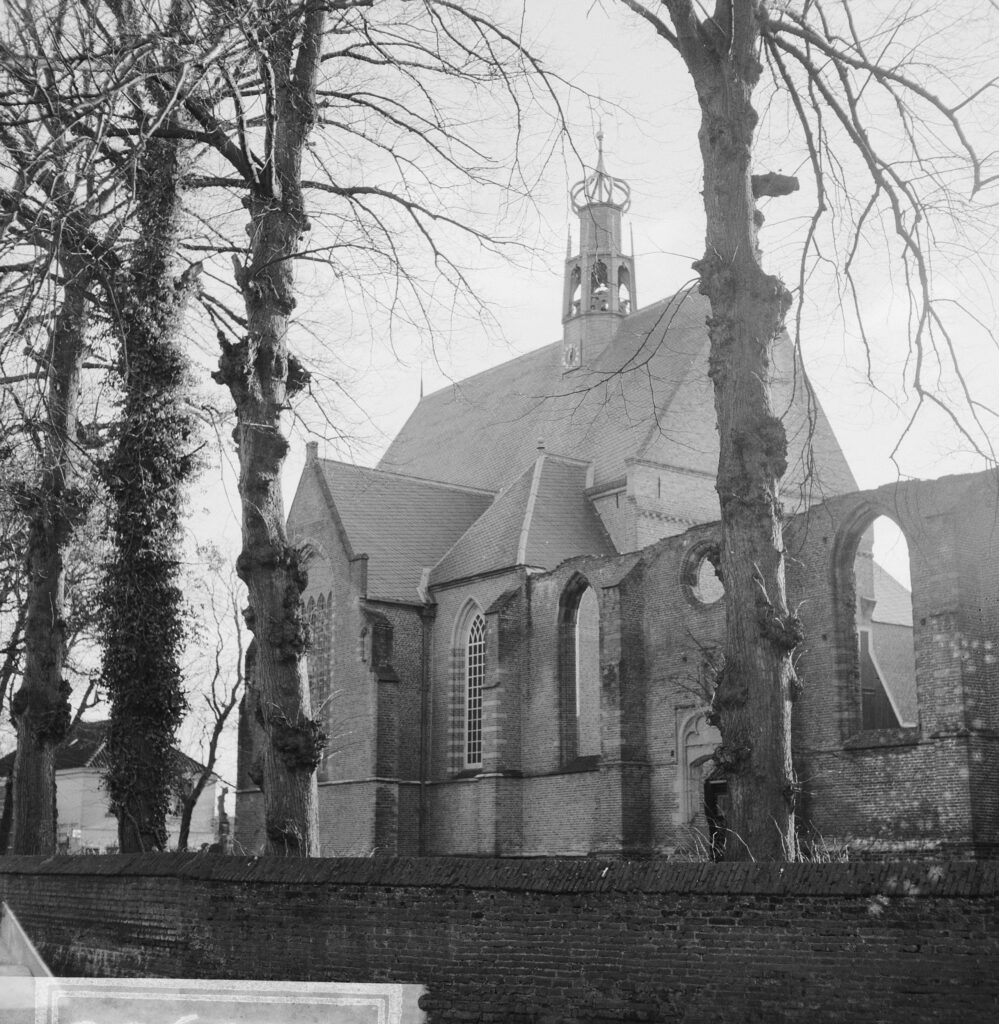
Ruïnekerk de Bergen, a place where tradition places the phenomenon of 1422 and historical custody. Ron Kroon / Anefo / Wikimedia Commons, CC0. Archive and dedication CC0 in Wikimedia Commons.
