
Documented history of the Sacrament of Niervart: the host found about 1300, the account of the five wounds, the transfer to Breda in 1449, the medieval cult, the disappearance of the object and the places where his memory lives.
A tradition between Niervart and Breda
The Sacrament of Niervaart belongs to two geographies. The narrative begins around 1300 in a peat area of the old Niervaart and its great public stage was developed in the church of Our Lady of Breda since 1449.
The floods transformed the first landscape and the host disappeared in the 16th century. To explain the case rigorously, we have to distinguish the approximate place of the finding, the temple of veneration and the museum that retains its main visual account.
The finding attributed to Jan Bautoen
According to tradition, the worker Jan Bautoen cut peat when he found a host on the ground. The sheet of his tool would have shredded it and the way it would have sprung blood.
Two women were called witnesses. The story tells us that Jan tried to raise the host and that, in the face of the bleeding, he again left it on the ground until the priest came.
The Macarius investigation
The parish priest informed the bishop of Liège, under whose jurisdiction the area was. Un envío llamada Macarius de Busco habría interrogado a los testigos y examinado la hostia.
The late version states that he tried to cross it with a poinch: four times he could not and in the fifth attempt five points of blood appeared, interpreted as reference to the five wounds of Christ.
Devotional relation and documentation
These details come from the tradition in subsequent texts and representations. No full laboratory report or contemporary report is kept to enable the material reconstruction of the test.
The historical importance is recognized in veneration, transfers, co-fradies, works of art and celebrations. The tab narrates the miracle as received without turning each scene into an independent physical data.
Niervaart as a pilgrimage center
The host was venerated in the local church and attracted pilgrims. The narrations attributed to him healing and other favors, while the place became a regional Eucharistic focus.
The toponym appears with variants such as Niervaert, Niervaart and Nieuwervaart. It should not be simply confused with the current city centre of Klundert, founded later and located west of the missing medieval settlement.
Floods and the Lost Place
The territory suffered repeated floods, including that of Santa Isabel in 1421. The old town and its church remained in a geography difficult to maintain and ended up disappearing.
There is no building today whose door can be pointed out as the exact location of the finding. The 51,6666152, 4,5508555 coordinate represents a historical corridor near Langeweg and should be read with approximate accuracy.
Why Klundert is not the exact point
Contemporary sources use "current Klundert" to guide the reader within the municipality and the region. This formula does not mean that the visible square or church of Klundert occupy the plot of the old Niervart.
The tab prevents a false accuracy. The map allows you to approach the historical landscape, but states that the specific location of the settlement, the church and the peat extraction point is not fixed.
The transfer of 1449
In the face of the risk of new floods and the loss of importance of the site, Jan IV of Nassau promoted the transfer. After a last celebration, the host went out on the night of March 13-14, 1449 by water to Breda.
The transport followed the Nieuwe Vaart and the Mark. The arrival made the church of Our Lady the new center of veneration.
La Grote Kerk de Breda
The host was installed on a specific altar and then had a sacramental chapel. The current Grotto Kerk is at Grotto Markt, coordinates 51.5890575, 4.7752931.
The temple retains architecture and memory linked to the cult, although today it belongs to a different ecclesial tradition and does not host the missing host.
Pilgrimage, city and tower
The arrival of pilgrims favored the church and the city. The official history of the Glot Kerk itself relates the influx and the offerings to the financing of the great building and its tower.
The economic relationship does not invalidate devotion, but helps to understand that a medieval pilgrimage was also an urban, artistic and social phenomenon.
El gremio de 1463
In 1463 it was founded in Breda a fellowship or guild of the Sacrament of Niervart to support the veneration and organize its public expressions.
The institutional memory did not completely end with the disappearance of the object. The current Collegium Sancti Sacramenti Niervaertensis retains symbols and activities linked to that story.
The theater of the miracle
The story was taken to the scene at the Spel vanden heilighen sacrely vander Nyeuwervaert, in charge of the playwright Jan Smeken. There is news of a performance at the Grott Markt in 1500.
The theatre taught history to a broad population and shows how tradition went from oral narration to a carefully built civic memory.
The altarpiece of about 1535-1538
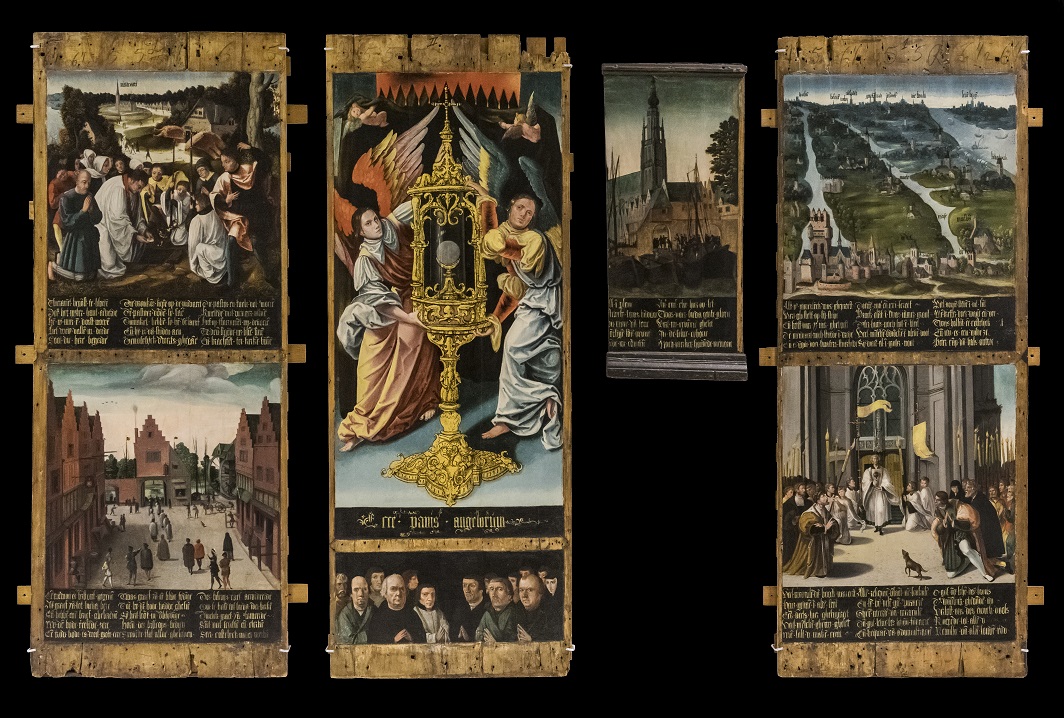
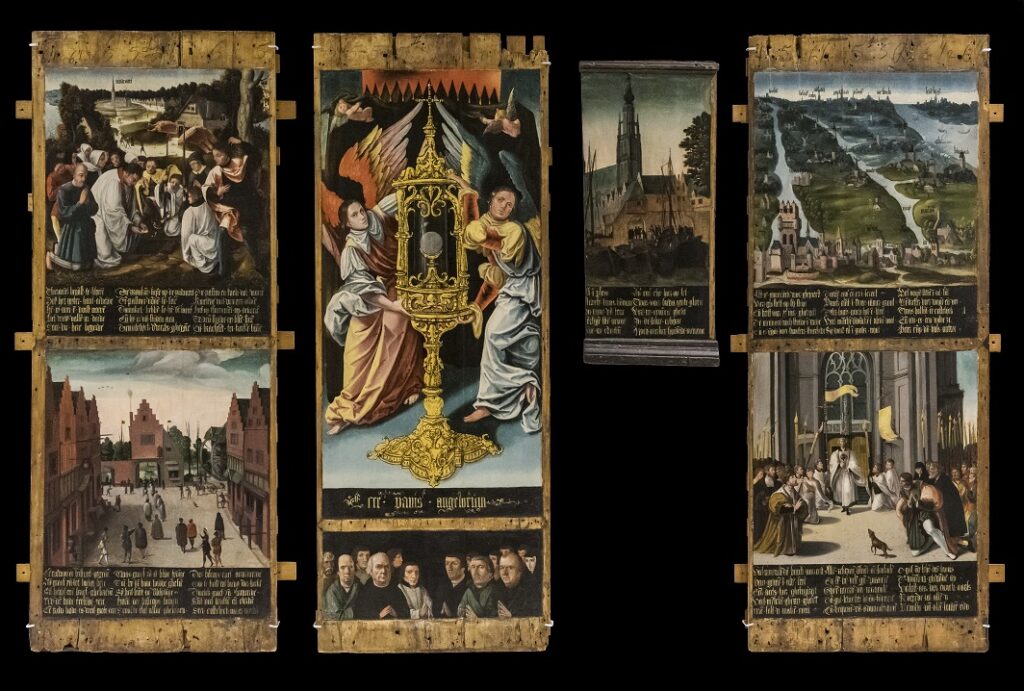
The preserved altarpiece represents the finding, the examination, the favors and the solemn exhibition. It was made for the church of Breda and works as a sequential account similar to an illustrated narrative.
It is currently part of the collection of the Stedelijk Museum Breda, on loan from the city. Its coordinates are 51.5896392, 4.7810102, but may not always be exposed.
Iconoclasia and disappearance
The host was probably lost during the iconoclasia of 1566. Some later news is about concealment or transfer, but no search has shown safe material conservation.
The Grotte Kerk claims she never met again. Therefore, a current location of the relic should not be published or suggest that the item is contained in the item by the altarpiece or an empty custody.
The recovery of the altarpiece
The work also suffered damage and dispersion. In 1625 the Breda authorities requested that those with fragments hand them over to reclaim it.
Their survival is an exceptional heritage testimony. It retains images of tradition without replacing the lost host or retrospectively demonstrating its properties.
Contemporary Catholic Memory
The diocese of Breda continues to remember the Sacrament of Niervaart in celebrations, preaching and tours. In a homily, Bishop Jan Liesen stressed that the true center is the sacrament of the Eucharist itself.
This guidance helps to classify the case: there is liturgical and community memory, but not a current cult of a preserved material relic.
How it is represented on the map
The main marker conserves the country and the landscape of origin through the approximate corridor of Niervaart. His description immediately refers to the Grotte Kerk of Breda as the place of worship since 1449.
The museum appears as a third heritage reference. This structure avoids moving the find to Breda or inventing a precise building in the flooded territory.
A possible cultural and spiritual route
The reader can learn about the surroundings of Klundert and Langeweg, visit the Grotte Kerk and visit the Stedelijk Museum. Each place offers a different part of the story.
Before travelling you must check schedules, accessibility and temporary exposure of the altarpiece. The tab does not promise that the work is visible on a given date.
The lost host and honesty
The disappearance does not make it necessary to fill the void with a legend of survival. To say "we don't know where it is" is a legitimate and respectful historical conclusion.
The Eucharistic faith of the Church does not depend on recovering that object. Memory can continue to invite prayer without presenting an empty custody as an authentic relic.
The sacrament as a true center
The extraordinary tradition points to the Eucharist celebrated in each community. Christ is no more present because visible signs appear no less present when there are no.
The fruit of this history can be a greater reverence, a reasoned faith and a concrete charity. The contemplation of the altarpiece must lead from heritage to mystery and from mystery to service.
A memory that goes through confessions
The Glot Kerk changed religious use and the Catholic community later developed its life in other temples. Presenting today the Sacrament of Niervart demands respect for those who guard the historical building and those who maintain the Catholic memory.
Shared heritage can favour dialogue rather than dispute. The history of iconoclasia should not be used to reopen hostilities, but to understand the losses, protect the works that survived and sustain a mature religious coexistence.
Sources consulted
- Diocese of Breda: the Sacrament as a true miracle, transfer, liturgical memory and pastoral sense.
- Great Church Breda: historia del Sacramento de Niervaart, chapel, pilgrimage and disappearance.
- Stedelijk Museum Breda: retablo del Sacramento, work, scenes and property custody.
- Canon de Moerdijk: Kidney, regional geography and transfer of 1449.
- Repertoire associated with San Carlo Acutis: Breda-Niervaart, initial reference contrasted.
Para orar
Lord Jesus, Bread of life, teach us to remember in truth and to celebrate your presence without seeking false assurances. May the heritage received lead us to the Eucharist, to unity and to the service of those who need food and hope. Amen.
Image credit
Remarkable of the Sacrament of Niervart, about 1535-1538, heritage of Breda. Stedelijk Museum Breda / Wikimedia Commons, CC BY-SA 4.0. File and license in Wikimedia Commons.
