
Głotowo retains a tradition about a host hidden during a 1290 raid and found years later in the field. The Archdiocese of Warmia today confirms the place as the Archdiocese of the Most Holy Sacrament and Passion, but the medieval account is presented as a foundational memory.
Głotowo, Eucharistic shrine of Warmia
Głotowo is a small town near Dobre Miasto in northern Poland. His church of the Most Holy Saviour is recognized by the Archdiocese of Warmia as the Archidian Sanctuary of the Most Holy Sacrament and of the Passion of the Lord. This institutional condition, the parish and the current pilgrimage are verifiable.
The local memory unites two devotions: the Eucharist and the Passion. To the temple is added the Kalwaria Warmińska, a landscape crucis path consecrated at the end of the 19th century that continues to host celebrations and pilgrimages.
The incursion attributed to 1290
The repertoire panel associated with San Carlo Acutis tells that in 1290, in the face of a Lithuanian incursion, a priest hid a golden silver copon in a field. A consecrated host would have been left by mistake inside. The village and church were destroyed and the survivors ignored the hiding place.
This beginning belongs to traditional narration. The file has not located the text of a 1290 act, the name of the priest, a contemporary inventory or the oldest document that allows to date every detail. This is why the conventional date is preserved without being presented as a complete archival reconstruction.
The farmer, the oxen and the light
According to the story, years later a farmer plowed the land in spring. The oxen stopped and leaned to the ground; an intense light would have emerged from the earth. When he excavated, the man found the little copon covered in mud and inside a white and intact host.
The image of the kneeled animals became the best known visual motif of Głotowo. He expresses the worship of creation before Christ, but his symbolic strength should not be confused with an independent proof that the episode would happen exactly like this.
The transfer to Dobre Miasto and the alleged return
Tradition adds that the authorities organized a solemn procession to take the host to a church in Dobre Miasto. A later chronicle states that it disappeared and was found again in the same field of Głotowo.
The return was interpreted as a sign to raise a temple in the place. It is a frequent structure in the foundational accounts of sanctuaries: the sacred object indicates by its return where it wishes to be venerated. Here it is explained as a religious tradition, not as a documented movement through preserved and accessible acts.
The parish documented since 1313
The official directory of the Archdiocese of Warmia dates from the creation of the parish of the Most Holy Saviour on March 12, 1313. This data offers a firm historical point for the ecclesial organization of Głotowo, a few years after the date attributed to the story.
The existence of the parish and its dedication alone do not prove the oxen, light or return of form. They do show that the local Christian community has medieval roots and that devotion was integrated into a stable ecclesial life.
The present temple of the 18th century
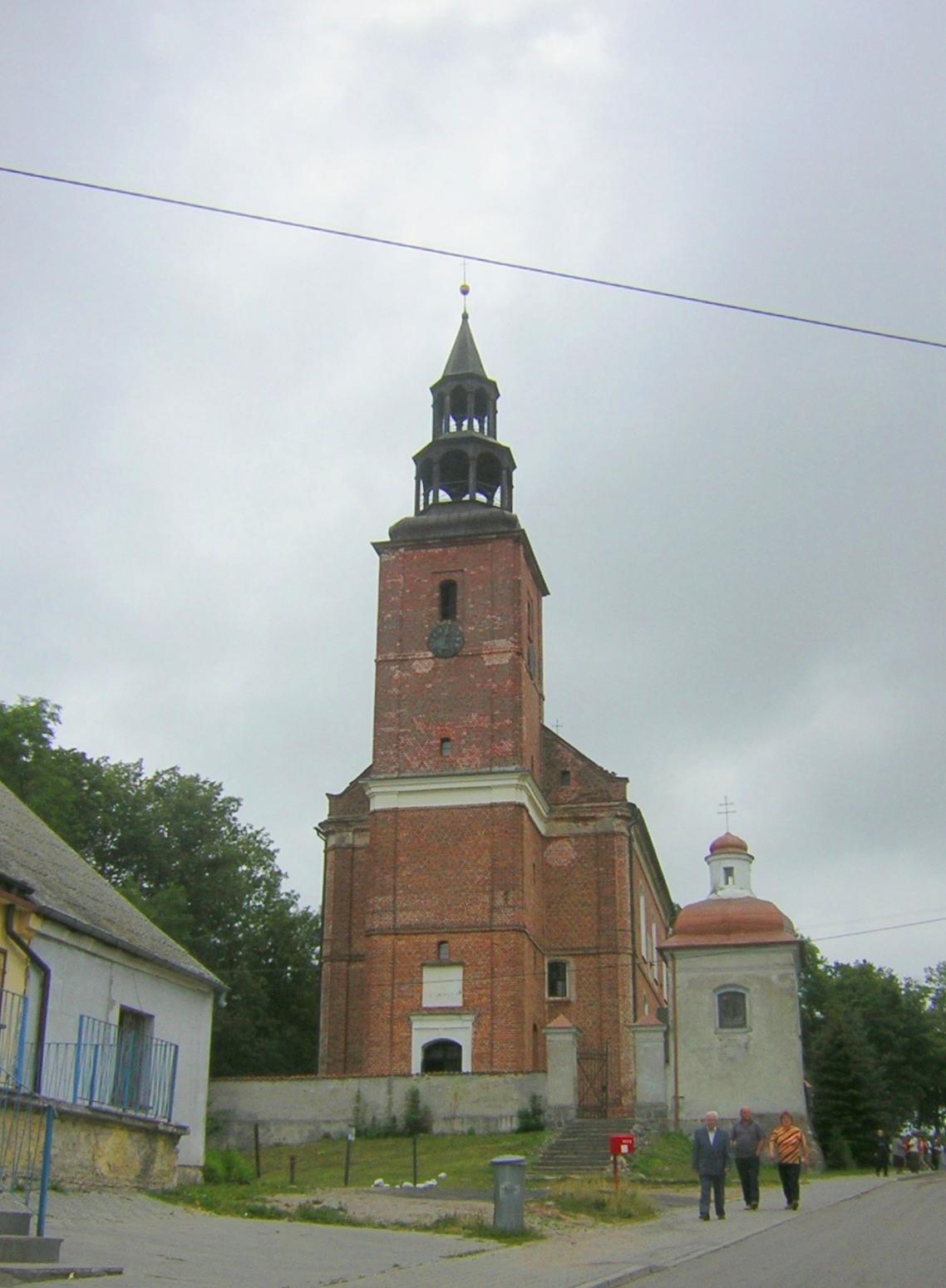
The medieval church was replaced by the current Baroque building. The outreach panel places its expansion and consecration by Bishop Krzysztof Potocki on 24 July 1726. The photograph of this document shows precisely that sanctuary, not a construction preserved since 1290.
The interior, altars and Eucharistic memory reflect successive generations of veneration. Distinguishing the Baroque building from medieval tradition helps to understand the place without compressing four centuries in one scene.
La Kalwaria Warmińska
At the end of the 19th century a cross-way inspired by the topography of Jerusalem was built next to the sanctuary. In 2014 the Archdiocese celebrated the 120 anniversary of its consecration, which placed that dedication in 1894.
The seasons link the memory of Passion with Eucharistic worship. The pilgrimages, masses and contemporary crucis provide direct evidence of a living devotion, although they do not resolve the historicity of the 1290 episode.
The relic and the limits of material continuity
The disclosure states that the pilgrims venerate a host preserved since the 13th century. A file with material description, conservation interventions, successive inventories or a chain of custody covering more than seven centuries has not been located online.
Out of respect for the sanctuary, the record does not deny its memory of veneration; out of respect for the truth, it also does not claim as proven an uninterrupted material identity. The center of faith is Christ present in the celebrated Eucharist, not biological antiquity in a form.
Location and visit
The sanctuary is in Deep 38, 11-040 Good City, Polonia. The marker uses coordinates 53,9595273, 20,3649686 and points to the church building of the Most Holy Saviour.
The Archdiocese publishes mass schedules and contact details, but it is appropriate to check them before travelling. The Kalwaria is traveled in the open air and the visit must respect the celebrations and the praying character of the place.
World map classification
Głotowo is incorporated as "Eucharistic tradition with existing sanctuary and pilgrimage." The category confirms the institutionally verifiable and maintains as a foundational memory the extraordinary elements of the 13th century.
Spiritual feeling
The story of a host protected in time of violence calls for the Eucharist to be cared for and for for peace. The image of the kneeling oxen recalls that Christian worship encompasses the body, work and creation.
The mature pilgrimage does not seek only an ancient object. It leads to mass, reconciliation, contemplation of Passion and service to those who are today suffering war or displacement.
Sources consulted
- Archdiocese of Warmia: parish and archdiocese of Głotowo, main institutional source.
- Archdiocese of Warmia: 120 anniversary of the Kalwaria Warmińska.
- Exposure associated with San Carlo Acutis: Głotowo, source of the traditional account subject to caution.
Para orar
Jesus, Bread of life, keep us in peace, teach us to worship you with humility and make us close to those who suffer violence and exile. Amen.
Image credit
Church of the Most Holy Saviour of Głotowo. Marcin n ® / Wikimedia Commons, CC BY-SA 2.5. File and license in Wikimedia Commons.
