
The Heggewonder tradition recalls five stolen forms in Wechelderzande in 1412 and found eight days later in Poederlee. The Heggekapel and the procession are still alive, but the forms have disappeared and no ecclesiastical decree of authenticity has been located.
The right name: Herentals-Poederlee
The international catalogue rotates the case as "Heretals, 1412" because the arrest of the accused and part of the narrative are related to that city. However, the place of the alleged finding and subsequent cult is the Hegge, in Poederlee, the current municipality of Lille.
The name Heretals- Poederlee retains both references without displacing the marker. The tab is located in the Heggekapel of Poederlee, not in the center of Herevals or in the church from which the forms were taken.
The January 1412 robbery
The municipal history of Lille tells that in January 1412 they disappeared from the church of Wechelderzande a chalice and five consecrated forms. The story attributes the theft to Jan van Langerstede, described in local tradition as a skulking gentleman.
The liturgical object would have been found later among its belongings in a Herrental inn. The municipal source presents this sequence as part of a popular legend preserved in Poederlee; that rating invites not to read every detail as a complete contemporary act.
The Hegge and the Hide
According to the story, the thief was lost as he went through the Hegge site and attributed his disorientation to the forms. He would have hidden them in a burrow or ground opening, after which he found the way back to the inn.
When he was interrogated, he confessed to the robbery and indicated where he had left the forms. The narrative thus unites three places: Wechelderzande as a source, Herestants as a place of detention and Poederlee as a place of concealment and subsequent veneration.
The finding eight days later
Tradition states that the five forms were located eight days later and remained intact despite winter and having been outside a temple. Such conservation is the element that local memory interprets as extraordinary.
The heritage sources describe the chapel as raised where the stolen forms were thrown or hidden and then recovered without damage. They do not, however, provide a material analysis of the forms or a modern ecclesiastical record.
The punishment of the accused
The municipal page reports that the accused was subjected to corporal punishment and executed. It is not appropriate to make this violent outcome a part of the cult or to present it as a divine intervention.
The criminal justice system of the 15th century applied penalties that we recognize as cruel today. A contemporary Christian reading can remember the value of the Eucharist and, at the same time, reject the fascination for the relish or any religious use of violence.
The civil claim of 1441
The panel released by the repertoire of departure attributes to the judge of Herestants a declaration of authenticity in 1441. This news is part of the historical reception of the case, but a decision of civil authority is not a doctrinal or canonical decree of the Church.
The full text of that declaration and an ecclesiastical decree of authenticity have not been located in the sources consulted. This is why the fact sheet does not transform the panel's reference into an episcopal recognition that does not contain.
The construction of the Heggekapel
Jan van Viesele, Mr. de Poederlee, promoted the construction of a chapel in the traditional location of the find. The official inventory of heritage has its origin in the first half of the 15th century; the municipal history indicates that it was completed by 1441 or 1442.
The difference of one year between summaries does not change the essential: the building has materialized the memory of the story since the 15th century. The chapel was soon small and extended to the west between 1442 and 1477.
Architecture and property protection
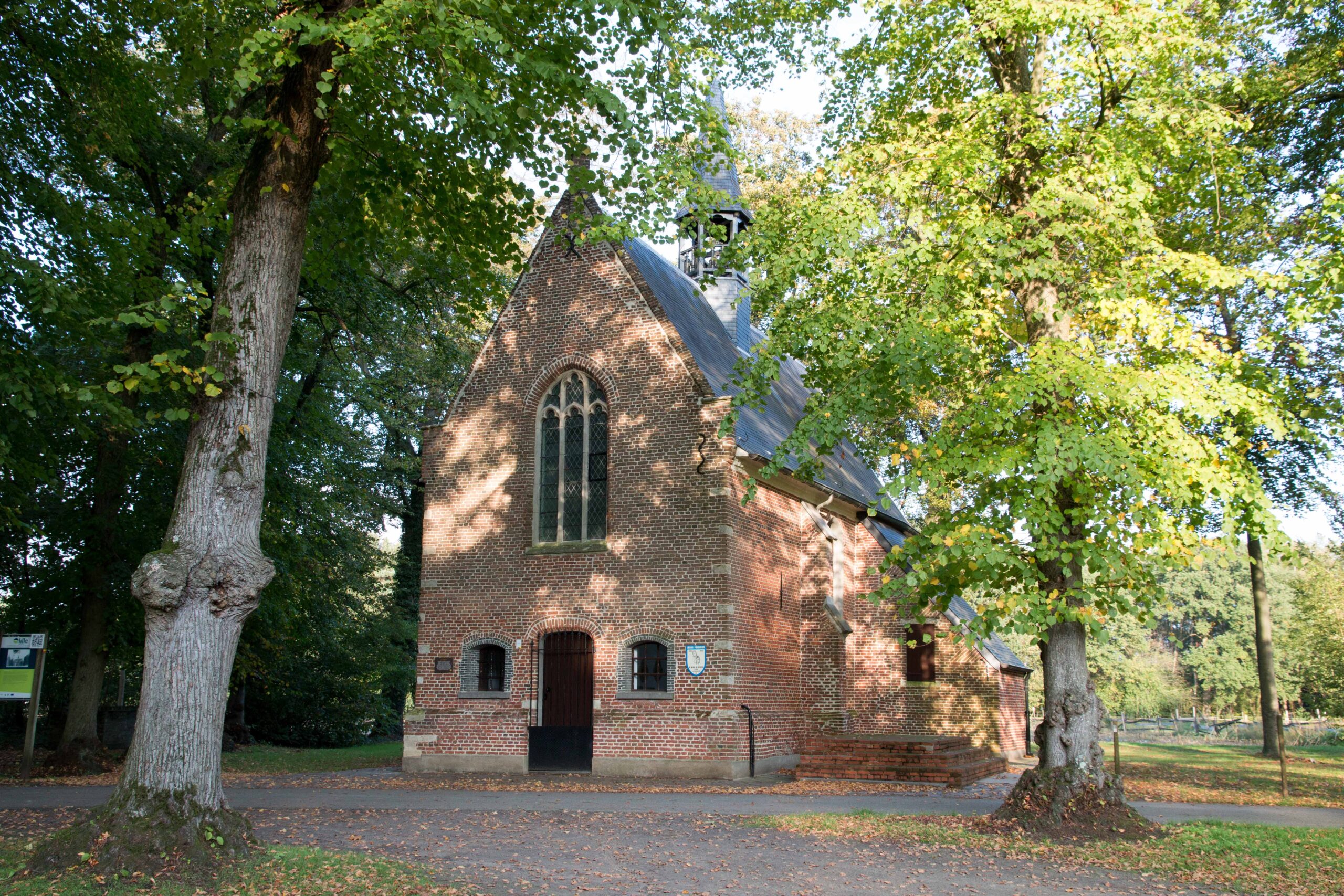
The Heggekapel, officially called the Chapel of the Venerable Most Holy Sacrament, is a late brick construction located in a wooded environment. It retains visible traces of its enlargements and an avenue linked to small chapels of the Dolores de la Virgen.
The Flemish Government recognizes it as an architectural heritage and a protected monument since 2004. This protection attests to the historical and artistic value of the building, does not in itself constitute a statement on the supernatural character of the story.
Damage and restoration
The property inventory records serious damage during the 16th century iconoclasia and a restoration in the early 17th century. The sacristy was added in 1672-1673, and other interventions allowed to preserve the whole.
The devotional repertoire states that the forms disappeared during the riots of 1566. By not staying today, the visit is directed to the chapel and historical tradition, not to the veneration of the five forms of 1412.
The annual procession
Every year, on the Sunday after Corpus Christi, a procession goes to the Heggekapel. This continuity offers clear evidence of a living local devotion and the relationship of the place with the Most Holy Sacrament.
The liturgical date must be checked each year on the parish or municipal channels. A historical record must not convert old schedules into a permanent agenda or promise access when the temple can be closed.
The Ommegang every 25 years
Since 1912, a large process representation of the Heggewonder has been held every twenty-five years. In 2012, the sixth centenary of the tradition, about 2,000 figures and collaborators participated and many visitors attended.
The next large Ommegang announced by the municipality is scheduled for 2037. This representation transmits community memory, but its theatrical language should also not be confused with an exact documentary reconstruction of 1412.
Cultural heritage
The Ommegang was incorporated in 2011 into the Flemish inventory of intangible cultural heritage. The Hegge Poederlee association works to preserve the story, the celebration and the goods linked to the chapel.
Property recognition values community transmission, participation and continuity. It does not scientifically certify the extraordinary conservation of forms or replace ecclesial discernment.
What can be said for sure
It is certain that there is a local tradition rooted since the 15th century, that a chapel was built in the place identified with the finding, that the building was expanded and restored and that processions and celebrations have kept their memory.
It is prudent to present as a story the intact preservation of the forms and personal details of the thief. It must also be declared that relic is not preserved and that no ecclesiastical decree of authenticity has been located.
The Eucharist and the sense of tradition
The Catholic faith in the real presence of Christ does not depend on ways to survive intact in the open. The Eucharist is a sacrament of communion celebrated by the Church and calls for worship, reconciliation and service.
The Heggekapel can help to contemplate the reverence due to the Most Holy. His spiritual fruit is not to recreate himself in the punishment of the accused or to exaggerate evidence, but to live with greater gratitude Mass and charity.
exact location
The chapel is located on the road called Heggekapel, 2275 Poederlee, municipality of Lille, province of Antwerp, Belgium. The coordinates 51.2189167, 4,8329404 correspond to the cartographed religious building.
Precision avoids the error of placing the case in Herestants. The marker points to the traditional location of the find, the preserved chapel and the current center of the procession.
Editorial classification
The tab is incorporated as "historical tradition with preserved place of worship." This category allows to map the Eucharistic heritage without declaring that every detail of the story has been demonstrated.
The visible description on the map reports the limits: missing forms, historical veneration and absence of localized ecclesiastical decree. The reader receives context before interpreting the marker.
The original Heretral identifier is also maintained so that future reviews can track the equivalence and do not recreate a duplicate tab or marker placed in the wrong city.
Sources consulted
- Municipio de Lille: The Hegge Wonder, local account, chapel, procession, and Ommegang.
- Official inventory of Flanders' property, building, chronology, extensions and protection.
- Municipality of Lille: history of Poederlee, construction and territorial context.
- City of Lille: ruta de la Heggekapel, territorial access and integration into local heritage.
- Repertory associated with San Carlo Acutis: Herestants, initial reference contrasted and geographically corrected.
Para orar
Lord Jesus, present in the Eucharist, give us reverence without credulity, memory without violence and a faith that gives fruits of charity. May every tradition lead us to truth, reconciliation and service. Amen.
Image credit
Heggekapel de Poederlee, capilla levantada en el lugar tradicional del hallazgo. Sally V / Wikimedia Commons, CC BY 4.0. File and license in Wikimedia Commons.
