
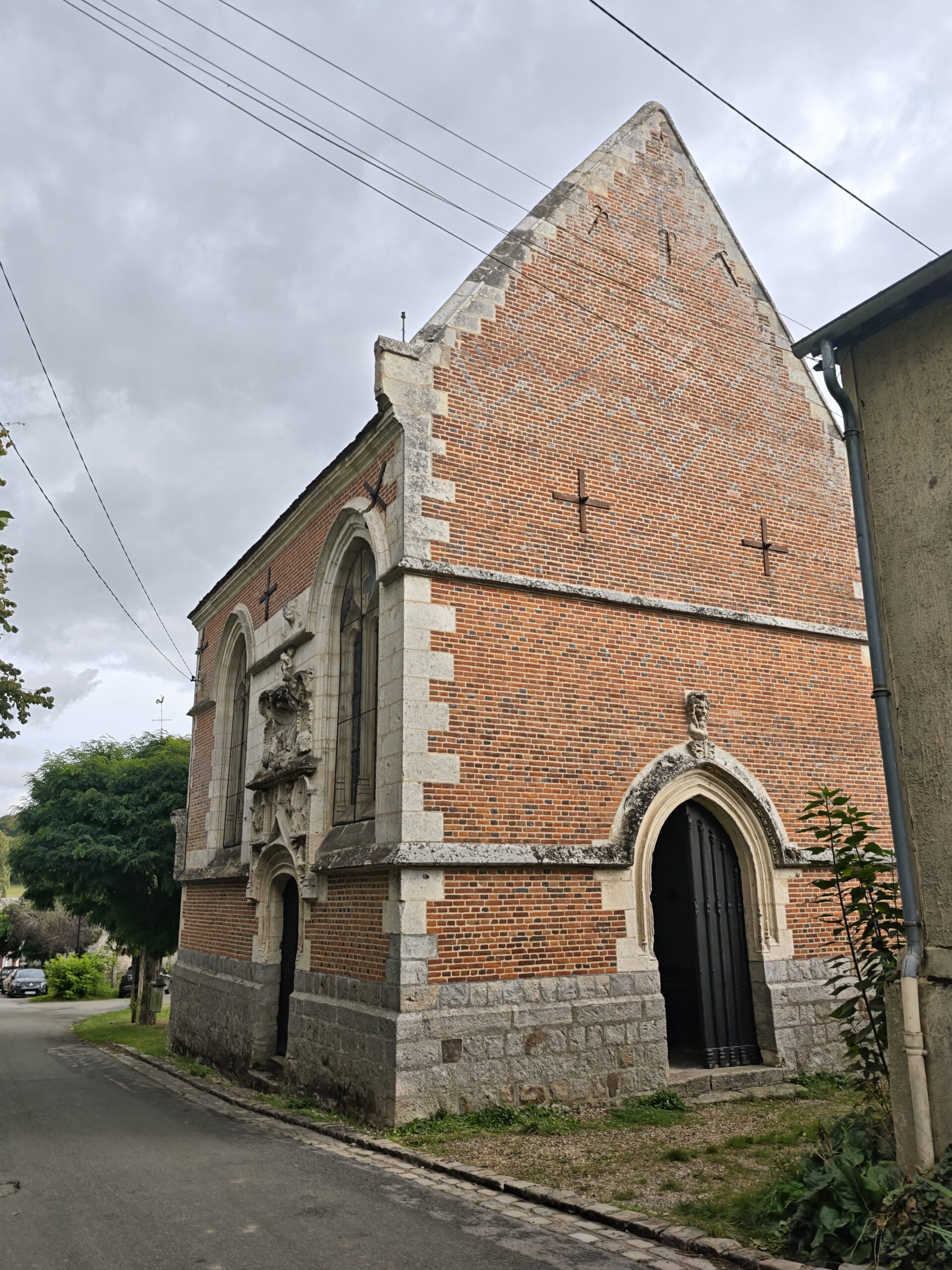
Marseille-en-Beauvaisis retains the chapel raised in memory of the theft of a Copon at Christmas 1532 and the finding of the forms on January 1, 1533. The tradition speaks of snow that did not cover the place and of healing; the forms no longer exist.
A story between Christmas 1532 and New Year 1533
The tradition begins in the parish church of San Martín de Marseille-en-Beauvaisis, a town in the current French department of Oise. During the Christmas parties of 1532, some thieves removed a golden silver copon containing consecrated forms. They then left the forms near the temple, in a bush or under a stone, according to the versions transmitted.
The find is located on January 1, 1533. Local memory claims it was snowing, but the point where the forms were found had not been covered. A neighbor warned the parish priest and he went with local inhabitants to take them back to the church with reverence.
What is documented and what belongs to the story
The existence of the chapel, its dedication to the Holy Hostias, its architecture and the continuity of a Eucharistic memory are verifiable heritage. The municipality and the inventory of the churches of Oise explain that the building was born from the tradition of theft, finding and healing attributed to prayer there.
The snow that did not cover the forms, the identification of the protagonists and each concrete healing come from historical and devotional accounts. A contemporary decree formally declaring supernatural has not been located online. This is why the document speaks of the Eucharistic tradition and does not present all its details as results tested by modern research.
The return of forms to San Martín
The heritage sources tell that the parish priest was warned and came with a crowd. He removed the forms and put them safe in the parish church of San Martín. The spontaneous procession of the finding thus became the first community gesture of reparation and custody.
The episode does not describe a physical transformation of species. The signal interpreted as extraordinary was its preservation in the midst of the snow and, later, the favors attributed to the place. This distinction makes it possible to correctly classify the case within the world map.
The cross and the first chapel
At the point of the finding a cross was first raised surrounded by thorns. The influx of people and donations made it possible to build a chapel the following year, according to the Églises de l'Oise study. The building became known as the chapel of the Holy Hosts.
The material foundation turned an edge of the old cemetery into a stable place of memory. The chapel was not built to permanently guard the forms at the same point, as they had returned to the church, but to remember the finding and to welcome the prayer of the pilgrims.
The 1628 enlargement
The municipality notes that Mr. de Gaudechart added a side chapel in 1628. The construction that is being envisaged today therefore brings together different stages. Its brick and stone factory and its dedicated ornamentation show the importance that devotion came to have in the locality.
The facade, the northern portal and the windows combine the forms of the flamenco Gothic and Renaissance. The building is valuable for both religious memory and architecture, and must be visited with respect due to a space of veneration.
Forms ceased to be preserved in the 16th century
The tradition spread by devotional sources maintains that the forms were consumed by order of Odet de Coligny, Bishop of Beauvais, before his break with the Catholic Church in 1561. The institutional sources consulted today confirm that there is no Eucharistic relic preserved in the chapel.
This absence must be made clear from the beginning. Whoever goes to Marseille-en-Beauvaisis can know the memorial place, pray and participate in worship or the celebrations announced, but will not find the forms attributed to 1533.
The cures transmitted
The fame of the place grew by accounts of the sick who would have obtained healing by praying where the forms were found. The iconography of the chapel retains scenes related to these stories, including those of a blind musician, a lord of Achy and a cleric named Jacques Sauvage.
The existence of paintings or glass windows proves that the community wanted to keep these stories, not that each healing today has an accessible medical or canonical file. The page presents them as a received memory and avoids promising results to anyone who visits the sanctuary.
A chapel wounded and restored
The building was damaged during the French Revolution and was restored in the 19th century. Marseille- in-Beauvaisis also suffered severe bombing in 1940. The vitrals were almost completely destroyed and were redone in 1949 by the master of the glass, Degouy de Beauvais, following the previous program.
The restoration allowed the chapel to serve the community again. Its continuity is not to keep every element intact since the 16th century, but to have been repaired and transmitted after wars, political changes and pastoral transformations.
The vitrals tell the story
The set of vitrals relates to the theft of the copon, the finding, the construction of the chapel and several cures attributed to the intercession received. Although much of the current windows dates back to 1949, it reproduces a cycle carried out in 1899.
These images work as visual catechesis. They help to understand how later generations interpreted the event. They must be read as religious art and community memory, not as documentary photographs of 1533.
The placing in the grave
Inside is a sculptural group of the setting in the tomb, made in the second half of the 16th century and widely restored in the 19th century. The official POP base of the French Ministry of Culture catalogues it as well protected in the chapel of the Holy Hostias.
The scene looks to the Passion and burial of Christ. Although it does not directly represent the finding of forms, it integrates the Eucharistic memory into the Paschal mystery: Christ himself delivered on the cross is received sacramentally by the Church.
Current adoration and procession
The diocese of Beauvais includes the Holy Hostias of Marseille-in-Beauvaisis in their relationship of pilgrimages and movements. He mentions worship in the chapel and procession from it to the church of San Martín, under the pastoral responsibility of the parish of Haut Beauvaisis.
The diocesan page itself shows a date that requires verification. This is why a fixed timetable is not published here and a specific celebration is not guaranteed every year. The parish or the diocese should be consulted directly before travelling.
The chapel and the parish church
The story links two very close buildings. The church of San Martín was the place where the recovered forms were reguarded. The chapel of the Holy Hostias rose in the traditional place of the find and today concentrates the specific memory.
The map uses the chapel as its main point because it is the monument expressly created by tradition. The fact sheet also explains the relationship with San Martín so that the reader does not confuse the origin, the finding and the subsequent development of the cult.
exact location on the map
The chapel of the Holy Hostias is located in Rue de la Chapelle, 60690 Marseille-en-Beauvaisis, Oise, Alta France region. The coordinates 49.5761750, 1,9530780 correspond to the building and coincide with those published by the Eglises de l'Oise inventory.
The marker points to a historical and pastoral place. A coordinate does not demonstrate the supernatural nature of a story; it allows to locate the related chapel with precision and to prevent the pilgrim from being directed to a temple of similar name.
Responsible classification
The chart is classified as "historical tradition with existing chapel and pilgrimage." This category recognizes the continuity of the place, the worship and the documented procession, and at the same time declares that the forms are no longer preserved and that no historical decree of authenticity has been located.
The formula avoids presenting a non-existent object and differentiates this memory from cases that retain an accessible relic or canonical pronunciation. Devotion can be valuable without concealing its documentary limits.
Spiritual feeling
The theft of a Copon recalls that the Eucharist must be guarded with reverence. The tradition of finding led to a community response: procession, prayer, chapel and memory. His spiritual fruit is not in seeking a prodigious effect, but in renewing faith and repairing the faults against the sacrament.
To worship Christ leads to care for his presence in the liturgy and to recognize him in those who suffer. The chapel invites us to unite respect for the Eucharist with conversion, reconciliation and concrete service to others.
Sources consulted
- Diocese of Beauvais: pilgrimage of the Holy Hosts, current worship and procession.
- Églises de l'Oise: chapel of the Holy Hostias, history, architecture, coordinates and bibliography.
- Municipality of Marseille-en-Beauvaisis: local history, origin and expansion of the chapel.
- Ministry of Culture of France, POP base, put in the tomb preserved in the chapel.
- Exhibition associated with San Carlo Acutis: Marseille-en-Beauvais, secondary devotional source tested.
Para orar
Lord Jesus, present in the Eucharist, give us an attentive and reverent heart. Forgive our faults, strengthen our faith and make worship become charity, reparation and humble service. Amen.
Image credit
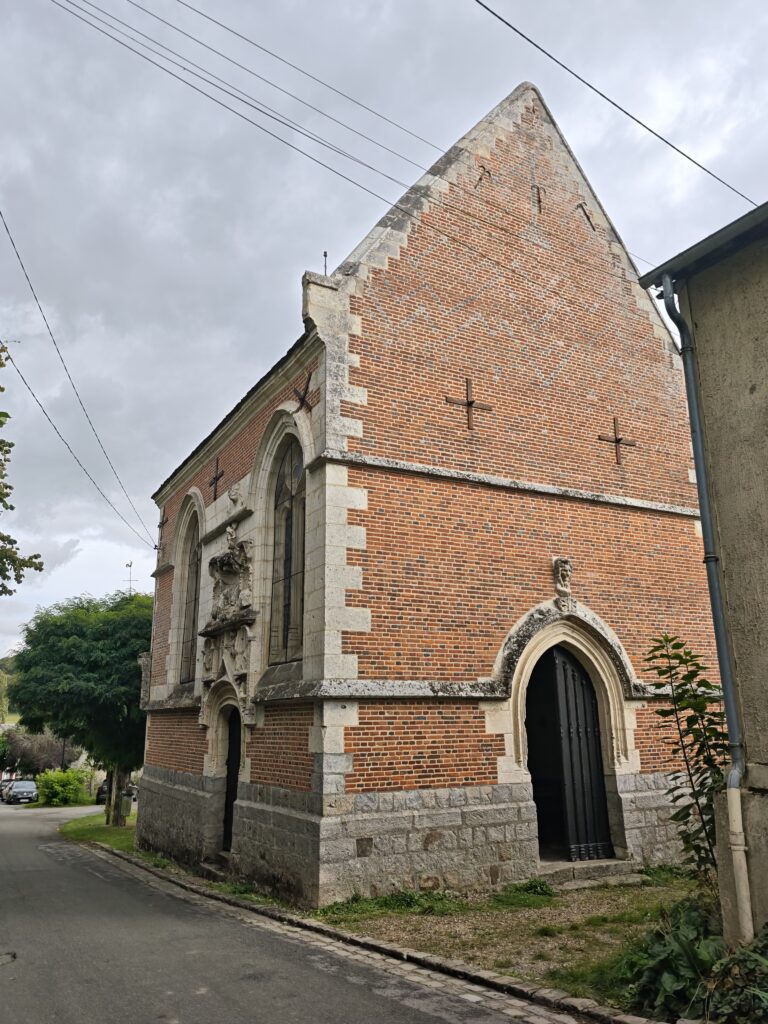
Fachada de la capilla de las Santas Hostias de Marseille-en-Beauvaisis. Claude Villetanuse / Wikimedia Commons, CC0. CC0 file and declaration in Wikimedia Commons.
