
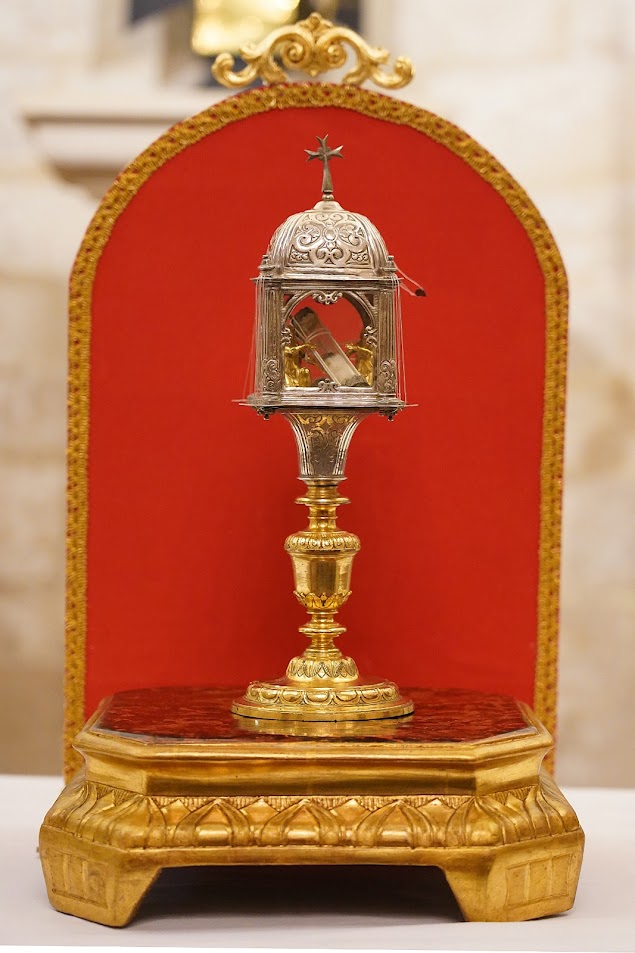
According to tradition, a woman who cooked a holy host in the frying pan saw her become a bleeding flesh that soaked all around.
Documented history and memory received
Trani retains a medieval tradition according to which a woman would have misled a holy host to her house and put her on fire. The narration and its relicary are part of the local religious memory, but no coetanea documentation has been located to treat the details as a proven chronicle. The fact sheet distinguishes the historical presence of the Eucharistic tradition and veneration from the supernatural affirmation, whose valuation does not correspond to this website; nor does it repeat stereotypical accusations against religious groups.
Who venerates the memory
The look is directed to Jesus Christ and to the mystery of his Incarnation, Passion, Death, Resurrection or Reign. The image, relic, monument or custom does not act by its own power: it serves the memory of the Gospel and leads to prayer, sacraments, conversion and charity.
History, tradition and discernment
Medieval local tradition without accessible coetanea documentation; no material authenticity is claimed. The tab retains the memory received without turning legend, witness or believing interpretation into a historically demonstrated fact.
Celebration and devotional life
Festivity or main time: Eucharistic Commemoration of Trani.
No automatic promise or prodigy guarantee is documented. Eucharistic veneration leads to mass, veneration, conversion, reparation of damage and charity.
Location on the map
The marker points to the Church of Sant'Andrea · Trani (Italy). The coordinate was contrasted with open mapping and institutional identification of the place.
Main source
Archidiócesis de Trani-Barletta-Bisceglie. Contrast lettering with OpenStreetMap/Nominatim.
Para orar
My Lord and my God, I think you are really present in the Most Holy Sacrament.
Image credit
Relicario conserved in Trani and associated with the local medieval Eucharistic tradition; it was donated to the cathedralicio lobby by Fabrizio De Cuneo in 1616. Photography documents the venerated piece, but it does not constitute a material verification of the story. It replaces the previous thematic crucifix. Photo: Alfredo Cavalieri, CC BY-SA 4.0, Wikimedia Commons.