
The tradition begins in Middelburg, the Netherlands, in 1374; the host-relic left for Cologne that same year and a part arrived in Lovaina in 1380. The cult of Middelburg ended in 1574 and the fragment of Lovaina is kept in a museum depot.
First correction: Middelburg is in the Netherlands
The repertoire of departure groups the case under Belgium because of the importance that Lovaina later achieved. However, the account of 1374 is located in Middelburg, the capital of Zealand, in the current Netherlands.
"Middleburg" is also an imprecise graph of the Dutch name Middelburg. The tab keeps "Lovaina" in the title because there a later cult was developed and goods linked to tradition are preserved.
El relato de 1374
According to the legend of origin, a noble woman from Middelburg asked that the people of her home communicate properly on the first Sunday of Lent. One of his servants, called Jan and from Cologne, would have received communion without confession or repentance.
The narrative states that he was blind and that the form became a small fragment of flesh. By biting it, three drops of blood would have fallen on the cloth of communion.
Repentance and healing in the narrative
The priest would have removed the fragment and kept it. Jan publicly asked for mercy and, according to tradition, regained his sight and changed his life.
These details belong to the devotional and moral account: they link dignified communion, penance and conversion. They are not presented as a medical history or as observations verified by independent contemporary documentation.
What sources allow you to study it
The Dutch pilgrimage repertoire of the Meertens Institute and Zeeuwse Ankers gather the history of veneration, places and historical literature. M Leuven documents the heritage of the brotherhood and the works commissioned to narrate tradition.
The preservation of news, objects and images shows that there was an influential cult. It does not automatically turn every scene of legend into a proven material fact.
The transfer to Cologne in 1374
Federico III of Saarwerden, Archbishop of Cologne, knew the story and that same year he arranged for the transfer of the so-called Sacramento del Miracle. The relic was linked to the agstines of Cologne.
This early departure is fundamental: the host attributed to the episode no longer remained in Middelburg when the Reformation ended the local cult two centuries later.
The division and transfer to Lovaina
In 1380 the Augustines of Lovaina requested a part. Tradition states that after three days of prayer the host was divided into two fragments, which allowed one to be kept in Cologne and to take the other to Lovaina.
The miraculous division is part of the account received. What is historically visible is the subsequent existence of objects, brotherhood and representations in Lovaina related to that transfer.
The cult in Lovaina
In Lovaina a wide devotion emerged. A fellowship was organized since 1426 and the bishop of Liège, John of Heinsberg, authorized in 1435 an annual procession on the first Sunday after Pentecost.
In 1935 the fifth centenary of that procession was solemnly commemorated. The length of the cult explains why the case ended up associated with Belgium, even if its geographical point of departure is Dutch.
The paintings of the brotherhood
M Leuven explains that in 1639 the co-fradia commissioned three paintings to represent the alleged event in Middelburg, the solemn transfer to Lovaina and the worship in the Augustine convent.
The works are testimony to how the 17th century community built its visual memory. They are not images taken in 1374, but later interpretations intended to teach and strengthen devotion.
The trajectory of the objects of Lovaina
After the changes of the revolutionary era, the goods passed through a hospital chapel and the church of Santiago de Lovaina. The sources describe a small fragment of the cloth of communion and a dark fragment attributed to the host.
Zeeuwse Ankers points out that the relic is currently linked to M Leuven. Museistic conservation allows the study of heritage, but it does not necessarily amount to a daily liturgical cult.
What's left in Middelburg
A part of the cloth of communion would have remained with the Middelburg agstines and held a more limited local devotion. The convent, documented since the beginning of the 14th century, occupied a sector close to the end of Vlasmarkt.
The memory of the city retained the story even after the departure of the host. The distinction between host, cloth and fragments avoids talking about a single, immobile relic for six centuries.
The end of local veneration in 1574
The Augustan hermit left Middelburg in 1574, when the city passed to the Dutch Revuelta and the Reformation was consolidated. With his departure he finished the local Catholic cult related to the case.
The conventional solar changed its use and the original set disappeared. That is why there is no miracle chapel today that can be visited in Middelburg.
The Schuttershof and the transformation of the solar
After secularization, the area was used by the corporation of archers and in 1587 the Schuttershof was raised. The toponymy of Augustijnenstraat also retains the memory of the Augustinian presence.
The coordinates of the map point to the end of Vlasmarkt and the surroundings of the old convent. It should not be interpreted as the centimetric position of a missing altar.
Why is a historical plan used
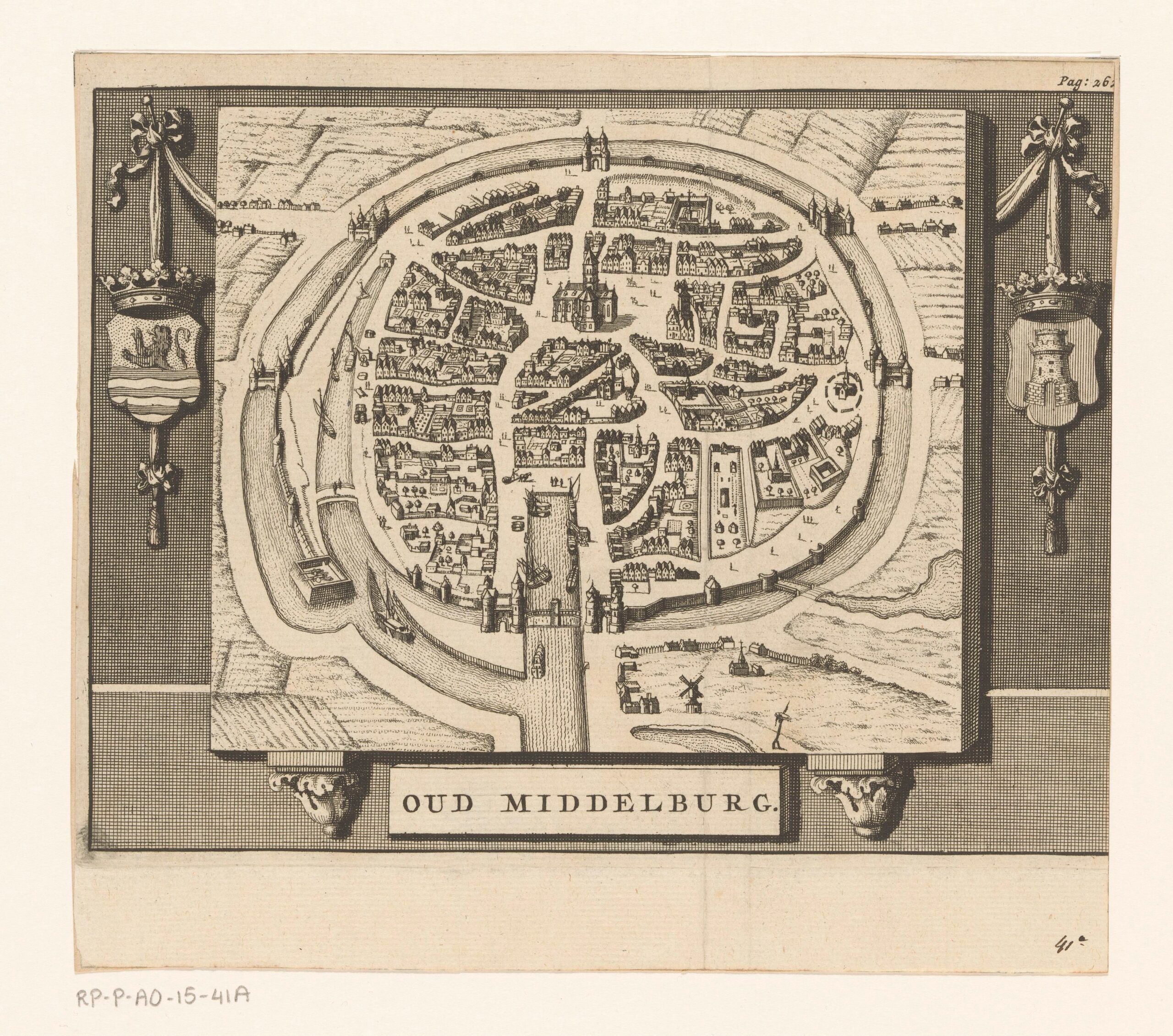
It would not be honest to illustrate the tab with a current church chosen only by proximity. The plan of the Rijksmuseum represents Middelburg around 1400 and offers the urban context closest to the time of the story.
The picture was made centuries later as a historical reconstruction, a circumstance that is declared in the credit. It is a contextual help, not a photograph or a contemporary uprising of 1374.
Cross-border geography
The historic route links three current territories: Middelburg in the Netherlands, Cologne in Germany and Lovaina in Belgium. A country-organized catalogue can oversimplify this medieval mobility.
The page assigns the geographical country to the site of the episode and explains the transfers. Thus the world map does not place a narrated event in Belgium.
This solution also retains the search by Lovaina and the Belgian identifier of the original repertoire. The correction does not break traceability: it adds country of origin, stages and property destination so that each data can be reviewed separately.
Veneration, heritage and recognition
The authorized procession in Lovaina and the fellowship document historical ecclesial recognition and practice. A modern scientific analysis determining the nature of the fragments has not been located in the sources consulted.
The category "historical tradition with corrected geography" allows to show the case without turning the heritage or the duration of the cult into an experimental certification.
The communion and the pedagogy of fear
Legend underlines the preparation for communion and repentance. However, it should be avoided to scare children or to claim that biting a host physically causes a wound to Jesus.
The Church teaches reverence, examination of conscience and reconciliation. This formation can be done with truth and charity, without turning a medieval narrative into an automatic threat.
The Eucharist as a gift
The center of the Eucharistic faith is not the curiosity of visible flesh or blood, but Christ who gives himself sacramentally and forms a reconciled community.
Tradition may invite you to receive communion with conscience, but its fruit must be conversion, love for others and hope, not obsession by extraordinary signs.
Approximate historical location
The marker is located at 51,4984800, 3,6081000, in the surroundings of the end of Vlasmarkt and the ancient Augustino solar of Middelburg, Zealand, Netherlands.
Precision is expressly rotated as approximate historical because the medieval building no longer exists and the urban plot changed. Anyone looking for the property of Lovaina must consult M Leuven and his current conditions of exposure.
Editorial classification
The fact sheet is included among the cartographed Eucharistic traditions, with country "Netherlands" and a description that reports the early transfer, the end of the local cult and subsequent museum conservation.
The Belgian link remains in the title and matrix to reflect the history of Lovaina. To correct the country does not eliminate that second life from the cult; it orders its stages.
Sources consulted
- Meertens Institute: repertoire of pilgrimages in Middelburg, veneration, place and bibliography.
- Zeeland Anchors: el hostiewonder de Middelburg, account, transfers and end of the convent.
- M Leuven: Brotherhood of the Sacrament of the Miracle, paintings and property memory of Lovaina.
- Belgian Repertoire of Eucharistic Miracles, synthesis of the path Middelburg- Colonia- Lovaine contrasted.
- Repertoire associated with San Carlo Acutis: Middleburg-Louvain, initial geographical corrected reference.
Para orar
Lord Jesus, Bread of life, give us a heart prepared to receive you and a humble memory that seeks the truth. May the Eucharist lead us to conversion, communion and service. Amen.
Image credit
Historical plan of Middelburg represented around 1400, urban context of the tradition of 1374. Rijksmuseum / Wikimedia Commons, CC0. Fiction of the work and dedication CC0 in Wikimedia Commons.
,_RP-P-AO-15-41A.jpg)