
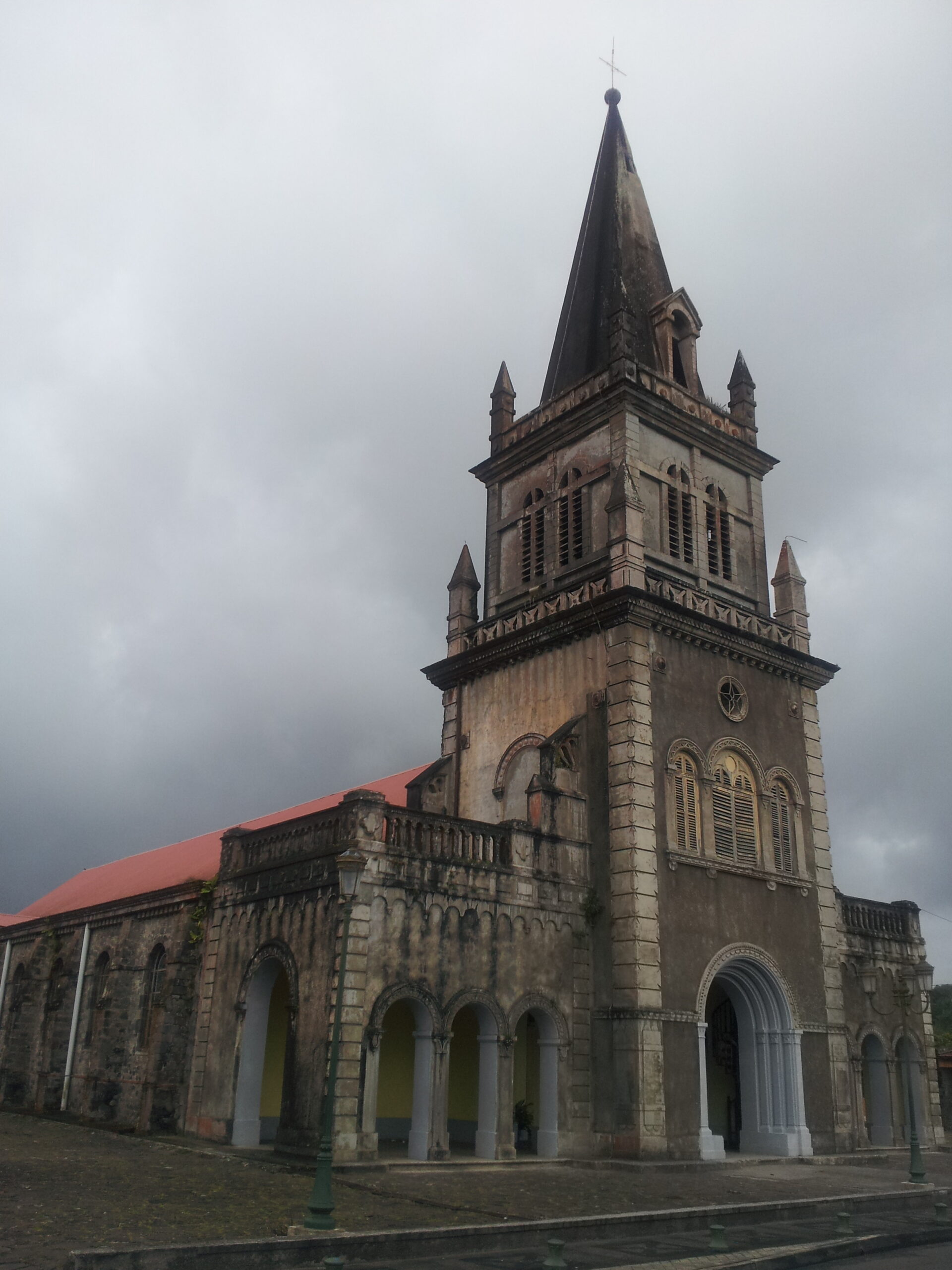
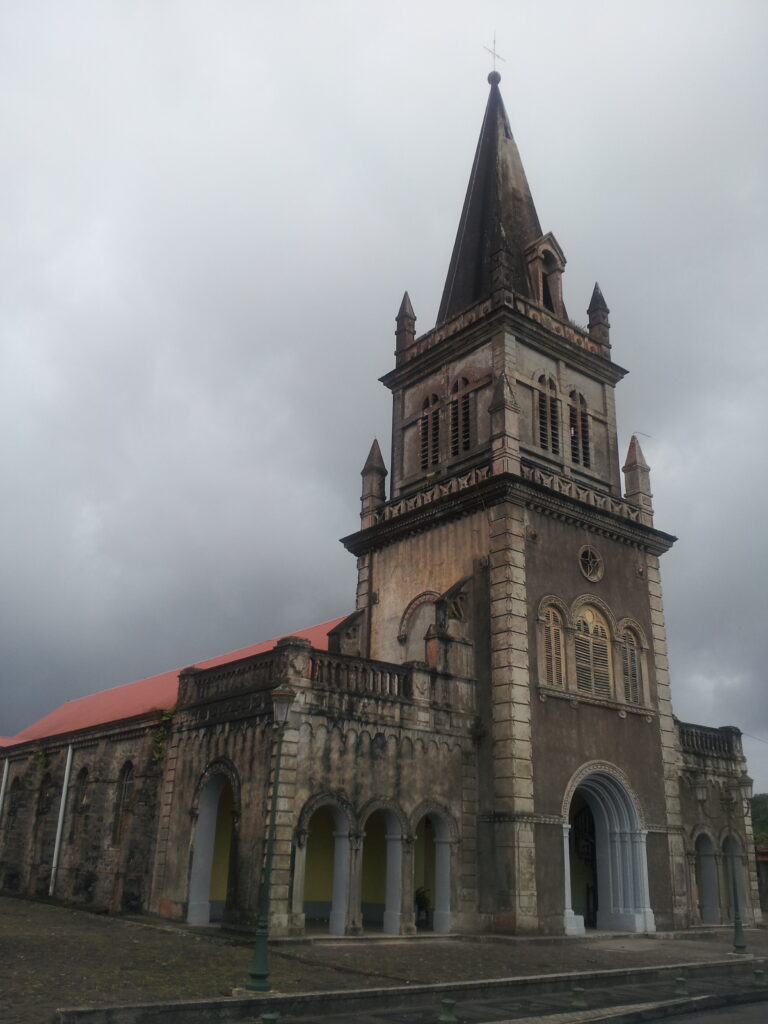
Le Morne-Rouge retains the memory of a Eucharistic worship celebrated during the eruption of the Pelée Mountain on May 8, 1902. Tradition states that many faithful saw Christ and his Sacred Heart in the host; the people were preserved that day, although another eruption destroyed it on August 30.
The Pelée Mountain and May 8, 1902
On the morning of May 8, 1902, the Solemnity of Ascension, the Pelée Mountain produced the eruption that devastated Saint- Pierre. Le Morne-Rouge is located on the slopes of the same volcano. In the face of danger, many inhabitants went to the church dedicated to Notre- Dame de la Délivrande, Our Lady of Liberation, seeking the sacraments and protection of God.
The context was a catastrophe of enormous gravity, not a stage prepared for a pious narrative. The population lived together with ashes, uncertainty and fear. The Eucharistic memory is understood within this emergency: confession, communion, exposure of the Most Holy and community prayer in the face of a threat that exceeded any human capacity.
Adoration and the transmitted vision
According to the panel of the exhibition associated with Saint Carlo Acutis, the parish priest - identified as Father Mary - gave a general absolution, distributed communion and exposed the Most Holy Sacrament. During worship, a woman would have exclaimed that the Sacred Heart of Jesus appeared in the host.
The narrative adds that many people saw Christ by showing his heart crowned with thorns and that some claimed to see blood. The vision would have lasted several hours and ended when the Most Holy was reserved in the sacred. This fact sheet attributes these details to the tradition that has been spread: there has not been an original record, a nominal witness relationship or a canonical file that allows them to be treated as a direct documentary check.
Preservation that day, destruction after
Le Morne- Rouge was not destroyed in the great eruption of May 8. The community interpreted that preservation as a grace linked to prayer before the Eucharist. However, the story did not end there: on August 30, 1902, another eruption reached and destroyed the people, causing numerous deaths.
Allowing the second event would turn the story into a promise of immunity that history itself denies. Tradition can speak of time granted to reconcile, receive the sacraments and prepare; it does not authorize the affirmation that devotion always protects itself from all physical misfortune. Nor should it be implied that those who died had less faith than those who survived.
Christian faith in a catastrophe
The Eucharist is not a talisman against volcanoes. For the Christian, Christ remains with his people both when a temporary liberation comes and when death and mourning break in. The prayer of Le Morne- Rouge expresses confidence, but also recalls the need to listen to science, respect evacuations and protect life.
In an emergency, general absolution and sacramental assistance are governed by the discipline of the Church and pastoral prudence. The historical account should not be used as current instructions or replace civil protocols. Faith and prevention do not compete: care for the vulnerable, care for alerts and facilitate safe evacuation are the requirements of charity.
Our Lady of the Deliverance hoy
The Catholic Church of Martinique continues the pilgrimage to Notre- Dame de la Délivrande. By 2026, the Archdiocese announced a pilgrimage march from Balata to Le Morne-Rouge, scheduled for August 29-30, at the request of Archbishop David Macaire and organized by the post-confirmation youth pastoral.
The call speaks of faith, brotherhood and hope, and shows that the sanctuary continues to live in diocesan pastoral. It does not in itself certify the Eucharistic phenomenon of 1902, nor does it indicate that the pilgrimage is organized specifically to commemorate it. It is used here to credit the temple and its ecclesial validity, without attributing it more than the source affirms.
The collection of Carlo Acutis
The international exhibition promoted by San Carlo Acutis is the source of the detailed Eucharistic account. Its catechetical value explains the presence of Morne-Rouge in the world repertoire and directs research to the place. At the same time, an exhibition sheet does not replace the contrast with archives, dioceses, vulcanological studies and historical documentation.
This is why the matrix distinguishes the current institutional source from the narrative source. The case is open to extension if 1902 testimonies, parish archives or a specific ecclesiastical statement are located. To publish now does not close the investigation: it makes the proven visible and honestly points out what is missing.
World map classification
Le Morne-Rouge is incorporated as "prodigy of Eucharistic protection with diocesan memory." The category combines the tradition of a vision during the worship and temporary preservation of May 8 with the current reality of the sanctuary and pilgrimage. It is not classified as a preserved material transformation or a phenomenon subject to modern scientific analysis.
Location and visit
Our Lady of Deliverance, Le Morne-Rouge, Martinica. The marker uses the coordinates 14.7756105, -61.1354005 and points to the shrine building, not the Pelée Mountain or a generic point of the municipality. The conditions of access and the current programme should be consulted by the Archdiocese before travelling.
Spiritual feeling
The Sacred Heart in the Eucharist recalls the love of Christ that accompanies a frightened community. Devotion invites reconciliation, receiving the sacraments with truth and supporting those who face danger, duel or displacement.
The full memory - the relief of May and the destruction of August - leads to adult hope. God does not abandon when the expected outcome does not come. The Eucharistic presence strengthens to serve, to lay off the dead with dignity, to rebuild and to keep the fraternity open.
Sources consulted
- Catholic Church in Martinique: pilgrimage of Notre-Dame de la Délivrande in 2026, institutional source on the validity of the sanctuary.
- International exhibition associated with San Carlo Acutis: Morne-Rouge, historical-devotional account with contrast.
Para orar
Lord Jesus, open heart and bread of life, accompanies those who live under the threat of a catastrophe. Give us caution to protect us, charity not to abandon anyone and hope to remain united in the test. He welcomes the victims and comforts their families. Amen.
Image credit
Our Lady of the Red Morne Deliverate. UHF / Wikimedia Commons, CC BY-SA 3.0. File and license in Wikimedia Commons.
